Coaches, fit your own oxygen masks! How do we support the coach’s needs?

As a coach, and leader of a team of coaches, I spend a lot of time thinking and writing about the needs of the coachee. Coaching is all about the coachee. The context in which coaching happens must establish and maintain trust. In my school, this means that the coaching conversation, when it happens with one of our team of trained cognitive coaches, is confidential. The details of any observed lessons or coaching conversations are not passed on outside of the coach-coachee relationship. Line managers are still expected to be aware of the teaching, development and work of their staff. Managers might pop in to lessons and conduct their own conversations, but the person’s coach is not a place for others to glean information. We have been very deliberate about protecting the sanctity of the coach-coachee relationship as, without trust, the conversation is no longer a safeguarded space for formalised reflection. It would become tainted with hints of evaluation, accountability and fear that could hinder honesty and prevent vulnerability.

A coach uses their coaching toolbox of strategies and awarenesses to minister to the coachee. To reflect, facilitate, provoke and deepen the coachee’s thinking, by paraphrasing and asking questions, while applying a nuanced understanding of non-verbal language and of cognition. When coaches reflect, they do so to develop their craft in order to better help others to build internal capacity, to better create a non-judgmental space for coachees to freely explore their thoughts and experiences, to paraphrase with more precision or question with more sophistication, to more deeply internalize the many layers of coaching knowledge and practice.

But recently I’ve been wondering about the needs of the coach. I’ve been a coach in some coaching conversations which have been emotional or confronting for the coachee. I’ve found myself affected by the emotion of the conversation, deeply immersed as I am in rapport with that person. I have left these conversations wanting to debrief, but aware of the moral obligation to maintain confidentiality for my coachee. When confidentiality is promised to the coachee, so that the conversation can be a safe space for talk, where can the coach go to reflect on their own experiences? How does a coach refine their practice if they are unable to share their experience of the conversation?

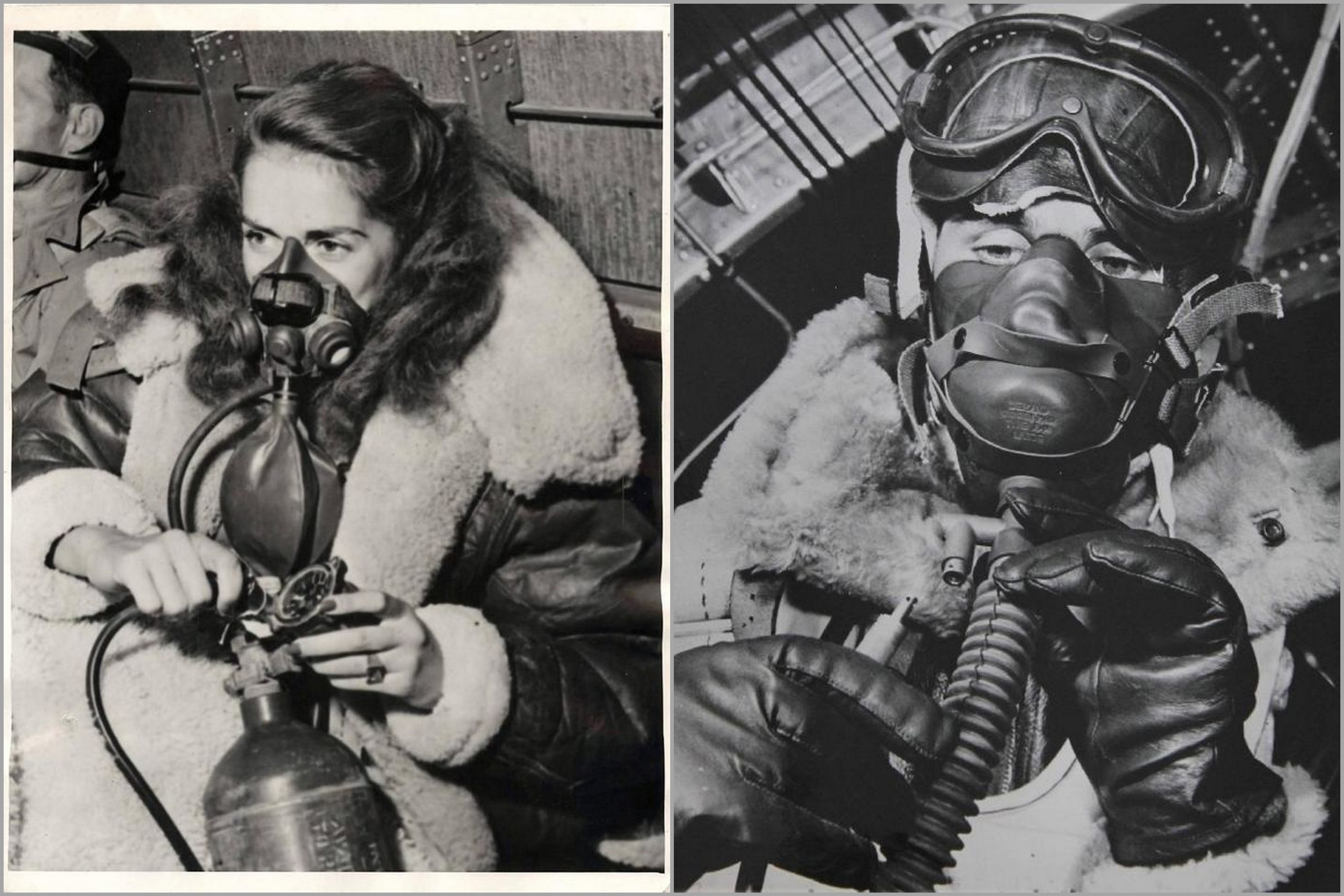
Coaches require somewhere for the coach to go in order to refine their coaching practice through reflection and planning, and as a tool for self-care. Fit your own oxygen mask before helping others, and all that. What support do coaches need? Who coaches the coaches? Where and how might they access support in ways which are mindful of the trust put in the coach to be trusted fortress of coachee information? What responsibility do organisations have in providing support structures for their coaches?

I’m lucky to work with a team of coaches at my school. We have all been trained in Cognitive Coaching, in non-inferential lesson observations and in using the Danielson Framework for Teaching as a tool for teacher reflection. In our meetings and in our Voxer group, we are able to debrief with each other to some extent, or to throw out questions to the collective mind when we come up against coaching challenges. We never use coachees’ names in these discussions or divulge identifiable information, so we tend to talk cautiously around issues or questions we have. For example: How might we differentiate our coaching model for highly-reflective or highly experienced teachers? What questions might be useful for surfacing deeper or more abstract thinking? How might we respond in a coaching conversation which becomes highly emotional for the coachee? We might have textbook answers from our training, but talking about and around these sorts of questions helps us to tease out our beliefs about coaching, our coaching practices and the tensions within our specific context. It helps to develop our shared understandings and language of coaching, as a collaborative group of coaches.

Ideally, a coach would be provided the opportunity to be coached on their coaching. In my coaching team we sometimes participant in meta-coaching (coaching about coaching) with each other. While we don’t ask our coachees to permit us to collect data during conversations, we can do this when we coach each other. A video or audio recording, or a transcript of questions and paraphrases, can act as data on which the coach can be coached around their own practice. We tend to do this in training or within our own coach group, so as not to impact our conversations with coachees. There’s nothing more likely to shatter the sense of a trusting, safe space than setting an iPad or dictaphone on the table to record the conversation!

Of course a coach can debrief at home, to a partner or family member, which might allow an opportunity to download. But this won’t necessarily provide a high level of support in working through an issue or experience.

Another possibility is finding support from coach-educators outside one’s own school context. I’m grateful to have connected with other Australian educators who are using and leading coaching in their own schools. On Voxer, we are able to discuss the issues in our own contexts, again without divulging names or identities of others. I can ask a question of the group and receive thoughtful, informed feedback from those who share my view of coaching but have different tools and knowledge at their disposal. Sometimes a paraphrase from another coach is all I need to see my own issue more clearly. Coaches informally coaching coaches, at point of need. It’s brilliant DIY professional support. I’ve found this invaluable in allowing me to think aloud about, and be coached through, wonderings or experiences, while protecting the confidentiality of my coachees.

Learning through sharing with other coaches is one reason that a few of us—myself, Chris Munro, Corinne Campbell and Jon Andrews—started the monthly Twitter chat #educoachOC. This one hour chat, which we co-moderate on the first Monday of each month, is a vehicle for bringing together those involved in coaching in education. The discussions are often rich and allow coaches, and those leading coaching initiatives in schools and systems, to explore the commonalities and differences, privileges and challenges. I emerge from that hour feeling understood and invigorated.

Being a coach (like being a principal or CEO, I imagine) can be lonely work, because the coach is required to keep what’s said in the coaching conversation, in that coaching conversation. As coaches, it’s important that we find ways to develop our practice and support our own needs, while protecting the trust of the coaching relationship. We need to support coaches, so that coaches can best address the needs of those they coach.

5 things I learned in 2015

Beware the barrenness of a busy life. ~ Socrates

Epiphanies and moments of clarity can be simple and, on reflection, obvious. The following list of ‘5 things I learned in 2015’ may seem like statements of the bleeding obvious. They are nothing new, and yet this year I’ve seen new refractions from, and noticed more minute details of, these simple truths. They have been affirmed for me this year through my experiences of being and becoming. Of teaching, leading, parenting, coaching, being coached, researching and writing.

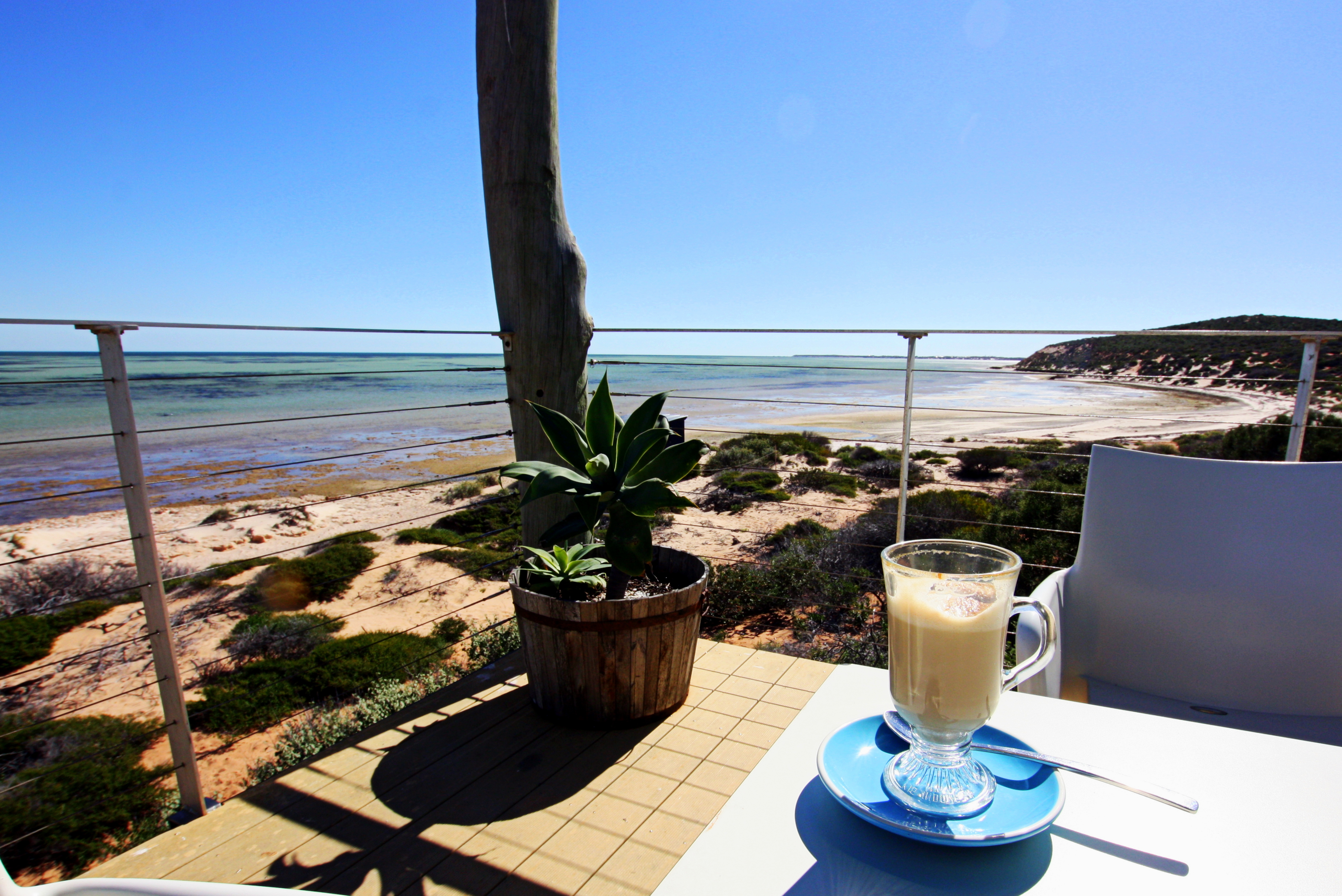
local café wisdom

local café wisdom

1. Doing many things at once can work, but it’s also important to take breaks.

In the last few years I’ve been working 0.8 of a teaching and leadership job at a school, parenting two pre-schoolers and working on my PhD (now submitted – woot!). While I always had a sense that this was working for me in its strange busy way, it wasn’t until my first writing retreat this year that I understood how much. On my retreat, I found it difficult to stay on my one task – editing the PhD thesis draft – for a full weekend. I realised that my routine of intense short bursts of PhD, in among the other many things in my life, worked for me. These short, regular, time-constrained bursts of energetic PhD work were intensive and focused. They felt like an indulgence, some intellectual ‘me-time’ in which I could luxuriate, a brain-bending haven from my other responsibilities. It helped me to love my PhD, while also appreciating the specialness of my teaching, leading and parenting roles.

Yet, as I discovered, relentless busyness is not sustainable. Breaks are required. Real, curl-your-toes-in-the-sand, unplug, breathe deeply and love abundantly kind of breaks. Nourishment for wellbeing. Care for self and others. Time to breathe.

2. Welcome resistance & engage in respectful disagreement.

On my blog, which is now 16 months old, as in Twitter and in my professional life, I have been becoming more comfortable with, and encouraging of, disagreement, although I prefer dissent to be served in a respectful, articulate and reasoned manner. And I prefer disruption which emerges from deep purpose, rather than trendy buzzwordification. Last year I completed the Adaptive Schools Foundation course, which champions graceful disagreement as a key element of high-performing groups. I’ve written a few blog posts which err on the side of controversial. I’ve engaged in Twitter debate. I’ve experienced my first peer review comments from academic journals, and attempted to take critique as an opportunity to strengthen my work. And in my role leading and implementing a school coaching initiative for teachers, I have welcomed the contributions of those who are resistant to the change.

I’ve found those individuals who might be dismissed as ‘resistors’ or negative voices, to be important ones worthy of close listening. I find myself asking those who disagree to take the time to explain their view to me. I listen intently, wondering, ‘What can I learn here? How might this help me to make what we’re doing better, stronger, and meaningful for a wider range of people?’

I am reminded of this line of Richard Bach’s from his novella Illusions:

There is no such thing as a problem without a gift for you in its hands. You seek problems because you need their gifts.

It is often in engaging with those who disagree with us, that we are taken to new places in our own thinking, helped to consider alternate perspectives, or are able to find solutions which we may otherwise not have reached.

3. Trust individuals. Believe in their capacity. Choose empowerment.

Punitive accountability measures which promote fear and compliance can only undermine teachers’ and school leaders’ professions, identities and practices. Through my experiences of coaching, my PhD research into school leadership and organisational change, and my observations of systems of teacher evaluation around the world, I have become increasingly convinced of the need to focus on empowerment and growth, through support and trust. It’s the belief upon which my school’s coaching model is based.

4. Connections with others are powerful.

We know that connecting with others is powerful. One of my ‘three words’ for 2015 was ‘sharing’ and another was ‘presence’, both words which speak of connecting with others and being present in relationships.

This year, not only have my personal and face-to-face professional relationships been impactful, but so have connections I have made online. For the first time this year, I began to meet ‘in real life’ individuals I’ve connected with on Twitter and through my blog. Catching up over drinks, breakfast or the conference room had been a seamless transition from tweet, blog post or Voxer message, to in-person banter, support and inspiration. I’ve engaged in wonderful blogging conversations. I’ve become bewitched with the potential of our interconnectedness and the ways in which technology might help us grow support networks and knowledge webs.

5. Teeny regular steps add up to a long journey.

My PhD was the thing that brought home this truth to me. Over three years I plugged away with little step after little step, finding stolen moments of doctoral time in the cracks in my days and nights. Regular, persistent effort. Sometimes forward; sometimes back; but maintaining forward momentum. And then I looked back along the path I’d walked and found that it added up to a thesis. So my big lesson was, just put one foot in front of the other. Keep going!

sunset, Gnarabup

sunset, Gnarabup

Indra’s Net: We are all connected

There is an endless net of threads throughout the universe … At every crossing of the threads there is an individual. And every individual is a crystal bead. And every crystal bead reflects. Not only the light from every other crystal in the net but also every other reflection throughout the entire universe. ~ Anne Adams

This post itself is a tangling of threads. It is in part a reflection on the first day of the national Australian Association of Research for Education (AARE) conference, which I am attending and at which I am presenting a paper. It is also part of a wider conversation I’ve been having through blogging. It was incited today by Robyn Collard’s Welcome to Country in which she used the above Anne Adams quote which refers to Indra’s Net, a Hindu and Buddhist concept that articulates the interconnectedness of the universe. It imagines each individual as a dew drop, jewel or pearl: reflective and distinctive, but also interconnected with all the other dew drops via the threads of the web. Parts and whole. Dazzling individualism within collective network.

This quote and concept added a layer to an already-layered conversation I’ve been having in the blogonet with Helen Kara and Naomi Barnes. It started with Steve Wheeler’s #blimage (blog + image) challenge. When Helen shared a photograph of tangled dew-bejeweled spiders’ webs in her garden, both Naomi and I responded to the image. Naomi wrote about the messiness of research. I wrote about how technology connects people to one another. I’ve since also written about the web-weaving spider as a metaphor for the researcher. And today I was connecting at AARE, in person, with a web of academics who I know mostly through their work and through Twitter.

So here I am again. Contemplating the web. And the dew drop jewels. And their infinite reflections and refractions. Their beauty and fragility and separateness and togetherness.

I spent much of this first day of the AARE conference in a four hour symposium in which scholars brought diverse perspectives to the same general topic of leadership in education. They agreed and disputed. They converged and diverged. It was a great example of respectful, well-considered and articulate debate. Graceful disagreement. Elegant contestation. Research as conversation.

For instance, in conceptualising leadership as artistry, Fenwick English noted the webbed connections between research, art, leadership and creativity. Scott Eacott discussed the relational aspects of leadership and of research, asking scholars to consider how their work relates to that of others. Christina Gowlett approached school leadership from a perspective of challenge and critique, agitating against dominant approaches, norms and expectations by embracing alternate theories of uncertainty and transgression.

Additionally, Gabriele Lakomski and Colin Evers discussed thinking in schools as a wide cognitive net. They define cognition as a dynamic system, comprising reciprocal interactions between people, artefacts, resources and environments. They noted that thinking is not just computationally logical-deductive; it is interpretive, intuitive, behind consciousness and beyond awareness. They explored the notion of the extended or supersized mind which distributes cognition. Our tech is our selves. Our communities and social networks are change collectives. Gabriele and Colin noted that cognition occurs “beyond skin and skull”, challenging the myths of the stand alone thinker, the heroic leader and the change agent. Individuals influence and are influenced by each other. Thinking and being is connectivity. Web not hierarchy.

These ideas resonate with the perspective I will be presenting at the Heroism Science conference in 2016, which suggests a reimagining of heroism in school leadership. That is, that school leader ‘heroes’ can work subtly, fluidly and invisibly in the service of their school communities. In education there needs to be shared vision and individual purpose, collective and individual capacity. Strengthening the web while protecting and nurturing the dew drops.

Like Costa and Garmston’s (2006) notion of holonomy (which is based on Koestler’s 1972 conceptualisation of the ‘holon’), Indra’s Net shows the dual importance of the individual and the collective. The jewel and the net. All are simultaneously together and separate. A change in one is reflected in a change in all.

So as I reflect (like the dew drop), I imagine webs of learning, webs of emotion, webs of relationships, webs of identity. I wonder: What influences the symbiosis between individual and collective? In what ways might we shape others? In what ways might others shape us? These could be questions for families, friendships, organisations, communities, nations, the world. What about our selves can we control and what choices are we making about what our own self-jewel reflects onto those around us and onto the universal web? In what ways could we harness the global mind, the universal self and the interconnectedness of humanity?

Imagine a multidimensional spider’s web in the early morning, covered with dew drops. And every dew drop contains the reflection of all the other dew drops. And in each reflected dew drop, the reflections of all the other dew drops in that reflection. And so ad infinitum. ~ Alan Watts

(Disrupting) disruption in business, academia & education

disruption: dis·rup′tion n. ~ from the Latin disruptionem ~ “a breaking asunder”; to break apart, split, shatter.

While the dictionary definition of disruption points to breaking apart, in fact now disruption often means to make anew. In business, disruption is about creating new markets and discovering undiscovered needs. Traditional products and modes are replaced by new business models, new technologies and new ways of appropriating the old. Google’s now-defunct ‘20% time’, which instigated ‘genius hour’ in classrooms around the world, was designed to nurture disruptive, moon-shot thinking. Often Uber, Airbnb and Apple are touted as examples of businesses which have displaced other services with their innovative thinking. Businesses and entrepreneurs like to see themselves as ‘disruptive’ because this means they are radical, ground-breaking and on-the-bleeding-edge of innovation.

As an English and Literature teacher, I am drawn to teaching texts which were either disruptive in their context, challenging socio-political status quos, or which feature disruptive characters. William Golding’s Lord of the Flies, George Orwell’s 1984 or Animal Farm, Margaret Atwood’s The Handmaid’s Tale and Oryx and Crake, feature films like The Matrix and The Hurt Locker. These texts allow me to challenge and extend students’ thinking, inciting discussion about humanity, history and ethics. They allow us to interrogate dominant belief systems and representations, and dig into our own values, attitudes and assumptions. Being a critical questioner of everything, including ourselves, is a key to disruption.

Tootle the disruptor-train goes off-track

Tootle the disruptor-train goes off-track

One of the books I read my own small children is Tootle, Gertrude Crampton and Tibor Gergely’s 1945 children’s book (you can see the Tootle birthday cake I made in this post on PhD-as-cake). In it, the young engine called Tootle breaks the firm rule ‘Staying on the Rails No Matter What’. Instead, he frolics through fields, making daisy chains, racing horses, talking to frogs and crushing buttercups. I continue to be dismayed that, unsurprisingly for a 1945 text, Tootle ends up complying with the rules. Rather than celebrating his individualism and his new way of being a train, he tows the line like every other locomotive. Each time I read the story, I want to shout through the pages: ‘Go your own way, little train! It’s ok to be different and subversive and joyful and live a life off the subscribed journey!‘ Clearly this says more about me than it does about the story.

In the blogosphere, I follow traditional academics, as well as independent off-centre researchers who are questioning, through action, what being an academic might look like. My PhD research uses a bricolaged paradigm and a fairly unconventional approach to writing up participant data. Bricolage refers to a kind of drawing together of a range of traditions to make a bespoke, rather than off-the-rack, approach, tailored to the particular research problem. This might be considered disruptive in the sense that it rethinks well-worn traditions and stitches them back together in a new form. Perhaps my inability to conform to one research approach is a bit like my inability to follow a recipe in the kitchen, where I’m always using recipes as a kind of springboard-guide, if I use them at all. But disruption isn’t just failing to conform, it’s finding new ways, forging new paths, building new possibilities. It’s providing alternatives to accepted ways of doing things. I think it’s so important that we define what terms mean for ourselves and our sectors, before we begin bandying and bandwagoning them about with reckless, jubilant abandon.

Some educators see the job of education as to nurture the innovative thinking of students, to prepare them for uncertain futures. In education, words like ‘edu-preneur’, ‘edu-innovation’ and ‘disruptive education’ have become popular. In my Twitter bio, I’ve used the word ‘disruptor’, to suggest that I am someone who questions and pushes at the boundaries of what is known and what is accepted, but I have questions around the thinking and behaviours of some self-professed disruptors. The irony is not lost on me; perhaps I should rethink my Twitter bio, but I like delicious words like ‘disruptor’ and ‘flâneuse’. Therein lies part of the problem. Trendy-sounding words are seductive. We like to roll them around in our mouths and social media feeds. 

On the one hand, I know business owners, writers, academics and educators who thoughtfully question the status quo, pushing the boundaries of practice and questioning accepted ways of thinking and acting. These people and their organisations are taking risks and building alternative ways of being in the world. Yet I’ve also noticed that some others bristle when their pithy, jargonistic talk of ‘being disruptive’ is questioned. Sometimes self-professed disruptors don’t take well to being challenged, or disrupted. Sometimes advocates of more traditional approaches or technologies attempt to disrupt the disruptors, but are shot down for being old-hat, stuck-in-the-past or not-on-the-bleeding-edge. Sometimes the whole discussion breaks down into paradigm-war name-slinging. I’ve spoken before about the importance of robust, respectful discussions in which we are ok with graceful disagreement and are able to listen to opposing viewpoints with compassion. I think if disruption is embraced, those doing the disruption should embrace deeper interrogation of their ideas than slick presentations or 140-character tweets might allow. This is why I love blogging and podcasts; they deepen conversation.

So, I approach the idea of disruption with both fascination and healthy scepticism. I do think we should ask what it is that might need disrupting, and why. Or perhaps what might need reconsidering, or consolidating, or investigating, or researching, or rebuilding. When buzzword-saturated talk of disruption becomes the unquestioned norm, perhaps it is those who question the dominant discourse of disruptors who are the most truly disruptive. Let’s not forget to be questioning, critical thinkers, especially within echo chambers of (disruptive, or other) discourse.

Advances are made by answering questions. Discoveries are made by questioning answers. ~ Bernhard Haisch

'Wave 1' by Annette Thas

‘Wave 1’ by Annette Thas

For wellbeing & productivity: breathe. pause. be.

Come forth into the light of things, let Nature be your teacher. ~ William Wordsworth

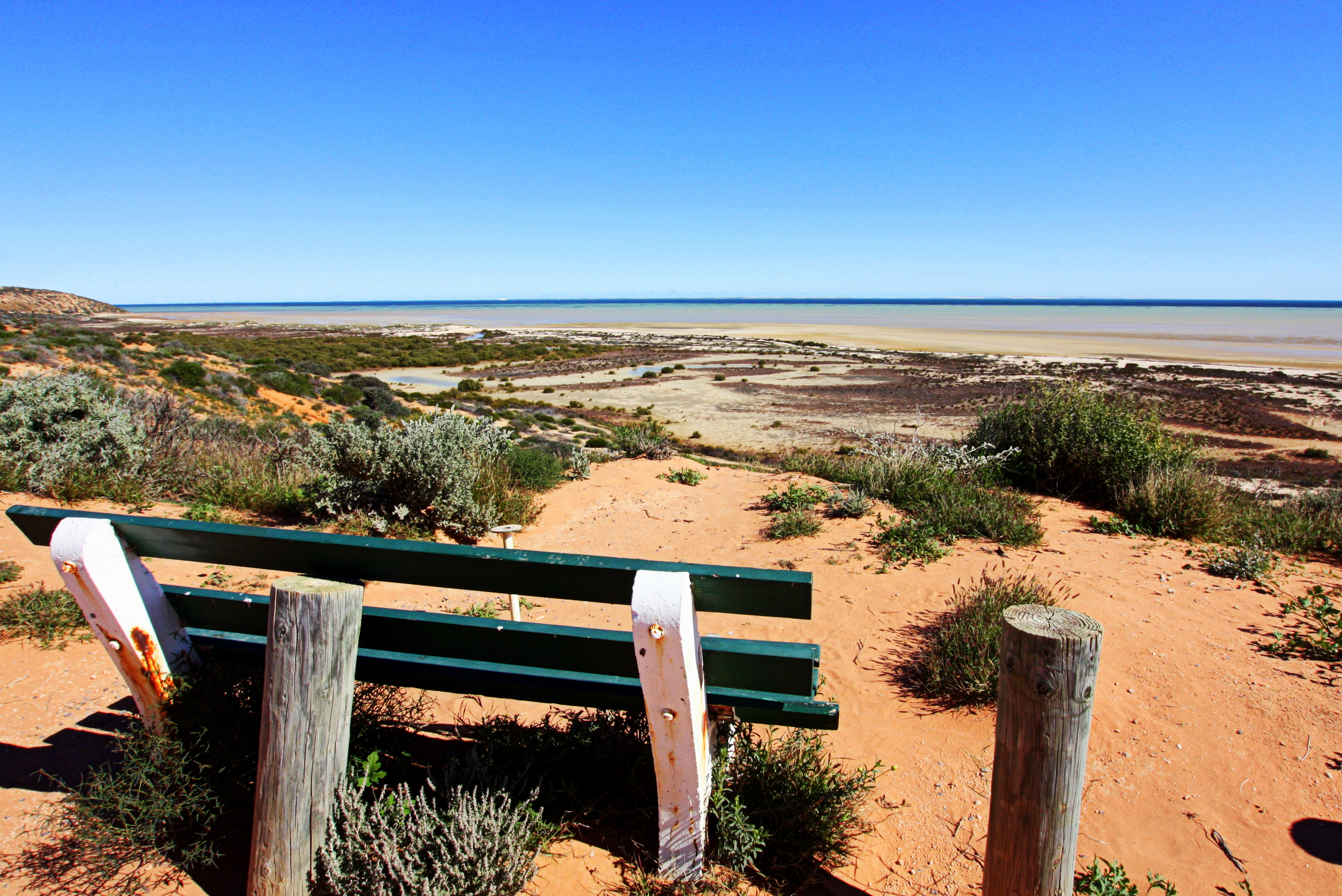
Shark Bay, by @debsnet

Like many educators, I love my work and I love to work. Not only that, as a PhD researcher I love my PhD, treating it like a luxury, a privilege and precious ‘me time’.

Shell Beach, by @debsnet

While I’ve acknowledged before that we need to give ourselves permission to take a break, I’m often not very good at it. Sometimes I have to force myself to take a break.

long shadows in red dirt, by @debsnet

After an eleven week term, at the end of which I spent an entire weekend slogging away at my thesis, I was obsessed. Obsessed because all my waking and teeth-grinding-sleeping moments were taken up with work or PhD. My thoughts about my doctoral research were permeating every crevice of my mind and each nook of my time.

Hamelin Pool Stromatolites, by @debsnet

I was delighting in this immersion. I was happy to be thinking about the thesis on my walks, in the car, in the shower, in my sleep. I felt like it was a super-productive push-to-the-end mindset. My mind was on all the time. PhD-wise, I was excited about my findings, my conclusions, my writing. But I was also exhausted.

Monkey Mia, by @debsnet

And then school holidays were upon me, and with them a pre-planned outback road trip with my husband and my two-under-five. I considered taking my doctoral work with me. I have so much to do, I thought. A thesis to revise, a conference paper to write. Just imagine how much reading and editing I could get done in long car trips or at the campsite.

Shell Beach, by @debsnet

As someone who considers blogging or participating in education Twitter chats as ‘down time’ (I know – how relaxing!), how could I contemplate a complete break? How could I go from an escape dedicated to working on my PhD ~ my recent PhD writing and revision retreat ~ to a trip taking an enforced break from it?

Monkey Mia dolphin, by @debsnet

I knew it was healthier to take a rest. Pause. Cut the cord for six days of just being, exploring and adventuring. Breathe.

fiction pile on Shell Beach, by @debsnet

Thinking back to my 3 words which set my intentions for this year, taking an outdoor-family-faraway break fits best with presence. Embodying human being rather than human doing. It was about being with my husband and kids, and being in nature.

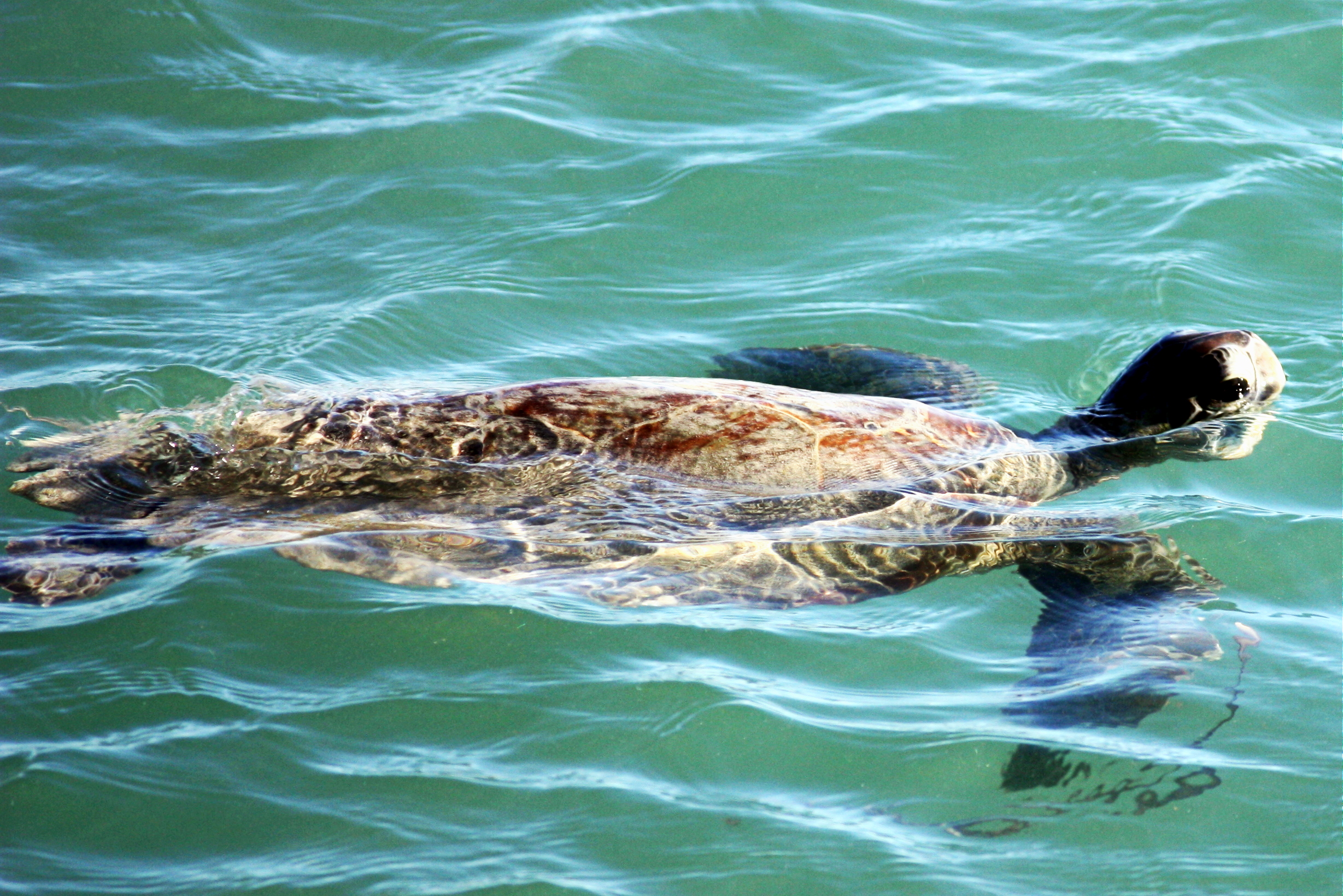
green turtle, Shark Bay, by @debsnet

There are some studies, like this and this, which explore how and why being in nature makes us feel better, improves wellbeing and enhances mental health. Anecdotally, most of us would attest to feeling ourselves melting into a more relaxed state when we spend time grounding ourselves outdoors. Curling our toes in soil, sand or snow.

Straya animals, by @debsnet

I’ve written before about spaces and places that make me feel grounded, inspired or joyful, but this trip was to somewhere I hadn’t been before: Shark Bay, a UNESCO World-Heritage listed peninsula on the most westerly point of Australia.

iron corrugations, by @debsnet

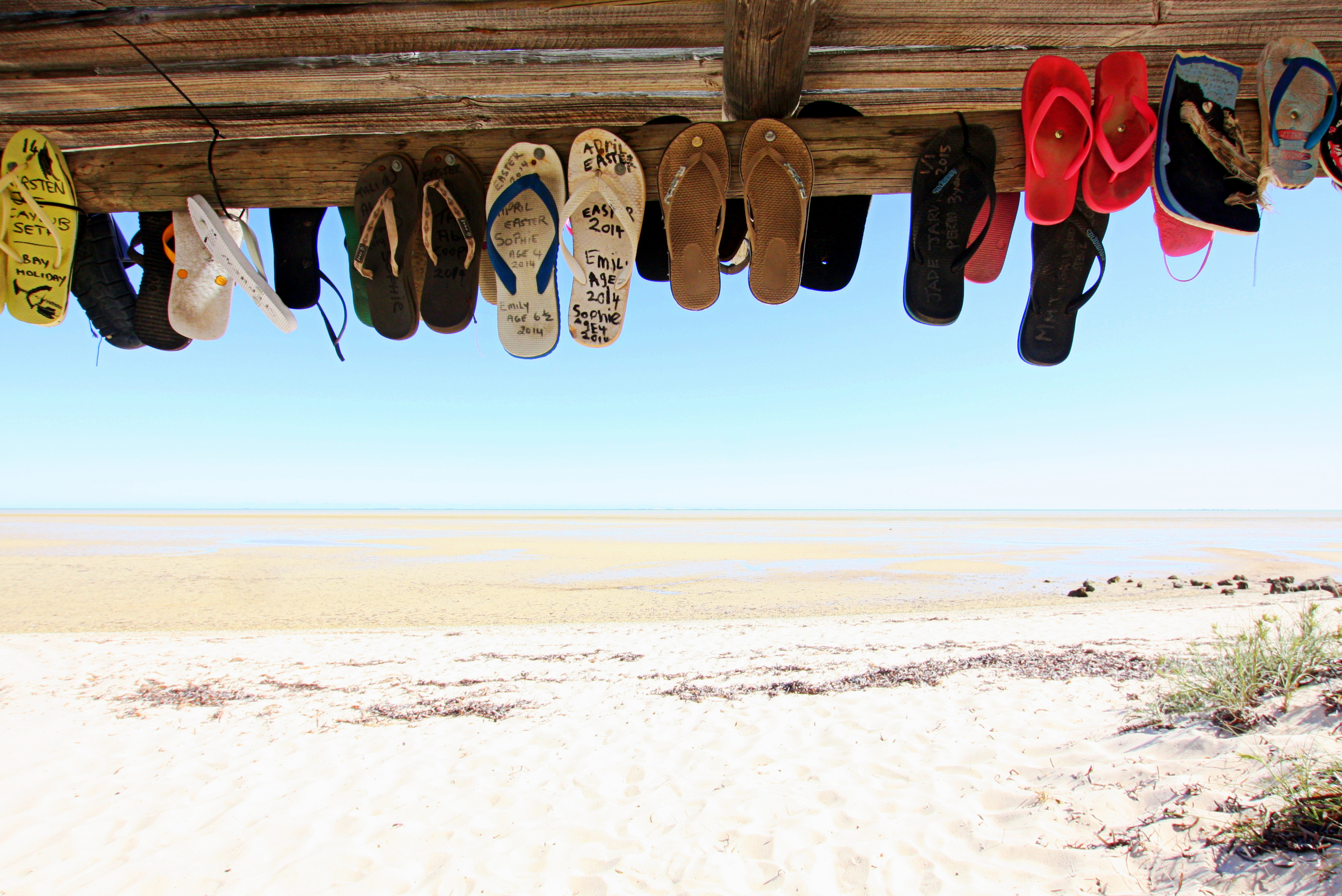
I allowed myself to luxuriate in this time out and time away. I read fiction (not academic texts or student papers!). We hand fed dolphins, visited a beach covered in pristine white shells as far as the eye could see, stomped through red dirt, went star gazing, saw the world’s oldest living fossils. The pictures in this post give you a sense of what I experienced.

Ocean Park, Shark Bay, by @debsnet

And so I have returned feeling intellectually and physically invigorated. Ready for the next round of PhD and school work, including teaching and leading my school’s new coaching model. I’ve stepped out of my obsessive space for enough time to allow for some recovery, but I’m aware that I need to nestle back into a place of productivity.

wire against blue sky, by @debsnet

As when I returned from Bali earlier this year, I’m hoping I can hold onto my present feeling of increased clarity and renewed wellbeing, channelling this into self-care as well as productivity.

Thong Shack, Denham, by @debsnet

Can and should teachers be (viewed as) researchers?

Sarajevo bullets, by @debsnetWhen we respect teaching as an intellectual activity and give teachers the opportunities to raise serious questions about what they teach, how they teach and the larger goals for which they are striving, they can play a dramatic role in transforming their institutions. ~ Peter Senge, Schools that Learn: A Fifth Discipline Fieldbook for Educators, Parents, and Everyone who Cares about Education

This month – April 2015 – is the month in which Dylan Wiliam argued in the TES magazine that teaching cannot and will not be a research-led profession, in which Tom Bennett responded that evidence-based education is dead (but that evidence-informed education lives), and in which John Hattie was quoted in a TES article as saying that teachers should not try to be researchers and that ‘I don’t have any time for making teachers researchers.’ In response to his own question, ‘Asking teachers to be researchers?’ he replies, ‘They are not.’

In this article Hattie is also quoted as saying that teachers should use the “literacy and sensibility of research to inform their practice” and that the worlds of research (by academics, not teachers) and teaching should “orbit together”. This resonates with Tom Bennett’s assertion that teaching be evidence-informed (but not evidence-based) and with the mandate of researchED which is to raise research literacy in the teaching profession and promote conversations between teaching and academic communities (my post about researchED Sydney 2014 is here).

As someone whose identity straddles ‘teacher’ and novice ‘researcher’ (as a PhD candidate coming towards the end of my PhD journey) I agree that research should inform teaching, leading and educational practice, and that worlds of education and the academy should work in collaboration. I am not sure, however, that we should draw a divisive line with ‘teacher’ on one side and ‘researcher’ on the other.

When I read the TES article which presented quotes from Hattie, a number of questions arose for me. What does Hattie mean when he says that teachers are not (and perhaps cannot be) researchers? What is his definition of ‘researcher’?

Is he discouraging teachers from reading academic literature and collecting data to inform their practice? Is he telling teachers they cannot be (taught to be) systematic thinkers who investigate, trial, collaborate, communicate and utilise scholarly literature and evidence to inform their practice?

Many teachers have been involved in action research projects, or Masters or PhD dissertations. Are these teachers, too, incapable of conducting and applying research thinking and methods? For me this is an issue of identity, of sense of self. Am I a teacher who researches? A researcher who teaches? A teacher and a researcher? Is Hattie suggesting that these identities are unavailable to me?

Is research in a real educational context by a real educator less valid than that of an academic from a university?

Many have responded to this conversation. Kevan Collins, chief executive of the Education Endowment Foundation, warns against encouraging teachers not to pursue evidence, as he articulates in this TES article.

Teacher Chris Parsons explores how the teaching profession might strategically develop its use of evidence to inform practice.

PhD candidate Charlotte Pezaro, writing for the Australian Association of Educational Research, explores ways in which academics and teachers might interact.

Policy analyst Patrick Watson in this post argues that we need to identify research which is worthwhile for informing practice, build the research-literacy of teachers and encourage action research to facilitate reflection and deeper understanding.

The 2012 Grattan Institute report ‘Catching Up: Learning from the best school systems in East Asia’ asserts that high-performing school systems view teachers as researchers, continually developing their knowledge base through practices such as professional reading and action research. My PhD cites examples of literatures which promotes participatory action research as transformative for individual practice and collaborative cultures. All research and all researchers have limitations. I wonder what the impact is of viewing teachers as researchers and of encouraging teachers to think of themselves as researchers. How does it shape teachers’ identities, self-perceptions and practices if they are encouraged to be consumers, curators, engagers and creators of research? Perhaps it is partly a question (to reflect Dweck’s work) of developing a research mindset.

One of Wiliam’s points is that research cannot tell us what could be only what we already know. If we are always basing our practice on what has been done, we aren’t innovating or trialling new possibilities. Teaching and schools should be about more than doing what has been done and what is known; it should be about moving forward and even about innovation and creativity.

Perhaps teachers who see themselves as researchers could call themselves ‘teachers as innovative, research-literate, reflective, evidence-informed, systematically-thinking, data-using-and-interrogating practitioners who drive their own learning and improvement in regards to what benefits their students.’ Or maybe that’s a bit long.

While I understand that the issue of whether teachers can or should be researchers is nuanced, complex and riddled with semantic argument, I (as someone who identifies as teacher and researcher) would like to think we can view teachers as researchers, by my definition, if not by Hattie’s.

Dream Big, Do Big: an example of inspiration, imagination & perspiration

Creativity represents a miraculous coming together of the uninhibited energy of the child with its apparent opposite and enemy, the sense of order imposed on the disciplined adult intelligence. ~Norman Podhoretz

artists Nicole Bailey and Trisha Lee enjoy their interactive sculpture

artists Nicole Bailey and Trisha Lee enjoy their interactive installation

This week I have watched some friends bring a crazy-wonderful dream to life. I am so excited about it because their project was the perfect storm of imagination and perspiration, creativity and scientific thinking, dream and action, madness and wonder. For this year’s Sculpture by the Sea exhibition at Cottesloe beach, they have brought together Aboriginal art, sand, sea and colourful PVC fit balls to create an artwork. As it says on the Water Dreaming webpage, “Water Dreaming is an Aboriginal dot painting installation in which the dots are represented by 250 inflated PVC balls embedded in beach sand. From terraces overhead the viewer will see a Dreamtime dot painting. Up close it’s an interactive play space where art and fun collide and visitors can bounce on and around the dots.”

It had long since come to my attention that people of accomplishment rarely sat back and let things happen to them. They went out and happened to things. ~ Leonardo da Vinci

filling balls with sea water and air; work in progress

filling balls with sea water and air; work in progress

The artists Trisha Lee and Nicole Bailey collaborated with Indigenous artist Shorty Jangala Robertson, of the Warlukurlangu Artists Aboriginal Corporation, to design the concept of bringing a Dreamtime story to life on the beach. The beach is an apt location for a depiction of an artwork from a tribe whose artists traditionally make art on sand and appreciate its transience and changeability. As an interactive artwork, it may well change during the exhibition, which runs from the 6th to the 23rd of March.

balls at sunrise, ready for installation

balls at sunrise, ready for installation

Not only do art and fun collide in this installation, but so do art and community. The installation is crowd funded, crowd created and will be crowd enjoyed. People will be told the artist’s Indigenous Dreamtime story and be able to play between, around and on the bouncy balls (which are filled with sea water and air).

To create this interactive sculpture, one lone water pump pumped 17,500 litres of water from the sea, across a sandy beach, up a hill to water tanks and all the way back down, to fill 246 big colourful fit balls. A digger dug a trench perimeter and helped to shift 30 cubic metres of sand, covering 290 square metres. Over two days, an army of one hundred volunteers filled and laid 250 sandbags and filled, rolled, hauled and placed balls. You can see it being installed in these time lapse videos of Day 1 and Day 2 of installation.

Sometimes I’ve believed as many as six impossible things before breakfast. ~Lewis Carroll

installation involved a digger and 100 volunteers

installation involved a digger and 100 volunteers

This was an example of risk taking in full flight and dreams come to life. What sort of inspiration and perspiration does it take to create a painting on a huge scale amid moving sand and with balls able to be bounced on and interacted with? What sort of people, what kind of force, can make that happen through the power of people, nature, art and technology? This project required not only blue-sky imagination, but also systematic experimentation, trial and planning in order to make it work.

The finished work - a dot painting on the beach, against the backdrop of the Indian Ocean

the finished work – a dot painting on the beach, against the backdrop of the Indian Ocean

This artwork stands as an inspiration to me as an individual, parent and educator. Shouldn’t we all aspire to making improbable dreams possible, to bringing vision to life, to dare to do something others might think crazy? Here’s to being creative, wildly imaginative, joyful and experimental, but also systematic, pragmatic, scientific and dogged enough to make moonshot ideas tangible reality.

Think left and think right and think low and think high. Oh, the thinks you can think up if only you try! ~Dr. Seuss

weeks of interactive bouncy fun!

weeks of interactive bouncy fun!

Powerful & unforseen consequences: our butterfly impacts

#leaningenvironments - evolution of a new edu-revolution?

#leaningenvironments – evolution of a new edu-revolution?

 A cloud from a minor volcanic eruption in Iceland—a small disturbance in the complex mechanism of life on the Earth—can bring to a standstill the aerial traffic over an entire continent. ~ Slavoj Žižek

With the start of the Australian school year almost here – a year in which I am working to implement the teacher-growth model on which I have been working for two and a half years – I have been thinking about what it is that makes a trusting, impassioned, vibrant community of continuous learners.

Ok, as both the subject of my work and of my PhD research, I have been doing more than thinking about this. I have read close to 300 references and written about 85,000 words around effective school change, what makes effective leadership and what kinds of learning teachers find transformational. I have blogged briefly about some key ideas to anchor school change, about the importance of embracing discomfort for growth and about my own learning environments.

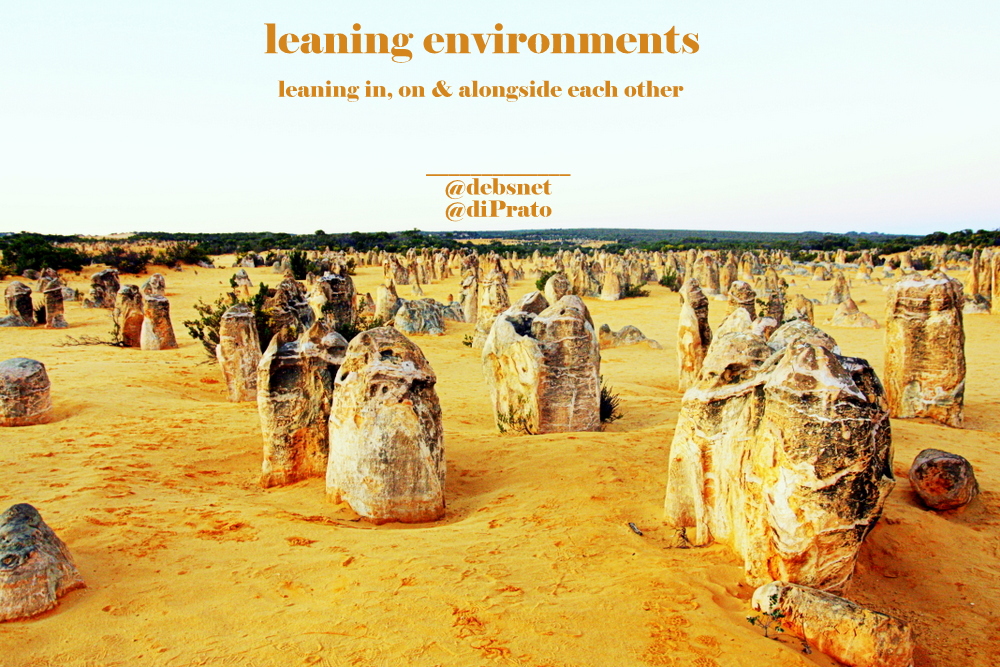
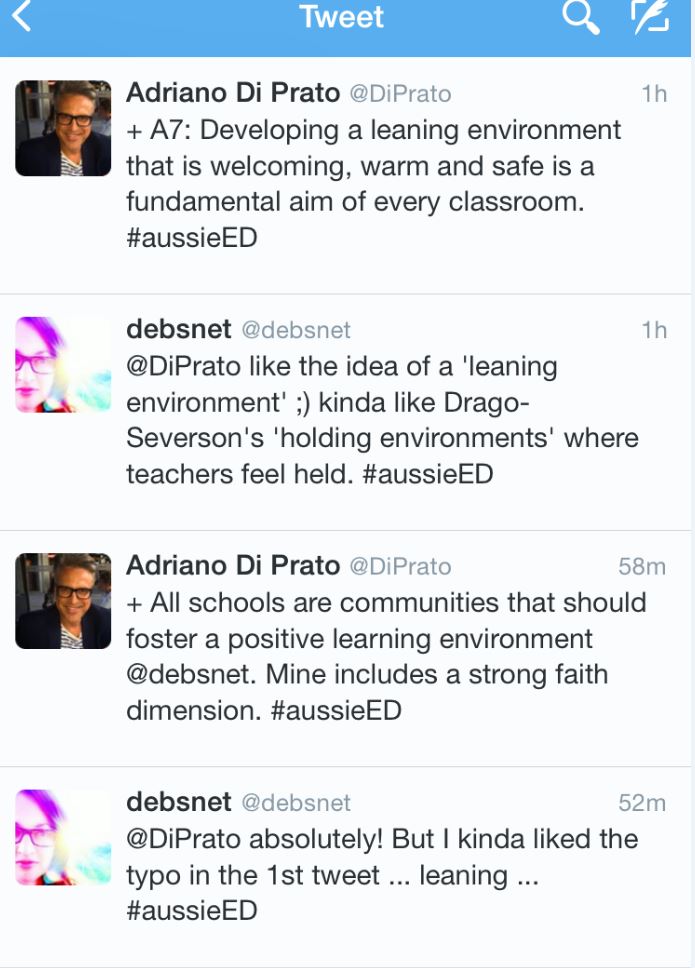
Tonight I was participating in the #aussieED Twitter chat when Australian educator Adriano Di Prato tweeted that ‘developing a leaning environment that is welcoming, warm and safe is a fundamental aim of every classroom.’ Now, I knew that Adriano meant ‘learning environment’ when he typed ‘leaning environment’ in a fast-paced Twitter chat, but it got me thinking: How are schools ‘leaning environments’?

It reminded me of psychologist and professor Ellie Drago-Severson’s notion of ‘holding environments’ (which I wrote a bit about here) in which she asserts the importance of teachers feeling ‘held’ by their learning and working environments, especially if positive change is to take place.

It reminded me of Costa and Garmston’s notion of ‘holonomy’ (explained in the Cognitive Coaching course material) in which the parts (individuals) and whole (organisation) are interdependent.

It reminded me of this great moment last year when a group of commuters on an Australian train platform used their leaning-together momentum to tilt a train and free a man trapped between the train and the platform.

So I tweeted back about ‘leaning environments’, and all of a sudden we were back-and-forthing about how the word ‘lean’ might apply to school environments. Would it be about individuals ‘leaning in’ to the community, to opportunities, towards each other? Could it be about students, teachers, parents and leaders ‘leaning on’ or ‘leaning alongside’ or ‘leaning with’ each other? Might it be ‘leaning out’, away from those things which should matter less but sometimes drive schooling (high stakes testing, grades, league tables)?

the power of a Tweeted typo

the power of a Tweeted typo

Fellow edu-Tweeter Melissa Daniels noticed the banter and asked whether this could be “the education revolution that started with a typo?” leading to another discussion about innovation, revolution and the evolution of ideas, all in 140 character bites.

Tweet @debsnet @DiPrato @PensiveM

This was an invigorating discussion for me, not because I thought it was to be the next big thing in education, but because of the thrill of the unsurprising serendipitous connections, conversations, ideas, thinking and challenges that come out of conversations and connections with like-minded like-passioned others. Here was a vibrant online environment of trusting, holding, leaning (in, out, on, with, alongside), impassioned, creative, continuous learners.

It also reminded me of our unforseen impacts. We never know the impact of a conversation, a word, a decision, or a typo.

I have noticed this in my self, in conversations or moments which stay with me until an idea bubbles to the surface. I have noticed it in my work with teachers and students, who often take some time to realise what moments or relationships have shaped them. I have noticed it in my PhD research participants, many of whom told me that the very act of being interviewed for my research changed something for them, opened something up, surfaced a reflection or became a moment of learning.

So, don’t ignore life’s typos. Even the seemingly tiniest things can have powerful & unforseen consequences.

You never know when you might uncover the next revolution.

Small shifts in your thinking, and small changes in your energy, can lead to massive alterations of your end result. ~ Kevin Michel

Montenegro by @debsnet

Transformational adult learning and growth: a conversation with Ellie Drago-Severson

All journeys have secret destinations of which the traveller is unaware. ~ Martin Buber

Columbia University

Columbia University

It was my privilege to meet in New York with someone whose writing has shaped my PhD research and my school-based work in building a teacher growth model: Ellie Drago-Severson.

Ellie is a developmental psychologist and Professor of Education Leadership and Adult Learning & Leadership at Teachers College, Columbia University. Her ‘four pillars’ of professional learning are: teaming or partnering with colleagues within and outside the school; providing teachers with leadership roles; engaging in collegial enquiry; and mentoring (or coaching).

While I have read her work (including Helping teachers learn: Principal leadership for adult growth and development, 2004; Becoming adult learners: Principles and practices for effective development, 2004; and Learning for leadership: Developmental strategies  for building capacity in our schools, with Blum-DeStefano & Ashgar, 2013) it was most interesting to hear her stories of working with teachers, school leaders, schools and districts to help them apply learning theory to practice. One example was of a school which, after working over time on the learning of its teachers, now consistently achieves the highest student achievement scores in its district.

Teachers College

Teachers College

Ellie’s examples of working with educators were based in some fundamental principles:

  • Teachers are adult learners who own their own learning and should be provided with choices. They should be able to choose if they are ready for growth. Even in mandated programs they should be able to choose their own paths.
  • Developmentally, learners may initially want ‘the answers’ or to be told how to improve, but the aim of adult learning should be to develop self-authoring individuals. Coaching should aim to grow individual capacity (e.g. Developmental Coaching, Cognitive Coaching).
  • Talk defines and drives behaviour (similarly to the beliefs of Adaptive Schools I explored here). Robert Kegan and Lisa Lahey’s How the Way We Talk Can Change the Way We Work: Seven Languages for Transformation (2002) looks at how language determines feelings, governs action and impacts learning. As well as talk, the quality of listening has been confirmed by research to be a developmental support for learning.
  • Change should start at a slow pace, with volunteers, building momentum and reach over time.
  • ‘Push back’ (resistance or questioning) should be welcomed and explored.
  • The key to learning is a trusting nurturing environment in which people feel ‘held’; they need to be simultaneously supported and challenged. It is vital to spend the time building culture and developing group norms and ground rules for confidentiality.

Strategies that Ellie uses when working with educators include:

  • Exercises from Developmental Coaching, such as those which help individuals to identify the underlying beliefs driving their behaviour and build a plan to address those beliefs;
  • Informal ‘drop in / drop out’ lunches to which staff are invited but not required. Lunch time conversations based on professional readings and the question ‘What might this look like in your practice?’
  • Journals for teachers / coaches / leaders as a sacred technology-free space for thinking.

There are many affirming ideas here for my school’s work in designing and implementing a teacher growth model, including the importance of a trusting environment, the role of talk and language, deliberately going slow, and providing scaffolds for ownership and differentiation of learning.

Some questions that arise are:

  • To what extent are we differentiating our teacher growth process for teachers? Is it enough for their experience to be one of meaningful, self-driven ownership?
  • What further strategies might we employ to build the cognition and engagement of teachers in their own learning (such as optional journals and online portfolios, or informal lunches to talk about teaching)?
  • How might we support those staff who are not yet self-authoring learners to develop their capacity for self-directed learning?
trust & rapport from the High Line: Eduardo Kobra's mural

trust & rapport from the High Line

Ideas to anchor school change

Without new experiences, something inside of us sleeps. The sleeper must awaken. ~ Frank Herbert

NYC art journal page by @debsnet https://theeduflaneuse.wordpress.com/

One of my art journal pages: ‘Don’t quit your daydream’

I recently completed the Adaptive Schools Foundation Seminar during which some of Garmston and Wellman’s foundational ideas really resonated with me in terms of school change (these are outlined in the course and in the source book The Adaptive School: A sourcebook for developing collaborative groups, 2nd ed., 2013).

1. Centrality of identity, beliefs and values

The Adaptive Schools book and course place emphasis on the importance of being conscious of teachers’ identities: their core beliefs, values and senses of self. These, rather than being set aside, are acknowledged and drawn upon in collaborative school practices. Graceful disagreement is seen as a path to developing group cohesiveness, empathy and shared identity. The teacher as person is honoured as an individual within the school, and a part of the school group.

2. The importance of talk

How we talk in schools, say Garmston and Wellman, influences our schools and our personal and collective experiences of them. Talk creates reality. This is why at my school we are using the Danielson Framework for Teaching (to provide a common language for talking about teaching) and Cognitive Coaching conversations (to provide a common way of encouraging teachers to think about their own teaching, in a way which allows the coach to facilitate the development of a teacher’s thinking, while at the same time getting out of the way of that thinking).

3. Tiny events create major disturbances

This is Garmston and Wellman’s third underlying principle of what they call ‘nonlinear dynamical’ systems, like schools. This principle affirms my experience of the unexpected, chaotic butterfly effects of incremental changes, which are sometimes unnoticeable or unmeasurable.

Teachers involved in our coaching cycle have commented that seeing another teacher’s lesson impacted their own practice in the following days; that reflecting on their teaching against the Danielson Framework brought foci and deliberate intent to their subsequent lessons; and that coaching conversations sometimes impacted their thinking long after the conversation had finished. Teacher coaches have noted that their Cognitive Coaching training has shaped the ways in which they communicate, not only with colleagues, but also with students and even with their own friends and families.

The Cognitive Coaching course has also impacted on my thinking around teacher growth and school change.

4. Holonomy

The notion of ‘holonomy’ is not from Adaptive Schools, but is from Costa and Garmston’s Cognitive Coaching (see Cognitive Coaching: A foundation for Renaissance schools, 2nd ed., 2006). It is the conceptualisation of the bringing together of individual (teacher) and organisation (school). The teacher is both influenced by and influencer of the school, involved in a continuously responsive relationship. The teachers as parts, and the school as whole system, work organically and symbiotically together.

For me, this notion of the interdependence between human individualism and organisational systems should be a key focus in school change initiatives. For my school, part of our approach has been designing a professional learning cycle based on the school’s strategic vision, and then having teachers pilot, drive and design the change. For us, the importance of honouring both organisation and teacher in a slow and deliberate process has been more important than fast change.

This coming week I will be at the Australian Council For Educational Leaders conference, sharing our story with other schools and departments who are working to develop the capacity of their teachers. And this time next month I will be in the middle of my visits to New York educators and researchers. I’m looking forward to having face to face conversations with those with whom I have connected via email and online, and seeing how they negotiate the tensions (and connections!) between teacher and school.

New York Is Always A Good Idea by @debsnet https://theeduflaneuse.wordpress.com/