
Building a school research culture

source: pixabay.com @ninocare

This year has been my first in a new role, the oddly titled ‘Dean of Research and Pedagogy’. I have a broad portfolio, including such things as pedagogy from PK-12 and overseeing the work of the Library, but two major aspects of the role are:

  • Building a professional learning culture of continual improvement, data generation and analysis. This includes overseeing the professional learning agenda and staff development, overseeing teacher action research projects, supporting our staff doing post-graduate study, leadership development, coaching teachers and leaders, and refining performance and growth processes.
  • Research innovation and support. This is about disseminating and building a body of research that promotes quality pedagogy and teacher improvement, executing evidence-based strategic initiatives, and working to develop a data analytics culture.

I sat down at the beginning of 2017 to map out how I was going to address these aspects of my role. What was the underlying strategy? What were the deliverables? Who were the key stakeholders? At the end of each year, how might I know I had been successful? What evidence of my own influence might I see if I was being successful in nudging the ever-nebulous school culture?

I wrote a two-year strategic plan (a working document that I revisit regularly) and put some measures for myself in place.

What follows is not my plan or those measures, but the kinds of things I have tried this year in my attempt at developing the research culture of the school.

  1. Harnessing internal and external expertise

As I explained in this recent blog post, staff development can include coaching, mentoring, consulting, courses, conferences and regular opportunities for goal setting and performance review. It includes collaborative learning experiences and those that occur over time. It includes harnessing both external and internal expertise.

This year a new initiative related to my role was called the Leadership Forum, a once-per-term cheese-and-wine event dreamt up and co-launched with the Director of Strategy. All of our school leaders, from Coaches and Year Co-ordinators to Heads of Faculty and the Executive, are invited each term to an early evening of cheese, wine, and connecting around leadership. This is an opportunity to connect the strategy of the school with the operational and relational work of our leaders.

The first Forum of the year was run by myself and the Director of Strategy, in which we took leaders through a process of reflecting upon research findings on effective school leadership, and then worked with them to set goals for themselves and their teams, aligned with the strategy of the organisation. For the second forum, we welcomed Professor Dylan Wiliam. For the third we ran a panel of three principals who spoke openly about their journeys of school leadership. And this final term, we welcomed Professor Pasi Sahlberg. This Forum provides one example of a way to engage teachers and leaders in current conversations around education, and with research and researchers.

Bringing experts into the school, and having them speak to our context, meant that their words and points connected more strongly with the people in the room. Also, staff enjoyed the collaborative experience of hearing them speak, together, so conversations have continued well after each presentation finished. Creating these kinds of crucibles of collaboration, and following up with books or articles that build upon the presentations, has been one way to nudge people’s thinking, especially when presenters are provocative or challenging.

  1. Research reports

I have published six of what I call the ‘Research Report’ to staff this year. The report is intended to provide all staff access to current thinking, research, and writing, around education. Across the year the report provides resources (from academic and theoretical, to popular and easily accessible) relevant to our specific school context, including to various sub-schools, faculties, and strategic priorities. The selected readings are a small selection rather than a comprehensive collection. Staff are encouraged to dip in and out according to their personal and professional interests.

I have been interested to note those people who have provided positive feedback about the report; many are non-teaching staff—from the Bursar to the administration staff—who have appreciated being able to immerse themselves in, or dip into, educational thinking, and have this shared in an accessible way. Making research accessible to all democratises the community and empowers everyone to have conversations around education. It has incited many corridor conversations, as well as more formal ones.

  1. Publishing on school platforms

Research is partly about communication and dissemination. In a school environment it is important that research can be made accessible for the community.

This year, on the school blog, I have written about things such as measuring success in education, professional conversations, and digital learning. In these posts I have referenced research in order to model how research can inform the thinking of educators and schools.

I was interviewed for the school podcast around the question, ‘What makes a great teacher?’, and I’ve written for and presented at other forums, in school and nationally.

Communicating in blogs, podcasts, and presentations, allows research to become alive and humanised.

  1. Keeping the staff professional reading library current

I am a card-carrying member of The Book Depository and have ordered plenty of resources for the professional reading library at school, in order to provide staff with the opportunity to engage with current research. At the end of each term, I promote a selection of books by emailing about them and placing them on a red trolley for the end-of-term staff morning tea in the Library.

I remind staff that professional reading can be counted as an informal professional learning activity under our Teacher Registration Board Professional Learning Activities Policy, so they can log it as part of their 20 professional learning hours per year for teacher registration.

  1. Keeping myself current

I could not do this role without keeping myself up to date with research. My adjunct position at a university helps to keep me current (as I have access to research literature behind the pay wall). It also allows me to do thorough literature reviews, such as those I have completed this year on digital learning and school libraries. I now have staff asking me to find current research literature for them to inform the work they are doing.

  1. Collaboration

It should go without saying that none of this happens without collaboration with a web of stakeholders. Relationships are key in this role. There’s no point me being in my office, reading away like the nerd I am, if no one is engaging with me or the work. Much of my day is spent in formal meetings or informal conversations.

One of the indicators of my success is when people seek me out, such as for individual coaching around career or professional development or a staff issue, to work with a team around a problem of practice, to generate data to gauge their impact, or to help with a Masters dissertation or PhD application.

One challenge to anyone in this kind of Research Lead role is the reality of the lives of teachers and school leaders. Educators are busy, pressed on from all angles, constantly rushing to their next class, to mark their next assignment, to jump through the next accountability hoop. Leisurely time and space to sit back and drink from the fire hose of current research literature is a fantasy. In addition, as this Deans for Impact blog post explains, teachers have deeply held sets of cultural and personal beliefs about learning and about how to best serve their students.

Engaging in research, and in discussions and explorations about research, can help teachers to interrogate those beliefs and bring together science, evidence, and systematic thinking with their praxis (wisdom of practice). We should value teachers’ lived experiences of lessons, relationships, students, and bringing content to life through pedagogy. We can also work to incrementally develop school cultures in which research becomes a part of ‘the way we do things around here’.

Tweeting and blogging: Selfish, self-serving indulgences?

Narcissus by Caravaggio http://totallyhistory.com/narcissus/

This week I’ve been mulling over a post in the TES written by Claire Narayanan in which she argues that teachers’ time is precious and they should quietly get on with their jobs, not spend time writing about it. In encouraging teachers to be ‘do-rus not gurus’ she writes:

In a world where self-promotion has rather shamelessly crept into education, the real heroes are not those who we may follow on Twitter, read about in leadership manuals or hear speak at conferences, but those who are at the chalkface.

These are the teachers who seek no recognition beyond a set of decent GCSE results; a thank-you from their headteacher every now and again and, best of all: “Thanks Sir/Miss, I enjoyed that lesson”.

They haven’t got time to attend every single TeachMeet in their region, read every piece of research written, attend every conference around the country on their subject area or update their blog. Does that mean they don’t care as much as those who do? No chance – they’re too busy marking and planning.

I found this interesting and a little challenging. Of course no-one attends ‘every’ TeachMeet, reads ‘every piece of research written’, or attends ‘every conference around the country’, but the suggestion that ‘real teachers at the chalkface’ are too busy marking and planning to entertain attending professional development, reading research, or blogging, implies that those who do make the time for these activities are perhaps neglecting their teaching jobs. Otherwise, how would they have the time? It also implies that these activities aren’t a valuable use of teachers’ time.

I agree with Claire that we shouldn’t pursue gurus and heroes in education. My PhD reveals the importance of leadership that is deliberately invisible and empowering, rather than visible, focused on the leader, or driven by outward performance. I’ve spoken of the silent work of coaches and leaders. And as a full-time teacher and school leader who also tweets, blogs, and writes peer-reviewed papers and chapters, I know the tricky balance between self care, time with family and friends, and service to the profession and to my students.

I wonder, though, about the implication that those who are on Twitter or presenting at conferences are shameless self-promoters or narcissists seeking heroic guru status. Many of those who tweet and blog, I would argue, do so because they are interested in learning from others, sharing their own perspectives and experiences, and engaging with educators from around the world.

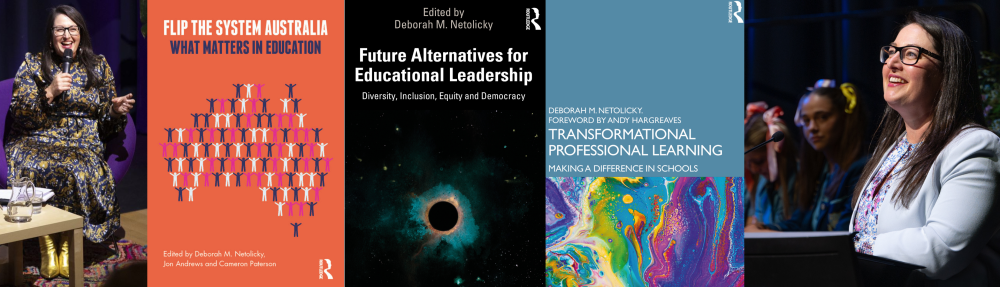
Part of what keeps me blogging is that it helps me think through ideas and get feedback from others. Another part is how useful I find the blogs of other people in helping or challenging my thinking. I also see blogging and academic writing as a service to the profession and a way to reclaim the narrative of education from those normally at its apex. It is why I am involved in the Flip the System series of books, which offer and value the voices of school practitioners—those working at the whiteboard, in the playground, and in the boardroom—that are often ignored in education reform, and yet are crucial voices to drive change in education. As Jelmer Evers and René Kneyber suggested in the first Flip book, teachers and school leaders can be agentic forces in changing education from the ground up by participating in global education conversation.

When I asked Claire on Twitter whether she saw all who tweet, share, blog, and present as shameless self-promoters, she responded, “Not at all. I’m all for sharing and learning. We all get on with the job in the way that suits us.” We seem to agree that different things work for different people. I don’t expect everyone to use their time as I do. There are benefits and costs to choosing to spend evenings, weekends, and holidays on professional activities or presenting at conferences. Last year I paid the price of going too hard for too long without a break.

For me, social media provides an avenue for sharing, learning, and connecting. I can tweet out my thoughts into the nighttime abyss, and somewhere, someone in the world is there to respond. I found this especially useful during the isolation of my PhD. I connected via social media with generous, supportive academics, researchers, and doctoral candidates from around the world who provided crucial advice and moral support.

My understanding of the world is broader for the conversations I have with those around Australia and the world, on social media and at conferences. These conversations and relationships allow me to see outside of my own context and my own perspective. They spill sometimes into productive collaborations that shape my thinking. I wrote here that:

In a world in which we are more connected than ever, we can be buoyed, empowered and supported by our connections…. We can pay forward and give back. We can … share our knowledge, contribute our time to help others on their journeys, listen to others’ stories, and celebrate others’ milestones.

Do I think we should acknowledge and celebrate the quiet daily work of committed teachers? Absolutely. Do I think we should encourage teachers to be mindful of workload, wellbeing, and self care? Yes, yes, yes. Do I think this is mutually exclusive from professional learning, engaging with research, interacting on social media, or writing blogs? No, I do not.

Education Gurus

It’s easy to make your own guru memes with Canva.

Knowledge and advice for schools and about education often seem to exist in a world of commodification and memeification. There is plenty of disagreement and debate in education, and plenty of competition on bookshelves and in conference programs. Educators and academics position themselves as brands via bios, photographs, and certification badges. As an educator and a researcher I have those whose work I follow closely; academics, for instance, whose presence affects me when I meet them because their reputation and body of work precede them.

In education, we have perceived gurus. These are people who have become ubiquitous in education circles, at education conferences, and in education literature. Teachers and school leaders scramble to get tickets to their sessions and to get photographic evidence of having met them. Their words are tweeted out in soundbites ad infinitum (or is that ad nauseum?), and made into internet memes. Sometimes these individuals partner with publishers or education corporates, and so the visibility and reach of their work grows. They become the scholars or experts most cited in staff rooms, at professional learning water coolers, and in job interviews when asked how research informs practice. 

Sometimes, these gurus are teachers or principals who have gained a large following on social media and subsequently a monolithic profile. Often, they are academics who have built up bodies of work over many years, becoming more and more well-known along the way, and eventually being perceived as celebrities or gurus. Yesterday I had the pleasure of learning from Dylan Wiliam, firstly at a day long seminar, and then at my school. At one point the seminar organisers apologised for running out of Wiliam’s books, acknowledging the desire of delegates to have the book signed.
Marten Koomen has traced networks of influencers in Australian education organisations. In his new paper ‘School leadership and the cult of the guru: the neo-Taylorism of Hattie’, Scott Eacott challenges the rise of the edu guru, those academics whose work is ubiquitous and influential to the point of being uncritically accepted and canonised. Eacott pushes back against the ‘what works’ mentality in education, in which educators are sold ‘what works’ and encouraged to slavishly apply it to their own contexts. Jon Andrews, too, questions the unquestioning way in which the loudest and most prominent voices become the accepted voices. Meta-analysis and meta-meta-analysis, often translated into league tables of ‘what works’ in education, have been the subject of criticism. George Lilley and Gary Jones have both questioned meta-analysis on their blogs. I’ve written about cautions surrounding the use of meta-analysis in education, especially when it drives clickbait headlines and a silver-bullet mentality of having the answers without having to ask any questions. Yesterday Wiliam made his oft-repeated points: that everything works somewhere, nothing works everywhere, and context matters. A guru cannot provide easy answers in education, as education is too complex and contextual for that.

taken at AERA last year

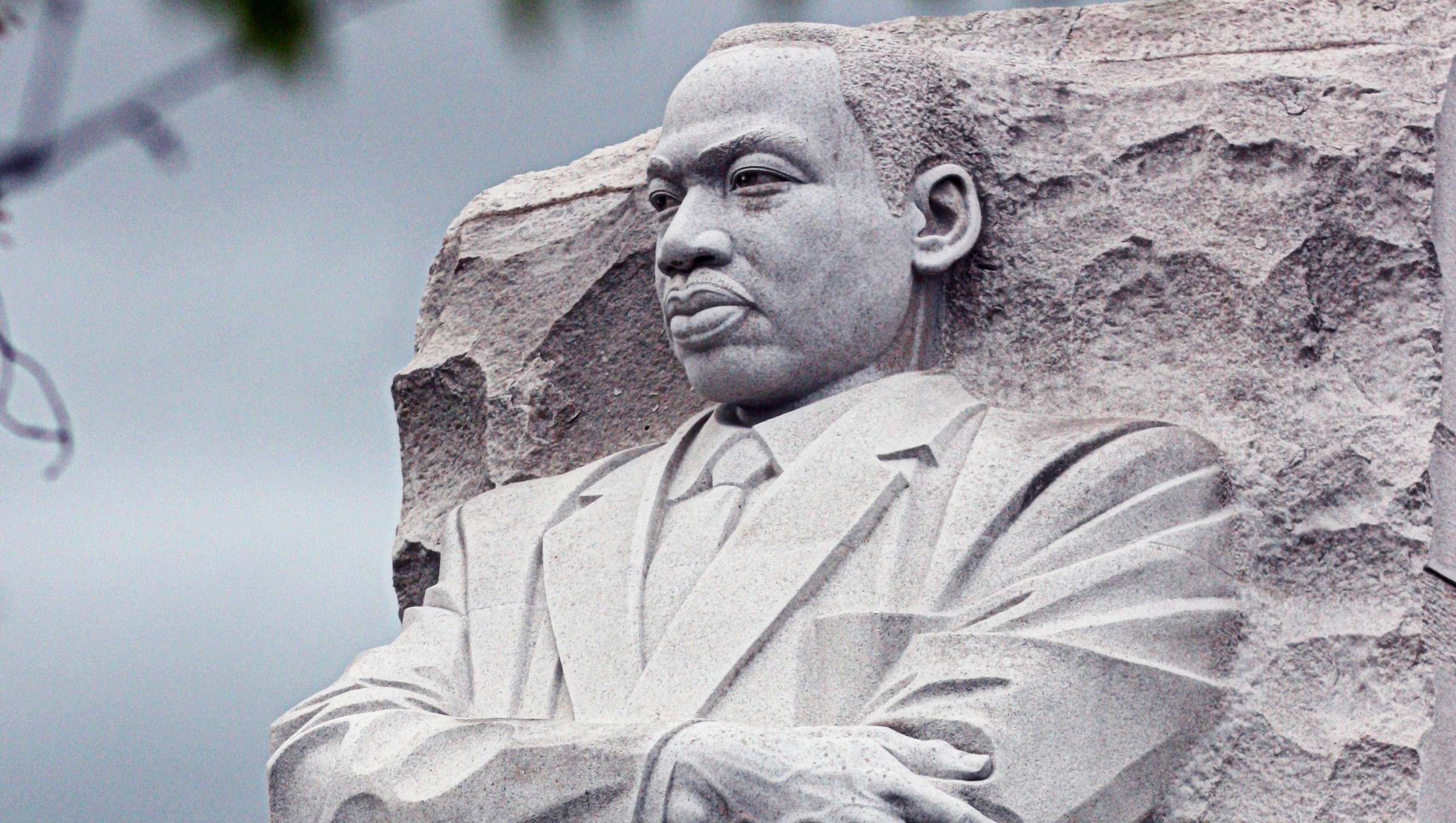
Much of this conversation around the rise of the edu guru has surrounded John Hattie, although he is by no means the only globally renowned education expert likely to make conference delegates weak at the knees. I was personally uncomfortable when he was beamed in via video link to last year’s ACEL conference and began to give an ‘I have a dream’ speech about education. As an English and Literature teacher I understand the power of rhetoric and analogy to persuade and inspire, but appropriating the legacy and words of Dr Martin Luther King Junior seemed a way to gospelise a personal brand of education reform.

I don’t think that education experts, no matter how influential they become, should encourage the uncritical acceptance of their ideas as dogma, or present themselves as the bringers of the One True Thing To Rule All Things of and for education. As Dylan Wiliam, channelling Ben Goldacre, repeatedly said yesterday, “I think you’ll find it’s a little more complicated than that.”

I wonder how perceived gurus feel about being guru-ised by the education masses. In part the famous and the infamous in education are so because of their actions: accepting more and more speaking gigs, performing the game of publishing and promoting their work. Most, I would guess, do this for the same reason someone like me speaks and publishes. To contribute to education narratives and change those narratives, hopefully for the better. To be of service to the profession and the field. To explore and wrestle with ideas, trying to find ways to make sense of the complexity of education in order to improve the learning of students and the lives of teachers and school leaders.

I wondered about the rise to gurudom and the moral obligation of the academic celebrity figure last year when at AERA I saw a panel in which four educational heavy hitters—Andy Hargreaves, Michael Fullan, Linda Darling-Hammond and Diane Ravitch—all advocating for the moral imperative of educational research and practice. They spoke of lifetime journeys of work intended to make the world a better and more just place. I wondered at the time about how much an early career academic can be brave and resistant in their work, as they try to build a career via the performative pressures of the academe. Can only the guru, free from institutional performativities and the financial pressures often associated with early career academia, say what they really want to say and do the work and writing they really want to do?

I don’t think experts in education are dangerous. We need expertise and people willing to commit their lives and work to making sense of and making better the world of education and learning. But in a world where teachers and school leaders are busy racing on the mouse wheels of their own performative pressures, we need to figure out ways to support and facilitate sceptical and critical engagement with research. Even those who are highly influential and highly admired need to have their work engaged with closely and critically. The danger comes when experts become so guru-fied that the words they use become part of an unthinking professional vernacular, used by educators who haven’t looked behind the curtain or beneath the book cover.

The Research Lead Down Under

candle at the Emu Plains Market

candle at the Emu Plains Market

Schools, school leaders and teachers are increasingly expected to be research literate, to be informed by evidence in their decisions and practices, and to be assessed against a range of high-stakes measures. In this kind of education world, schools need to be able to make sense of the measures against which they are being assessed, and have the capacity to generate counter-narratives or alternative data to measure those things that are important for them.

As I’ve alluded to, I have this year begun a new role at my school, which encompasses overseeing professional learning, staff development, innovation and pedagogy. But it also encompasses the kinds of work associated with what UK schools call a ‘Research Lead’: developing the research base and systematic methodologies of the organisation; data generation and analytics; executing evidence-based strategic initiatives; overseeing and developing research and innovation frameworks.

As Hargreaves and Fullan (in Professional Capital, 2012) point out, leading evidence-based school practices and change is a complex process. Having a person dedicated to the curation, generation and communication of research supports everyone from the classroom to the boardroom in making better decisions. A role dedicated to raising the profile and practice of research helps a school to remain agile in response to current educational research; evidence-informed and systematic in its methods; proactive in its processes and communications; and keenly focused on its strategic impacts within the wider context of the global education world.

The Research Lead role has been around in UK schools for a few years, and now there are Research Schools. See, for instance, the Wellington Learning and Research Centre and the Huntington Research School.

As the UK’s College of Teaching noted yesterday, teachers need access to evidence, strategies for understanding it, and opportunities to conduct their own research, not to mention the desire to engage with research in the first place. Access is a real issue, and while there are open access journals, the occasional free paper, and popular dissemination sites like The Conversation and the AARE blog, many teachers do not have the library privileges, money or time to access pay walled journals and expensive books. The Research Lead can be a conduit between research and staff at the school.

The role of Research Lead is explained in this Education Development Trust report, by Tom Bennett. The report positions the Research Lead as gatekeeper, consigliere, devil’s advocate, auditor and project manager. Interestingly, the report notes that schools where Research Leads had made the biggest impact were frequently schools where the role was part of the brief of a senior member of the leadership team. It lists authentic buy-in from senior leadership and a ‘place at the table’ of school life as necessary conditions of the role; the Executive needs to support the role and give it authority, autonomy, time (for the Lead to manage projects and for staff to engage with research) and commitment. The autonomy is partly important for projects and getting work done, but also because the Research Lead might have to sometimes take an unpopular position, or suggest a pause during a time of rapid change; they need to be free to do so.

Elsewhere in the world, the American School of Bombay has a Research and Development Centre. In Australia, examples such as the St Stephens Institute in Perth, the Barker Institute in Sydney, the Crowther Centre at Brighton Grammar School in Melbourne, the Centre for Learning, Research and Innovation at Geelong College, and the Centre for Research, Innovation and Future Development at St Paul’s in Brisbane, show how Australian schools are focusing on centralising and developing research. Just last year, my own role and others local to me were created, incorporating ‘research’ in the title. Some of these roles incorporate learning technologies. Others incorporate student academic achievement and staff learning and development. The research focus is based around the strategic vision and learning principles of each school. In Australia, there is often a focus on generation and innovation (finding out what might work in what context) rather than on prescribing ‘what works’. Teachers are seen by many schools as potential researchers.

So the Research Lead, or equivalent, is advisor, instigator, filter, conduit, provocateur, disseminator, critical questioner, sceptic, creator of partnerships, and builder of a professional culture in which rigorously considering evidence, research literature, and how to measure impacts are an accepted part of the way things are done. The Lead is across and through the organisation, an influence and an advocate for systematic thinking through. As Gary Jones’ blog often explores, evidence-based practice is nuanced and rife with challenges. The Research Lead needs to move beyond lip-service to research and hat-tips to evidence-based practice. They need to be aware of their own preferences, biases, blind spots and deficiencies, as well as the research-and-evidence temperature of the organisation, and how to evaluate and generate evidence and research.

I’m looking forward to shaping the Research Lead part of my own role. As a boundary-spanning PhD-universityadjunct-schoolleader-teacher it is something to which I am deeply committed and about which endlessly fascinated. My nerdery will be put to good use!

Rethinking professional learning: an academic paper for JPCC

This week I’m thrilled to see my paper ‘Rethinking professional learning for teachers and school leaders’ published in the Journal of Professional Capital and Community. This journal, whose Editor in Chief is Andy Hargreaves, boasts an Editorial Board including Linda Darling-Hammond, Michael Fullan, Alma Harris, Karen Seashore Louis, Pasi Sahlberg, Helen Timperley and Yong Zhao. My paper appears in Volume 1, Issue 4, alongside a theoretical paper by Dennis Shirley. As an early career researcher, I couldn’t ask for more distinguished company.

Even more pleasing is that the journal is open access during 2016, so free for anyone to download and read. Open access to the paper means that it can be accessed by practitioners who so often don’t get to read and engage with the literature in (often pay walled) academic journals. In fact, it has already been downloaded (at today’s count) 1689 times. Wow. That’s a bunch more times than my PhD thesis.

The paper, which draws from the lived experiences of teachers, middle leaders (often a forgotten group in education literature) and executive leaders in one Australian school, outlines the findings of my PhD around what makes professional learning that transforms beliefs and practices. It discusses my study’s response to the questions:

  1. What is the role of professional learning on identities or growth?; and
  2. What professional learning is transformational?

My PhD found that transformational learning (as defined by Ellie Drago-Severson, 2009, as that which actively shifts cognition, emotion, and capacity) is: collaborative and individual; occurring in life, school, and work; and requiring elements of support and challenge. Not only was it lifelong, but it was life-wide. For these participants, it is life experiences, as well as professional experiences, that influence their professional beliefs and practices. The following is a table, which didn’t make the final cut of the paper, shows the range of features of professional learning found in my study.

tabulated findings around professional learning

tabulated findings around professional learning

This table shows the variety of experiences that educators in my study considered transformational for themselves. These experiences included relationships with family members; role models and anti-models of teaching and leadership; post graduate study; difficult life experiences; becoming a parent; and connecting with others at conferences or via social media. It included heutagogical (self-determined) learning, as I outlined for this blog post for the Heutagogy Community of Practice.

It also included, especially for leaders operating at an executive level, the time and space for silence, reflection and thinking. The research interviews themselves proved to be spaces of learning for some of the school leaders, who saw them as an opportunity to be listened to intently and to think deeply about their learning and leading.

The participants in my study had some important cautions about professional learning and about school interventions. They cautioned that a mandated approach to professional learning, even if differentiated, might not address the needs of all professional learners. They wondered about how to honour the individual teacher and the organisational priorities when leading professional learning in schools.

The paper concludes that, while my study intended to explore the ways in which educators’ experiences of professional learning form and transform their senses of professional identity, it found that it is not just professional learning, but life experiences that shape professional identities and practices. That is, our teacher selves and teacher actions are moulded by critical experiences that tangle with and shape our identities, lives, relationships, and emotions. The best professional learning, as suggested by this study, is highly individualised and knottily enmeshed with educators’ senses of self, of who we are professionally.

Anyone who teaches knows that we cannot separate our teacher selves from our non-teacher selves. As teachers our lives affect our learning and teaching, and our learning and teaching influences our lives. For many teachers, ‘life’ and ‘work’ are well beyond blurred. We are humans who teach and teachers who exist as humans in the world. The leaders in this study tended to describe themselves as either teachers who lead or as leaders who teach; they remained teachers in their identity self-perceptions. See this post for further musings about the notion of teacher identity, that ‘being a teacher’ stays with many of us beyond our years in the classroom.

One suggestion to emerge from this paper is that we would benefit from rethinking what it is that we consider and label as ‘professional learning’. Professional learning is not hours logged on a spreadsheet or entered into an app. It is not necessarily being in a room with other educators at a course or conference that is labelled ‘professional learning’ (although it might be). It is those critical moments across our lives and work that shape the core of who we are, in and out of the classroom and the boardroom. Professional learning can be personal, unexpected, unscheduled, nonlinear, messy, unbounded, and unacknowledged.

Can we redefine ‘professional learning’ in more expansive and flexible ways? How might we acknowledge those hours educators spend blogging, or studying, or tweeting, or visiting schools, or collaborating intensively, or volunteering in the service of others? How can leaders lead the learning of teachers in ways that honour their individual learning trajectories and their own agency? How might we rethink our systems and schools in order to focus, not on hours of what is easily labelled or effortlessly deployed (staff day scattergun PD, anyone?), but on what actually engages us and changes our cognition and our capacities?

Should a coach be curious?

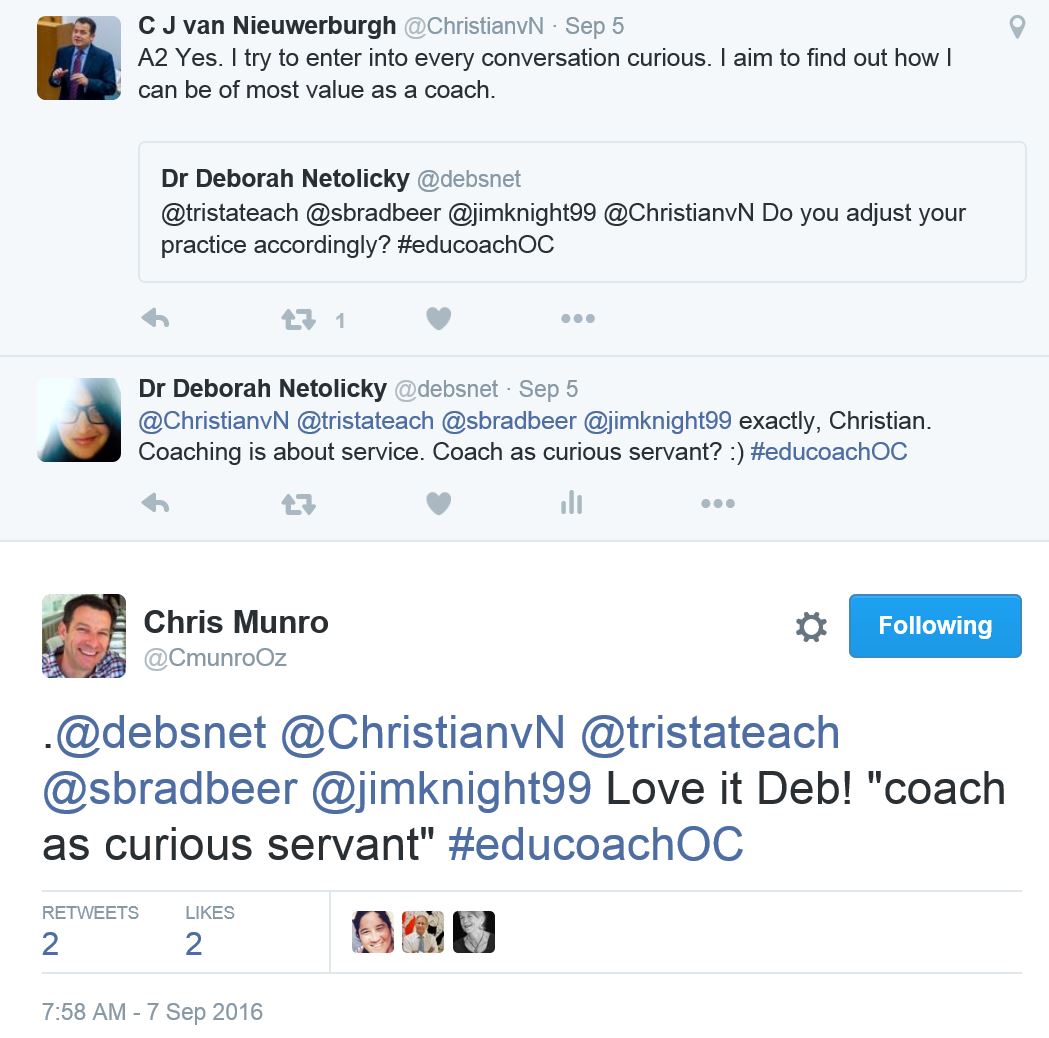
On Twitter recently I have noticed a few people talking about the qualities that a good coach might have. One of the qualities that has been raised more than once is that of being curious. During the last #educoachOC chat, I had this interchange with two respected voices in educational coaching, Christian van Nieuwerburgh and Chris Munro.

snippet of conversation from the last #educoachOC Twitter chat

snippet of conversation from the last #educoachOC Twitter chat

And it got me thinking. What might be the focus of a coach’s curiosity? Does being of valuable service as a coach involve being curious? Does being curious mean showing genuine interest in a coachee and demonstrating eagerness to hear the details of their experiences? Is it about paying close attention or finding out more? Does a coach’s desire to find out more make a coachee feel valued and empathised with, or does it sidetrack the purpose of the conversation?

The notion of coach curiosity rubs against the grain of Cognitive Coaching in which the coach–while encouraged to be open, inquiring, flexible, caring and compassionate–is instructed to set aside the following unproductive patterns of listening:

  • Autobiographical: This is ‘me too!’ listening in which the listener is compelled to share experiences of their own that they see as relevant to the speaker’s experiences. The coach needs to restrain their urge to be drawn into thinking or speaking about their own stories.
  • Solution: This is listening in which the listener is drawn to thinking up their own solutions to the listener’s problems. Rather than problem-solving, the job of the Cognitive Coach is to assume that a) the coachee knows their own context and problem best, and b) has the capacity to solve their own problems, using the coaching toolbox to help that person access their own internal capacities and thereby developing their self-efficacy.
  • Inquisitive: This is curious listening in which the listener wants to know more about the details of a particular situation. However, the purpose of a coaching conversation is not for the coach to know intimate details, or to provide advice, so what purpose does curiosity serve in a coaching conversation? Who is it helping?

This is what Art Costa and Bob Garmston write about inquisitive listening:

Inquisitive listening occurs when we begin to get curious about portions of the story that are not relevant to the problem at hand. Knowing what information is important is one critical distinction between consulting and coaching. As a consultant, a person needs lots of information in order to ‘solve the problem’. As a coach, a person needs only to understand the colleague’s perspective, feelings, and goals and how to pose questions that support self-directed learning. (Costa & Garmston, 2006, Cognitive Coaching: A Foundation for Renaissance Schools, p.65)

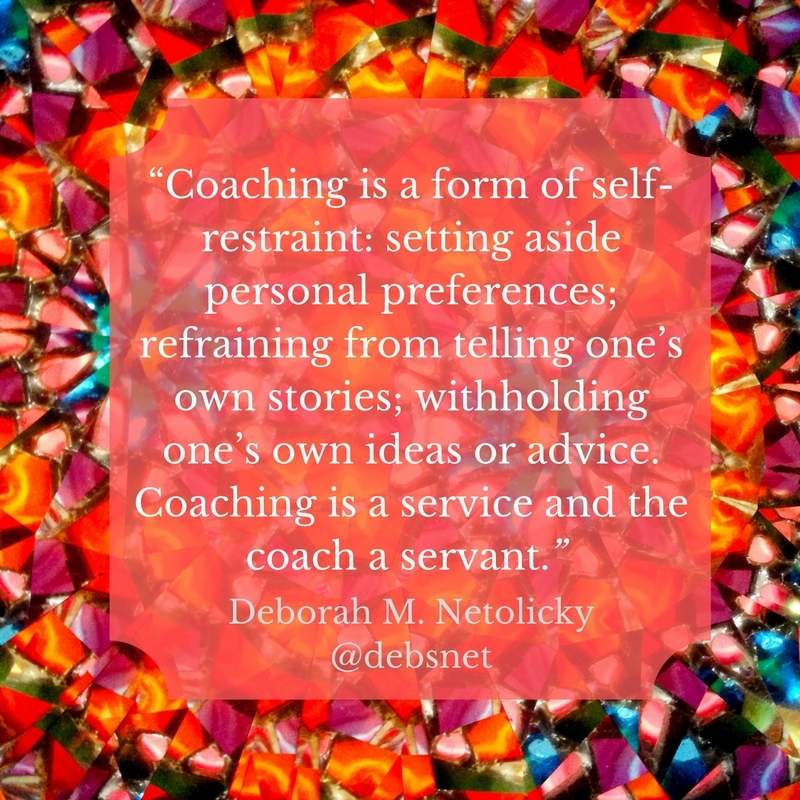
Coaching is a form of self-restraint: setting aside personal preferences; refraining from telling one’s own stories; withholding one’s own ideas or advice. Coaching is a service and the coach a servant. The coach is mirror, conduit, bucket in the well, water on the grass; a gentle influence that helps the coachee be the best version of themselves, and move towards where it is that they want to go with increasing capacity. In Cognitive Coaching this capacity development is focused around the Five States of Mind: consciousnesses, craftsmanship, efficacy, flexibility and interdependence.

So, should a coach be curious, or is curiosity a form of self-ish, rather than self-less, listening? If a coach’s questions are focused on seeking to understand the inner details of a coachee’s experiences, is that of value to the coachee? Often I find that as a coach I don’t need to know details. The coachee knows the details of their own situations and their thinking is benefited by being able to focus on where they want to go, rather than recounting minutiae for my benefit.

When I am being coached—my thoughts flying and forming and jelling and tumbling—I don’t necessarily want to be diverted by the well-intentioned interest of the coach. A coach’s curiosity to know more can sometimes take me from my own desire to move forward in my thinking, backwards or sideways to having to explain the specifics of my situation. My coach might not know the context or background of my issue, but I do. I don’t need help knowing the situation I am in; I need help to think my way to future solutions and successes. I want a coach to be present, to listen attentively, to hear, to paraphrase, and to ask me well-crafted questions that I haven’t thought to ask myself. Coaches might ask themselves: ‘If I’m being curious in this conversation, is that about me and what I want to know, or is it of benefit to the coachee?’

What do you think? Should coaches be curious, and if so, about what? If coaches are on a need-to-know basis, what exactly do they need to know?

Power of a nerd herd: Ode to my people

Nerd Face Emoji

It seemed Liv had spent the last eighteen years in search of her people, and in one sudden explosion of fate, they’d all been brought together in this place in time. Her eyes filled with tears as a sudden awareness filled her. They were all nerds.” ~ Danika Stone, All the Feels

The word ‘nerd’ is often given a bad name, being associated with relational ineptitude and being socially outcast. But for me nerdiness is about finding joy in knowledge: attaining it, interrogating it, producing it. Immersion in it. Consuming, curating and creating.

I love it when a nerd is positioned as a central figure of a story. One example is astronaut and botanist Mark Watney, the protagonist in Andy Weir’s 2011 novel The Martian. At one point Watney, stranded on Mars alone, yells, “Hell yeah! I’m a botanist! Fear my botany powers!” Watney embraces his nerdiness, calling himself a “space pirate” and invoking the metaphor of Iron Man when he catapults himself into space near the novel’s end. The story arc of the novel, and the Ridley Scott film in which Matt Damon plays Watney, is carried by this nerd-hero and his melding of science knowledge and affable humour. Watney is the epitome of the lovable nerd.

Recently, I’ve been reflecting on those people in my professional and personal spheres who make me feel like I’m at home when I’m with them. Many of these are fellow nerds. That is, we connect over our mutual love of something geeky (reading, writing, teaching, research, literature, coaching, art, science, story). We have a shared joy in finding things out and in doing purposeful work.

These are family and friends who, while I was completing my PhD, asked me about my research and listened to my responses. They are colleagues who get excited about a project we’re working on. Who co-plan courses, lessons, cross-curricular opportunities and assessments with a fervent enthusiasm and a twinkle in their eye. Who understand, or at least watch with knowing amusement, when I get excited about a new academic text or education book arriving on my desk (O, Book Depository, my faithful friend!), or about a paper being published. Who smile patiently when I cyclone into their office full of ideas busting to get out of my head or words tumbling out of my mouth. They are the past or present principal who continues to show an interest in and support of my work. Who sometimes says ‘yes’ and sometimes challenges me to think and do more.

They are the mentor or coach who waits while I work through my messy thoughts and helps me to arrive at cleaner ones. They are the colleague and bloggers who trust me enough to listen to their unformed thoughts or read their still-emerging ideas.
They are the professional friend who coaches me on Voxer or takes a phone call to help me work through a professional problem or issue. They are my PhD supervisors who gave me the space to explore some off-the-wall ideas, while challenging me to construct airtight rationales for non-traditional approaches. They are the well-known academic who shares their expertise via social media, flattening hierarchies and transgressing time zones. They are the conference-goer who stops me in the corridor after my presentation to talk for an hour, before moving our conversation to the long lunch it deserves. They are the co-author I’ve never met face to face, or spoken to on the phone, but with whom I’ve collaborated, co-written, and whose thinking and writing has pushed mine into new crevices.

They are my kind PLN who engage thoughtfully with me on Twitter, respond to my blog posts and meet up with me in cities around the world. Twitter is full of generosity. In my PhD acknowledgements, I thanked family and friends who had shown an interest and those in the social media world who had provided an antidote to isolation when I felt alone in my own head in the PhD wilderness.

Those people who feel like my tribe provide a space that is at once safe and challenging, celebratory and questioning, inspiring and industrious. It’s a place I can be excited about an idea, a text or a possibility. I can geek out and nerd it up without risking an eye roll or a snigger. I can share narrow interests and pursue broad passions.

In a world in which we are more connected than ever, we can be buoyed, empowered and supported by our connections, our people, our herd, our tribe, our squad. We can pay forward and give back. We can support each other’s nerdy excitement. In the karmic circle of knowing, learning, doing, being, leading and caring, we can share our knowledge, contribute our time to help others on their journeys, listen to others’ stories and celebrate others’ milestones.

Thank you to my fellow nerds who give me a sense of belonging and allow me the luxury of knowing that my personal brand of nerd has plenty of places to call home.

Achievement unlocked: I think I am Nerd Face Emoji.

Achievement unlocked: I think I am Nerd Face Emoji.


Reflections on coaching after ISCAPPED 2016

ISCAPPED2

The International Symposium for Coaching and Positive Psychology in Education (ISCAPPED) happened in Sydney this week. It involved two days of keynotes, breakout sessions and corridor conversations by academics, pracademics and practitioners committed to researching, implementing and sharing their coaching and positive psychology work in schools around the world, and specifically in Australia. The yoking of two fields meant that it was possible to glean the differences in the arenas and the places at which they intersected. What stood out to me as a point of difference was the language used; while positive psychology sessions tended to use words like ‘self-esteem’ and ‘strengths’, coaching presentations were around ‘efficacy’ and ‘capacity’.

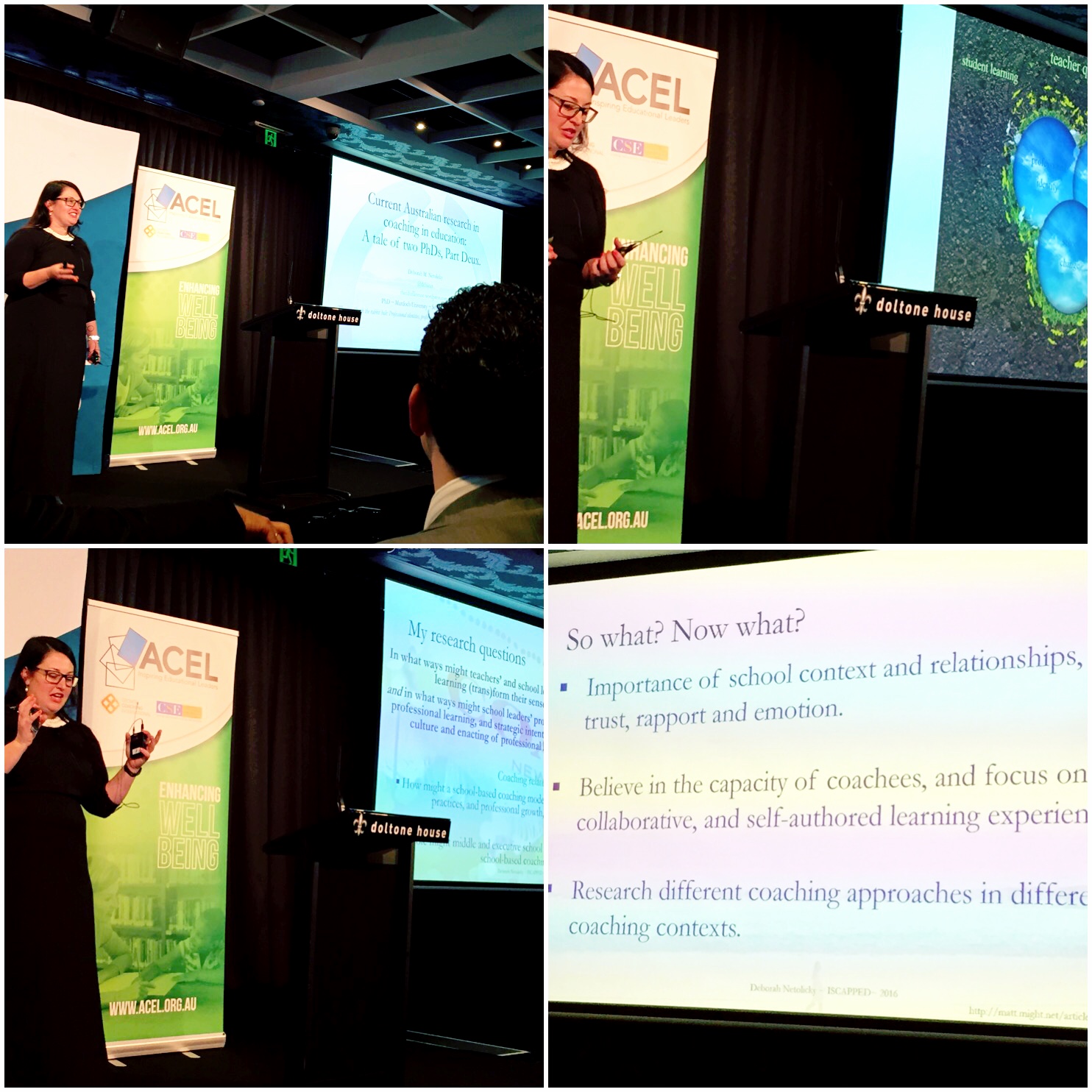
I presented twice at the symposium, once with colleagues, on the journey of our coaching model for teacher growth, and once on the coaching findings of my PhD research, which was set against the context of that school-based coaching model for teacher professional learning.

My colleagues and I outlined the story of the development of our model from its strategically-aligned beginnings, to its teacher-owned development and its whole-school implementation. Our presentation included a structured conversation that used some of the basics of Cognitive Coaching: the pattern of pausing, paraphrasing and posing cognitively-mediative questions, while setting aside the coach’s own patterns of unproductive listening. Our selection of coaches is based on beliefs that, while everyone is coachable and has the capacity to improve, not everyone can be a good coach.

I then shared my PhD research alongside Alex Guedes, who has also conducted research against the backdrop of a school-based coaching model for teacher capacity building. This presentation, which occurred under lights on the stage on which the keynotes were presented, covered the context, foci, method and findings of our PhD studies, with a particular focus on coaching. My findings, which I explore in more detail in this paper in the International Journal of Mentoring and Coaching in Education, include that coaching can be an empowering, identity-forming, relationship-building and language-shaping experience. They also include that coaching, while not a silver bullet, can be an effective part of positive organisational growth.

These findings resonate with Costa and Garmston’s notion of holonomy, in which the parts and the whole are both separate and together; the individual and the organisation grow and influence one another. Identities, language and understandings are collectively constructed. Congruent tools like Cognitive Coaching and the Danielson Framework for Teaching can be used to grow people, teams and systems, within environments and relationships of trust. In the coaching intervention that provided the context for my study, and that continues to operate in my school, non-judgemental data provides a ‘third point’ in coaching conversations, in order to depersonalise teacher reflections. Another third point is the Danielson Framework, our shared standards of teaching practice.

lucky enough to catch Vivid Sydney while we were there

lucky enough to catch Vivid Sydney while we were there

Coaching is hard cognitive work. This Monday, the #educoachOC Twitter chat will explore listening in a coaching context. I’ve recently been exposed to another string to the listening toolbox I use when coaching, which has thus far included careful listening for spoken language use, purposeful paraphrasing and watching eye movement to gauge what thinking is going on for the coachee. Recently, Bruce Wellman, author of The Adaptive School and Learning-focused supervision, came to work with my school on a variety of things. He worked with our team of coaches on something he calls non-verbal paraphrasing. He ran a workshop with us and shared his paper titled, ‘Nonverbal elegance when paraphrasing’.

Bruce couches this idea in research from anthropology, linguistics, cognitive science and neuroscience. Gesture, he explains, reduces the cognitive load of the speaker, saving energy by communicating information through body as well as spoken language. It is also primal in that gestures can reflect emerging or intuitive understandings. That is, our physicality can express those things we might not yet have words to express, or those things we are wrestling with between our knowing and not knowing.

In a coaching context, our brain’s mirror neurons help us to show empathy with the coachee, and we can also be deliberate about mirroring body language in order to be in rapport. Bruce suggests that additionally, we can “listen with our eyes”, watching for how someone’s body language extends, amplifies or makes clearer their thinking. Paying careful attention to how coachees use their hands—to explain concepts, sequence events or place people in their internal world—is a powerful listening skill. It allows the coach to paraphrase, not just the words the coachee uses, but also the physical referencing. Since doing this workshop I’ve noticed myself paying more attention to gesture, and trying to reflect back coachees’ gestures during my paraphrasing.

(Side note: As I type this I’m finding that I am gesturing between keystrokes as I try to figure out my ideas and the words I’ll use to express them. Perhaps that’s because Bruce Wellman’s concept of non-verbal paraphrasing is new to me, and my primal brain is helping me figure out my understandings. I’ve spoken a lot about writing as a mode of inquiry – writing to understand. I’m wondering now about gesturing as a mode of inquiry – gesturing to understand. *gesticulates wildly*)

So there are multiple skills to coaching, which can be honed and developed over time, but as Christian van Niewerburgh’s keynote pointed out, the coaching process and coaching skills aren’t enough. They are necessary but not sufficient. I agree with Christian when he says that transformative coaches are those who adopt coaching as a way of being. I also agree with him that coaching needs a theoretical and evidence base. Coaching isn’t a recipe on a laminated sheet. It is more than a process, a conversation or something anyone can do after a quick training session in which they are given a conversational formula.

Cognitive Coaching, which is the model in which I am trained and that my school uses in our context, is deeply rooted in research, and layered with multiple lenses and skills. The research base for Cognitive Coaching is most rigourously explored in Art Costa and Bob Garmston’s Cognitive Coaching text, now in its third edition (the previous editions were called Cognitive Coaching: A foundation for Renaissance schools). Other references include this 2003 paper on why Cognitive Coaching persists. These references and others (I have plenty!) tease out the reasons why coaching, done well, can be powerful and transformative.

Coaching is not mentoring, or telling, or advice giving, or passing judgement, or giving ‘helpful’ tips that make the feedback-giver feel like they’re being really useful. It is trusting in the capacity of the other person to solve their own problems, decide on their own trajectory of growth and consider how best to improve. The coach’s difficult work is in expertly and deliberately using a toolbox of knowledge and skills. These knowledge and skills are deliberately used as well as internalised and woven into the coach’s way of being, to help move the person’s thinking forward. That’s where the ‘cognitive’ in Cognitive Coaching comes in. The coach mediates thinking, because thought is what drives action. Changing thinking changes behaviour. It’s in the ‘a-ha’ moment, which cognitive coaches call ‘cognitive shift’, that individuals are transformed from the inside out. The magic is that the coach is mirror, conduit, provocateur and nudger, but it is the person being coached who does the thinking and finds their way.

Reflections on researchED Melbourne #rEdMel

I’ve landed back in Perth after a whirlwind trip to Melbourne for this year’s researchED conference. This post is an attempt to unravel the tangled threads in my head, after what was a big day of thinking, listening and talking.

On coaching: Our panel

Being on a panel with Corinne Campbell, Chris Munro and Jon Andrews was the highlight of the day for me. That included not only the panel presentation but the opportunity to be in the same place, at the same time, able to flesh out our ideas about coaching together (as well as plenty of other educational issues).

Founder of researchED, Tom Bennett, saw the four of us working together early in the day and joked that it was like four Avengers coming together in one movie. That struck a chord with me, because we are four individuals deeply committed to making a difference in our own contexts, in four different Australian cities. But we’ve come together across social media time and space to collaborate on #educoachOC, a monthly Twitter chat on coaching in education, which aims to centralise, clarify and tease out the global conversation around coaching in schools. I met Corinne and Chris for the first time at last year’s researchED conference in Sydney, the first Australian iteration. I hadn’t met Jon until yesterday, yet we’ve been collaborating for months, and talking about practice, writing, leadership and coaching.

So getting together with my fellow Avengers was like landing in my nerd heartland for a day. We are, however, less about avenging and more about advocating for supporting teachers and trusting in their capacities for improvement. Coaching was revealed in the panel discussion as an enhancement and growth process, not a deficit model for fixing underperformers.

Our panel seemed well-received, and I learned from my fellow panellists as we covered what we mean by coaching, why each of our schools adopted coaching, what it looks like in each school, the impacts we’ve noticed, and the broader implications for coaching in schools. We explored issues of trust, implementation and mandation. We considered the conference theme: how coaching might fit with ‘working out what works’. On the one hand coaching does not prescribe ‘what works’ to coachees, and yet coaching has been shown to work. It is a researched but contested approach to learning and growth, with coaching models varying in intent and execution. Coaching is about practitioners being given the time and space to work out what works, for them, in their contexts.

On research ethics: My presentation

My individual presentation was on a topic I later described on Twitter as the unsexy undergarments of research: ethics. Necessary and crucial, but often viewed as unexciting. I looked at ethical considerations and decision making, for teachers researching their own schools, using my PhD study as an example.

I shared this quote from Helen Kara’s book Creative research methods in the social sciences:

Ethics should underpin every single step of research, from the first germ of an idea to the last act after dissemination. And ethical problems require ethical decision-making – which allows for creativity.

Here, Helen reminds researchers that ethics is creative problem solving. It does have to be well-considered, systematic, respectful and just (see the Australian National Statement on Ethical Conduct in Human Research), but it doesn’t need to be tedious.

I outlined the ethical challenges in my PhD, and the ways in which I grappled with those and made decisions. My operationalising of ethical solutions included writing information letters and consent forms; using an independent interviewer to interview teacher participants (and a rigorous approach to protecting teacher identities); designing deliberate interview protocols; drawing data together into composite stories; and utilising metaphor to protect participants while making interpretive meaning.

I discussed the benefits and limitations to being a researcher embedded in one’s own context. Below are the implications and questions I ended with.

Evidence-based practice in education

Among other presentations, I saw two on using evidence and research in schools, one by Gary Jones and another by Ray Swann. What I enjoyed about both approaches to evidence-based and research-informed practice in schools, is that they promoted valuing of not only the ‘best available evidence’, but also the wisdom of practice of teachers and school leaders. That is, they valued tacit knowledge and the expertise that comes with lived experience. They also acknowledged the value-laden and culturally-influenced nature of using evidence in schools. I think these are important layers to understanding what works in schools, and how schools can work towards finding what is shown to work in other contexts, and how they might therefore pursue what works in their own.

What I enjoy about Gary’s work is that he provides explicit frames for applying systematic approaches to evidence-based practice. He manages to make sense of the complexities of evidence-based practice, in order to communicate it with clarity, and in a way that educators can understand and apply. I recommend reading his blog and his handbook for evidence-based practice.

The researchED Avengers?

Thinking back to Tom’s analogy of the Avengers, the crowd at researchED is kind of like a room of fantastical superheroes. Here were close to 200 educators—teachers, school leaders, researchers and professors, each with their own individual gifts, talents, passions, stories and arenas of expertise—spending their Saturday dedicated to learning, connecting and talking about working out what works in education. There were some great questions from the audiences in the sessions I attended. Those that got me thinking included:

“Who decides what the ‘best available evidence’ is and how do they decide?”

“Where should coaching happen and how long should a coaching conversation be?”

“If you were start your research again, would you make the same decisions?”

There were also great comments, questions and provocations from those educators on Twitter who were engaging with the conference hashtag from afar, adding another level of richness to the online and offline conversations.

When Dylan Wiliam popped into the speakers’ dinner, it added a further layer to discussions. Here was another educator coming out to talk education on a Saturday night, after coming straight from presenting at a national conference, and before getting up the next day to present all day again. For me, it was great to be able to discuss his new book, Leadership for Teacher Learning, the use of the Danielson Framework for Teaching, and performance pay.

Tom describes researchED as built on and powered by (I’m paraphrasing and embellishing here) blood, sweat, volunteers and fairy dust. That is, those supporting this conference, around the world—including participants, presenters and schools—care deeply about education. These are people dedicated to making classrooms and schools better places for better learning.

It was a pleasure to be part of the conversation for the second year in a row. I’ve been left with plenty to think about.

_____________________

And some more reading …

You can see my reasons for attending researchED Melbourne 2016 here.

Jon Andrews has shared his reflections on Melbourne’s researchED here.

Pamela Snow has written this post about her presentation at yesterday’s researchED on justice re-investment.

Greg Ashman wrote this post about his day at researchED.

Gary Jones wrote this post reflecting on Melbourne’s researchED.

Susan Bradbeer has written this post about her experience of researchED from afar, as someone who followed the conversation on social media and the blogosphere.

Tom Bennett had some reflections after the Melbourne event, published here on the TES blog.

You can see my reflections on researchED Sydney 2015 here.

Professional identity & professional learning: Reflections on my TER podcast interview

identity is liquid (aka Little Lagoon, Shark Bay)

identity is liquid (aka Little Lagoon, Shark Bay)

Recently I was interviewed by Cameron Malcher for the TER podcast about my PhD. You can listen to the interview, which was released on Sunday (it kicks in at the 35 minute mark). My favourite part of the podcast was Cameron’s concluding thoughts that were sparked by the interview. Below is not a blow by blow account, but a reflection on what we discussed.

What is professional identity?

In my PhD I defined identity as “ongoing sense-making process of contextually-embedded perceived-selves-in-flux”. It is a process rather than a product, a constant state of becoming. It is fluid rather than fixed. It is constantly shifting, as suggested by Fred Dervin’s notion of identity as liquid. It is socially constructed and contextual; that is, identities are co-constructed with others, and we are different versions of ourselves in different situations, with different people.

Factors that make up our professional identities include our beliefs, values and assumptions. Our identities are created and rewritten through language, through the ways we tell the stories of ourselves, to ourselves.

On the blogosphere and the Twitterverse there have been arguments about the disconnect between who owns identity and labels, suggesting that some think that identity is superimposed on us by others’ perceptions, while some believe that we own and make our own identities. The socially constructed nature of identities suggests that both have merit. We write ourselves for ourselves, and our self-perceptions rely on how others perceive and interact with us (although this interactions can be rejection of others’ perceptions, as well as acceptance).

Why consider professional identity in education?

Teaching is deeply personal. Part of the reason I brought professional identity together with learning, leading, and school change is that I think they are inseparable. Looking at education reform through the lived experiences and identities of those in schools is key to understanding its impacts. Professional learning and the leading of schools need to take teachers’ and leaders’ senses of selves into account, and engage with them.

Focus of my research

I conducted research within my own school and examined the stories of 14 teachers and leaders, including myself. The background context was a school-based teacher growth initiative.

I used narrative research to explore how these educators’ professional identities interacted with their learning and with school change. I was interested in what it is that shapes and shifts educators’ professional identity perceptions and in what ways schools and systems might work with a greater understanding of educator identities when designing and implementing education reform.

My narrative approach involved interviewing participants in ways that encouraged storytelling, including using coaching protocols, and then storying those data. It required me to be reflexive as the researcher. The experience of my PhD was personally and professionally transformative for me. I loved it, and it was incredible professional learning. In particular, the luxury of listening to educators’ stories was a joy and a privilege. I presented at AARE last year on my creative, literary approach to storying data, and this Saturday I’m presenting on my ethical decision making at the researchED conference in Melbourne.

Research findings

My research found that:

  • We professionally learn throughout our lives. Our professional learning encompasses life moments that are professional and personal, formal and informal, in schools and out of schools, singular and collaborative. Professional are shaped by good and bad experiences, by role models and anti-models.
  • Learning which taps into who educators see and feel they are, has the most impact on their beliefs, thoughts, behaviours, and practices.
  • Coaching and being coached is identity shaping, shifting teachers’ and leaders’ beliefs about learning and teaching.
  • The Danielson Framework for Teaching can be a useful tool for teacher self-reflection when used by teachers for their own growth.
  • School reform and school cultures which trust the capacities of teachers to reflect and improve is empowering and capacity building.

Implications of my research

With the caveat that my PhD was highly contexualised (considering the nature of the school and individuals I studied) the findings have something to offer the education world.

Firstly, there is a need to broaden the definition of professional learning, to allow teachers and schools to think more broadly about what it is that transforms educators, and who drives the professional learning of teachers. In my own leadership practice I am wondering how professional learning might be more autonomous and individualised. About how professionals might choose and follow, with support and opportunity, their own growth trajectories. About how schools and systems might acknowledge and encourage heutagogical (self-determined) learning.

Secondly, schools and systems can work from their own contexts to design and slowly iterate models of professional learning, from the bottom up and the middle out. As many scholars point out, effective education reforms are contextual. They cannot be lifted from one school or nation and dropped on another. Change in schools should be at a slow evolution-not-revolution pace, and based in assessing available evidence and current context.

As a result of my reading and research, I advocate for distributed and empowering leadership in schools, and school systems that trust teachers. I am a card-carrying, flag-waving fan of the Flip the System movement, which champions the agency and voice of teachers within their own systems. Teachers and school leaders have the internal capacity for analysis, reflection and growth. The individual should be honoured, valued and supported, within the holistic collective of the organisation and the system.