Evidence For Learning in Australia

In the UK the Education Endowment Foundation (EEF) is championed by some as a tool for helping teachers, school leaders and schools to make the best decisions for their students, based on what research and evidence shows. Now in Australia, Evidence for Learning (E4L), powered by Social Ventures Australia and the Commonwealth Bank of Australia, is piggybacking on the EEF’s toolkit in order to provide an Australasian equivalent. It is advised by, among others, John Hattie, and is partnering with AITSL and with State education departments to map the toolkit to State education frameworks and the AISTL Professional Standards for Teachers and Principals.

Last year I spoke with John Bush, Associate Director of the Learning Impact Fund, about the toolkit, and this week I attended a breakfast workshop run by Dr Tanya Vaughan, Associate Director for the E4L toolkit and Honorary Fellow at the Melbourne Graduate School of Education (MGSE) at the University of Melbourne. As the Research Lead at my Australian school, I was keen to hear more about how it was progressing and what it is offering Australian schools.

The aims of the E4L Toolkit

Tanya framed the toolkit as as an instrument for helping great practice become common practice. E4L aspires to make accessible, and develop the rigour of, evidence of what works and why in education, in order to make a difference to learners. That is, it aims to build, share and use evidence to support better decision-making in schools, to in turn lead to better outcomes for students.

The E4L toolkit is free and unrestricted in order to provide all schools with access to evidence of what works best in education, regardless of budget or postcode. This, Tanya explained, will help to address the barriers for teachers engaging with research:

  • Shortage of time;
  • Overload of information; and
  • Insufficient contextualized information for practice.

I would add that much educational research is behind a pay wall in journals inaccessible to non-researchers, or in very expensive books that aren’t affordable for many schools. Tanya was adamant that “front line professionals are the heart and soul of evidence-based education practice”, and that E4L endeavoured to improve communication between professionals and researchers, teachers and ‘the evidence’. This connection between educational research and practice is one to which I am especially committed.

What does the E4L Toolkit look like?

The E4L effect size league table’s Top 5 edu-practices

A first glance, the E4L toolkit shows a set of effect-size league tables of teaching practices, each showing – via symbols – the average cost of implementation, the ‘evidence security’ of the claim, and the average month’s worth of learning impact.

Visitors to the toolkit can drill down into the site. Clicking on a single practice such as ‘feedback’ reveals summaries addressing the following questions: What is it?; How effective is it?; How secure is the evidence?; What are the costs?; and, What should I consider? Clicking further into ‘References’ reveals the studies that sit behind this practice, with abstracts. Some practices additionally have an Australasian research summary.

Tanya was clear that the toolkit presents averages. In fact, it presents averages of averages, or more accurately meta-meta-analyses. While Tanya advocated for mixed methods – including talking to leaders, teachers and students – most of what the toolkit presents are syntheses of meta-analyses and randomised control trials (often considered the ‘gold standard’ of educational research).

The lock rating symbols, showing apparent ‘security of evidence’ are based on the number of meta-analyses beneath the meta-meta-analysis. It is the notion of evidence security and the simplification of ‘what works’ to effect size league tables that has me feeling cautious about the toolkit and its potential use. In attempting to address education practitioners’ shortage of time to engage with research and the overload of research information out there, does E4L provide an oversimplified tool likely to be accepted uncritically by busy educators working in our schools?

What is meta-analysis?

Meta-analysis is a statistical analysis using an equation: the experimental mean, minus the control group mean, divided by the population standard deviation. Simpson (2017) gives us this description of what happens:

“Individual studies report quantitative measures of the outcomes of particular interventions; meta-analysts collect studies in a given area, convert outcome measures to a common metric and combine those to report an estimate which they claim represents the impact or influence of interventions in that area. Meta-meta-analysis then takes the results of meta-analyses, collected in broader fields, and combines those estimates to provide a rank ordering of those fields which make the most difference.”

Simpson’s paper, released in January this year, challenges analogies between evidence-based practice in medicine and education. Treatments in medicine, he argues, are often standard and well-specified, with agreed outcomes which are relatively easy to measure. Education is more nuanced, complex and contextual.

Simpson invokes Eysenck’s (1984) notion of comparing apples with oranges, when he points out that meta-analyses often do not compare studies with the same comparisons, measures and ranges of participants. He contends that aggregated effect sizes are more likely to show differences in research design manipulation than in effects on learners. Bloggers such as Jon Andrews, in this post, and Gary Jones, in this one, have teased out the limitations of meta-analysis as method in educational research. Gary insists that “if teachers and school leaders wish to use effect sizes generated by research to help prioritise interventions, then it is necessary to look at the original research”, rather than relying on simplified lists. Educators need to look behind the curtain.

Snook et al. (2009) argue that when averages are sought or large numbers of disparate studies amalgamated, as in meta-analyses, the complexity of education and of classrooms can be overlooked.  They also point out that any meta-analysis that does not exclude poor or inadequate studies is misleading or potentially damaging. Terhart (2011) points out that by focusing on quantifiable measures of student performance, meta-analyses ignore the broader goals of education.

Meta-analysis is singled out by Wiliam (2016) as an unsuitable technique for identifying the relative effectiveness of different approaches to student learning. He states that:

Meta-analysis is simply incapable of yielding meaningful findings that leaders can use to direct the activities of the teachers they lead.”

Wiliam’s PowerPoint presentation from last year’s ResearchED conference in Washington—titled ‘Why teaching isn’t—and probably never will be—a research-based profession (and why that’s a good thing)’—presents the problems with meta-analyses for deciding ‘what works’ in education. In the presentation, Wiliam reminds us that everything works somewhere and nothing works everywhere. He encourages us instead to ask: Under what conditions does this work?

Possibilities and reservations

In her E4L Toolkit presentation this week, Tanya Vaughan advocated for trusting the profession to be thoughtful and intelligent and to engage with the research literature that sits behind the seductive league tables of the E4L toolkit. Her call for mixed methods research—for qualitative and quantitative to “play together”—resonated with me. Many methods of research have something to offer the field, and all are limited.

My hunch is that the E4L toolkit has something to offer educators in Australia (as a starting point rather than an answer sheet), and I can see the significant work that has gone into producing it, as well as the good intentions behind it. Yet I have my reservations. I worry that an uncritical acceptance of the toolkit’s content, alluring in its apparent simplicity, will result in an impoverished understanding of ‘what research says’. We are in danger of giving education research lip service, or wading in shallow pools of evidence. The use of meta-meta-analyses as the basis for the toolkit has the potential to over-synthesise limited quantitative data to the point of distorting original findings, and ignore the limitations, qualities and complexities of the synthesised studies.

Everyone from the profession to the media is likely to translate these effect-size league tables into seemingly authoritative soundbites of ‘what works’ without taking the time to consider what might work where, for whom, and under what conditions. If Australian organisations and schools are to embrace the E4L Toolkit as part of their pursuit of having a positive impact on learners and more systematic bases on which to make decisions, I hope they do so with a cautious step and a critical eye.

References

Eysenck, H. J. (1984). Meta-analysis: An abuse of research integration. The Journal of Special Education 18(1), 41–59.

Simpson, A. (2017). The misdirection of public policy: Comparing and combining standardised effect sizes. Journal of Education Policy, 1-17.

Snook, I., O’Neill, J., Clark, J., O’Neill, A. M., & Openshaw, R. (2009). Invisible learnings? A commentary on John Hattie’s book: Visible learning: A synthesis of over 800 meta-analyses relating to achievement. New Zealand Journal of Educational Studies, 44(1), 93-106.

Terhart, E. (2011). Has John Hattie really found the holy grail of research on teaching? An extended review of Visible Learning. Journal of Curriculum Studies, 43(3), 425-438.

Wiliam, D. (2016). Leadership for teacher learning: Creating a culture where all teachers improve so that all students succeed. Moorabbin, Australia: Hawker Brownlow Education.

School leadership and resisting performativity

Performativity is a technology, a culture and a mode of regulation that employs judgements, comparisons and displays as means of incentive, control, attrition and change based on rewards and sanctions (both material and symbolic). The performances (of individual subjects or organisations) serve as measures of productivity or output, or displays of ‘quality’, or ‘moments’ of promotion or inspection. As such they stand for, encapsulate or represent the worth, quality or value of an individual or organisation within a field of judgement. (Ball, 2003, p.216)

We live in an education world that is highly-metricised and focused on hyper-accountability. Students, teachers and school leaders exist in a world in which data and high-stakes testing rule with a policy-clad fist. Countries, schools and students are pitted against each other. The media creates polarising narratives – public vs. private schooling, parents vs. teachers, home vs. school, this country vs. Finland or China. Governments create policies like competitive performance pay for teachers and additional testing.

Sahlberg (2011) frames the Global Education Reform Movement (GERM) as a viral force of accountability, performativity, and commodification. Ball (2003) notes the panopticism of managing schools; all are watched and simultaneously scrambling to be visible in the ‘right’ ways. Zhao (2016) acknowledges the strong desire for measuring students, teachers, and schools, but argues for treating numbers with suspicion and expanding what is measured in education. Biesta (2015) notes that the view of education as encompassing only academic achievement in a small and selective number of domains and subject areas, is a limited one. He warns:

The problem with excellence is that it very quickly leads to a competitive mind-set, where some schools or some education systems are supposed to be more excellent than others. In my view, the duty of education is to ensure that there is good education for everyone everywhere.

This notion of democratisation rather than contestation or commodification is radical in our current edu-climate. Ball identifies institutional self-interest, pragmatics and performative worth as the new ethical systems of education. Heffernan (2016) points out that principals’ behaviour has changed as the focus of schools has shifted towards one led by performative numbers and specific sets of data; principals work to improve data. She cautions against “focusing on improving these specific data sets to the detriment of other, holistic, pursuits in education that are not so easily quantified and measured” (p.389). Keddie et al. (2011) express concern that the narrowing of priorities due to performative schooling cultures has pushed to the margins schools’ focus on social justice and equity. Ball suggests that ‘values schizophrenia’ is experienced by educators whereby they sacrifice their commitment, judgement and authenticity for impression and performance.

Leading in schools is complex at the best and easiest of times. Plenty of scholars have identified the qualities of effective school leaders. One example is Gurr and Day (2014), who in their reflections on 15 stories of successful school principals across 13 countries, identify successful principals as: having high expectations; being both heroic and empowering in their leadership; developing collective, shared vision; taking on the symbolic role of storyteller and sense-maker; embodying integrity, trust, and transparency; being people centred; and balancing instructional and transformational leadership. Navigating these multiple and complex roles is challenging even when everything is going well and there is plenty to celebrate. When things get tough and demanding, leaders are really tested.

In a world that values metrics over stories and test scores over empathy, it takes courage to hold the line on egalitarianism, advocating for individuals with difficult circumstances, or mining richer seams of data than the popular ones of NAPLAN, PISA, TIMSS, tertiary entrance examination scores, and an ever-increasing litany of tests. It can be daring and dangerous to advocate for an education that does more than pander to market perception, external measures and competitive league tables.

Sometimes, leaders have to make difficult but unpopular decisions for the greater good of the organisation, for the many, or for the principles of education. Leaders’ decisions can be objected to by those without the big picture context or an understanding of a situation’s complexities. Leaders can listen to others’ feedback and take it on board in decision-making, and they can be as transparent as possible in their communication. (Academic writing, especially the blind peer review process, has helped to shape my acceptance of and willingness to learn from dissenting voices, brutal criticism and those who disagree with me. I’ve applied this in my school context by finding ways to ask for honest, sometimes anonymous, feedback from others in order to inform my practice and the education reform initiatives in which I have been involved.)

Can we adopt Biesta’s call to pursue ‘good education for everyone everywhere’ while also pursuing excellence? Can leaders of schools help to create counter- or simultaneous narratives to those of high-stakes accountability around narrow foci?  I think leaders can buck against the push for compliance, performance and the enterprise mindset. We can choose resistance to performative pressures, although not without a price.

*           *           *

Post-script: Interested in democratising education? This Re-Imagining Education for Democracy Summit, in Queensland in November, could be a great place for presentation and discussion of ideas. It’s being spearheaded by Stewart Riddle, who wrote this 2014 Conversation piece Education is a public good, not a private commodity.

References

Ball, S. J. (2003). The teacher’s soul and the terrors of performativity. Journal of Education Policy, 18(2), 215-228

Biesta, G. (2015). What is education for? On good education, teacher judgement, and educational professionalism. Eurpoean Journal of Education Research, Development and Policy, 50(1), pp 75-87.

Gurr, D., & Day, C. (2014). Thinking about leading schools. In C. Day & D.Gurr (Eds.), Leading schools successfully: Stories from the field (pp. 194-208). Abingdon, OX: Routledge.

Heffernan, A. (2016). The emperor’s perfect map: Leadership by numbers. Australian Educational Researcher, 43(3), 377-391.

Keddie, A., Mills, M., & Pendergast, D. (2011). Fabricating an identity in neo-liberal times: Performaing schooling as ‘number one’. Oxford Review of Education 37(1), pp. 75-92.

Sahlberg, P. (2011). Finnish lessons. New York, NY. Teachers College.

Zhao, Y.  (2016). Numbers can lie: The meaning and limitations of test scores. In Y. Zhao (Ed.), Counting what counts: Reframing education outcomes (pp. 13-29). Bloomington, IN: Solution Tree.

The Research Lead Down Under

candle at the Emu Plains Market

candle at the Emu Plains Market

Schools, school leaders and teachers are increasingly expected to be research literate, to be informed by evidence in their decisions and practices, and to be assessed against a range of high-stakes measures. In this kind of education world, schools need to be able to make sense of the measures against which they are being assessed, and have the capacity to generate counter-narratives or alternative data to measure those things that are important for them.

As I’ve alluded to, I have this year begun a new role at my school, which encompasses overseeing professional learning, staff development, innovation and pedagogy. But it also encompasses the kinds of work associated with what UK schools call a ‘Research Lead’: developing the research base and systematic methodologies of the organisation; data generation and analytics; executing evidence-based strategic initiatives; overseeing and developing research and innovation frameworks.

As Hargreaves and Fullan (in Professional Capital, 2012) point out, leading evidence-based school practices and change is a complex process. Having a person dedicated to the curation, generation and communication of research supports everyone from the classroom to the boardroom in making better decisions. A role dedicated to raising the profile and practice of research helps a school to remain agile in response to current educational research; evidence-informed and systematic in its methods; proactive in its processes and communications; and keenly focused on its strategic impacts within the wider context of the global education world.

The Research Lead role has been around in UK schools for a few years, and now there are Research Schools. See, for instance, the Wellington Learning and Research Centre and the Huntington Research School.

As the UK’s College of Teaching noted yesterday, teachers need access to evidence, strategies for understanding it, and opportunities to conduct their own research, not to mention the desire to engage with research in the first place. Access is a real issue, and while there are open access journals, the occasional free paper, and popular dissemination sites like The Conversation and the AARE blog, many teachers do not have the library privileges, money or time to access pay walled journals and expensive books. The Research Lead can be a conduit between research and staff at the school.

The role of Research Lead is explained in this Education Development Trust report, by Tom Bennett. The report positions the Research Lead as gatekeeper, consigliere, devil’s advocate, auditor and project manager. Interestingly, the report notes that schools where Research Leads had made the biggest impact were frequently schools where the role was part of the brief of a senior member of the leadership team. It lists authentic buy-in from senior leadership and a ‘place at the table’ of school life as necessary conditions of the role; the Executive needs to support the role and give it authority, autonomy, time (for the Lead to manage projects and for staff to engage with research) and commitment. The autonomy is partly important for projects and getting work done, but also because the Research Lead might have to sometimes take an unpopular position, or suggest a pause during a time of rapid change; they need to be free to do so.

Elsewhere in the world, the American School of Bombay has a Research and Development Centre. In Australia, examples such as the St Stephens Institute in Perth, the Barker Institute in Sydney, the Crowther Centre at Brighton Grammar School in Melbourne, the Centre for Learning, Research and Innovation at Geelong College, and the Centre for Research, Innovation and Future Development at St Paul’s in Brisbane, show how Australian schools are focusing on centralising and developing research. Just last year, my own role and others local to me were created, incorporating ‘research’ in the title. Some of these roles incorporate learning technologies. Others incorporate student academic achievement and staff learning and development. The research focus is based around the strategic vision and learning principles of each school. In Australia, there is often a focus on generation and innovation (finding out what might work in what context) rather than on prescribing ‘what works’. Teachers are seen by many schools as potential researchers.

So the Research Lead, or equivalent, is advisor, instigator, filter, conduit, provocateur, disseminator, critical questioner, sceptic, creator of partnerships, and builder of a professional culture in which rigorously considering evidence, research literature, and how to measure impacts are an accepted part of the way things are done. The Lead is across and through the organisation, an influence and an advocate for systematic thinking through. As Gary Jones’ blog often explores, evidence-based practice is nuanced and rife with challenges. The Research Lead needs to move beyond lip-service to research and hat-tips to evidence-based practice. They need to be aware of their own preferences, biases, blind spots and deficiencies, as well as the research-and-evidence temperature of the organisation, and how to evaluate and generate evidence and research.

I’m looking forward to shaping the Research Lead part of my own role. As a boundary-spanning PhD-universityadjunct-schoolleader-teacher it is something to which I am deeply committed and about which endlessly fascinated. My nerdery will be put to good use!

The power of clear messaging

Cervantes sign

Cervantes sign

While professional learning is the internal process of knowing, learning and becoming, professional development tends to refer to activities, courses, sessions, talks or conferences that teachers attend, voluntarily or otherwise. While it’s more trendy now to say ‘CPD’ (continuing professional development) than ‘PD’, one-off rather than sustained learning continues to pepper the lives of teachers as they and their schools attempt to improve themselves, keep up to date with the profession and meet legal and professional requirements.

The Australian school year has begun, which means that teachers have been given the opportunity to enjoy or endure staff days. Staff days prior to the commencement of the academic year tend to include time for planning, collaboration and setting up classrooms, as well as guest speakers, seminars or the kind of scattergun PD that hopes to land somewhere in the audience and maybe make a difference.

How do schools make decisions as to what kinds of development, collaboration and individual growth they facilitate for their staff? Especially in light of provocative reports like that from the TNTP (2015), The mirage: Confronting the hard truth about our quest for teacher development, which suggested that we do not yet know what helps teachers to improve the quality of their instruction? The TNTP report (of a two year study into teacher professional learning of over 10,000 teachers and 500 school leaders in three USA public school districts) found that, despite schools and systems investing time and money into professional learning of teachers, no clear patterns emerged to suggest which deliberate efforts improved teacher performance, as measured by teacher evaluation scores (using the education district’s final evaluation score, calculated using the district’s official methodology).

The TNTP report did note one school system whose teachers and students consistently performed better and improved more than the three public school districts. The report states that this better-performing, teacher-developing system had a more disciplined and coherent system for teacher development, a clear vision of success, and a network-wide culture of high expectations and continuous growth. Coherent system. Clear vision. Cohesive culture.

This year, my school decided not to invite a dizzyingly inspirational guest speaker or enlist the services of an external expert to run PD with our staff on those days. Instead our focus was on honouring, respecting and utilising internal expertise, and on communicating clear messaging around the school’s strategic priorities for the year. Valuing tacit knowledge and lived professional experience was important, as the strategic priorities were not new, either for the school or in education. The message, from the school executive and senior leadership team, to teachers, psychologists, education assistants and non-teaching staff, was that there are three key priorities for the year, summarised as three simple words. And that none of these was new, but rather things that teachers and other staff engage in every day, in and out of their classrooms.

What we aimed to do on our staff days was what Hargreaves and Shirley describe in their book The fourth way: The inspirational future for educational change as “explore the nitty gritty challenges of their practice through thoughtful exchanges with colleagues and in relation to relevant research” (2009, p. 93). We provided presentations from internal experts and leaders, including a panel of community members, as well as accessible readings and time for colleagues to collaborate with one another, both in their teams and with others from across the school.

The sense I got from our staff days was that staff were:

  • Relieved at the lack of new initiatives and the deliberate slowness in rolling out current projects; we continue to move forward, but in a measured way.
  • Comfortable with the clarity, simplicity and consistency of the messaging.
  • Grateful to be informed of and included in the strategic direction of the school.
  • Energised by the opportunity to work in a structured way with colleagues, around how the school’s strategic priorities would come alive in their own contexts.

I am often inspired by Ellie Drago-Severson’s work on adult learning, and the notion of the ‘holding environment’ as one of high support and high challenge, where people feel both ‘held’ and encouraged to be their best. Additionally, plenty of literature around school change talks about the need for shared vision, as does the 2016 ACER Professional Learning Community Framework for Australian schools. It is worth considering at length how to share school vision with the community so that it is lived, breathed, understood and propelled by those across the organisation. Everyone from the principal to parents and students have a part to play in knitting a community together around a common purpose. This year, those three words communicated from the executive down are helping to bind our community more closely together with common vision and shared purpose.

Personal and organisational vision

vision

The only thing worse than being blind is having sight but no vision. ~ Helen Keller

A key theme in literature about school change is the need for compelling, coherent, and shared vision. See, for instance, Hargreaves and Shirley’s 2009 The fourth way, Senge’s 2012 The fifth discipline, Fullan’s 2001 Leading in a culture of change or Fullan and Quinn’s 2016 Coherence. For Peter Senge, shared vision is one part of nurturing a ‘fearless and open community inquiry’. For Michael Fullan, not only is shared understanding and purpose of members of an organisation important, but any new initiative must be coherently connected with the culture, mission, and moral imperative of the school in order for the change to be sustained over time.

So vision is important, but in order to propel a school forward it must be shared. While the individual teacher is sometimes the focus of school reform (improve the quality of each teacher’s teaching!), it is collective expertise–in teams, schools and the profession–that can shift beliefs, practices and narratives in education.

We need to constantly consider the symbiosis between individual and group, teacher and school, person and system.

Personal vision, that of the individual, is sometimes overlooked in the conceptualisation of vision in education. Yet educators’ identities, emotions, lived experiences and visions (for the kind teachers and leaders we aspire to be, for the influences we aspire to have on our students and school communities) are an important ingredient in the educational landscape. In her 2006 book Seeing through teachers’ eyes, Karen Hammerness longitudinally explored four teachers’ visions, and how these evolved and were enacted over time. She found that teachers were continually searching for a place that aligned with their visions for their students and their classrooms; they were always looking for a match between their identity and their context.

So schools seek to develop commonality of vision and purpose, while individuals seek to align with their contexts in terms of their own beliefs, identities and the purpose that propels them in their work.

Schools are more than workplaces; they are organismic settings for learning, collaboration and transformation. At worst, they can be ill-fitting contexts or pits of anxiety. How we feel and fit in our context influences our work and our community, and the experiences of our students.

I’ve written before about Costa and Garmston’s notion of holonomy (see Cognitive Coaching: A foundation for Renaissance schools), which draws together the individual and the larger system, whether that be team, organisation, profession or system. Costa and Garmston base their conception of holonomy on Arthur Koestler’s work around the word “holon” as something which operates simultaneously as a part and a whole. The holon is independent and interdependent, disparate and united. Koestler combines the Greek word “holos” meaning whole, and the suffix “on,” which indicates a particle or part, in order to conceive of the holon as a part-whole.

Each person is both independent agent and interdependent part of the group, responsive to the larger system. Holonomous individuals, according to Costa and Garmston, possess the capabilities to maintain self-directedness while acting independently and interdependently; they are simultaneously self-regulating, responsive to the organisation and able to influence those around them. They are flexible and efficacious, simultaneously part and whole.

As I work in my own school in the arenas of professional growth and performance review, we are working towards, not just a shared vision, but also processes, practices and structures that are connected with the through-lines of our personal and organisational visioning, our shared beliefs, values and purpose.

Aligning what schools do with shared vision and purpose can be challenging work, requiring constant focus and attention to the relationship between intent and enaction. There are tensions to navigate if a school’s vision is at odds with external measures and expectations. Or if a school’s vision is at odds with those of its individuals.

How might schools find ways to address tensions between their contextual purpose, and an educational system that might rub against their grain? How might schools draw individuals into personal and organisational visioning? How might we each continue to kindle our internal purpose, that of our colleagues and that of our profession? I have some answers for my own context, but am continually asking these kinds of questions.

Research-informed education practice: More than lip service and shallow pools

stromatolites in shallow pools

stromatolites in shallow pools, Shark Bay

In a variety of educational contexts I have recently heard everyone from keynote speakers to respected educational practitioners talk about research in education, especially the notion of bringing a knowledge of research into schools.

The general gist of what I’ve been hearing is ‘we need research-informed practice’ and ‘we need to look to the best research to inform decision making in schools’. These are statements I absolutely agree with, but digging a little deeper has led to disappointment. When people have gone on to explain what they mean by those fashionable sweeping statements, they have mentioned one or two researchers or studies of which they are aware. These oft-mentioned authors or studies seem to be those that are highly promoted, wheeled out by well-funded organisations or publishers, or neatly packaged into half-day workshops or laminated sheets. Some are those promoted as a one-stop-shop of what works in education: the simple answer for which we’ve all been searching!

The problem is that education is not simple, and neither is research. Learning, teaching and school leadership, are highly complex and contextual. There can be no simple answer, magic wand, silver bullet or laminated sheet of pretty-looking graphs that can transform education. (I was, however, recently challenged to have a go at thinking about in which directions we might look in order to improve teaching and learning.) As Dylan Wiliam suggests, research can point us in profitable directions, illuminating those interventions on which we might best spend our time.

Research, too, is highly complex and multifaceted. To engage effectively with research, educators need to understand its limits and what it can offer. All research is limited. I’m well aware of the limitations of my own research. I know my research has something to offer, but that offering is a small nudge, a keyhole insight, a singular thread in a tangled web. Academic writers are constantly delineating the parameters of their work; what their work has done and can show, and what it hasn’t done and can’t show. Each study or paper or chapter illuminates a different part of the tangled web of research in education.

As educators teaching, or leading teachers, we need, not just to be able to spout a couple of scholarly names, assert that ‘so-and-so tells us that X doesn’t work’ or make decisions based on appearing to engage with research. We need to engage with, pore over and deeply interrogate—with a critical eye—a range of research. Jon Andrews points out that deeply influential people who penetrate huge educational conversations and decisions may be going unchallenged by the profession at large. Marten Koomen traces some of these influential figures and their spheres of edu-influence.

John Hattie’s meta-analyses are often referred to in education circles as examples of research that tells us what works; it is certainly his name that I am currently hearing most often in schools and at conferences. I respect Hattie’s work and that there are things it can tell us, but am skeptical about the ways in which it has been universally adopted as a ubiquitous beacon of research light in the edu-darkness. Dylan Wiliam, in his 2016 book Leadership for Teacher Learning, discusses the limitations of meta-analyses and their application in education, cautioning that “meta-analysis is simply incapable of yielding meaningful findings that leaders can use to direct the activities of the teachers they lead” (p. 96). Snook et al. and Terhart also present critical perspectives on Hattie’s book Visible Learning. This is just one example of how a particular set of results has become so widespread that it unquestioningly becomes part of the fabric of edu-talk.

We can’t pat ourselves on the back for unquestioningly consuming the most pervasive or seductively-packaged research. Gary Jones’ blog is a good place to start for those looking for considered sense-making around how schools might interact with research.

I am committed to playing a part in bringing the worlds of research and practice, theory and action, academia and schools, meaningfully and purposefully together so that they speak to and inform one another. It’s why I am pleased by the schools in Australia embracing school-university partnerships and internal roles like Head of Research. This recent report (by Tom Bennett, featuring Alex Quigley and Carl Hendrick) tracks some of the impacts, successes and challenges of Research Lead roles in schools in the UK.

I believe that schools can lead and generate research. They can develop roles and processes that bring critical organisational mindfulness to the movable feast of edu-research and how practitioners might navigate, probe and be informed by it. Let’s do more than wade in shallow pools of research literature or pay lip service to being research-informed. Instead, let’s find ways to lead and embed research thinking and informed decision making into the fabric of what we do.

Schools can lead and generate research #AHISA16

Rottnest rainbow, by Deborah Netolicky

This week I’m attending the AHISA (Association of Heads of Independent Schools of Australia) conference, which brings school leaders from around Australia together for a few days of visiting schools, conferencing, and networking. In my daily life, conversing with educators, many of whom I’ve never met, in other spaces and places tends to happen through social media (Twitter, blogging, Voxer). This week, however, via the AHISA conference, I’ve had the pleasure of catching up with those I have met and know well: my first principal and a variety of leaders with whom I have worked in Perth, Melbourne, and London. As someone who has worked in independent schools in Australia and the UK (for over 16 years, except for 6 months at a London comprehensive) this conference visit has been in some ways like watching my career flash before my eyes, as I’ve reconnected with various colleagues I’ve worked with at various times and places across the last decade and a half. It’s a reunion and a catch up with those I’ve worked over the years, a chance to talk with current colleagues about how the conference relates to our current work, and a place to make new connections with school leaders from around the nation.

In the conference sessions, I’ve been following a thread that is important for my own current work: professional learning for teachers and leaders, especially that emerging deliberately out of specific contexts. These sessions are relevant to me and my school because I have led a whole-school, evidence-based strategic intervention: a coaching-for-professional-growth model. This role has involved, since 2012, canvassing research literatures, writing papers, presenting to the school Board each year, and leading teams of teachers to prototype and iterate a context-specific model to support teacher and leader growth. This intervention was top-down (driven by the school’s strategic vision) as well as middle-out and bottom-up (developed by teams of teachers, led by me and overseen by the school Executive). It has meant generating data around the impacts of our work and tracing the influence of the model on teaching, learning, leading, school culture and the organisational language of professional conversation.

At the AHISA conference, the best workshop presentations for me have been those that have outlined how a school or system has applied systematic, research-informed, evidence-generating methodologies, with a clear aim.

Dr Gary Jones (2016) points out that schools can use evidence to make better decisions. He elevates the following from Barends, Rousseau and Briner (2014) as a frame for evidence-informed decision making in education:

  • Asking: translating a practical issue or problem into an answerable question;
  • Acquiring: systematically searching for and retrieving the evidence;
  • Appraising: critically judging the trustworthiness and relevance of the evidence;
  • Aggregating: weighing and pulling together the evidence;
  • Applying: incorporating the evidence into the decision making process; and
  • Assessing: evaluating the outcome of the decision taken.

Evidence might include: published academic research that quantitatively or qualitatively analyses empirical data; data, facts, and figures gathered from the school; specialised professional experience and judgements of relevant practitioners; and values, views, and concerns of relevant stakeholders. Schools can value and consider a range of research, as well as tacit knowledge and the richness of their own context.

As Dylan Wiliam points out in his 2016 book Leadership for Teacher Learning (and elsewhere), research cannot tell teachers and schools what to do, but can inform their decision making and their efforts. We can look to research for likely-to-be-productive avenues in education, rather than for recipes or silver bullet solutions to be unquestioningly followed.

In fact, schools can lead research, not just follow it. They can generate research, not only consume it. School leaders and teachers can be researchers, can apply research thinking, and can be critical questioners of research literature. They can challenge each other, participate in respectful debate, investigate contradictory positions, or consider multiple possibilities. They can pilot, prototype, and iterate new ways of doing things, while collecting data on the progress and impacts of interventions.

It has been great this week to connect with past, current, and future colleagues at the AHISA Leading, Learning, and Caring conference. It has been even more pleasing to see the work of some educators and schools in applying evidence-informed and data-generating design thinking to their complex work. Still, there are those who could more rigorously interrogate their assumptions, practices, and uses of research literature. There are those from whom others would benefit if they contributed their thoughts to edu-dialogues. Many of us would benefit from listening more closely to others. Whether affirming, querying, or dissenting, it is a range of thoughtful voices from multiple perspectives that together can shift the narrative, practice, and evidenced understanding of education.

Questioning heroic leadership: The visible-invisible hero

heroes

Our notions of heroism change over time. The construction and reception of heroes is dependent on context. Often the heroes of a time and place are only decided in hindsight when their actions and the consequences of those actions are weighed by the collective, the media or Hollywood scriptwriters.

Texts can reflect the values, anxieties and aspirations of their time and place. For example, the Star Wars franchise has changed its notions of the hero over time. Early Star Wars films had some diversity back in the 1970s. Leia was an independent hero who could stand up for herself and played a key part in the Rebel Alliance. But she was still pictured as the pretty woman handing medals to the male heroes. Lando Calrissian was a non-white heroic figure, but a more minor and less honourable character than the two white males, Luke and Han. Diversity and Otherness were also foregrounded by the multiple alien species in the films, from everyone’s favourite heroic Wookie, to sinister or repulsive villains.

Fast forward almost forty years and Rei and Finn, the heroes of the 2015 Star Wars Episode VII (which I have written about here and here), show the shift in the hero’s representation in terms of gender and race.

Meanwhile, Batman is a hero whose representation has evolved over time, from the silly unintimidating comical figure of the 1960s television show, to the tortured, vengeful, imposing figures of recent films. Newer Batmans, including those played by Christian Bale and Ben Affleck, are psychologically darker and more complex.

In 2016, heroes like Deadpool and the new Ghostbusters question the traditional portrayal of the hero. Deadpool, like the animated hero Shrek, challenges stereotypical hero behaviour. He is rude, lewd and without a noble cause. The new Ghostbusters expand our vision of how heroes might look. The Game of Thrones franchise, too, agitates reader and viewer expectations of the hero by presenting us with complex, shifting characters who dance along and frequently cross the line between heroism and villainy.

To leadership …

How is the realm of leadership affected by the fluid definitions of heroism, dependent as they are on the time and place in which any real, mythological or fictional hero is created and received?

Today I’ll be speaking at the Rise and Future of Heroism Science Conference in order to explore what insights the data from my PhD has to offer the field of heroism, and what heroism has to offer the arena of leadership.

The questions I ask are:

  • Must the school leader hero be a charismatic, selfless visionary? A beacon of bravery and a moral crusader?
  • Are alternate leadership metaphors and narratives helpful for thinking about contemporary leadership in schools?

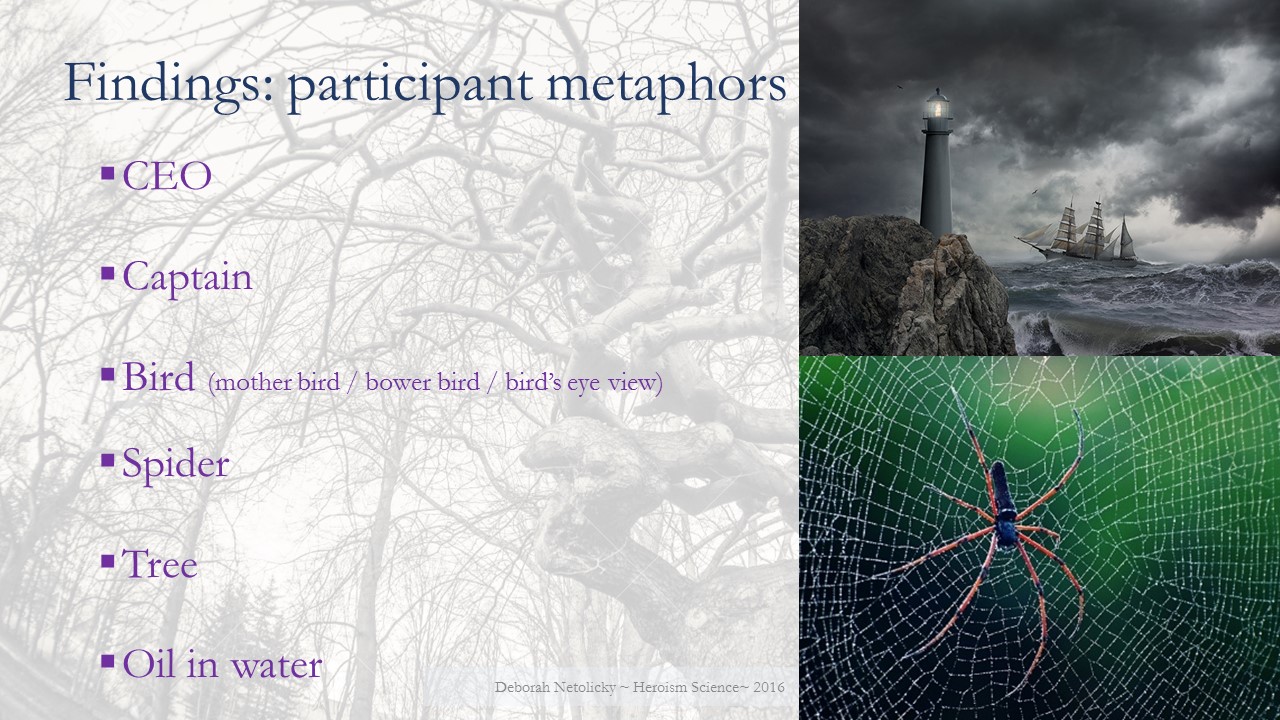
My answer, based in the emergent themes from the interview data of school leaders in my PhD study, is that the traditional lone hero on an individualistic quest is not an appropriate metaphor for the school leader. The leaders in my study reflected notions of servant, distributed, caregiver or transparent leadership.

Participants offered up their own metaphors for heroic leadership, revealing that heroism when leading others can be fluid, deliberate and imperceptible.

by Deborah Netolicky

In my PhD thesis, I applied the literary character of the Cheshire Cat to emblematically articulate the visible-invisible school leader, who deliberately appears and disappears, showing only part of themselves depending on the needs of those who they lead. The Cheshire Cat leader empowers others to find their way through their professional Wonderlands. Sometimes they are the encouraging grin, the glimmering eyes, the disappearing tail. At times they are the disembodied voice, mentoring, coaching or guiding. Unlike the autocratic and unlikeable Red Queen, the Cat is a mysterious guide who operates from the aerial view of the tree, with an understanding of the bigger picture.

The image of leaders posturing as white knights of school improvement, wielding swords of change and self-promotion, is seductive but unhelpful. Heroism in school leadership can be deliberate, fluid and at times imperceptible. School leaders can focus on the collective good and intentionally navigate visibility and invisibility (although I wonder to what extent deliberately imperceptible leadership can feel like being an under-appreciated Santa Claus, and how leaders feel when their machinations to build the capacities of others go unnoticed).

My PhD suggests that leadership that serves a community or organisation, and the individuals within it, need not be highly visible. Heroism in leadership can be about deliberate invisibility, the barely discernible swish of a tail and the disappearing gleam of a Cheshire grin.

Professional identity & professional learning: Reflections on my TER podcast interview

identity is liquid (aka Little Lagoon, Shark Bay)

identity is liquid (aka Little Lagoon, Shark Bay)

Recently I was interviewed by Cameron Malcher for the TER podcast about my PhD. You can listen to the interview, which was released on Sunday (it kicks in at the 35 minute mark). My favourite part of the podcast was Cameron’s concluding thoughts that were sparked by the interview. Below is not a blow by blow account, but a reflection on what we discussed.

What is professional identity?

In my PhD I defined identity as “ongoing sense-making process of contextually-embedded perceived-selves-in-flux”. It is a process rather than a product, a constant state of becoming. It is fluid rather than fixed. It is constantly shifting, as suggested by Fred Dervin’s notion of identity as liquid. It is socially constructed and contextual; that is, identities are co-constructed with others, and we are different versions of ourselves in different situations, with different people.

Factors that make up our professional identities include our beliefs, values and assumptions. Our identities are created and rewritten through language, through the ways we tell the stories of ourselves, to ourselves.

On the blogosphere and the Twitterverse there have been arguments about the disconnect between who owns identity and labels, suggesting that some think that identity is superimposed on us by others’ perceptions, while some believe that we own and make our own identities. The socially constructed nature of identities suggests that both have merit. We write ourselves for ourselves, and our self-perceptions rely on how others perceive and interact with us (although this interactions can be rejection of others’ perceptions, as well as acceptance).

Why consider professional identity in education?

Teaching is deeply personal. Part of the reason I brought professional identity together with learning, leading, and school change is that I think they are inseparable. Looking at education reform through the lived experiences and identities of those in schools is key to understanding its impacts. Professional learning and the leading of schools need to take teachers’ and leaders’ senses of selves into account, and engage with them.

Focus of my research

I conducted research within my own school and examined the stories of 14 teachers and leaders, including myself. The background context was a school-based teacher growth initiative.

I used narrative research to explore how these educators’ professional identities interacted with their learning and with school change. I was interested in what it is that shapes and shifts educators’ professional identity perceptions and in what ways schools and systems might work with a greater understanding of educator identities when designing and implementing education reform.

My narrative approach involved interviewing participants in ways that encouraged storytelling, including using coaching protocols, and then storying those data. It required me to be reflexive as the researcher. The experience of my PhD was personally and professionally transformative for me. I loved it, and it was incredible professional learning. In particular, the luxury of listening to educators’ stories was a joy and a privilege. I presented at AARE last year on my creative, literary approach to storying data, and this Saturday I’m presenting on my ethical decision making at the researchED conference in Melbourne.

Research findings

My research found that:

  • We professionally learn throughout our lives. Our professional learning encompasses life moments that are professional and personal, formal and informal, in schools and out of schools, singular and collaborative. Professional are shaped by good and bad experiences, by role models and anti-models.
  • Learning which taps into who educators see and feel they are, has the most impact on their beliefs, thoughts, behaviours, and practices.
  • Coaching and being coached is identity shaping, shifting teachers’ and leaders’ beliefs about learning and teaching.
  • The Danielson Framework for Teaching can be a useful tool for teacher self-reflection when used by teachers for their own growth.
  • School reform and school cultures which trust the capacities of teachers to reflect and improve is empowering and capacity building.

Implications of my research

With the caveat that my PhD was highly contexualised (considering the nature of the school and individuals I studied) the findings have something to offer the education world.

Firstly, there is a need to broaden the definition of professional learning, to allow teachers and schools to think more broadly about what it is that transforms educators, and who drives the professional learning of teachers. In my own leadership practice I am wondering how professional learning might be more autonomous and individualised. About how professionals might choose and follow, with support and opportunity, their own growth trajectories. About how schools and systems might acknowledge and encourage heutagogical (self-determined) learning.

Secondly, schools and systems can work from their own contexts to design and slowly iterate models of professional learning, from the bottom up and the middle out. As many scholars point out, effective education reforms are contextual. They cannot be lifted from one school or nation and dropped on another. Change in schools should be at a slow evolution-not-revolution pace, and based in assessing available evidence and current context.

As a result of my reading and research, I advocate for distributed and empowering leadership in schools, and school systems that trust teachers. I am a card-carrying, flag-waving fan of the Flip the System movement, which champions the agency and voice of teachers within their own systems. Teachers and school leaders have the internal capacity for analysis, reflection and growth. The individual should be honoured, valued and supported, within the holistic collective of the organisation and the system.

Santa Claus Phenomenon: The hidden magic of coaching & leading

It’s not until you’re a grown up that you realise Christmas doesn’t just ‘happen’. That magical day was pulled together by the incredibly stressed adults in your family. ~ Rosie Waterland in this post about Christmas

Sometimes in adult life we engineer magic. With glee we secretly make the miraculous and enchanting happen for others.

As parents, we realise how engineered the magic of Christmas is. We kind of know it when we discover that our parents are really Santa, but it’s not until we create Santa for our own children that we appreciate the hard work that goes into it.

All the preamble, that constant constructing of stories of Santa and reindeer and the intricate goings-on of Christmas Eve. Answering questions about store Santas and how Santa gets into the house and where the reindeer park the sleigh. Stealthy gift shopping, gift assembling and gift wrapping. On Christmas Eve there’s waiting until the children are definitely asleep and then assembling the gifts, artfully nibbling a cookie, enthusiastically chomping a carrot, dusting snowy footprints to the tree (and then closing the pet out so they don’t ruin the footprints overnight). This is magic that requires long term planning and strategic operation. 

Then: Christmas morning! Children wake. Santa’s magic comes alive. The Santa narrative seems not only possible, but real and wonderful. The children shower gratitude on the mysterious and benevolent figure of Santa. There are joyous cries of, “Thank you, Santa!” and “Santa got me exactly what I wanted!” How they glow with appreciation for the jolly red fellow and his generosity. Somehow he knew exactly what they needed at this point in their lives.

Of course, I do all of this because I enjoy the looks of amazement on my children’s faces and the thought that they feel part of something fantastical. But sometimes, as a parent, I secretly think, ‘It was us! It’s us you should be thanking!’ In these moments, I want my children to realise that all that joy is down to my husband and I. We contrived and concocted this whole thing. Of course I don’t ruin the magic. I encourage their belief and enjoy their wonder (they are currently 4 and 5). But part of me still sometimes wants recognition for all the hard work of being Santa and providing the magic.

Christmas Eve vignette from our place

Christmas Eve vignette from our place

There are two professional roles where I think this Santa Claus Phenomenon (no, it’s not a thing; I just made it up) plays out in professional life: the coach and the leader. It’s not that these roles are magical, but both have a sense of hard work going on behind the scenes, potentially without recognition from the recipient. Like the parents acting as Santa, both roles require the person to provide others with what they most need in that moment.

Coaching is hard cognitive work. In this post, I used the metaphor of the duck to describe the coaching experience; the duck’s legs paddle manically below the surface while above the water, all seems serene. So the coach works hard, but in order to be effective, this work needs to be imperceptible to the coachee. In fact, in order to best serve the coachee, the work of the coach needs to draw out and draw on the coach’s inner resources, so that they shine brightly. The coach is the hidden passageway or the mirror to self.

Similarly, a leader who empowers their staff can sometimes feel like the unsung hero. This kind of leadership is the subtle and invisible kind. Stepping back so others can step forward. Subtly coaching and nudging and encouraging and scaffolding. This isn’t brave sword-wielding white-knight stuff, the celebrated charismatic leader on the public stage. It’s about believing in and nurturing others’ capacities, in sometimes imperceptible ways. It is hard work with plenty of setting up and engineering for successes, but it’s done quietly in the background and sometimes no one sees this leader’s careful preparation and toil.

How do coaches who want to build the internal resources of their coachees, and leaders who aim to build their organisations by developing their people, interact with the Santa Claus Phenomenon? How do coaches and leaders celebrate or measure their wins? One way in a coaching conversation is in the responses to the question at the end in which the coach asks something like “How has your thinking shifted from the beginning of the conversation to now?” Leaders can know their own impacts by tracking the progress of their teams and individuals. But perhaps in both cases, others won’t notice the impacts, or the careful steps the leader conducted to get there.

I’ve written a paper for the Heroism Science conference that explores the idea of the less-visible leader. The leader who empowers. The coach who helps develop the coachee’s self-efficacy through layered and complex, but barely visible, practice. I wonder how this kind of leadership plays out in reality. Is the knowledge of one’s own impact enough? What happens when others don’t recognise that a coach or leader is engineering the magic? What if, from outside, it seems like the coach or leader isn’t doing anything? Is that as it should be–the noble but unseen work of coaching and leadership–or is it problematic?