On teacher evaluation & the New York APPR reforms: a view from Down Under

There are no such things as limits to growth, because there are no limits to the human capacity for intelligence, imagination, and wonder. ~ Ronald Reagan

NYC skyline, by @debsnet

As part of the Education Transformation Act of 2015, New York State is reforming its Annual Professional Performance Review (APPR) and Teacher Effectiveness rating system.

Grant Wiggins in his open letter to Governor Cuomo calls the APPR reforms a “step backward” which disempowers teachers.

NY Middle School Principal Lisa Meade voiced her concerns here and put out the call out to New York educators to respond to the proposed teacher evaluation reforms. Educator Christina Luce added to the conversation in her post, asserting that, while she supports an annual professional reflection and review, the proposed reforms are narrow, punitive and make “an already horrendous evaluation system even worse”.

While I am not a New York educator, I felt compelled to offer a perspective from a different system. My visits with schools and educators last October helped me to learn about how teacher evaluation is approached in New York. While some of the challenges faced were global, shared with Australian schools, some were surprising to me. I wrote various posts documenting my reflections in New York including:

  • My visit to a school in Westchester which opened my eyes to the constraints on New York schools in teacher evaluation;
  • My visit to a school on the Upper East side which reminded me about the need for schools to find teacher evaluation and growth processes appropriate to their context;
  • Meeting Ellie Drago-Serverson at Columbia University to discuss the best environments and practices to facilitate adult learning;
  • Meeting with Charlotte Danielson and Cindy Tocci around effective applications of the Framework for Teaching for teacher growth and evaluation; and
  • Meeting with New York City professional development provider Teaching Matters, an organisation which bases its work in a belief about the capacity of teachers to be leaders and for schools to be vibrant places of distributed leadership.

slice of harlem, by @debsnet

The proposed APPR reforms seem to make an already limited system of scoring even narrower, based on data that I imagine does little to reflect a holistic picture of a teacher, their teaching, and their students’ learning. While the use of these kinds of data for measuring teacher effectiveness have been questioned (see for instance this post and this post by Grant Wiggins), I have instead focused on how these reforms sit with my own beliefs about teacher learning.

Costa and Garmston in this paper talk about safety, but not comfort, being a prerequisite for learning, pointing out that the brain works in such a way that if we do not feel safe, we cannot think and learn. They note that sensory signals entering the brain travel first to the thalamus, then to the amygdala or threat detector, and then to the neocortex where thinking happens. “If threat, fear, pain even in the most minute portions are perceived, neurological and chemical processes occur which prepare the system for survival, not reflection.” While learning often happens in a space of what they call ‘disequilibrium’, or what I call the discomfort zone, there needs to be safety and trust for thinking, reflection and growth to occur. The New York teacher effectiveness system does not seem to allow for a safe environment of learning and growth, but rather opens up the potential for fear and a fight-or-flight response.

This notion of safety-but-disequilibrium is supported by Ellie Drago-Severson’s concept of high-support high-challenge ‘holding environments’ as the optimal environments for adult learning. By Dan Pink’s work on motivation which he notes is extinguished by punitive approaches. By David Rock’s work which shows that carrot-and-stick approaches result in resistance. In reflections by Robert Evans that teachers resist externally imposed change. By the Adaptive Schools foundational concepts of trust and of honouring both the individual and the system.

Upper East Side, NYC, by @debsnet

In light of how the brain works and how thinking and motivation are ignited, the New York teacher evaluation system, current and proposed, doesn’t make sense to me. It is a punitive deficit model which assumes that teachers are underperforming, unprofessional and in need of external measures to bring them up to scratch. In a recent paper, Dylan Wiliam points out that “each teacher has a better idea of what will improve the learning of their students, in their classroom, in the context of what they are teaching them, than anyone else.” Teachers should be trusted to be professionals and given the support, and challenge, to grown on their professional journeys.

My school’s teacher growth model is based on a belief in the capacity of teachers. It is based in a belief that everyone is coachable. That is, that teachers want the best for their students and that they are fully capable, with support, of setting goals, analysing data and improving their practice in ways which most benefit their students.

Wiggins is right when he says these reforms disempower teachers. Surely if we want teachers to get better, it isn’t scoring them we should be primarily concerned with, but growing them. Teachers should receive ongoing support to refine their practice and focus on becoming increasingly better at serving their students’ pastoral and learning needs. I absolutely agree with regular performance check-ins and goal setting work, but I also believe in teachers.

My hope for any school system would be that teachers are given opportunities for growth born out of a belief in their capacities and in their important work with our children, rather than public scorecards based on questionable measures.

New York, I’m thinking of you, your teachers, your school leaders and your students.

NYC, by @debsnet

Can and should teachers be (viewed as) researchers?

Sarajevo bullets, by @debsnetWhen we respect teaching as an intellectual activity and give teachers the opportunities to raise serious questions about what they teach, how they teach and the larger goals for which they are striving, they can play a dramatic role in transforming their institutions. ~ Peter Senge, Schools that Learn: A Fifth Discipline Fieldbook for Educators, Parents, and Everyone who Cares about Education

This month – April 2015 – is the month in which Dylan Wiliam argued in the TES magazine that teaching cannot and will not be a research-led profession, in which Tom Bennett responded that evidence-based education is dead (but that evidence-informed education lives), and in which John Hattie was quoted in a TES article as saying that teachers should not try to be researchers and that ‘I don’t have any time for making teachers researchers.’ In response to his own question, ‘Asking teachers to be researchers?’ he replies, ‘They are not.’

In this article Hattie is also quoted as saying that teachers should use the “literacy and sensibility of research to inform their practice” and that the worlds of research (by academics, not teachers) and teaching should “orbit together”. This resonates with Tom Bennett’s assertion that teaching be evidence-informed (but not evidence-based) and with the mandate of researchED which is to raise research literacy in the teaching profession and promote conversations between teaching and academic communities (my post about researchED Sydney 2014 is here).

As someone whose identity straddles ‘teacher’ and novice ‘researcher’ (as a PhD candidate coming towards the end of my PhD journey) I agree that research should inform teaching, leading and educational practice, and that worlds of education and the academy should work in collaboration. I am not sure, however, that we should draw a divisive line with ‘teacher’ on one side and ‘researcher’ on the other.

When I read the TES article which presented quotes from Hattie, a number of questions arose for me. What does Hattie mean when he says that teachers are not (and perhaps cannot be) researchers? What is his definition of ‘researcher’?

Is he discouraging teachers from reading academic literature and collecting data to inform their practice? Is he telling teachers they cannot be (taught to be) systematic thinkers who investigate, trial, collaborate, communicate and utilise scholarly literature and evidence to inform their practice?

Many teachers have been involved in action research projects, or Masters or PhD dissertations. Are these teachers, too, incapable of conducting and applying research thinking and methods? For me this is an issue of identity, of sense of self. Am I a teacher who researches? A researcher who teaches? A teacher and a researcher? Is Hattie suggesting that these identities are unavailable to me?

Is research in a real educational context by a real educator less valid than that of an academic from a university?

Many have responded to this conversation. Kevan Collins, chief executive of the Education Endowment Foundation, warns against encouraging teachers not to pursue evidence, as he articulates in this TES article.

Teacher Chris Parsons explores how the teaching profession might strategically develop its use of evidence to inform practice.

PhD candidate Charlotte Pezaro, writing for the Australian Association of Educational Research, explores ways in which academics and teachers might interact.

Policy analyst Patrick Watson in this post argues that we need to identify research which is worthwhile for informing practice, build the research-literacy of teachers and encourage action research to facilitate reflection and deeper understanding.

The 2012 Grattan Institute report ‘Catching Up: Learning from the best school systems in East Asia’ asserts that high-performing school systems view teachers as researchers, continually developing their knowledge base through practices such as professional reading and action research. My PhD cites examples of literatures which promotes participatory action research as transformative for individual practice and collaborative cultures. All research and all researchers have limitations. I wonder what the impact is of viewing teachers as researchers and of encouraging teachers to think of themselves as researchers. How does it shape teachers’ identities, self-perceptions and practices if they are encouraged to be consumers, curators, engagers and creators of research? Perhaps it is partly a question (to reflect Dweck’s work) of developing a research mindset.

One of Wiliam’s points is that research cannot tell us what could be only what we already know. If we are always basing our practice on what has been done, we aren’t innovating or trialling new possibilities. Teaching and schools should be about more than doing what has been done and what is known; it should be about moving forward and even about innovation and creativity.

Perhaps teachers who see themselves as researchers could call themselves ‘teachers as innovative, research-literate, reflective, evidence-informed, systematically-thinking, data-using-and-interrogating practitioners who drive their own learning and improvement in regards to what benefits their students.’ Or maybe that’s a bit long.

While I understand that the issue of whether teachers can or should be researchers is nuanced, complex and riddled with semantic argument, I (as someone who identifies as teacher and researcher) would like to think we can view teachers as researchers, by my definition, if not by Hattie’s.

Everyone is coachable: we are all capable of change & growth

All who wish to continually improve their craft … never lose the need to be coached. ~ Art Costa & Bob Garmston

dedicated to those who dream, by @debsnet

I was recently asked a question on Twitter: ‘Are some teachers un-mentorable?’ My response was along the lines of, ‘No-one is unmentorable or uncoachable; a person always has the capacity for growth.’ This belief underpins my ideas about school change and my school’s teacher growth model on which I presented at researchED conference in Sydney and ACEL in Melbourne.

In scholarly literatures, coaching (sometimes used interchangeable with the term ‘mentoring’, such as in the writings of Ellie Drago-Severson, who I talked with last year) seems to be divided into expert coaching and peer coaching.

Expert coaching involves an expert or master who provides guidance to a less-experienced apprentice. This includes Jim Knight’s instructional coaching in which the expert instructional coach provides judgements, feedback and suggestions, based on their expertise.

The other kind of coaching is peer or reciprocal coaching in which someone is paired with those of a similar level of expertise. These peers proceed to coach or mentor each other in a collaborative and non-hierarchical way. This approach, which is intended to develop a collaborative learning culture as well as the individual’s practice, includes models like instructional rounds, in which teachers form small professional learning groups which collectively work to enhance their practice.

Both coaching trends are based on use of data for growth (in a teaching sense, this would be some kind of classroom observation data) but are underpinned by different principles and beliefs. Expert coaching models assume that people learn best when someone with more knowledge and experience provides them with specific, targeted feedback for improvement, while the peer coaching models assumes that it is by working together that we can improve.

One form of coaching which can be conducted by a peer or an expert is Costa and Garmston’s Cognitive Coaching which is based in brain research like this which suggests that we are most likely to grow when we do thinking ourselves, rather than receive thoughts doled out by others. Cognitive Coaching focuses on developing individuals as self-directed learners who consciously reflect upon, conceptualise and apply understandings from one experience to the next. It is a data-based, non-judgemental, developmental and reflective model for conversations for planning, reflecting and problem resolving, as well as a tool for developing professional communities that value interdependence and individual capacity for self-directed learning.

The goal of Cognitive Coaching is the growth of individual and organisation through the development both of autonomy (of the individual) and interdependence (the development of a holonomous organisational culture in which individuals function as both autonomous, independent individuals and interdependent, responsive members of the larger system).

Unlike expert models of coaching which involve specific coach feedback, judgements and suggestions, Cognitive Coaching involves mediated processing. The Cognitive coach does not offer judgements, feedback or advice, but asks ‘artfully vague’ questions or presents impartial observational or other data, followed by silence, in order to encourage the cognitive and reflective processes of the teacher. There is certainly an art to the asking of well-crafted cognition-provoking questions, as I have found in my journey as a coach. This approach is intended to create personal change through new connections in the brain and reconstruct knowledge through a conscious, reflective approach to new experiences.

By avoiding positive and negative value judgements and opinion, by coaching ‘without manipulation,’ Cognitive Coaching aims to transform an individual’s beliefs about learning and refine their cognitive maps by encouraging them to talk and think about their decisions. In this way, talking aloud leads to examination and refinement of choices and behaviours.

The use of a Cognitive Coaching process for teacher learning and development is supported by Charlotte Danielson’s work (you can find my conversation with Charlotte here) in which she notes that mentors, supervisors, evaluators and colleagues should beware of imposing their own styles or preferences when observing. The question is not “Is this how I would do it?” but “Given the context, what is appropriate?” She also advises that classroom observations must be accompanied by conferences before and after observed lessons.

My own experiences as cognitive coach and coachee have shown me the power of this kind of coaching to allow people’s own internal resources to kick in to gear, their own passions and thinking to light up, and their confidence to solve their own problems and forge their own paths to soar. It has shown me the power of really being listened to and being given a safe, trusting place in which to verbally explore situations. It has also shown me that when you own your ‘a-ha’ moments, the learning sticks. Change happens. Practice shifts.

So, returning to the question of the uncoachable or unmentorable teacher, I wonder about the intent of the coaching or mentoring.

Cognitive Coaching aims to ‘convey a valued person from where they are, to where they want to be.’ There are some important assumptions being made here. The person is valued. They are assumed to be motivated and capable of reflection and growth. And they are helped on their learning journey to a destination to which they aspire. This model of coaching is not a deficiency model based on where the manager wishes the person would go or what an expert has identified as an area of growth. It is about the person. And. Where. THEY. Want. To. Go.

Do I believe that absolutely any teacher, any person, can be coached or mentored into professional growth? Absolutely.

We believe that all human beings are capable of change, that we continue to grow cognitively throughout our lifetime and that we all possess a vast reservoir of untapped potential. ~ Art Costa & Bob Garmston

buddha, by @debsnet

Research and education: a match made in the conference room? #rEDSyd

Luna Park, Opera House, Harbour Bridge

 If you want to go fast, go alone. If you want to go far, go together. African Proverb

I have just returned from presenting at the researchED conference in Sydney. As explained on its website, researchED, founded by Glaswegian Tom Bennett (you can read his reflection on the day here), is a “grass-roots, teacher-led organisation aimed at improving research literacy in the educational communities, dismantling myths in education, getting the best research where it is needed most, and providing a platform for educators, academics, and all other parties to meet and discuss what does and doesn’t work in the great project of raising our children.”

It is the first time this conference has come to Australia and I was pleased to, through attending and presenting, be part of a movement to close the gap between educational research and practice, between academic theorising and school reality.

view from Sydney Harbour Bridge

view from Sydney Harbour Bridge

As a hybrid teacher-leader-researcher I believe in consuming, curating and creating research in order to influence theory and shape practice. At the researchED Sydney conference, I presented with a colleague on our school’s emerging-from-research teacher-professional-learning-and-growth model. It was a current example of how a school might utilise research and a scientific-but-also-people-driven process to develop a strategically aligned, evidence-based, context-appropriate initiative.

Opera House

Opera House

Some of our key presentation messages about school change were:

  • Go slow to go fast. School change is an evolution not a revolution.
  • Start with context and vision. Align initiatives and interventions with it.
  • Believe in the capacity of all individuals to solve their own problems, do their own thinking and drive their own learning.

This next image reflects those things we hoped our model would achieve. We have data measures planned to measure, as much as we can and in a variety of ways, the impact of this model.

'Take one' (or take all!) for your school

‘Take one’ (or take all!) for your school

The researchED conference (or is it a movement?) was one example of a forum for real life, cross-continental, global sharing of research-influenced education practice. You can read some other blog reflections here and here. We need frames and contexts which facilitate conversations between school and academic worlds, in order to facilitate more considered and systematic approaches to education.

Luna Park

Luna Park

Teacher Growth: Helping teachers open their gates from the inside

This post on my Australian school’s teacher growth model was originally written as a guest post for Starr Sackstein, acclaimed educator, author and bloggess extraordinaire. It was inspired by a #sunchat Twitter chat moderated by Starr, which challenged me to talk more specifically about the professional learning and culture model I keep going on about …

~ ~ ~

No one can persuade another to change. Each of us guards a gate of change that can only be opened from the inside. We cannot open the gate of another, either by argument or emotional appeal. ~ Marilyn Ferguson

open your gate from the inside

How do you help someone open their gate from the inside?

The global education community tends to agree that better teaching equals better student achievement. Schools, districts and nations have taken this notion and used it in attempts to improve the quality of teachers through professional development and teacher evaluation systems.

There is a long continuum of possibilities for developing teachers and teaching, but it seems that many systems sit solidly at the teacher-evaluation-for-improvement end. When I visited the USA I was surprised at the quantitative, and at times punitive, approaches being used to score and evaluate teachers. Eric Saibel’s recent post questions whether all the work and time put into teacher evaluation has made a difference to teaching or student learning. In this thoughtful video conversation Eric talks with Starr Sackstein about ideas for meaningful teacher feedback and growth.

As a teacher, school leader, researcher and parent, teacher growth and evaluation are areas of immersion and passion for me. My own ideas are based on my:

  • Experiences as a classroom teacher in Australia and the UK;
  • Experiences as Head of Faculty in Australian schools;
  • Recent visits to New York schools, researchers and edu-experts;
  • Current PhD research on what makes transformative professional learning and leadership; and
  • In-school strategic work on researching, piloting and developing a teacher growth model for my Australian school. We are at full implementation phase this calendar year.

To develop my school’s teacher growth model we have used a Schooling by Design backwards design approach to planning and implementation. This has allowed us to align our vision, purpose, evidence and action. This has centred us around our own context and our goals of improving the learning of our students and developing the professional culture of our school.

Our change management philosophies of ‘go slow to go fast’ and ‘evolution not revolution’ have given us permission and time to tailor the model to our context and nurture teacher buy-in. Adaptive Schools, which I have written about here, has influenced our work by providing us with models of collaborative strategically-aligned change.

Our model itself is based in a belief that schools are relational places where trust is key to risk taking, growth, willingness to be vulnerable, deprivatising classrooms and learning from, with and alongside each other. It involves teachers-trained-as-coaches (and, every few years, administrators) who help teachers to use non-judgemental lesson data (written scripting, video, audio) as the basis for reflection against the Danielson Framework for Teaching and teachers’ own goals. The Danielson Framework was chosen for its research-basis and specificity. We like that ‘distinguished’ teaching is all about what the students are doing.

As well as meeting with Charlotte Danielson in Melbourne and Princeton (where we spoke about the nature of coaching and my school’s use of her Framework), I heard her speak at the 2014 Australian Council for Educational Leaders Conference in which she explained the importance of a trust environment of challenge and support for teachers, and teaching frameworks as conduits for the thinking of the teacher, rather than telling by the administrator. Ellie Drago-Severson agrees that adult learning needs an environment of support and challenge. Her work on ‘holding environments’ and adult learning is based in trusting the capacity of adult learners. I spoke with her in October about her work with schools and the importance of starting slow and building momentum. We are similarly focused on self-directed teacher growth with a belief in the capacity of teachers to reflect, learn and grow.

As the cornerstone of our conversations, Cognitive Coaching places our emphasis heavily on the coach as non-threatening facilitator of teacher thinking, rather than feedback-giver and scorer. The coach focuses on facilitating the teacher’s thinking, not giving advice or solving problems. This approach is partly based on research like this which shows that what actually gets our brains to be open and changeable is compassionate, positive conversation which sparks our own thinking.

The opening quote by Marilyn Ferguson reflects my thinking on teacher growth and evaluation: teachers need to be supported in opening their own gates from the inside. If, as David Rock and Dan Pink have explained, rewards and punishments don’t motivate, change behaviour or facilitate creativity, how can we encourage students and teachers to be intrinsically motivated, passion-driven, continuous learners who seek improvement through curiosity, reflection, collaboration and risk tasking?

Does your teacher growth or evaluation model encourage self-directed growth and a culture of professional learning? How might you build trust, apply a belief in the capacity of teachers, or develop collaboration in your own context?

it's all about the growth

it’s all about the growth

Powerful & unforseen consequences: our butterfly impacts

#leaningenvironments - evolution of a new edu-revolution?

#leaningenvironments – evolution of a new edu-revolution?

 A cloud from a minor volcanic eruption in Iceland—a small disturbance in the complex mechanism of life on the Earth—can bring to a standstill the aerial traffic over an entire continent. ~ Slavoj Žižek

With the start of the Australian school year almost here – a year in which I am working to implement the teacher-growth model on which I have been working for two and a half years – I have been thinking about what it is that makes a trusting, impassioned, vibrant community of continuous learners.

Ok, as both the subject of my work and of my PhD research, I have been doing more than thinking about this. I have read close to 300 references and written about 85,000 words around effective school change, what makes effective leadership and what kinds of learning teachers find transformational. I have blogged briefly about some key ideas to anchor school change, about the importance of embracing discomfort for growth and about my own learning environments.

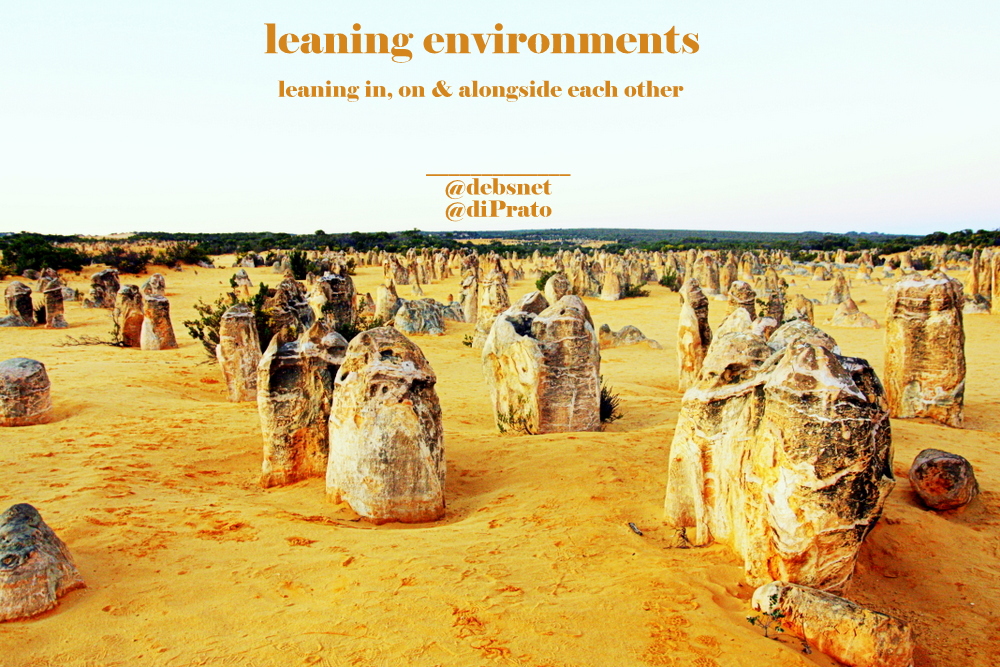
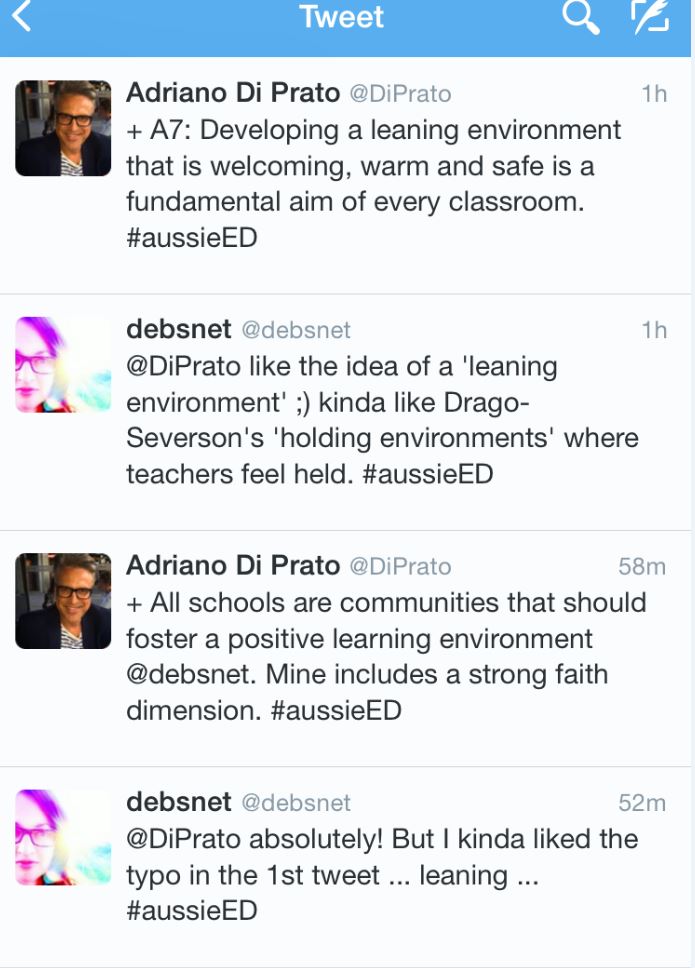
Tonight I was participating in the #aussieED Twitter chat when Australian educator Adriano Di Prato tweeted that ‘developing a leaning environment that is welcoming, warm and safe is a fundamental aim of every classroom.’ Now, I knew that Adriano meant ‘learning environment’ when he typed ‘leaning environment’ in a fast-paced Twitter chat, but it got me thinking: How are schools ‘leaning environments’?

It reminded me of psychologist and professor Ellie Drago-Severson’s notion of ‘holding environments’ (which I wrote a bit about here) in which she asserts the importance of teachers feeling ‘held’ by their learning and working environments, especially if positive change is to take place.

It reminded me of Costa and Garmston’s notion of ‘holonomy’ (explained in the Cognitive Coaching course material) in which the parts (individuals) and whole (organisation) are interdependent.

It reminded me of this great moment last year when a group of commuters on an Australian train platform used their leaning-together momentum to tilt a train and free a man trapped between the train and the platform.

So I tweeted back about ‘leaning environments’, and all of a sudden we were back-and-forthing about how the word ‘lean’ might apply to school environments. Would it be about individuals ‘leaning in’ to the community, to opportunities, towards each other? Could it be about students, teachers, parents and leaders ‘leaning on’ or ‘leaning alongside’ or ‘leaning with’ each other? Might it be ‘leaning out’, away from those things which should matter less but sometimes drive schooling (high stakes testing, grades, league tables)?

the power of a Tweeted typo

the power of a Tweeted typo

Fellow edu-Tweeter Melissa Daniels noticed the banter and asked whether this could be “the education revolution that started with a typo?” leading to another discussion about innovation, revolution and the evolution of ideas, all in 140 character bites.

Tweet @debsnet @DiPrato @PensiveM

This was an invigorating discussion for me, not because I thought it was to be the next big thing in education, but because of the thrill of the unsurprising serendipitous connections, conversations, ideas, thinking and challenges that come out of conversations and connections with like-minded like-passioned others. Here was a vibrant online environment of trusting, holding, leaning (in, out, on, with, alongside), impassioned, creative, continuous learners.

It also reminded me of our unforseen impacts. We never know the impact of a conversation, a word, a decision, or a typo.

I have noticed this in my self, in conversations or moments which stay with me until an idea bubbles to the surface. I have noticed it in my work with teachers and students, who often take some time to realise what moments or relationships have shaped them. I have noticed it in my PhD research participants, many of whom told me that the very act of being interviewed for my research changed something for them, opened something up, surfaced a reflection or became a moment of learning.

So, don’t ignore life’s typos. Even the seemingly tiniest things can have powerful & unforseen consequences.

You never know when you might uncover the next revolution.

Small shifts in your thinking, and small changes in your energy, can lead to massive alterations of your end result. ~ Kevin Michel

Montenegro by @debsnet

Embrace your discomfort zone: bubbling in the crucible of growth

Out of your vulnerabilities will come your strength. ~ Sigmund Freud

my scribblings: Comfort vs. Discomfort Zones

my scribblings: Comfort vs. Discomfort Zones

Scholarly literature and the blogosphere are saturated with thoughts around motivation, growth and what it means to learn, lead and be the best we each can be. Some of this is around what qualities, attitudes or behaviours we need in order to weather life’s difficulties while continuously growing our selves.

Skill sets & mindsets for discomfort and growth

Carol Dweck’s much-touted work on mindset argues that our self-conceptions frame our life paths. If we perceive ourselves as having fixed immovable traits, then we are less likely to be resilient and positive in the face of challenge. Those who perceive that their talents and abilities can be developed are more able to see setbacks as opportunities for learning and growth.

Art Costa and Bob Garmston’s Cognitive Coaching model would suggest that we need to help individuals to reflect upon their own goals and experiences, figuring out their own ways to get better while assuming that each individual has the capacity to do exactly that.

In their recent book Uplifting Leadership Andy Hargreaves, Alan Boyle and Alma Harris talk about a yin-yang balance between positive energised leadership and tenacious hard work. They talk about disciplined innovation and feet-on-the-ground (rather than pie-in-the-sky) creativity. “An uplifting mindset and skill set keeps your head up high while your feet stay firmly planted on the ground.” Hargreaves, Boyle and Harris articulate the need for leaders to have visions and dreams alongside the determination to struggle through hardship and adversity. They remind us that “without dreams, profound human and social change would scarcely be possible” but that we need inspiration that incites action, daring and doing. Leaders, then, are grounded visionaries whose diligent exertion drives imagination and change.

Environments of support and challenge: being held while being pushed

In her work on adult learning, Ellie Drago-Severson talks about organisations as ‘holding environments’, spaces in which adult learners feel ‘held’ and which provide both high support and high challenge. When I spoke with Ellie this year, she emphasised the need for schools to facilitate the development of self-authoring individuals, able to take charge of their own journeys of transformation.

Charlotte Danielson, too, talks about the need for support and challenge for teacher growth. Teachers need an environment of trust, she says, in which it is safe to take risks in the spirit of ongoing professional inquiry. As I explained previously in my reflections on hearing Charlotte speak at the Australian Council for Educational Leadership 2014 conference, the need for balance – between safety in which teachers feel supported and trusting, and enough discomfort to challenge practice and change thinking and behaviour – has been pivotal in my school’s work to provide a setting for the transformation of classroom teaching, professional conversation and collaborative culture.

Enter the discomfort zone, the birthplace of rainbow growth

So while we need to feel supported enough to take risks, we need to be daring enough to be vulnerable, uncomfortable and daring. Margie Warrell calls this the ‘Courage Zone’, the place beyond comfort (but before terror and paralysis) in which risk taking and growth happens.

In my own experiences I have found this discomfort zone to be a tipping point for my own growth. Often it is in the squirmiest spaces of discomfort that my breakdowns become my breakthroughs. As I illustrated (literally) in the drawing above, my discomfort zone is a place of dark messiness, but from which rainbow-like growth can emerge. The comfort zone might be all white fluffy clouds, affirmations and unicorn-blessed pixie dust, but it also tends to be a space of inertia.

My classroom is a place in which my experience and comfort level are best served by being challenged to try new things like a recent term without marks or grades. And while my online PLN and at-school professional friends provide me with support, it is getting out of the supportive echo chamber and into dissenting debate which pushes my thinking and incites my learning.

Some of the most uncomfortable moments of my growth this year have been in my PhD work which often involves wrestling with my thesis. Support and criticism from my supervisors help me to work tenaciously through difficult research and writing problems to find solutions and make progress. As an experienced educator but novice researcher, it is interesting negotiating a space in which my learning curve is dizzyingly exponential. The best thing about grappling with and through discomfort is the unrivalled feeling of satisfaction at solving, innovating or realising learning.

Who, where or what makes you feel ‘held’ and comfortable? How at ease are you in your discomfort zone? Is it a crucible of growth for you? What do you find when you stay there and thrash around for a while?

Suffering has been stronger than all other teaching …. I have been bent and broken, but – I hope – into a better shape. ~ Charles Dickens, Great Expectations

Mostar jumper: leap into discomfort

Mostar jumper: leap into discomfort

Why blog? Personal evolution & community transformation

There is nothing to writing. All you do is sit down at a typewriter and bleed. ~ Ernest Hemingway

doorway

doorway

I began this blog a few months ago as a way to explore, record and share my thinking around a particular self-directed professional learning experience: a trip from Australia to New York intended to gain insights around teacher effectiveness, teacher evaluation and teacher growth. The trip was amazing personally and professionally. I met with schools, school leaders, teachers, researchers and global edu-experts who challenged and inspired.

Now that initial blogging purpose is sated and I find myself wondering: should I continue blogging?

My first instinct is: yes. And that mainly emerges out of the enjoyment I have found in reflecting, writing, sharing and engaging with others as a result of my posts. I alluded in post about social media for educators, this post about being a connected educator and this one about finding your professional global tribe, that Twitter has been invaluable in connecting me with other like-minded (and non-like-minded – just as important!) people. Blogging, however, allows for much more developed thinking than tweeting. Twitter can facilitate 140 character conversations, but it doesn’t allow you to burrow deep into ideas and give them a shake. So since blogging, I have been blogging about blogging, and now I’m at it again.

My reservations about continuing a blog are primarily about time. I am a parent of two pre-school age children, an educator at an Australian school, and a PhD candidate who is two years, 150 pages and 300 references into my thesis (more about how I juggle those things here). Right now as I write a blog post about whether I’ll write future blog posts, there is a long list of other things I could be doing.

And yet, here I am.

Partly because this blog has allowed me to explore my own thinking around my work and study. It is a free space to write. I have my PhD to write too, but blogging is a space in which I can write without pressure and with more freedom of style and content. It keeps me thinking and learning and connects me with other thinkers and learners.

I also know what other blogs give me. They can be transformational, inciting change, encouraging action and inspiring thinking through the sharing of stories, expertise and others’ intellectual struggles around big and small ideas. They promote reflection, conversation and growth, in the blogger and the reader. Perhaps my own musings might provide insights for others, open a window to my context, challenge another’s thinking or facilitate connections across geographical and philosophical boundaries?

So I feel propelled to continue blogging, but I wonder how that journey might evolve, if anyone will read my posts, and if that even matters. Certainly I would (will?) be a blogger who blogs when I have something to say, rather than to chase numbers of clicks on a page.

Western Australia by @debsnet

possibilities

Developing reflective practitioners: a conversation with Charlotte Danielson & Cindy Tocci

As our understanding of teaching expands and deepens, we need a vocabulary that is correspondingly rich, one that reflects the realities of a classroom where students are engaged in learning important content. Such a framework is valuable for veterans as well as novices as they all strive to enhance their skills in this complex work. ~ Charlotte Danielson, 2007

fall colours

fall colours

Brilliant fire-coloured fall foliage frames Princeton’s historic Nassau Inn, where I sat in a booth with Charlotte Danielson, creator of the Framework for Teaching, and Cindy Tocci, executive director of the research arm of Educational Testing Service. Somewhere in the wooden table is Albert Einstein’s name, where he carved it when he was a visiting professor at Princeton. After explaining my school’s journey with our teacher growth model, we talked about coaching, the Framework for Teaching and the challenges of maintaining a reflective transformative professional culture.

What is a coach?

One question raised was about the level of expertise of the coach: was conversation expertise enough, or was it more useful to also have content expertise? Our team of teacher coaches will often work with those outside their own area of expertise; this builds connections across school boundaries and allows the focus to be on pedagogy and the teacher’s own reflection, rather than on content. Another related question was raised about the potential space between a feedback-based (judgement given) approach to coaching and a reflection-cognition-based approach (no judgement given).

Charlotte challenged that “the opposite of judgement is not ‘do nothing’.” A collaborative approach was suggested as an alternative, in which teachers work together in a conversation to solve problems of practice or generate ideas for improvement, in which both teacher and coach are participating in the conversation as reflective educators. This speaks to some feedback we have had from teachers about their coaches not being ‘in’ the conversation and feeling that being Cognitively Coached was a one-sided unbalanced experience. In a coach-as-collaborator conversation there would need to be clarity around how much of the coach’s self it is appropriate to insert into the conversation, and how much content expertise the coach would need to meaningfully contribute to the discussion. There would still need to be restraint in resisting the urge to solve another’s problem for them and in the tendency to advise someone to teach using your own teaching preferences.

For us, I think the default position for the coach still needs to be the facilitator-of-another’s-thinking role, but there may be room for collaborative approaches to the parts of the conversation. Is collaboration appropriate for us in this context? Or perhaps peer collaboration in which teachers really work together in this way is an appropriate strategy for our teachers to pursue for their growth outside the official coaching conversations?

Princeton leaves

Princeton leaves

How to apply the Framework for Teaching?

Charlotte and Cindy both noted that, while it is important to strive for accuracy when using the FFT, it is important that teachers, coaches and managers not get too caught up in the micro-analysis of detail, or looking for all the dot points. In fact, Charlotte has been developing a more holistic, less broken-down ‘clusters’ model which encourages teachers to look at the big ideas of the Framework, as an alternative to the original document. This alternative might be a way for our teachers to focus on the big things happening in their classrooms, rather than minute details of lessons.

How to develop understanding of the Framework for Teaching?

Master Coding of teaching videos was explained as a difficult but powerful exercise in developing an attuned, precise understanding of the Framework for Teaching and forging shared understandings of its language. Videos of classroom practice are useful for teachers in showing how the Framework components translate into practice, and for coaches in developing a common understanding of the Framework and what particular levels of performance look like in practice. Collecting video footage of lessons involves:

  • Choosing a range of short lesson snippets (e.g. 10 mins) which relate to particular Framework components;
  • Ensuring audio, as well as visual, quality is good, especially if students are doing group work (how do you capture what students are saying? How do you decide which groups to listen to?)

Videos should be watched and independently scored, followed by conversations around the reasons for those individual scores, in order to reconcile individual perspectives into a group agreement.

Videos of coaching conversations also have a place in helping coaches to deepen and develop their coaching practice.

These kinds of rigorous processes take time. Charlotte and Cindy both highlighted the importance of a slow implementation process in which groups develop their understandings together.

We also talked about using the Framework for Teaching for teacher self-reflection purposes and also for student reflection on the sorts of learning and environment of their classroom. My school has been experimenting with different teacher self-evaluation tool possibilities, as well as perception surveys, but hasn’t developed a concrete approach to asking students how their classrooms rate against the Framework for Teaching.

How to encourage regular reflection between formalised processes?

Another challenge raised was that of developing the learned skill of reflection in teachers in between these formalised reflective processes. How do we know teachers are reflecting regularly on their practice in order to grow their practice? How can we make sure teachers are asking themselves:

  • What did my students learn today?
  • What did I learn about my students today?

Any model of teacher growth has this challenge: outside of the formalised process, how do we encourage and ensure meaningful reflection and growth on an ongoing basis?

IMAGINE

IMAGINE

Transformational adult learning and growth: a conversation with Ellie Drago-Severson

All journeys have secret destinations of which the traveller is unaware. ~ Martin Buber

Columbia University

Columbia University

It was my privilege to meet in New York with someone whose writing has shaped my PhD research and my school-based work in building a teacher growth model: Ellie Drago-Severson.

Ellie is a developmental psychologist and Professor of Education Leadership and Adult Learning & Leadership at Teachers College, Columbia University. Her ‘four pillars’ of professional learning are: teaming or partnering with colleagues within and outside the school; providing teachers with leadership roles; engaging in collegial enquiry; and mentoring (or coaching).

While I have read her work (including Helping teachers learn: Principal leadership for adult growth and development, 2004; Becoming adult learners: Principles and practices for effective development, 2004; and Learning for leadership: Developmental strategies  for building capacity in our schools, with Blum-DeStefano & Ashgar, 2013) it was most interesting to hear her stories of working with teachers, school leaders, schools and districts to help them apply learning theory to practice. One example was of a school which, after working over time on the learning of its teachers, now consistently achieves the highest student achievement scores in its district.

Teachers College

Teachers College

Ellie’s examples of working with educators were based in some fundamental principles:

  • Teachers are adult learners who own their own learning and should be provided with choices. They should be able to choose if they are ready for growth. Even in mandated programs they should be able to choose their own paths.
  • Developmentally, learners may initially want ‘the answers’ or to be told how to improve, but the aim of adult learning should be to develop self-authoring individuals. Coaching should aim to grow individual capacity (e.g. Developmental Coaching, Cognitive Coaching).
  • Talk defines and drives behaviour (similarly to the beliefs of Adaptive Schools I explored here). Robert Kegan and Lisa Lahey’s How the Way We Talk Can Change the Way We Work: Seven Languages for Transformation (2002) looks at how language determines feelings, governs action and impacts learning. As well as talk, the quality of listening has been confirmed by research to be a developmental support for learning.
  • Change should start at a slow pace, with volunteers, building momentum and reach over time.
  • ‘Push back’ (resistance or questioning) should be welcomed and explored.
  • The key to learning is a trusting nurturing environment in which people feel ‘held’; they need to be simultaneously supported and challenged. It is vital to spend the time building culture and developing group norms and ground rules for confidentiality.

Strategies that Ellie uses when working with educators include:

  • Exercises from Developmental Coaching, such as those which help individuals to identify the underlying beliefs driving their behaviour and build a plan to address those beliefs;
  • Informal ‘drop in / drop out’ lunches to which staff are invited but not required. Lunch time conversations based on professional readings and the question ‘What might this look like in your practice?’
  • Journals for teachers / coaches / leaders as a sacred technology-free space for thinking.

There are many affirming ideas here for my school’s work in designing and implementing a teacher growth model, including the importance of a trusting environment, the role of talk and language, deliberately going slow, and providing scaffolds for ownership and differentiation of learning.

Some questions that arise are:

  • To what extent are we differentiating our teacher growth process for teachers? Is it enough for their experience to be one of meaningful, self-driven ownership?
  • What further strategies might we employ to build the cognition and engagement of teachers in their own learning (such as optional journals and online portfolios, or informal lunches to talk about teaching)?
  • How might we support those staff who are not yet self-authoring learners to develop their capacity for self-directed learning?
trust & rapport from the High Line: Eduardo Kobra's mural

trust & rapport from the High Line