Amid ongoing concern about teacher shortages and teacher burnout, celebrating and trusting teachers is crucial. As education increasingly integrates trends such as generative and agentic artificial intelligence, the role of the teacher remains vital. Teachers and their classroom practice make a measurable difference to student learning and achievement. Teachers have been found by research to be the most influential school-based variable in improving student learning and achievement.
I was recently asked to comment on what makes a great teacher, as part of News Corp’s ‘Australia’s Best Teachers’ campaign. It got me thinking about my early days of teaching, and my days as a student. Teachers are often pivotal figures in the lives of young people. We all remember a great teacher from our own schooling. For me, it was my Year 12 Literature teacher, Penny McLoughlin, or Miss Mac as we called her. Miss Mac would bound into our classroom, her eyes glittering with excitement about the day’s lesson. She exuded a love of literature, a passion for the power of language, and a deep care for all her students. We could tell that she loved her subject, that she planned lessons thoughtfully, and that she cared about us as learners and people. I didn’t know it then, sitting in that Year 12 class, but I would go on to teach high school English and Literature for more than 20 years, to undertake academic research into what it is that makes a great teacher, and to become a school principal who witnesses the daily dedication and profound impact of the teachers in my school.
So, what is it that makes a great teacher? Great teachers beautifully balance expertise, craft and care. They seamlessly blend curriculum mastery and rigorous academic standards with systematic teaching, compassionate understanding, and a curiosity about students’ interests, abilities, and lives outside the classroom. There is a well-known line, often attributed to Maya Angelou, that rings true in the classroom: “People will forget what you said, people will forget what you did, but people will never forget how you made them feel.” Great teachers recognise the interconnected nature of academic success and wellbeing. They create classroom environments of high expectations and high care in which students feel safe while also being challenged to do their best.
Great teachers are experts who have the student at the centre of their work. They are specialists in curriculum (what they teach), in pedagogy (how they teach) and in their own students (who they teach). They systematically and purposefully design learning opportunities that inspire critical thinking and meaningful engagement in learning. They judiciously apply a range of strategies to the students in front of them. They provide meaningful, precise and compassionate feedback to help each child improve. Clear feedback, given with genuine care, encourages students to see feedback as an opportunity to grow.
Great teachers differentiate and personalise learning for students, responding to student needs in ways that are adaptive, flexible, evidence-informed and grounded in knowledge of learning and teaching. Teachers constantly check on student understanding and assess student progress, often in subtle ways that a student or observer might not notice. Responsive practice enables teachers to tailor their approach according to the dynamic needs of each child, classroom, and cohort. Great teachers are themselves curious learners who engage in professional learning that enables them to reflect critically on their practice, refine their approaches, and grow professionally.
Teachers continue to show up with expertise, empathy and excellence in their classrooms every day. Recognising and championing great teachers for the excellent and important work they do, such as through a kind word or a thank you note, can make the world of difference in a teacher’s day. Teachers: your quiet impact is noticed and your work matters greatly.
Looking back on any year reveals triumphs and celebrations as well as challenges and low points. 2024 has been a year that saw an uplifting Olympics and Paralympics in Paris, and leaps in space exploration, but also ongoing cost-of-living crises, worrying levels of mental health, cybercrime, geopolitical conflict, and extreme weather events. Personally, I experienced an incredible Aboriginal cultural immersion experience in North East Arnhem Land, published 11 episodes of The Edu Salon podcast, co-authored a lead article for Australian Educational Leader with Patrick Duignan on reimagining educational leadership, and received two awards: as an Excellence Awardee for Principal of the Year in the Australian Education Awards, and the Australian Council for Educational Leaders South Australia Media Award.
As I reflect on education across 2024, three key trends have risen to the surface in my work as principal, and in the work of schools: personalised learning, GenAI, and holistic wellbeing. None of these topics are new, but they are at the forefront of current educational thinking and practice. As we enter 2025 this week, these foci will continue to shape education.
Personalised Learning
Best practice, research-informed methods of instruction are key to how we design learning and teaching in schools. Schools continue to develop ways in which students’ diverse needs and identities are served, including through engaging student voice and choice, via quality differentiation, by using technologies to enhance and personalise learning, and by tailoring pathways to individuals where appropriate. Within the intentional frameworks of learning and teaching in schools, students are increasing positioned as agents of their own learning. They set goals, influence their own learning, and shape their own learning pathways. While in school, students are studying vocational courses, earning micro credentials, undertaking early university courses, and running their own businesses. At my school, in 2024 we introduced a seed fund and mentorship program to support students pursuing their own social enterprises.
The worlds of education and work will need to continue to develop personalised learning opportunities, with a focus on diversity, adaptiveness, a global mindset, and less hierarchical structures. Generation Alpha—born 2010-2024—have information not only at their fingertips but also digitally integrated into their lives. They experience emerging technologies, fast-paced change, global influences and remote learning. Their digital experiences are personalised by algorithms and so they are accustomed to digital experiences curated to them personally. They connect, collaborate, and create online. They are innovators, entrepreneurs, technology enthusiasts. They are concerned by ethical issues such as equity and sustainability. My own children are Gen Alpha and they are questioning the value of traditional work and life pathways. They hope for life, learning and work to be self-directed, flexible, inclusive and gratifying.
Learning will continue to be personalised, as well as gamified, ‘stacked’ through a range of microlearning opportunities, and lifelong. Schools will continue to reflect on the purpose of teachers as experts who broker learning experiences for students, and schools as hubs of learning opportunities that allow each learner to thrive.
Generative AI
2024 has been a year of the rise and rise of generative AI as collaborator in learning and teaching, with tools such as ChatGPT, Microsoft Copilot and Google Gemini becoming mainstream. Technologies such as artificial intelligence, and extended realities, continue to be tools with which educators develop awareness and intentional deployment.
AI can be a useful accelerant for research, thinking and writing, reducing the time it takes to complete tasks. Using AI as a collaborator and productivity booster can support the work of those in schools. AI can, for example, be used for generating quizzes, transcribing meeting minutes, writing sample test questions, analysing curriculum documents, summarising information, explaining key concepts, drafting communications and generating exemplar responses.
Students can use AI in a range of ways, ensuring that they reference and attribute it appropriately. They might use AI to conduct initial research on a topic, search for useful resources, create digestible summaries of complex information, brainstorm ideas for creative tasks, translate language, generate practice questions, or create study schedules.
Of course, any technology must be used responsibly, ethically, safely, and with a healthy level of scepticism. Critical questions include asking ourselves and our students about biases inherent in AI models, what is excluded by an AI model, assumptions embedded in an AI ‘voice’, and how we might verify the accuracy and validity of the information provided.
Generative AI will continue to shape education as we collaborate with it and develop our use of it as a tool to enhance learning, teaching and leading. Yet teaching and leading are not purely transactional processes that can be replaced by artificial intelligence. Technologies cannot replace authentic voice, teachers that see and know their students, compassionate leadership, or nuanced and context-embedded decision making.
Holistic Wellbeing
Schools are places of human connection and complexity. In my chapter for the 2019 book Flip the System Australia: What Matters in Education, I wrote that “education is not an algorithm but a human endeavour”, a line which seems more poignant now that our lives are increasingly shaped by algorithms, from the route we take to a destination, to the music to which we listen, to what we see on the internet or social media. In 2024, wellbeing has continued to emerge as something with which schools and education systems constantly grapple. Challenges include student absenteeism, student mental health, teacher recruitment and retention, and teacher and school leader wellbeing.
We need to feel safe and well if we are to learn, and so learning for students is about more than intentional teaching; it is facilitated by positive relationships and learning environments in which learning is valued, progress is expected, and mistakes are seen as opportunities to grow. For students, responsive pastoral care programs and robust pastoral structures provide a holding environment in which every child is known and noticed.
Schools need to continue to provide opportunities for meaningful human connection. We need to continue to see education as a human endeavour, about people, belonging and community. In 2024, there were people in my school community who faced hardship and sorrow. It is these moments—often quiet and unseen—that remind us that the greatest privilege of leading is not in celebrating accolades or public successes, but in walking alongside others in private moments of grief and sadness. It is in these moments that the school as community comes to the fore and we most lean in to our humanity in order to support one another.
It is vital that schools create cultures of high care, high challenge and high trust for all in our school communities, including students, staff and families. I would add that these environments need to be high observation, in which we see, hear, know and support each individual. Key parts of education work are noticing, listening, empathising, and offering care. One thing we can all focus on in 2025 is paying attention to our daily interactions and being truly present with those in our community.
On 31 October, UNESCO launched the 2024/5 Global Education Monitoring (GEM) Report, Leadership in Education: Lead for Learning, which engages with Sustainable Development Goal 4 ‘Quality Education’. The report explores global research and practice in educational leadership, capturing the current landscape, possibilities, practices and challenges of leadership in education around the world.
Below, I briefly summarise some of my key takeaways from the GEM Report.
Impact: School leadership matters
The report notes that leadership in schools is second only to teaching in the classroom for its capacity to impact on student outcomes and experiences. If we are to improve outcomes for students, it is vital to understand the impacts, influence and ingredients of school leadership.
The report notes that those principals who have a significant positive impact on schools tend to set transformative directions, use policies and reforms to drive purposeful change, enable safe and positive environments, build relationships, develop people, provide feedback, manage resources strategically, and work to improve classroom teaching. It also notes that school principals in Australia have been reporting higher levels of stress, burnout and depression in recent years (with women reporting this more than men), with workload quantity, lack of time for engaging with important work, and the seeming impossibility of managing life outside of the job, being major reported causes.
Australia’s Professional Standards for Principals, developed by the Australian Institute for Teaching and School Leadership in 2014, define the principal’s role as focused on five areas: leading teaching and learning, developing self and others, leading improvement and change, managing the school, and working with the community. Based on the work of Ken Leithwood, the GEM Report identifies four key roles of the school leader as: setting expectations and vision, focusing on learning and leading instruction, fostering collaboration, and developing people to improve school outcomes.
Autonomy: There can be no leadership without the opportunity to make decisions
The context for leadership affects those things a leader does in setting expectations, such as sharing vision, holding high expectations, setting a personal example, representing the community, and staying abreast of trends, data and information to inform decision making. Standards and accountability mechanisms for schools and school leaders vary from system to system and school to school. The GEM Report found that in 20 high-income countries, the more principals had the primary responsibility for human and financial resource decisions, the more likely it was that a country would be among those ranked more highly in terms of average performance in mathematics.
School leaders have more chance to make a positive difference if they have autonomy, support and well-defined responsibilities. Education systems need to empower school principals with sufficient autonomy to manage financial and human resources and to make decisions related to teaching and learning. Autonomy must, however, come with adequate support, sufficient resourcing and appropriate accountability measures.
Collaboration: School leaders cannot and should not lead alone
School leaders are not solo heroes, but part of an enmeshed ecosystem of influence. As I often say, leading is an action and a way of being, not a role or a formal title. All can lead. In schools, this might mean senior leaders, middle leaders, teachers, school services staff, students, parents and community members.
Shared school leadership and collaboration among empowered stakeholders strengthens decision making, contributes to enacting a shared vision, and leads to lasting improvements in educational outcomes and school cultures. School leaders have a central role to play in developing school culture and climate; maintaining a safe, healthy school environment; raising resources strategically, building networks; managing risk; nurturing collaboration; enabling others to act; and consulting with families and community.
School leaders who build the capacity of others, ensure they are accessible, provide training and resources, foster a collaborative environment, involve others in decision making, are involved in collaborative structures and processes, and distribute leadership among and across the organisation, are more likely to see the school’s vision realised.
Schools can promote shared school leadership by establishing clear communication channels, ensuring transparent decision-making processes, implementing regular feedback mechanisms, ensuring clarity of roles, and recognising unique contributions. School leaders can keep track of staff professional development needs, provide individualised professional support and mentoring opportunities, ensure evaluation of practice, and reward good performance.
Collaborative relationships (such as those built through committees, teams and other collaborative structures) strengthen governance, improve decision making, enhance accountability, and foster inclusive and resilient environments. Fostering safe, inclusive and culturally responsive environments is key to ensuring a climate of care and challenge where collaboration can thrive, where shared vision can be realised, and where all students, staff and wider community can flourish.
It seems that everywhere educators turn there is a news piece, recent study or professional learning opportunity about educator wellbeing.
Facilitating schools and education systems that support staff to sustain their care, energy and enthusiasm – and thrive as fulfilled, healthy professionals – is an ongoing and oft-discussed challenge for schools. There remain ongoing and increasing concerns around the wellbeing of teachers and school leaders, and system-wide attraction and retention challenges in teaching and school leadership. The International Baccalaureate’s Wellbeing for Schoolteachers report (Taylor et al., 2024) points out that teacher wellbeing has an unequivocal impact on both teachers’ professional performance and the wellbeing and academic success of students. Yet staff cannot flourish without sustainable workloads, appropriate support, and a safe environment of trust, care, open communication, growth, recognition and feedback.
I have had the pleasure of chatting with Helen Kelly and Amy Green on The Edu Salon podcast, who both provide useful insights to those considering staff wellbeing in their organisations. The OECD (2013) defines wellbeing as made up of the following elements.
Life evaluation – a reflective assessment on a person’s life or some specific aspect of it.
Affect – a person’s feelings or emotional states, typically measured with reference to a particular point in time.
Eudaimonia – a sense of meaning and purpose in life, or good psychological functioning.
Martin Seligman’s PERMAH model (Positive Emotion, Engagement, Relationships, Meaning, Accomplishments, Health) also provides a helpful framework for thinking about what contributes to human flourishing.
Patrick and colleagues (2024) highlight the importance of fostering positive relationships in schools, active wellbeing teams, leaders addressing their own wellbeing, building trust within staff, and ongoing initiatives rather than stand-alone wellbeing events. Karnovsky and Gobby (2024) criticise deficit approaches to educator wellbeing that encourage teachers to look after their own wellbeing without addressing systemic and workplace issues “that are complex, institutionalised, entrenched and unlikely to be readily remedied.” The longitudinal Australian Principal Occupational Health, Safety and Wellbeing Survey (Dicke et al., 2024) continues to show declining principal wellbeing; increasing physical, verbal and cyber attacks against principals; and increasing principal sentiment to leave the role altogether. A recent meeting of Australian Education Ministers focused, in part, on teacher and school leader workload and wellbeing.
Additionally, in Australia, the Closing Loopholes Act, or ‘right to disconnect’ law, now offers an opportunity to reshape workplaces and workplace boundaries. The Act means that an employee may refuse to monitor, read or respond to contact (or attempted contact) from their school or a third party (which could include parents or students) outside of their working hours, unless the refusal is unreasonable. The new right does not stop schools from sending emails to employees outside of work hours, but seeks to protect employees who choose to ignore attempts to be contactable from being disciplined or terminated as a result. Schools can review their communication and collaboration practices, and be clear about how staff are supported to disconnect from work after hours.
Despite the swirling mass of talk about staff wellbeing, context, as always, is Queen. Any attempts to address the wellbeing and flourishing of staff need to be embedded in the school and system context, and to include the voices and participation of staff in that school or system. Schools need to ask their staff what their preferences and concerns are, and work alongside staff to find practical ways to address these.
Taylor and colleagues (2024), point to school climate as key to teacher wellbeing, including staff voice in school decision making, work autonomy, good teacher-student relationships, feelings of belonging with the school, and sufficient resources to carry out duties. At my school, in response to a range of staff feedback and the work of our Staff Wellbeing Committee, we are undertaking a process of reviewing and refining our policies, practices and resourcing with a view to how these impact our staff, their workloads, their sense of purpose, their experience of joy, their professional satisfaction, and their emotions about work.
Our school is dedicated to creating a safe and nurturing environment that prioritises the safety and wellbeing of all individuals, treats staff as trusted professionals, and attempts to flexibly and compassionately address individual staff circumstance, and facilitate staff autonomy and growth. Open communication is key to individualising flexible work options that balance empathy, compassion and flexibility, with accountability, high standards and practicality.
We have released our first go at a ‘Staff Wellbeing and Flexible Working Guidelines’ document that makes explicit the school’s approach to supporting staff wellbeing, and outlines flexible work options, while acknowledging that each staff member’s personal circumstances is different, and there is no ‘one size fits all’. These guidelines are an iterative work in progress and will evolve alongside ongoing opportunities for staff to provide honest, respectful feedback to inform decision making.
When speaking about school culture, I have often referred to the words of Peter Drucker (‘Culture eats Strategy for breakfast’), Herb Kelleher (‘Culture is what people do when no one is looking’), and David Morrison (‘The standard you walk past is the standard you accept’). Recently I came across this from Bill Marklein: “Culture is how employees’ hearts and stomachs feel about Monday morning on Sunday night.”
In schools we need to be asking ourselves: How can we all contribute to cultivating an environment where everyone–students and staff–looks forward to coming in on Monday morning? How might we foster cultures and practices in which we celebrate our purpose, find the joy in our work, and think creatively about schools as places of learning, caring, leading and working?
References
Dicke, T., Kidson, P., & Marsh, H. W. (2024), Australian Principal Occupational Health, Safety and Wellbeing Survey: 2023 data, Institute for Positive Psychology and Education, Australian Catholic University
Karnovsky, S., & Gobby, B. (2024). ‘How teacher wellbeing can be cruel: refusing discourses of wellbeing in an online Reddit forum’. British Journal of Sociology of Education, 1-19.
OECD. (2013). OECD Guidelines on Measuring Subjective Wellbeing. OECD Publishing.
Patrick, P., Reupert, A., Berger, E., Morris, Z., Diamond, Z., Hammer, M., … & Fathers, C. (2024). ‘Initiatives for promoting educator wellbeing: a Delphi study’. BMC psychology, 12.
Taylor, L., Zhou, W., Boyle, L., Funk, S., & De Neve, J-E. (2024). Wellbeing for Schoolteachers (Report No. 2). International Baccalaureate Organisation.
Schools in Australia offer parents plenty of choice, and when choosing a school for their child there are many questions parents might ask about a school. Is the school culture one based in shared values? Are the teaching, academic opportunities and learning outcomes of high quality? Do pastoral structures and programs cater for the wellbeing of students? Is the school community one with which the family feels aligned and that promotes belonging? Are the sizes of the school and classes conducive to the level of care the child needs? Is the school committed to valuing and catering for each child?
With the Australian news currently publishing stories about some schools changing from single sex to co-education (mostly boys’ schools becoming co-ed), a question that is yet again in the limelight is: which is better, single sex education or co-education? I reflect below on the reasons that single sex education for girls and young women plays a vital role in serving the wellbeing and educational needs of our girls.
Schools are segments of society and the wider community, and, as pointed out by advocates of co-education, a mixed-gender environment does replicate our world. However, that means it can also replicate the inequities of the world into which our girls enter, post-school.
The 2023 United Nations’ Gender Snapshot points out some worrying figure for girls and women, including the following.
At the current rate of progress, the next generation of women will spend on average 2.3 more hours per day on unpaid care and domestic work than men.
Globally women hold 26.7% seats in parliament, 35.5% in local government and 28.2% of management positions in the workplace.
Women are twice as likely as men to report instances of discrimination based on sex and almost twice as likely as men to experience discrimination on the basis of marital status.
The 2023 Global Gender Gap Index places Australia as:
29th for Political Empowerment;
38th for Economic Participation and Opportunity;
78th for Educational Attainment; and
89th for Health and Survival.
Australia is ranked 71st in the world for women’s income as compared with men’s, and 53rd for wage equality for similar work. In Australia, the gender pay gap is 15%, and 34% of board positions are made up of women. The OurWatch website cites terrifying statistics about violence against women in Australia, including that 39% of women have experienced violence since the age of 15.
These sobering figures demonstrate that the gender gap in power, leadership, earnings, domestic labour, and violence remains entrenched. Bridge (2022) writes:
“We will not find gender justice by replicating the injustices and inequalities of society in our schools, and until we can reach equality our girls simply become collateral damage.”
There is a range of research demonstrating the benefits for girls of single sex education. A South Australian study by the Commissioner for Children and Young People (Connolly, 2022) found that girls reported that teachers use female students to moderate and monitor the behaviour of boys, including being asked to sit between boys to disrupt interactions between them, as well as taking boys to the principal’s office when they have ‘done something wrong’. The report found that school policies can promote the message to girls that boys can’t manage their own behaviour and that girls are responsible for the behaviour of their male peers. It additionally found that girls and young women in co-ed schools feel anxiety about playing sports at school. Sadker and Zittleman (2009) assert that in co-educational classes, boys have been found to get more of a teacher’s attention; and that boys are more likely to volunteer and to call out, while girls who know the answer are more likely to wait to be called on. When girls feel safe, Sadker and Zittleman say, girls are more likely to speak up in class and less likely to minimise themselves or ‘play dumb’. Bleidorn et al.’s (2015) study across 48 countries found significant gender gaps in self-esteem, with males consistently reporting higher self-esteem than females. Franklin and Rangel (2022) found that girls attending all-girls schools outperformed their peers at coeducational schools in mathematics and science.
As the principal of a girls’ school, I see first-hand every day the benefits of single-sex education for girls and young women. Earlier this year, I wrote about my observations, including that girls at my school tell me they can ‘come as they are’. Students say they feel they can be themselves, express themselves, and be accepted for themselves. Single sex education can disrupt gender norms, providing safe spaces for girls to grow and develop, and encouraging girls to take up space, to make space and to see spaces for themselves in those arenas not traditionally dominated by girls and women. Girls in single-sex education contexts are more likely to view the STEM domain as a female one, and to speak more positively about their STEM learning experiences (Robinson et al., 2021). Thompson’s (2003) research found that girls’ school environments led to girls selecting post-school pathways beyond those traditionally seen as ‘female’. She notes that:
“There appears to be something about the all-female high school environment that socialises women to more feminist gender role attitudes. Girls may be socialised differently in an all-female environment where girls are the top students and leaders, and where school personnel are proactive in resisting the traditional gender system. Perhaps the absence of boys encourages girls to focus more on careerist goals and less on romance and popularity.” (p.272)
Girls’ schools are designed intentionally for girls and young women. Gendered assumptions and pressures are deliberately disrupted, and female leadership, voice, ambition, and achievement are normalised. Leadership development is strongly tied to increasing self-confidence (Fitzgerald & Schutte, 2010). The Australian ‘Hands Up for Gender Equality’ study (Fitzsimmons et al., 2018) found that those activities that most develop confidence and efficacy in young people and 1) travel, 2) team sport, 3) leadership experience, and 4) leadership education. Girls in girls’ schools are the leaders, leadership is purposefully developed, wellbeing and curricular programs are tailored to girls, and participation in all arenas—including sports and STEM—is encouraged.
All schools are responsible for creating environments where young people feel safe from discrimination and violence, are accepted as and comfortable to be themselves, can focus on their education, and are supported to achieve their best. Each child is an individual with their own gifts and needs, and girls’ schools provide a safe, intentionally-designed environment in which our girls can and do flourish.
References
Bleidorn, W., Arslan, R. C., Denissen, J. J. A., Rentfrow, P. J., Gebauer, J. E., Potter, J., & Gosling, S. D. (2016). Age and gender differences in self-esteem—A cross-cultural window. Journal of Personality and Social Psychology, 111(3), 396–410.
Connolly, H. Commissioner for Children and Young People, South Australia (2022). Stereotypes and Sexism: the views and experiences of SA school students.
Fitzsimmons, T. W., Yates, M. S., & Callan, V. (2018). Hands Up for Gender Equality: A Major Study into Confidence and Career Intentions of Adolescent Girls and Boys. The University of Queensland.
Franklin, D & Rangel, VS 2022, ‘Estimating the Effect of Single-Sex Education on Girls’ Mathematics and Science Achievement’, Leadership and Policy in Schools, vol. ahead-of-print, no. ahead-of-print, pp. 1–18.
Robinson, D. B., Mitton, J., Hadley, G., & Kettley, M. 2021. ‘Single-sex education in the 21st century: A 20-year scoping review of the literature’, Teaching and Teacher Education, vol. 106, pp. 103462-.
Sadker, D., & Zittleman, K. R. (2009). Still failing at fairness: How gender bias cheats girls and boys in school and what we can do about it. Simon and Schuster.
Thompson, J. S. (2003). The effect of single-sex secondary schooling on women’s choice of college major. Sociological Perspectives, 46(2), 257-278.
UN Women and United Nations Department of Economic and Social Affairs. (2023). Progress on the Sustainable Development Goals: The Gender Snapshot 2023.
World Economic Forum. (2023). Gender Gap Index Report.
At my school we recently undertook a review of our school values. Students and staff generated values, which were synthesised into themes, and then voted on by the students and staff. One of the values that emerged from this process was ‘Growth’. Despite recent years bringing the importance of wellbeing, and the connection between learning and wellbeing, into sharp focus, this value reminds us of the need to continue to strive and to grow. Being well is about more than comfort and ease of existence. It encompasses physical, emotional, social, cognitive and spiritual wellbeing. It includes purpose, belonging, sense of self, and and feelings of happiness, joy, hope and satisfaction. Being well means living well, and of living a life of positive contribution.
Valuing growth reminds us that those experiences that transform us are often those that require some struggle. My PhD research into professional learning, and my experience of the PhD journey, revealed the power of experiences of discomfort to create a shift within us, to change our beliefs and practices, to develop our resilience, and to see challenge as an opportunity to grow with grace and humility. Wellbeing can be built on a foundation of challenges faced and overcome. ‘I did it!’ realisations can lead to future thoughts of ‘I can’t do it yet, but I will persevere’. We learn over time that working through problems (cognitive, emotional, social, or physical) reaps rewards.
I recently attended a session by Adjunct Professor Erica McWilliam AM in which she quoted Michael Foley from his book The Age of Absurdity (2010):
“Difficulty has become repugnant because it denies entitlement, disenchants potential, limits mobility and flexibility, delays gratification, distracts from distraction and demands responsibility, commitment, attention and thought.” (p.113)
McWilliam observes that parents and teachers can, with good intentions, rush in and rescue young people too soon, and that doing so deprives them of the pleasure of rigour and the satisfaction of wrestling with complexity. Young people do not thrive when protected from difficulty. Rather, they benefit from being given the space and opportunity to be challenged. McWilliam asserts that our young people need to learn ‘strategic independence’, and she argues that schools and teachers should avoid the seduction of providing environments which are low challenge and low threat, with too many opportunities to retreat from what feels hard or uncomfortable.
The notion of a high challenge, high support environment, as optimal for learning and wellbeing, resonates with the concept from developmental psychology of a ‘holding environment’. Each individual benefits from being ‘well held’ in a nurturing and safe environment, and simultaneously supported to rise to challenges and to take risks.
Grit and a growth mindset appear in the recent World Economic Forum (WEF) white paper on ‘The Education 4.0 Taxonomy’, which outlines those abilities, skills attitudes, values, knowledge and information that students need for their futures. The WEF calls Education 4.0 an approach to reimagining education in a way that is inclusive, focuses on a broad range of skills to prepare learners for the Fourth Industrial Revolution, and leverages technological and pedagogical innovation to put learners at the centre of learning. This last part is key: learners at the centre of learning.
The Taxonomy identifies the following elements as essential for future life, learning and work: Creativity; Critical thinking; Digital skills and programming; Problem solving; Systems analysis; Collaboration; Communication; Negotiation; Socio-emotional awareness; Physical balance, coordination, positional awareness, strength; Adaptability; Conscientiousness; Curiosity; Grit; Growth mindset; Initiative; Civic responsibility; Environmental stewardship; Empathy and kindness; Global citizenship; and Discipline-specific knowledge. These elements bring together knowledge, skills, dispositions, and a focus on compassion, inclusion, citizenship, social justice, technology and the environment.
The WEF identifies four teaching and learning domains on which schools and education systems can focus to develop the above elements. These are:
personalised and self-paced learning that engages each individual student’s context and interests, elicits engagement, and promotes active learning;
accessible and inclusive learning that embraces multilingual and multicultural learning opportunities, teaches the values of cultural competence, and enables access to learners across abilities and backgrounds;
problem-based and collaborative learning including experiential learning and service-based learning, which connects students with their communities, fosters awareness of political issues and social needs, cultivates the attitudes and values pertaining to global citizenship and civic responsibility, and promotes an understanding of interdependence in a group setting and personal accountability to the group; and
lifelong and student-driven learning within, and beyond, the formal classroom setting.
Being a lifelong learner who values growth mans being open to, and excited about, continuous growth and incremental improvement. It can mean working hard, being curious, sitting with discomfort, seeking to enjoy working through complexity, and seeing mistakes as learning moments. Parents and teachers can set an example of what growth throughout our lives can look like. We can give the young people in our care the space and support to grow enough so that we are increasingly redundant, and they fly on their own as independent, self-authoring people committed to their own journeys of growth.
The realities have been largely distressing: pandemics, war, climate events, economic instability, rising inflation, financial stress, skills shortages, and threats to democracy. Concerns about climate change, geopolitical turbulence, and health, abound. Technologies are providing risk and opportunity. Some professions are in crisis, while some industries are reinventing ways of working and pioneering hybrid alternatives.
In 2022, schools dealt with huge amounts of staff absence, largely from Covid-19, as well as significant profession-wide teacher shortages, and increasing student and staff wellbeing concerns. We have also seen young people and school staff rise to meet challenges, and hope-full conversations, research, and practice interventions at local, national and global levels.
The wellbeing of students remains paramount, with schools implementing multi-layered approaches to equipping students to lead fulfilling and flourishing lives. Many schools have been busy reviewing or introducing strengthened wellbeing programs, as well as bolstering human resources to support students’ physical, emotional, and relational wellbeing. Initiatives that focus on service to others are being integrated with work that focuses on knowledge of and care for self.
The wellbeing of staff, too, remains a top priority for schools. The ‘great resignation’ and ‘quiet quitting’ trends of the last couple of years have employees in all sectors asking themselves why they are doing the work they do, and what their alternatives might be. With teacher shortages and crises of teacher recruitment and retention, the workload and workforce conditions of teachers have been under the spotlight. At an education policy level, well-meaning but insufficient solutions have been tabled, such as reviewing initial teacher education (again), paying some teachers more, and providing pre-made teaching resources and lesson plans in an attempt to ‘unburden’ teachers of some of their work.
Schools have been digging deep into their cultures. They have been moving beyond bolt-on wellbeing initiatives and viewing wellbeing as a solely individual pursuit, to working on the complexities of community, belonging, and meaning, as ways to envisage and address wellbeing. Schools are focusing on clear strategic priorities, combined with cultures in which each person is supported as an individual who valued for who they are while being nestled as part of a connected whole.
Those of us leading in schools have been increasingly considering how we can make our workplaces sites of connection, purpose, wellness, and hope. This might be through considering the administrative burden on teachers and seeing what can be taken away – such as subject report comments, expectations of extensive written feedback on every assessment, and co-curricular expectations. Many schools have attempted to streamline communication through platforms such as Teams in an effort to stem the unmanageable firehose of emails. Parent teacher interviews, information evenings, and other meetings, have often moved online to enhance flexibility and accessibility. Some schools are building meeting times into the school day, rather than holding these after school hours. Schools are implementing responsive learning technologies, automated marking and feedback systems, and collaborative planning technologies. Reducing the number of summative assessments, and increasing student ownership over reflection and feedback on formative tasks, is one way to simultaneously support learning and reduce teacher workload.
As we watch corporate sectors reimagining their workplaces in ways that allow increasing flexibility for workers, the school as workplace is also being reconsidered, albeit more slowly. Some schools and systems have been generous in their leave policies and leave conditions, while others have been unable to do so due to financial constraints. Professional learning budgets are being spent on providing time for meaningful planning and collaboration, and on coaching and mentoring, as well as on opportunities for networking and connecting with those beyond the school gates and local community. While school timetables are notoriously inflexible, schools are considering how to allow staff more flexibility about how and where they work. It isn’t yet usually possible to offer teachers regular ‘working from home’ days. However, within the available parameters many schools are negotiating job-share and attractive part-time arrangements for teachers.
A focus on student and staff wellbeing has been bolstered by a focus on inclusion and agency. Education organisations have been interrogating the inclusivity of their language, physical spaces, policies, and practices. A focus on addressing the diverse needs of learners has led to continued work in differentiation and appropriate adjustments. Many schools are engaged in exciting work on increasingly one-size-fits-one approaches to learning, to success pathways, and to ways of demonstrating achievement. Students and staff are being offered opportunities for meaningful collaboration and a voice in positive change. Personalisation, voice, and choice, are being increasingly woven into the fabric of learning, leading, and working.
As we move towards the end of 2022, and into 2023, wellbeing, inclusion, and agency will continue to be issues with which schools grapple.
Giving meaningful feedback to students is a key lever for improving student progress, and also a primary draw on teacher time. On the latest episode of my podcast, The Edu Salon, I discuss feedback with Professor Dylan Wiliam, including what feedback is most likely to be effective for student learning, and how feedback practices can address issues of teacher workload. Dylan reminds us that feedback is not to improve the work, but to improve the learner. It should not be a post-mortem dissection of past work, but rather provide understandable information about, and incite action towards, how to improve next time. For feedback to be effective, the student needs to engage with it, reflect on it, seek to understand it, and act on it.
Teachers employ a range of feedback strategies such as: marking and annotating student work; whole-class feedback through markers’ reports unpacking trends and patterns; marking keys showing what correct or good answers include; rubrics that describe what students can do and the next level of achievement; exemplars of student work to illustrate what good responses looks like; and videos of student practical or performed work for students to reflect upon. Teachers work towards provision and processes of feedback that allow students to do the thinking around feedback, rather than merely emotively reacting to a mark. This might be by protecting time for students to process and act on feedback, withholding marks until the student has acted on feedback, or providing opportunities for students to re-do tasks.
This week, I returned the marked mid-year examination to my Year 12 Literature class. This is a deliberately slow and intentional process that takes at least one lesson. First, I explain to students that what I am least interested in is the mark they received, and what I am most interested in is what they can learn in order to make improvements between now and their next exam. Then, the students receive the written reflection proforma, exam paper, and markers’ report (outlining the marking key and the whole-cohort feedback). Then, students reflect in writing about what they learned through their experience of revising, preparing for, and sitting the exam. For instance, was the exam paper what they expected? Were they adequately prepared? Were they familiar with the terminology and concepts of the questions? Did their exam strategy and time management work well, or would these benefit from adjustments? Next, students receive their annotated papers and build on their reflection. What were their strengths? On what could they improve? What could they do and what will they do between now and the next exam?
Once students have reflected as much as possible, shown me their reflection, and we have had a one-on-one conversation about their learnings and planned actions, they receive the rubrics that include their marks, as well as indicating where they went well and less well in addressing the criteria. They then complete their written reflection and upload a summary of what they did well, and what action they will take to improve. In the lessons following (and/or between lessons at other scheduled times), I make time to speak to each individual student about their understanding of the feedback, what they have done well, and how to best invest their time to improve. Students often re-write their least successful response, or set a plan for practising responses to questions and revising content.
Giving feedback, as important as it is, should be manageable for the teacher. In Western Australia, the curriculum authority is moving towards a rule of no more than eight assessments across the year (including examinations) for Year 11 and 12 courses. The move to fewer summative assessments is encouraging teachers to assess less, find alternate ways of gauging student understanding, and teach explicit revision strategies to support students being assessed on multiple topics studied over time, rather than topic by topic as they are taught and learned. (Also listen to the podcast episode for discussion of how to leverage students’ cognitive architecture to make the most of long term and working memory.) A bonus is that teachers and students feel less like they are hurtling from assessment to assessment, and more like time is spent learning, revisiting, and reflecting.
Fewer assessments for students to complete means fewer assessments to mark, and potentially more time for students to engage with feedback. Spending time on students working to understand feedback is crucial for student progress and also means that all the hard work teachers put into providing feedback is understood and utilised by the learner. In the podcast episode, Dylan discusses his suggestion that teachers do ‘four quarters marking’: about 25% marking in detail, 25% skim marking to inform teaching, 25% teacher-monitored student self-assessment, and 25% peer assessment. (You can read more about this approach in Carl Hendrick and Robin MacPherson’s 2019 book What Does This Look Like in the Classroom?) This is likely to be an approach that challenges traditional practices and expectations of students, parents, teachers, and school leaders. It is, however, a provocation that reminds us to consider how our feedback practices engage the student as self-regulated learner committed to continuous improvement. As Dylan says in the podcast episode: “Good feedback works towards its own redundancy.”
A recent report purports to dispel myths about professional learning, including the apparent ‘commonly held’ beliefs that ‘professional learning is a waste of time and money’ and that ‘districts should implement research-based PL programs with no modifications’. These claims run counter to much literature around professional learning which argues that effective professional learning is a lever for improving student learning and achievement by improving teaching, and that context is crucial for any education model (and that therefore any model should be tailor fit to context).
This week I presented to a group of school leaders about leading professional learning. Part of my preparation for the presentation took me back to the roots of my work in this space, and those concepts I have come across that have stuck with me, become part of my thinking, and continue to anchor my work. I explain some of these below, in addition to others I discussed on the day, such as trust, context, teacher expertise, and teacher agency, self-determination and self-efficacy.
HOLONOMY
Holonomy is an ecological concept that has captured my attention for years, drawing together the individual and the larger system. Art Costa and Bob Garmston (2015) base their conception of holonomy on Arthur Koestler’s work around the word ‘holon’ as something which operates simultaneously as a part and a whole. Holonomy encapsulates the simultaneity that each person is both an independent individual and an interdependent part of the larger system, at once self-regulating, responsive to the organisation, and able to influence those around them.
This speaks to me of what we must consider when leading professional learning: balancing the needs of the individual and the needs of the organisation or system.
HOLDING ENVIRONMENT
Introduced to me through the outstanding work of Ellie Drago-Severson on leading adult learning, is the notion of the ‘holding environment’. With its roots in Donald Winnicott’s psychology concept, this is an environment of psychological safety in which members of the community or organisation feel ‘held’ in a culture of high care and high challenge.
Ellie was the first to really challenge me to consider how we honour where each adult learner is at, differentiate learning for adults in schools, and take an invitational, growth-focused approach to professional learning.
MEANINGFUL COLLABORATION
In Chapter 4 of Transformational Professional Learning, I explore that 1) collaboration does not happen by calling a group of people a ‘team’, or by organising for a group of people to be in a room together; and 2) feeling good working with colleagues is not professionally learning. Politeness, compliance, avoidance, and silence may make for an easy, harmonious-feeling meeting, but do not result in rigorous collective work that moves individual, team and organisation forward.
Rather, collaboration occurs when there is a clear shared purpose, collective accountability, collaborative norms, a focus on data to inform, and protocols for collaborative ways of working. Taking the time to create the conditions for skillful collaboration, to structure and nurture intentional collaborative practices, and to develop people’s skills in graceful disagreement and productive conflict, facilitates meaningful collaborative opportunities that develop teachers and positively impact students.
SEMANTIC SPACE
The importance of language is explored by Robert Kegan and Lisa Lahey (2001), and Bob Garmston and Bruce Wellman (2016). The notion of semantic space—‘how we talk around here’—is outlined by Stephen Kemmis and Hannu Heikkinen (2012), and Rachel Lofthouse and Elaine Hall (2014).
Talk defines and drives emotions, relationships, belonging and action. Talk is a terrific barometer of professional culture, allowing us insights into beliefs, values and behaviours. We can ask: What are the staff water cooler conversations like at our school? How do we collectively talk about our work and practice? What questions do we ask? What contributions do we make? What shared language, and ways of speaking and listening, do we use? How do we talk around here?
In a recent episode of my podcast, The Edu Salon, Adam Voigt says: “The language that the leaders of a culture use, shapes the kids that grow in it, and they leave speaking that way as a result. If you’re looking to transform culture you can’t do it without changing words.”
I have this year written on my office whiteboard something I remember Rachel Lofthouse saying at a conference in 2017:
The talk is the work.
We need to value, focus on, create space for, and put effort, intentionality, time, and learning, into the talk in our schools.
References
Costa, A. L., & Garmston, R. J. (2006). Cognitive coaching: A foundation for Renaissance schools (2nd ed.). Heatherton, Australia: Hawker Brownlow Education.
Drago-Severson, E. (2004). Becoming adult learners: Principles and practices for effective development. Teachers College Press.
Garmston, R. J., & Wellman, B. M. (2016). The adaptive school: A sourcebook for developing collaborative groups. Rowman & Littlefield.
Kegan, R., & Lahey, L. L. (2001). How the way we talk can change the way we work: Seven languages for transformation. John Wiley & Sons.
Kemmis, S., & Heikkinen, H. L. (2012). Future perspectives: Peer-group mentoring and international practices for teacher development. In Peer-group mentoring for teacher development (pp. 160-186). Routledge.
Lofthouse, R., & Hall, E. (2014). Developing practices in teachers’ professional dialogue in England: Using coaching dimensions as an epistemic tool. Professional Development in Education, 40(5), 758-778.
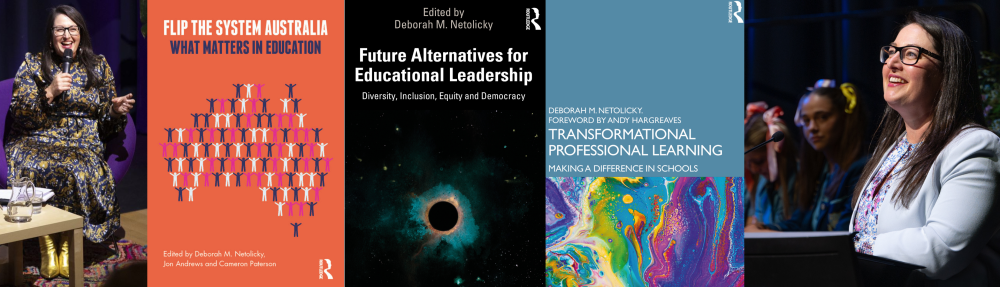
Netolicky, D. M. (2019). Transformational professional learning: Making a difference in schools. Routledge.
I was invited to speak today as part of the Future Schools webinar series. In particular, I was asked to engage with the notion of flipping the education system, based in my work in co-editing the 2019 book Flip the System Australia: What Matters in Education.
That was then
Even though today’s conversation was for a group interested in future schools and the future of schooling, thinking about it required me to reflect back to 2018, when much of the work of the Flip the System Australia book was being done. Back then, my co-editors—Jon Andrews and Cameron Paterson—and I were experiencing the then- educational environment of measurement and surveillance. This included a distrust of schools and teachers, heightened accountabilities according to quantifiable measurables in education, policy rhetoric about educational quality assurance and effectiveness, competitive comparisons of performance in high stakes standardised tests, and a push for teachers to do ‘what works’ according to simplified and dehumanised lists of apparent best practice (although, as Dylan Wiliam says, everything works somewhere, and nothing works everywhere).
Our book built upon the Flip the System books that came before ours (from the Netherlands, Sweden, and the UK) and sought to value and promote a diverse range of voices in education talking about what matters (or what should matter), over what works. We argued for the humanising of educational narratives, the democratising of educational policy and practice, and the development of deep and sustained trust in the teaching profession.
Teachers’ being and becoming
My Flip the System Australia chapter argues for elevating the professional identities and voices of teachers and school leaders in educational research, practice, and policymaking. In the chapter, I explore the quantifying and performative measuring of teacher work as limiting the complexities of that work and reducing teacher identities to a limited range of options. I define identity in my book Transformational Professional Learning as “the situated, ongoing process through which we make sense of ourselves, to ourselves and others” (p.19). It is a constant, context-embedded process of being and becoming, with professional identities inextricably linked to personal identities; we are our whole selves at work, and our lives influence our teaching.
Teaching as a performance disconnected from identity and purpose is unsustainable. Teachers need to feel that their identities are aligned with the purpose of the profession, with shared school values, and with their daily work. Rather than being required to fit themselves to a school, teachers need to feel that they truly belong in a school community in which they share a common moral purpose and are valued for their individual selves, including their gifts and imperfections.
Embracing authenticity and embedding inclusive practices are becoming increasingly important in schools. More than that, as Jelmer Evers wrote in the Foreword to our Australian book, a shared professional identity can transcend borders and nationalities, and can form the basis of reinventing democracy and our schools.
The more things change, the more they stay the same
A focus on the humanity and the positive contribution of education to the lives of all young people remains the core purpose of education. In Flip the System Australia, Carol Campbell describes the purpose of education as “the betterment of humanity” (p.81). In my chapter, I say that “education is not an algorithm but a human endeavour” (p.16). The betterment and care of each child, and thereby the betterment of humanity, includes supporting children to be their best, most agentic and self-determining selves, able to make positive contributions to their communities and to the world.
In Australia, the 2019 Alice Springs Education Declaration, and before it the 2008 Melbourne Declaration on Educational Goals for Young Australians, expressed two key goals:
Goal 1: The Australian education system promotes excellence and equity; and
Goal 2: All young Australians become: confident and creative individuals; successful lifelong learners; and active and informed members of the community.
Yet Australia remains far from an education system that promotes, for all young Australians, excellence and equity.
Melitta Hogarth’s Flip the System Australia chapter reveals the contradictory nature of policies and practices that appear to be unbiased, but that perpetuate conservative, colonial values, and the silencing of Indigenous voices in education. She argues for Indigenous representation at every level of education leadership and decision making in Australia. Kevin Lowe in his chapter argues for collaborative, productive engagement between schools and Aboriginal and Torres Strait Islander communities. There remains ongoing disadvantage for Indigenous Australian children, in terms of education, social and health outcomes. Systemic inequities have been exacerbated by the pandemic and compounded by Western-centric curriculum and biased measures of educational success.
In Chapter 11 of Flip the System Australia, Andy Hargreaves, Shaneé Washington and Michael O’Connor shared findings on teacher wellbeing that now read as a prelude to the intensification of workload and the impacts of the pandemic that have followed. They commented that “teachers feel they are losing control over their professional decisions, … they are being asked to carry the mounting social problems of the world on their own shoulders, and, in the midst of all these things, they feel constrained and compromised by competencies and assessments they do not always believe in” (p.101). Their chapter asserts that there is no student wellbeing without teacher wellbeing. Since that chapter was written, wellbeing has escalated, making its way up the education agenda. Educators have been reminded of something we have always known that now needs our careful attention and action: that wellbeing is inseparably joined with learning and achievement.
This is now
Flipping the system is about flattening and democratising education. Three years on from the publication of Flip the System Australia, the world is facing unremitting and overlapping crises. We only need to turn on the news to see that our planet and democracy remain in peril. In education, governments are enacting fast policy (with teachers and school leaders often hearing about each new policy twist and turn during a press conference), with schools then quickly implementing the changing guidelines and protocols.
Although there are frightening data around teacher and school leader burnout and retention challenges, teachers and school leaders remain incredibly committed to serving their communities, through the most difficult of circumstances. There has been the need for, and therefore the rise of, school and teacher autonomy during the pandemic, as educators have made context-embedded decisions about what their students and communities need, and how to best work to meet these needs.
Schools have been revealed as places of connectedness, relationality, socialisation, and community, as well as learning. The last couple of years have led schools to develop innovative uses of educational technologies, flexible post-secondary pathways for students, and generous networks of educators collaborating together across countries and sectors to share, support and grow alongside one another. Effective leading has been shown to be an authentic practice of care and hope. Those working in schools have been literally changing education from the ground up, which was the catch cry of the original Flip the System book by Jelmer Evers and René Kneyber.