Opt-in interest groups for teacher professional learning

Source: pixabay.com by @rawpixel

I wrote earlier this year about the individualised professional learning pathways model that my school is trialing this year. Teachers and leaders are now able to have more voice and choice in the internal process of professional learning in which they engage. Where before staff were allocated a school-based development process (such as coaching) based on their place in a three-to-four year cycle, we have in 2018 opened up a range of new options and each staff member negotiates with their line manager the one most appropriate to their career stage, interest and development needs.

One of these options is what we are terming ‘Professional Learning Groups’. These groups have been opted into by staff from PK to 12, from various faculties, and in a variety of roles including teachers, leaders and staff from libraries or co-curricular arenas. This year, of our 140-odd teaching staff, 40 chose to be involved in one of these groups, so each group includes about ten people. The following groups were on offer.

  • Teaching best practice
      • Members of this group have a particular interest in teasing out classroom teaching. From evidence-based methods to transfer to ensuring that they are able to ‘reach’ all students in their classes, they have come with a desire to focus on their core business as teachers: teaching!
  • Pedagogies of learning spaces
      • This group is made up of a range of teachers and leaders working in various learning spaces across the school, some of which are newly refurbished and some of which are well-established. There has so far been vibrant discussion and sharing of the practices, challenges, and benefits of co-teaching and teaching in open or flexible spaces.
  • ICT for teaching and learning
      • Members of this group have a range of expertise and needs surrounding the use of technologies for teaching and learning. They have so far been very interested in one another’s expertise and also in the targets each person is setting for themselves, and challenges each is facing. They have been able to offer one another advice.
  • Post-graduate study
      • My idea for this group came about when I was doing my PhD. Working in a school while moonlighting as a post-graduate student can be incredibly isolating as you rush from work to study. There are often few people with whom teachers and leaders can discuss their study, especially when it involves self-directed research. This group is as much about solidarity, support, recognition and acknowledgement of those engaged in further study as it is about research methods or dissertation writing.

As the recent Gonski 2.0 report surfaced, teachers would like time to talk about and collaborate around teaching. Groups like these can provide this opportunity. While from the outset I had a loose idea of what these groups would do—such engage in scholarly literature, reflect and workshop problems of practice together, share practice, visit one another’s classrooms, collaborate in online spaces—I am facilitating them in a way that allows the group’s interests and needs to lead the way the group operates. This means employing structures for collaboration and coaching-style language, but in a way that is open to the groups operating in ways that are unexpected or taking directions that are surprising. These are not groups at which I am the expert at the helm or the instructor filling colleagues with my knowledge. They are groups of expert practitioners whose value is in the rich expertise around the table, and the potential of professional conversation and collaboration about our daily work.

Each person has come to each group with a particular intention, and we fleshed these out in our first meetings. The opt-in nature of the groups has meant that staff have generally arrived with enthusiasm for being involved; they have chosen this pathway for themselves. As my leadership role is PK-12, and in a previous role I coached classroom teachers across the school around their classroom practice, I get to see the potential symbiosis between disparate areas of the school (like the co-teaching in Year 3 and in Year 11 Physics, literacy approaches from PK-12, common strategies for behaviour management and developing classroom culture or addressing students with particular learning needs), but many staff do not have the opportunity to see the connections between themselves and others in the organisation. How might a Year 12 Design and Technology teacher know that their design thinking process mirrors that of the Pre-Primary classroom? The luxury of spending time with colleagues who share similar interests and challenges cannot be underestimated, especially in the environment of a PK-12 school where so often we can be siloed in our year level or faculty teams. So far there seem real benefits to those from vastly different areas of the school workshopping similar challenges and goals, ones they may not have known they shared with colleagues until coming together.

Teachers and school leaders need professional learning opportunities that are at once self-chosen and self-directed, but also collaborative and supported. Often internal expertise goes unrecognised and untapped in schools. Looking outside and borrowing others’ practice has its benefits, but schools can and should consider the expertise of those within their own walls, rather than looking tirelessly to external ‘experts’. Teachers are experts in their own classrooms. School leaders are experts in their own school contexts. They deserve to be recognised as such, and to be given time and permission to deeply and collectively engage in the core aspects of their work.

Education research and the teaching profession: Barriers and solutions

Beware the great wall of research. Proceed with caution. (Taken in George Town, Penang.)

Tonight’s #aussieED Twitter chat has been advertised as talking about ‘bad research’ and ‘good research’, and also asking ‘where can a good teacher turn?’ for research. The topic of research in education is a popular one. Teachers are encouraged to use evidence-based and research-informed practices. They are encouraged to know what research is worth listening to, what is worth ignoring, and what has been misused or debunked (hello, learning styles and neuromyths like ‘we only use 10% of our brains’ and left/right brain learning). Education researchers seek to disseminate their research to the profession. Some organisations seek to bridge the gap between education research and practice. Yet a gap remains.

What barriers are in the way of the teachers and school leaders accessing research to inform their practice?

  1. Time. Teachers and leaders in schools are busy. So busy that often their wellbeing and mental health suffers. It is extremely difficult, especially in the face of multiple accountabilities, for those working in schools to find the time to trawl through academic journal articles and lengthy books in order to decipher research and ponder its relevance to their daily work.
  2. Access and cost. Most academic journal articles are behind a paywall and many academic books have a hefty price tag often well over $100. I have written for both, and the irony is that credibility in the academy is based on publishing in these kinds of texts, yet these are the least accessible for practitioners.
  3. Misrepresentation. The media often misrepresents education research, publishing catchy or sensationalised headlines and simple messages that ignore the complexities or realities of education research. For example, the Sydney Morning Herald recently reported that flipped learning was ‘a new teaching method’ that might be piloted in Australian schools, despite the fact that Australian educators have been using (or intentionally not using) flipped learning for more than ten years. Meanwhile, education terms like ‘growth mindset’ become ubiquitous and meaningless. That is, everyone uses them without ever having engaged with the original research or the responses that have come since.
  4. Simplification. There are dangers to pushing an evidence-based ‘what works’ agenda. Firstly, as Dylan Wiliam so often says, everything works somewhere and nothing works everywhere. But simple league tables of ‘what works’ in education abound. On the one hand these seem useful summaries of research for time-poor teachers, yet they are tools that can be misused and misunderstood if educators do not draw back the curtain to look behind the summaries to the research on which they are based. Meta-analysis mixes together multiple studies in a way that over-simplifies or misrepresents the research on which it is based. For a longer explication, see my extended discussion of meta-analysis in education.
  5. Commodification. There is money to be made in the big business of education. ‘Research’, ‘evidence’, and ‘data’ have become sloganised and used to promote books, professional learning opportunities and conferences. There is a fine line to walk between providing support to the teaching profession by making research accessible, and the corruption of message and purpose that happens when people seek to make money from it, focusing on sales and branding over the authenticity and credibility of what is on offer.

So, what’s the teaching profession to do? Where can we turn when much research is either inaccessible or so multitudinous that it is impossible for the average professional to wade through and find meaning? When the media and some companies or edu-experts are promoting and selling (often contradictory) silver bullets that are too good to be true?

  1. Provide teachers with the questions to ask about research. Context matters, for instance. Where did the studied intervention work? For whom? Under what conditions? Method matters, too. How many participants were in the study? From what school contexts? Via which methods were data generated? What were the ethical considerations and how were these dealt with? What can the study tell us, and what is it unable to tell us? For instance, randomised control trials (RCTs) minimise bias and are often cited as the gold standard of research, but have their own limitations and are not the most appropriate vehicle to answer every research question. A multiplicity of research approaches gives us diverse ways of understanding education, but we need to interrogate the approaches and arrive at conclusions with caution.
  2. Do post-graduate study. Of course this option is not for everyone, and it shouldn’t be a necessity for teachers, but being a Masters or doctoral candidate does provide library access as well as developing an understanding of a variety of research methods.
  3. Consider creating a research role for school, department, or district. While budget constraints might make this difficult for some schools or education departments, a role of ‘Research Lead’, ‘Head of Research’, or in my case ‘Dean of Research and Pedagogy’, can provide a conduit between a school or system and the world of education research. I have written here about some of the things I have been doing to build a research culture in my school.
  4. Build a professional reading repository for your school, district, or system. This might include subscriptions to practitioner or academic journals (e.g. Australian Educational Researcher, Learning & Instruction, Journal of Educational Change), as well as access to research-based practitioner books or academic books. There are also affordable subscriptions, like those of the Media Centre for Educational Research Australia (MCERA), the imminent researchED Magazine, Australian Educational Leader, and the UK Chartered College of Teaching’s journal Impact.
  5. Engage with blogging and online publications. Part of the reason I blog is to give back and contribute to the education community. I work in a privileged school that has the resources to put me in a role where I get to read, write, research, design professional learning opportunities, work with teachers, and help others to do the same. My blog, along with others such as that of the excellent and always-sense-making Gary Jones, seeks to illuminate and summarise research for a practitioner audience. Blogging also engages an audience of international colleagues whose feedback and challenges help to shape my thinking. Online publications such as the EduResearch Matters blogThe Conversation and the Times Education Supplement are also vehicles used by scholars to make research accessible to education practitioners.
  6. Engage with academics and universities, via professional learning or school-university partnerships in order to bridge the gap between those doing educational research, and those seeking to understand and enact it in practice.

At this time two years ago I was attending the American Educational Research Association conference in Washington DC to present on my PhD research. I have attended three Australian Association of Educational Research conferences. I am a research-immersed practitioner. Alongside my full-time school leadership role (in which I also teach English and Literature), I am a research adjunct at a university. I engage in both research and practice. This road, however, is always a winding and imperfect one. Teachers, school leaders, researchers and education commentators need to work together to understand and enact education research and its implications.

Doing even better things

My word for 2018 is metamorphosis, which for me is a lot about letting go. I’ve been thinking about what ingrained habits, automatic behaviours, and stale dreams, I can shed this year as I move towards my next zero birthday and my anniversary of ten years since I returned to Australia from the UK. To move into metamorphosis right now feels like I need endings before I can think about any butterfly-esque new beginnings.

I’ve been thinking on what Professor Dylan Wiliam often says:

We need to prevent people from doing good things, to give them time to do even better things.

It’s not that I am filling my days and nights with wasteful things. I do many fun, productive, worthwhile things. In fact, perhaps part of my problem is my constant feeling that every minute I spend must be worthwhile, as though an unproductive minute is a wasted minute. It was my personal trainer who challenged me to reconsider my downtime. He said my health is being affected by an unceasing stress response cycle and that my body is constantly overloaded with adrenaline, cortisol, and norepinephrine.

I have gotten into some not-so-helpful habits, probably ones that working or studying parents often get into. It started in 2011 when I returned to work part-time after my first period of parental leave. My first child was 6 months old. I felt anxious that I might be perceived not to be working hard or long enough, or that I might be late responding to something, so I put my work email on my phone and responded to emails in the playground, in the supermarket queue, and in life’s cracks where I might previously have been daydreaming or looking around. Then in 2012, after having my second child, I returned to work again. I also enrolled full-time in my PhD (because: nerd bucket list!) and so I spent all my spare time (between work and parenting 2 children under 2) working on my doctorate. I managed to submit my thesis within 3 years of enrolling, and completed shortly afterwards, but I had set in motion a dangerous pattern. Once my PhD was done, I presented at more national and international conferences, and ramped up my academic and blog writing. I went from part-time work back to full-time work.

My downtime had become a different kind of work. I wasn’t having breaks. I was switching from teaching work to leadership work to domestic work to research work. Or I was using my non-work non-productive time to prepare for the next bout of work or productivity. Or I was so tired that in the evenings I would halfheartedly watch bad tv or trawl social media in the name of ‘time to myself’. I continued with all of this through some very rough personal patches and did my utmost not to let work, home, or doctorate, be affected. I had some good tricks, like seeing my PhD as intellectual ‘me time’, using calendars and to-do lists with military precision, and switching off from the rest of the world when I was playing with my kids. But is checking social media or writing a blog after the kids have gone to bed the best way to spend my time? Is it helping me to wind down for a good night’s sleep? Multiple work trips and conference presentations can be rewarding and invigorating, but can also negatively impact family time and lead to more stressful work weeks before and after. Is moving from the paid work of my days to the unpaid writing of my nights and weekends stoking my internal fire, or just exhausting me in a relentless cycle of Doing The Things.

What Things am I doing, and why?

I have begun to pare back my obligations. I have turned my email and social media notifications off and buried Facebook in the back of my phone. I’ve withdrawn from my Book Club. I’m reconsidering how often to post on this blog and am thinking perhaps ‘when it takes my fancy’ would be ok, rather than keeping myself to a schedule. I am figuring out how to protect my most productive time for my most important projects and how I might schedule in regular silence and stillness. My trainer has recommended flotation tank therapy.

I’m hoping that lightening my load will help me to stop doing some good things in order to do even better things. Some of those even better things are those I am passionate about (like writing what I’m burning to say, editing an important book, or serving the community via board-member type positions) and some are in the name of self-care, like getting a good night’s sleep, protecting a regular exercise schedule, and working out how to properly stop.

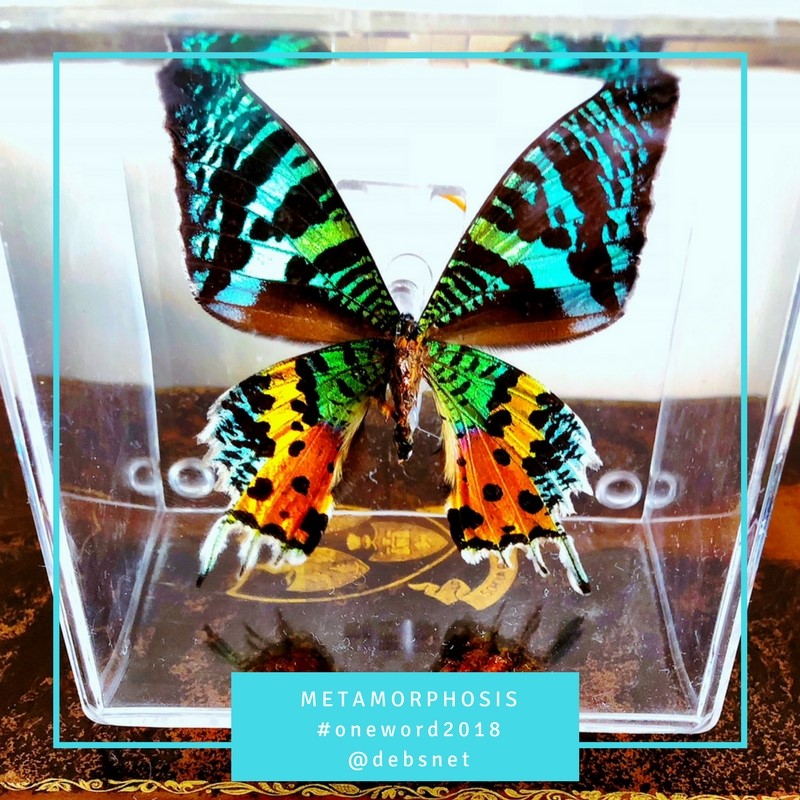
METAMORPHOSIS and emerging from the chrysalis: #oneword2018

taxidermy butterfly left to me by my scientist grandfather

It’s that time of year when we’re recovering from the holiday season and gearing up, or regenerating, for the new year. It’s a time, often, of reflecting on the year that’s been and planning for the year ahead. For the last few years I have used a ‘oneword’ to clarify my intent for my year. While I sometimes forget the oneword intentionality I have set, especially when life is at its busiest or most pear-shaped, mostly I find that choosing a single word allows me to bring a mindfulness to my year that is based on an essential focus to which it is easy to return across a year.

In 2015 it was CONQUER, as I worked at a ruthless pace to submit my PhD in between parenting my two young children and working 0.8 at my school.

In 2016 it was MOMENTUM, as I tried to capitalise on my PhD through lots of presenting (including at AERA) and writing from my thesis, still in the spaces between life and work.

In 2017 it was NOURISH, as I worked to clarify my work and life by focusing on that which nourished me.

On 2017 …

In 2017 my oneword embodied itself in multiple aspects of my life. As my youngest child entered full-time school, I returned to full-time work that has been nourishing in its focus. That is, I’ve been grateful to spend my time in areas of passion and purpose: teacher professional learning, building a research culture, focusing on staff development, and leading the Library, as well as teaching English.

In 2017 I have said ‘yes’ to projects because they are nourishing experiences for me, or because I have been burning to say something. My formal 2017 publications, for example, have been:

I have also joined the Board at my children’s school, and become a member of Evidence for Learning’s Research Use and Evaluation Committee. These commitments are about contribution, giving back, and making a difference; through them I receive the nourishment that comes from doing something worthwhile.

In 2017 I have spent nourishing time with my family, including a couple of lovely holidays. I have been seeing a new personal trainer whose strength and conditioning sessions have meant that my regular three-day-long headaches seem to have disappeared. Working with him has meant looking after my body, paying more attention to it, and getting stronger.

To 2018 …

2018 is around the corner and I’ve been considering what might be my fundamental intention for a year that already feels like an ending before it has begun. The end of 2018 will mark 10 years since I returned to Australia from the UK. That decade is a time in which I have had my two children, from pregnancy to babies to primary school students. It’s the decade in which I completed my PhD. The end of 2018 will mark a full decade of working at my current school (well and truly my longest ever period of employment). And at the end of next year I will have a zero birthday. The years from 2009-2018 feel like a chrysalis from which I will emerge at the end of next year. (I’m no doubt influenced here by the book I’ve just finished: Stephen and Owen King’s 715-page novel Sleeping Beauties in which women around the world are falling asleep indefinitely and being cocooned in mysterious chrysalides.) This seems a perfect time for looking back and looking forward.

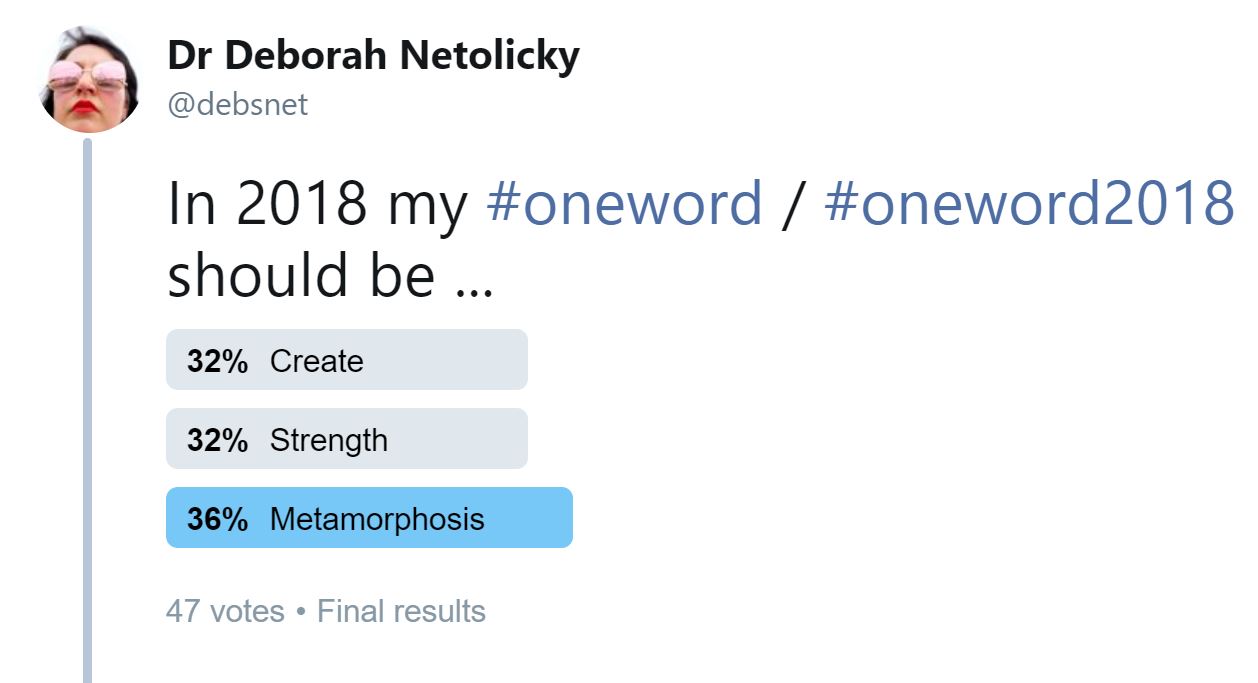
On Twitter it was a close race ….

For 2018 I have considered the word CREATE because I have some projects I’m keen to progress. I have considered STRENGTH because I would benefit from focusing on the strength of my body as well as the strength of my advocacy for others and perhaps for myself. But I am going to tackle a more complex and messy word this year: METAMORPHOSIS.

It’s not that I think 2018 will be filled with transformation. In fact, it’s more likely to be about consolidation and simplification (think Marie Kondo’s KonMari method applied to life, or perhaps Sarah Knight’s life-changing magic of … ahem … figuring out what not to worry about). METAMORPHOSIS isn’t just about change. It isn’t that I think I’ll grow proverbial wings in the space of a year. But it is about development and moving on to another stage. For me that stage is mid-teaching-career, post baby-having, post-PhD stage. It’s time to figure out what ‘mid’ and ‘post’ look like when they are my ‘now’.

METAMORPHOSIS is also about letting go. It is about shedding old skins, old bodies, old habits, old values, old dreams. It is about considering what I want to take into my next decade, and what I’m willing to leave behind. After a few packed but fragmented years, full of simultaneous, competing, overlapping commitments (teaching! school leadership! PhD! academic writing! presenting at conferences! pregnancies! parenting! moving house! all at the same time!), it’s about re-assessing how I am spending my time and considering where it might be that all my endeavour is leading me.

The questions I will ask in 2018 in order to be mindful of METAMORPHOSIS in 2018 are:

  • What might flight, freedom, joy, and purpose look like and feel like for me?
  • How might I imagine the next decade and what might I need to do to get there?
  • What do I want to focus on doing and what can I stop doing, or do less of, in order to fulfil that focus?

Flipping the flippin’ education system

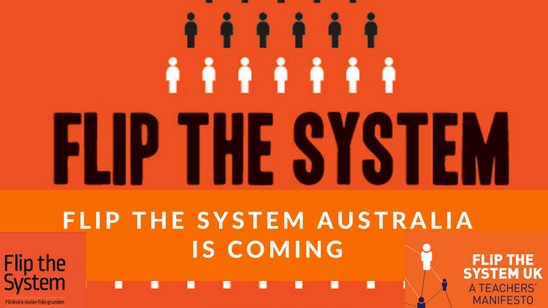
I have been thrilled in the last couple of weeks to be part of the Flip the System publishing movement. Its inception was the original 2016 book, dreamed up and brought to fruition by Dutch teachers Jelmer Evers and René Kneyber: Flip the System: Changing education from the ground up. In it, a number of contributors discuss the purpose of education. They urge schools and teachers to resist complying with the decrees of policymakers or kowtowing to external accountability measures. Rather, they promote trusting the teaching profession to influence the education system from the bottom up and the inside out. You can see Jelmer speak in his TEDX talk about how he and René conceptualised subverting the system to promote teacher agency and collaboration.

Then, on 29 November 2017, a new book—Flip the System UK: A Teachers’ Manifesto, edited by Lucy Rycroft-Smith and Jean-Louis Dutaut—was published. This book applies the notion of flipping the system to a UK context, offering a suite of voices intended to elevate teacher professionalism and empower teachers to effect change from within the education system. In this UK volume is a chapter I have co-written with Australian teachers Jon Andrews and Cameron Paterson, entitled ‘Flipping the system: A perspective from Down Under’. Here, we offer a way of thinking about flipping the system from an Australian perspective. That Flip the System UK sold out its first print run in its first night of publication says something about the magnetism of this movement. Editor Lucy Rycroft-Smith has been tweeting some excellent threads about the book from her @honeypisquared Twitter account. These are wonderful précis of the book’s contents, especially for those of us who have yet to receive our print copies of the book.

What these contributions to the Flip the System books so far show, are the commonalities amongst the global community of teachers. The Netherlands, the UK, Australia, and other countries around the world, are all facing reform agendas driven, not by those in classrooms or schools, but by those appointed to governments or catapulted to guru status, or those who might profit from their own reform recommendations (“Look! Education is in crisis. <Insert oft-wheeled-out-reason-for-education-crisis>. Here, buy my silver bullet / snake oil.“).

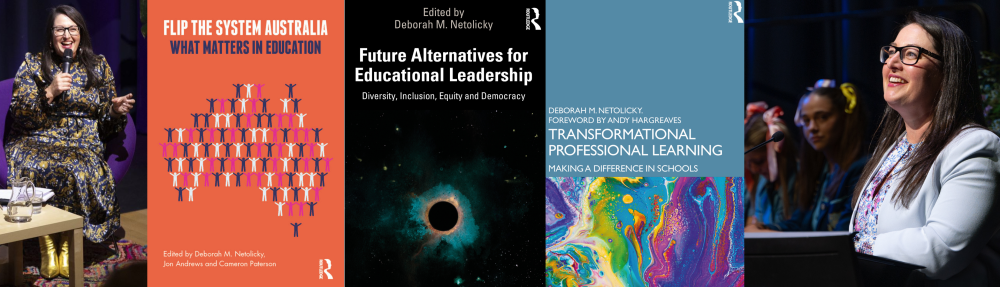
It was thrilling to have my first book chapter published in the last couple of weeks (hoorah! with more chapters in the long publishing pipeline). Even more exciting was that Jon Andrews, Cameron Paterson and I also signed our own book contract for a Flip the System Australia book. In it, we, along with an arsenal of incredible authors, will situate the Australian context within the global milieu, standing on the shoulders of Evers, Kneyber, Rycroft-Smith, Dutaut, and the Flip the System contributors thus far. From an Austraian lens, we and our contributing authors will argue for the wisdom of practitioners and the agency of the teaching profession, and for allowing teachers to take the lead as a trusted and meaningful part of global education conversation, policy, and practice.

So, a book chapter, a book contract, and being part of a global movement to re-professionalise, re-empower, and re-claim teaching? I’m flipping excited!

Educators: Hold the line on voice, autonomy, and trust

Can we hold the line in the face of challenging circumstances?

This week I was thrilled to welcome Professor Pasi Sahlberg to my Western Australian school to talk to our leaders—from coaches and team leaders to Heads of Faculty, senior leadership and the Executive—about school leadership and what high performing education systems do. Pasi’s list covers things about which many of us leading in schools, and researching and writing about education, are concerned: collaboration, learning and wellbeing, trust-based responsibility, continuous improvement, and equity. They are also guiding principles for teachers in classrooms, who use what Pasi calls ‘small data’ every day. In my PhD, which was based around effective school change and transformational professional learning, these were also themes that emerged; in particular, my research surfaced trust, professional collaboration, and continuous improvement through a range of educator-centred experiences.

I am reminded of the chapter I have co-authored in the upcoming Flip the System UK: A Teachers’ Manifesto book. In it, Jon Andrews, Cameron Paterson, and I, cite Sahlberg’s concept of the Global Education Reform Movement (GERM) and its destructive influence on teacher voice, power, and agency. We argue for a re-professionalising and re-humanising of teaching and education.

I am reminded, too, of my speech to the Australian Council for Educational Leaders conference last year about trusting and supporting teachers. In his new book, FinnishED Leadership: Four big, inexpensive ideas to transform education, Sahlberg supports the autonomy of teachers and schools. He writes:

Strengthen collective autonomy of schools by giving teachers more independence from bureaucracy and simultaneously investing in teamwork in your school. This enhances social capital that is proved to be a critical aspect of building trust within education and enhancing student learning. (p.43)

He notes that the Finnish government spends 30 times more funds on the professional learning and development of educators than on accountability procedures, such as tests and surveys.

We live in a time of compliance and performativity. Australian schools are like tin cans being crushed from the outside-in by a focus on the results external testing (NAPLAN, HSC, WACE, VCE, PIRLS, TIMMS, PISA, the upcoming Phonics Check) and on publicly published league tables and competition-based publications such as the myschool website.

When Pasi spoke to leaders at my school, robust discussion ensued. He challenged us to ask what is within our control, what it is that we can change, what we would do if we could enact our dream for the best way of serving our students, starting tomorrow. He challenged us to question the systemic and regulatory parameters within which we operate, and to hold the line on those things we know will make a difference to our students.

Sahlberg’s work is supported by that of others, such as Michael Fullan’s on the wrong drivers for education reform, and Fullan’s work with Andy Hargreaves on professional capital in their book, Professional Capital: Transforming teaching in every school, and in the Journal of Professional Capital and Community. The Flip the System movement, too, beginning with Jelmer Evers and René Kneyber’s book Flip the System, brings together and champions the voices of teachers, academics and education experts in order to reclaim the space of education discourse for those working within schools.

So, what can we do in our own contexts? How might we reshape the narrative of education, or advocate for the following?

Less testing

More collaboration

Less accountability

More equity

Less competition

More trust

Teaching apprenticeships: Legitimate pathway or the death of the profession?

Teaching is a complex profession that requires a range of knowledge, skills, and practices. It also has a human, emotional, and relational dimension. I have been a teacher for almost 20 years and despite multiple degrees, constant professional learning, and decades of experience, I am still constantly learning and incrementally improving in terms of my teaching practice.

Last week UK education secretary, Justine Greening, announced that higher apprenticeships will become a technical route to teaching in the UK. That is, someone wanting to become a teacher will not need to earn a university degree, but will be able to do so via a vocational path.

That the Schools Week article suggests that low apprenticeship wages will be a cost-saving measure for schools suggests that an apprenticeship pathway to a teaching career is about cheaper, faster labour, rather than how to train teachers in the best way. This has been pointed out by Laura McInerney who says, “This shift to apprenticeships, therefore, starts to look like a way to pay A LOT of teachers a low-wage throughout their ‘training’ years —  and never pay many of them a full wage,” undermining Greening’s claim that she wants teaching to remain a highly regarded, high status profession.

McInerney also notes that teachers are very attached to the notion of our profession as a graduate one, in which a university degree provides part of the foundation. As a member of the profession, I feel this, and have been challenged on social media about whether I am being a snob about qualifications by being critical of the notion of apprenticeship teacher training. Others, too, have been accused of elitism for opposing the apprenticeship idea.

Even though these reforms are being suggested in the UK rather than Australia (and it has been almost 10 years since I have taught in the UK), I’ve been thinking about it over the last week. Why do I believe that teachers should have a degree? Is resistance akin to snobby elitism, or is this a key issue on which we must hold the line?

As part of my current role I place student teachers at my school for their teaching practicums, and I wonder if all schools provide appropriate workplace learning environments. But much of my gut feeling about an apprenticeship route to the classroom is around a belief that teaching should be a valued, knowledgeable and skilled profession. Teachers should be respected members of our communities. I don’t think a degree is sufficient for teaching–it’s not all we need–but I think it is necessary. A degree provides a foundation of knowledge, integrity, and credibility, in terms of subject knowledge and theoretical knowledge of teaching itself. It is also about the skillset we get through the process of a university degree. My various university qualifications, including the PhD, have provided me with the bedrock for the learning I do every day in the course of my career. My university studies also show my students, and the school community, that I value education and have expertise to share. The qualifications of a school’s leaders and teachers are often published, demonstrating the education foundation of that school’s staff and suggesting their capacity to educate the students in their care.

What do you think? Should teachers have university degrees or are more vocational pathways to the career appropriate? Can an apprenticeship have parity with a degree? Does learning teaching ‘on the job’ make sense? Or will apprenticeship options, and related wages and conditions, devalue and demoralise the profession?

Feedback: It’s emotional

it’s emotional (Jeanne Moreau in Elevator to the Gallows)

The red pen is symbolic of marking. It’s viscous crimson ink, staining crisp white pages, is bedded in the history of giving feedback on written work. It stands out from blue or black writing, allowing corrections to be seen. That’s probably why the default colour for Microsoft Word tracked changes is red. It’s bold, noticeable, stark.

The red pen has also been at the centre of controversy. In 2008, 2013, and as recently as 2016, there were international articles arguing that marks made by red pens on student work were threatening and confrontational for students, and that teachers should stop marking with them. In 2010 Rutchick, Slepian, and Ferris found that teachers using red pens to correct essays marked more errors and awarded lower grades than teachers using blue pens. A 2013 study by Dukes and Albanesi was central to renewed furore, arguing that marking with red pens can upset students and lead to weakened teacher-student relationships. Some educators retorted that the whole idea was silly and continued to wield their red pens. Some schools responded with ‘rainbow marking’ policies in which teachers armed themselves with red-free sets of highlighters and pens. Yellow! Pink! Purple! Green! Blue!

This week a student asked me to look over a practice exam response he had done in his own time. I was sitting next to him and asked if he had a pen I could use to give him feedback on it. His immediate response: “Do you want a red one?”

Pat Thomson yesterday published this post about the ‘bleeding thesis’, explaining that doctoral students can feel like the pages are bleeding when they receive red scrawling annotations and red tracked changes on their drafts. I have heard high school students complain similarly about the ‘bleeding pages’ of their marked work. “Oh, my essay looks like it’s bleeding!”

When I was editing my PhD thesis I had a swag of Artline finline pens. My personal favourites were green, purple, and dark pink. When I was in a self-flaggelatory mood, I would use red. It felt like punishment, a dark culling of my words, permission to be ruthless with my writing.

Yesterday a colleague emailed me a draft paper and asked me to ‘scribble on it’, so I annotated it with my reactions, thoughts, and suggestions. Part of their email response to my annotations was “I feel like I am getting your feedback on a Lit essay I’ve handed in, and admit to feeling a certain amount of pride at the ticks and double ticks!” Yes, I ticked those parts of the paper that resonated with me or I felt were important (a hard English teacher habit to break). I know my students scour their marked work, counting the ticks. They often call out “I got a double tick!” And now that I think about it, I annotated my colleague’s draft in green pen.

Of course, it’s not really the pen that is important. It’s the quality of the feedback that matters. A tick can be meaningless (but nonetheless emotion-inducing) praise, unless there is an understanding of why it’s there. This 1984 study by Semke found that teacher-written corrections do not increase writing accuracy, writing fluency, or general language proficiency, and they may have a negative effect on student attitudes. Dylan Wiliam points out that feedback can help or hinder learning, and that the feedback-giver/feedback-receiver relationship is key to feedback’s effectiveness.

It is neither possible nor desirable to give great quantities of feedback. As an English teacher, I have to constantly navigate the balance between giving meaningful feedback to help students move forward, and balancing my marking workload. Over my career I’ve developed a suite of varied strategies to ensure students are constantly engaging in feedback over their work, without me constantly collecting and correcting workbooks or homework. I’ve found I can give every student some brief, immediate feedback verbally if I check homework in a lesson once students are working. I can set peer and self assessments designed to engage students with the task and the work so that they are empowered to give themselves and each other relevant feedback. I can work with individuals and small tutorial groups to give targeted feedback. I constantly ask myself: Who is doing the mental work? It is the student who needs to be thinking and working to improve; my correcting errors ad nauseum is going to have little impact.

But feedback, written and otherwise, is emotional. Sometimes feedback can feel collaborative and inspiring and propulsive and nurturing (a thank you shout out to my co-authors on various projects, and some generous reviewers!). Sometimes it can feel brutal and visceral and dismissive and unforgiving. Sometimes it’s a warm embrace and sometimes it’s a swift kick in the guts.

The harshest feedback I’ve seen hasn’t been from the ink of a red pen, but from anonymous peer reviewers for academic journals. This Twitter account might give you an idea of the kinds of feedback some academics receive about their work. It cites reviewer comments like, “You have put in a lot of effort answering a question that should have never been asked” and “The biggest problem with this manuscript, which has nearly sucked the will to live out of me, is the terrible writing style.”

We need to be ok with failure, as suggested by this post on self-esteem that a friend shared with me this week, and as I explain in this post, in which I share some harsh verbal feedback from one of my PhD supervisors. As I said in this post, receiving peer reviewed feedback can feel like simultaneously getting a high five and a punch in the face. One thing that doing a PhD, receiving feedback during the journal double-blind peer review process, and being a reviewer myself, have taught me, is that we need to train ourselves (and our students) to be resilient and interested receivers of feedback. By ‘interested’, I mean we need to be curious about what we might learn and open to listening to even that feedback which might hurt at first. If I find that a reviewer or colleague ‘just doesn’t get it’, I need to be able to take that as a sign that I could make my intention clearer.

As marketing consultant Jay Baer would say, when it comes to feedback we need to hug our haters. Or as a colleague of mine says, we learn most when we welcome complaints. It is through seeing our work through the eyes of others, and by being open to criticism, that we can figure out how to push our work forward, improve it incrementally, take it in a new direction, or defend it more vigorously.

What’s the point of technology in education?

source: pixabay.com @Pexels

I’ve always been a bit of a secret techy nerd, thanks, in part, to my dad who was an early adopter of computer technologies. In the 1980s, we had an Amstrad CPC desktop computer, one with a cassette tape deck to play computer programmes. My parents taught me how to write basic computer code using … BASIC (Beginner’s All-purpose Symbolic Instruction Code). My mum wrote programmes using BASIC that my brother, sister and I could play. We soon upgraded to an IBM PC and floppy disks. While we also had a full set of Encyclopaedia Britannica, we were at the bleeding edge of 80s technology! We continued to upgrade computers and have access to games. From the 80s I have fond memories of the arcade-style game Gilligan’s Gold, and in the 90s I loved strategic simulation games like Civilization and Jones in the Fast Lane. The Walkman revolutionised and mobilised music listening, and I spent hours of my high school years in my bedroom making mix tapes on a double audio cassette player; timing was everything.

Now for a statement of the ridiculously obvious: The technological landscape has changed dramatically since I was a child. Its physical, virtual, and ethical parameters are very different. I have been considering what our children and students need now in terms of technologies that can aid or augment learning and living, and what kinds of knowledge and nous they require to be effective and empowered negotiators of their current worlds and the multiple identities they act out on real and virtual platforms.

But why bother with digital technologies? Why not stick to traditional technologies (pen, paper, the overhead projector!)? In part, our local and global context requires it. The world feels a sense of urgency around predicting our students’ future and busily preparing them for it. Being tech savvy has become an economic imperative.

In Australia, technologies and technology education are an ever-increasing focus. The 2008 Melbourne Declaration of Educational Goals for Young Australians states that “when students leave school they will be confident, creative, and productive users of technologies” (p.8) and that “practical knowledge and skills development in areas such as ICT and design and technology are central to Australia’s skilled economy and will provide crucial pathways to post-school success” (p.12).

As part of the 21st century skills movement, digital literacy has become a global focus. A Commonwealth of Australia (2009) report highlights digital media literacy as a dynamic concept and a necessary condition for a successful digital economy. It says: “Digital media literacy ensures that all Australians are able to enjoy the benefits of the digital economy: it promotes opportunities for social inclusion, creative expression, innovation, collaboration, and employment. … The focus of digital media literacy policy and programs is on the development of three core skill sets:

  • the technical ability to engage at a basic level with a computer and the internet, such as to create documents and emails;
  • the ability to understand and critically evaluate digital media and digital media content; and
  • the ability to create content and communications.”

In 2013 the Australian Curriculum, Assessment, and Reporting Authority (ACARA) published the seven General Capabilities in the Australian Curriculum, including the ICT Capability that “involves students learning to make the most of digital technologies available to them, adapting to new ways of doing things as technologies evolve and limiting the risks to themselves and others in a digital environment (p.49).

In 2014, the Australian Government released the Industry Innovation and Competitiveness Agenda that aims to strengthen Australia’s competitiveness. One of the major announcements at this time was the proposal to focus on science, technology, engineering, mathematics, and innovation in schools, and the introduction of the Coding Across the Curriculum Program.

In 2015 ACARA released The Australian Curriculum: Technologies, which aims to develop the knowledge, understanding, and skills to ensure that, individually and collaboratively, students:

  • investigate, design, plan, manage, create, and evaluate solutions;
  • are creative, innovative, and enterprising when using traditional, contemporary, and emerging technologies, and understand how technologies have developed over time;
  • make informed and ethical decisions about the role, impact, and use of technologies in the economy, environment, and society for a sustainable future;
  • engage confidently with and responsibly select and manipulate appropriate technologies − materials, data, systems, components, tools, and equipment − when designing and creating solutions; and
  • critique, analyse, and evaluate problems, needs, or opportunities to identify and create solutions.

ACARA (2016) has since declared STEM education a national priority, describing STEM as closely linked to Australia’s productivity and economic wellbeing, central to a well-rounded education, and contributing to a diverse and capable STEM workforce pipeline.

The introduction of OLNA as an online literacy and numeracy assessment, and NAPLAN moving to computer-based assessment from 2018 (on an opt-in basis), means that students from Year 3 need to be able to be proficient keyboard and computer users in order to effectively demonstrate national literacy and numeracy requirements.

So how are educators to engage in all of this? Fullan (2013) urges us to move beyond a superficial homage to 21st century learning skills to developing what it means to actually implement them in practice. Higgins (2014) challenges us to ask: “Do we need a curriculum with less specified knowledge, allowing a greater emphasis on skills, based on the argument that information (and therefore knowledge) is more readily accessible? Or do we need more knowledge, as the basis for developing greater expertise and the ability to make informed and complex judgements, based on a deeper understanding of a topic or field?” (p.571).

The launch of a new communication and learning management platform at my school and my involvement in a couple of strategic projects have had me thinking about digital pedagogy and how to choose digital tools for learning. In a sea of fast moving technologies and faster moving policy, perhaps we can anchor ourselves with the building blocks of teaching and learning: good curriculum and assessment design, well-considered pedagogy, and knowledge of our students. Then we can make decisions around technology based on what it is we want them to know and be able to do.


References

Fullan, M. (2013a). Stratosphere: Integrating technology, pedagogy, and change knowledge. Toronto: Pearson.

Higgins, S. (2014). Critical thinking for 21st-century education: A cyber-tooth curriculum? Prospects44(4), 559-574.

Choosing the (digital) pedagogical tool fit for the learning

source: pixabay.com @byrev

The list of digital technologies that might be used for teaching and learning is extensive. It includes: LMSs (Learning Management Systems); MOOCs (Massive Open Online Courses); BYOD (bring your own device); BYOT (bring your own technology); BYOC (bring your own connectivity); makerspaces; robotics; digital portfolios; online discussion forums; blogging platforms; wikis, microblogging; back channels; audio recording and music making; image and video editing; creation of infographics, slideshows, and presentations; digital storytelling; social media; collaboration tools; mobile apps; game-based learning and environments; coding and computer programming; augmented and virtual realities; technologies for creating physical or virtual 3D models; gesture-based computing; learning analytics and statistical analysis software; online authoring tools; wearable technology; affective computing; rubric generators; quizzes; online response systems such as polls and surveys; video conferencing; cloud computing; and student feedback tools such as Turnitin, GradeMark, and PeerMark.

E-learning technologies are sometimes defined as asynchronous (any-time) or synchronous (real-time). Flipped learning is that in which traditional teacher instruction is delivered between classes via online video or presentation technologies, and class time is used for application and collaboration. Blended learning melds traditional classroom pedagogies with online learning tools and environments. Rhizomatic learning, a loose appropriation of Deleuze and Guattari’s rhizome in an educational context, is non-linear and not predetermined (Cormier, 2008; Koutropoulos, 2017) and heutagogical learning is self-determined (Hase & Kenyon, 2000, 2007; Netolicky, 2016). Beetham (2013a) describes e-learning as learner-centred experience that allows learners more control over the time, place, and pace of their learning and the opportunity to connect with learning communities worldwide, much like the experience of many teachers who use social media for networking and learning.

I’ve been doing some reading since I recently posted my initial thoughts about digital pedagogy and I am reassured that scholars tend to agree that pedagogy should drive the use of technologies, rather than technologies driving the way teaching and learning happens, or as an end in themselves. Digital technologies and methods are mostly seen as part of a teacher’s arsenal of tools for teaching curriculum content, skills, and understandings.

Laurillard (2013) states that, while the scope and style of pedagogy changes as technology changes, no one has yet shown that we need to change our understanding of how students learn. Higgins (2014), however, argues that technology has changed what we learn and how we learn.

The changing digital technology landscape has led to educators attempting to personalise and gamify learning, to construct open online learning environments and self-directed learning opportunities, to leverage students’ personal mobile devices for learning, and to utilise technologies to facilitate processes such as analysis, collaboration, communication, and creation. Dichev and Dicheva (2017), however, found that even though gamification in education is a growing phenomenon, practice has outpaced research and we do not know enough about how to effectively gamify education or even whether gamifying education is beneficial. Additionally, online learning such as that via MOOCs can be overwhelming and confusing to those without highly-evolved skills in managing their connectivity (Beetham, 2013b). This brings into question the equity of technologies. Who has access? Who dominates? Who becomes lost in the system or excluded from it?

Many authors note that teachers should not assume that because students are surrounded by technology they are savvy, confident, ethical, or safe users of it. Safe, ethical use of technology needs to be guided and explicitly taught, as do skills such as online collaboration and evaluating the quality of available information. Students need the skills and aptitudes to sustain engagement with digital learning, especially if it is self-directed and self-paced.

Most proponents of digital learning base their use of technologies on traditional pedagogy. Good pedagogical design, traditional or digital, ensures that there is alignment between the curriculum we teach, the teaching methods we use, the learning environment we choose, and the assessment procedures we adopt (Biggs, 1999). Importantly, a role remains for teachers as expert designers of learning (Laurillard, 2013; Selwyn, 2016) who establish learning tasks, supportive environments for learning, and conducive forms of social classroom relations. Hunter (2015) suggests the following questions to teachers:

  • Where is the pedagogy?
  • What is the content?
  • How is your choice or the students’ choice of particular technology tools going to enhance learning?

So, we need to start with the desired learning outcomes. Curriculum design comes before pedagogy, which comes before technology. Then we choose the pedagogical tool fit for the learning purpose.

It cannot be assumed, however, that teachers, even those who are tech-savvy, know how to best use technologies for pedagogical purposes. Lei (2009) found that although pre-service teachers are often digital natives who use technology extensively for themselves, they lack the knowledge, skills, and experiences to integrate technology into classrooms to help them teach and to help their students learn, even when they recognise the importance of doing so. Teachers can leverage digital technologies within a pedagogical frame, but only when we have the knowledge and understanding of available technologies and their pedagogical potential.

References

Beetham, H. (2013a). Designing for active learning in technology-rich contexts. In H. Beetham & R. Sharpe (Eds.) Rethinking pedagogy for a digital age: Designing for 21st century learning (2nd ed.), pp.31-48. Abingdon, England: Routledge.

Beetham, H. (2013b). Designing for learning in an uncertain future. In H. Beetham & R. Sharpe (Eds.) Rethinking pedagogy for a digital age: Designing for 21st century learning (2nd ed.), pp.258-281. Abingdon, England: Routledge.

Biggs, J. (1999). Teaching for quality learning at university. Buckingham: Society for Research in Higher Education and Open University Press.

Cormier, D. (2008). Rhizomatic education: Community as curriculum. Innovate 4(5).

Dichev, C., & Dicheva, D. (2017). Gamifying education: what is known, what is believed and what remains uncertain: a critical review. International Journal of Educational Technology in Higher Education14(1).

Hase, S., & Kenyon, C. (2000). From andragogy to heutagogyultiBASE In-Site, 5(3), 1-10.

Hase, S., & Kenyon, C. (2007). Heutagogy: A child of complexity theory. Complicity: An international journal of complexity and education4(1).

Higgins, S. (2014). Critical thinking for 21st-century education: A cyber-tooth curriculum? Prospects44(4), 559-574.

Hunter, J. (2015). Technology integration and high possibility classrooms: Building from TPACK. Abingdon, England: Routledge.

Koutropoulos, A. (2017). Rhizomes of the classroom: Enabling the learners to become curriculum. In S. P. Ferris & H. Wilder (Eds.), Unplugging the classroom: Teaching with technologies to promote students’ lifelong learning, pp.103-118. Cambridge, MA: Chandos Publishing.

Laurillard, D. (2013). Forward to the second edition. In H. Beetham & R. Sharpe (Eds.) Rethinking pedagogy for a digital age: Designing for 21st century learning (2nd ed.), pp.xvi-xviii. Abingdon, England: Routledge.

Lei, J. (2009). Digital natives as preservice teachers: What technology preparation is needed? Journal of Computing in Teacher Education, 25(3), 87-97.

Netolicky, D. M. (2016). Rethinking professional learning for teachers and school leaders. Journal of Professional Capital and Community, 1(4), 270-285.

Selwyn, N. (2016). Education and technology: Key issues and debates. London: Bloomsbury Publishing.