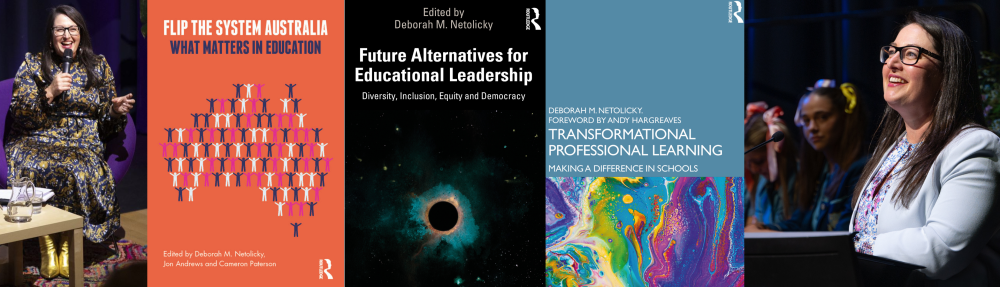
The ‘Flip the System Australia’ book is in production

Flip the System

This week the book manuscript for Flip the System Australia: What matters in education, has moved from the editorial team to the production team at Routledge. It is ‘in press’, which means that the full manuscript will be copy-edited, typeset and a cover designed. You can check out the contents and pre-order it here.

The book is edited by Jon Andrews, Cameron Paterson and I. It includes a collection of 27 chapters by a range of educators, mostly from Australia but also perspectives from around the world. The contributing teachers, school leaders, educators and scholars are: Jon Andrews, Gert Biesta, Susan Bradbeer, Paul Browning, Carol Campbell, Keren Caple, Kelly Cheung, Flossie S. G. Chua, Rebecca Cody, Benjamin Doxtdator, Scott Eacott, Melissa Fotea, Carla Gagliano, Ryan Gill, Dan Haesler, Gavin Hays, Andy Hargreaves, Adam Hendry, Anna Hogan, Melitta Hogarth, Tomaz Lasic, Ben Lewis, Bob Lingard, Rachel Lofthouse, Kevin Lowe, Cameron Malcher, Chris Munro, Deborah Netolicky (me!), Michael T. O’Connor, Cameron Paterson, David Perkins, David Rutkowski, Pasi Sahlberg, Sam Sellar, Yasodai Selvakumaran, Greg Thompson, Ray Trotter, Shaneé Washington, and Daniel Wilson.

What draws the book’s contributions together is their ‘flip the education system’ theme. The Flip the System movement is not our own. The first book in the series (preceded itself by other publications, which we explain in the book) was Flip the System: Changing education from the ground up, edited by Dutch teachers Jelmer Evers and René Kneyber (2016). The Swedish version, Flip the system: Förändra skolan från grunden, was edited by Per Kornhall, Jelmer Evers and René Kneyber (2017). The UK version, Flip the System UK: A teachers’ manifesto, was edited by teachers Lucy Rycroft-Smith and Jean-Louis Dutaut (2018). Flip the System is a loose kind of series in which the notion of ‘flipping the education system’ evolves as diverse international voices explore what this might look like.

In previous Flip the System books, the editors and authors have called for a reprofessionalising of the teaching profession; an education system in which teachers are empowered to influence the education system, rather than being dictated to by top-down bureaucracy. When I explained this theme to a colleague recently, their response was laughing out loud. Is the idea, of teachers being empowered to shape the education landscape, laughable?

Certainly it is easy to feel disempowered as a teacher in an education system obsessed with measurement and competition. Education appears to be a political football constantly booted around for votes. It is also an increasingly corporatised arena in which companies peddle solutions and generate relentless data.

Can those in schools—teachers and school leaders, and even students—be empowered agents in the system, rather than fodder for the education machine? We think so.

To give an idea of the kinds of material covered by the book, sub-themes of the chapters in Flip the System Australia include:

  • Democratising education and addressing inequity.
  • Resistance to mechanisms or systems driven by performance, dehumanised measurement, increased competition, and constant edu-surveillance.
  • Replacing top-down accountability with support for teachers and teacher-led, inside-out reform.
  • Teacher leadership, autonomy, empowerment, and professionalism.
  • Elevating the voices of those working in schools.
  • Learning and leading for a system that honours those who spend each day in our schools, including teachers, school leaders, students and families.

As Jon, Cam and I have edited this book, we have realised why teacher voices are often absent from education debates. It isn’t just that teachers are not usually invited to decision making tables, or that they are often placed at the bottom of education power structures. There are ethical dimensions to our work which mean that we cannot always share our stories or give the media newsworthy soundbites. Our stories are also those of our students and our communities, and we are responsible for protecting them. Also, teaching is complex and demanding work, and teachers and school leaders are in the service of their students. Where is the time for contributing to the system when we are busily working inside the system?

We three editors each work full time in our schools. We have written our chapters and edited this book in our ‘leisure time’ (note the ironic inverted commas). I was surprised to realise that while we have each met each other (I have met Jon; I have met Cam; they have met one another), at no point have the three of us been in the same physical room together. The magic of Skype, Zoom, Google Docs, Twitter, and Dropbox have meant that we could collaborate from afar, in our own timezones and our own time.

We have done this work, as Flip the System editors and authors have done before us, because we think that this book and these authors have something important to contribute to the conversation on education. We are thrilled to be able to give a platform to teachers, school leaders and education researchers. We are grateful for the generosity of the contributing authors. We know there are voices missing from this book, but we hope the book can be part of a move to diversify the voices to whom others listen around education.

Flip the System Australia is coming. And we can’t wait to hold a print copy in our hands.

You can follow the progress of the book on Twitter via @flipthesystemoz and #FliptheSystemOz.
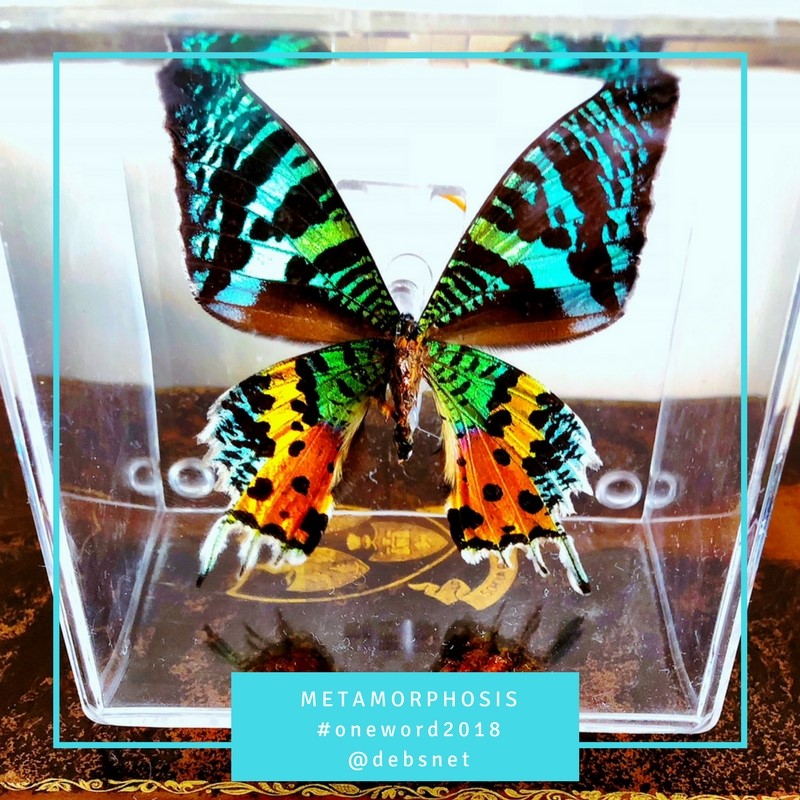
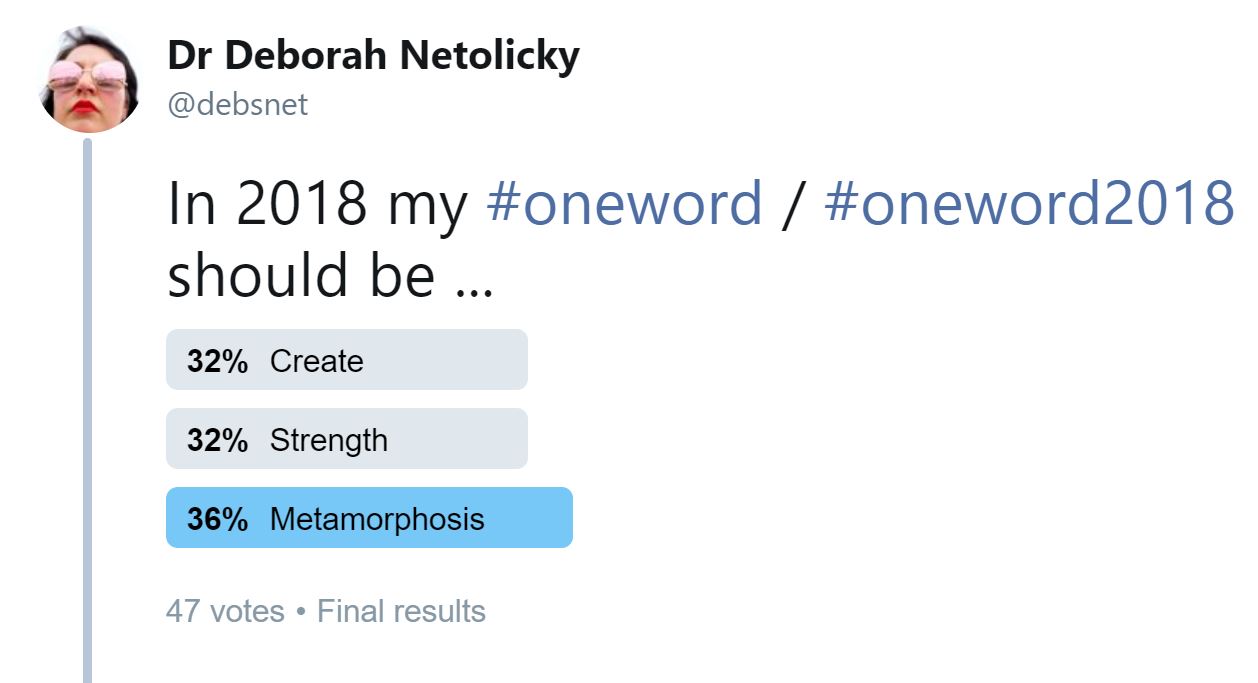
METAMORPHOSIS and emerging from the chrysalis: #oneword2018

taxidermy butterfly left to me by my scientist grandfather

It’s that time of year when we’re recovering from the holiday season and gearing up, or regenerating, for the new year. It’s a time, often, of reflecting on the year that’s been and planning for the year ahead. For the last few years I have used a ‘oneword’ to clarify my intent for my year. While I sometimes forget the oneword intentionality I have set, especially when life is at its busiest or most pear-shaped, mostly I find that choosing a single word allows me to bring a mindfulness to my year that is based on an essential focus to which it is easy to return across a year.

In 2015 it was CONQUER, as I worked at a ruthless pace to submit my PhD in between parenting my two young children and working 0.8 at my school.

In 2016 it was MOMENTUM, as I tried to capitalise on my PhD through lots of presenting (including at AERA) and writing from my thesis, still in the spaces between life and work.

In 2017 it was NOURISH, as I worked to clarify my work and life by focusing on that which nourished me.

On 2017 …

In 2017 my oneword embodied itself in multiple aspects of my life. As my youngest child entered full-time school, I returned to full-time work that has been nourishing in its focus. That is, I’ve been grateful to spend my time in areas of passion and purpose: teacher professional learning, building a research culture, focusing on staff development, and leading the Library, as well as teaching English.

In 2017 I have said ‘yes’ to projects because they are nourishing experiences for me, or because I have been burning to say something. My formal 2017 publications, for example, have been:

I have also joined the Board at my children’s school, and become a member of Evidence for Learning’s Research Use and Evaluation Committee. These commitments are about contribution, giving back, and making a difference; through them I receive the nourishment that comes from doing something worthwhile.

In 2017 I have spent nourishing time with my family, including a couple of lovely holidays. I have been seeing a new personal trainer whose strength and conditioning sessions have meant that my regular three-day-long headaches seem to have disappeared. Working with him has meant looking after my body, paying more attention to it, and getting stronger.

To 2018 …

2018 is around the corner and I’ve been considering what might be my fundamental intention for a year that already feels like an ending before it has begun. The end of 2018 will mark 10 years since I returned to Australia from the UK. That decade is a time in which I have had my two children, from pregnancy to babies to primary school students. It’s the decade in which I completed my PhD. The end of 2018 will mark a full decade of working at my current school (well and truly my longest ever period of employment). And at the end of next year I will have a zero birthday. The years from 2009-2018 feel like a chrysalis from which I will emerge at the end of next year. (I’m no doubt influenced here by the book I’ve just finished: Stephen and Owen King’s 715-page novel Sleeping Beauties in which women around the world are falling asleep indefinitely and being cocooned in mysterious chrysalides.) This seems a perfect time for looking back and looking forward.

On Twitter it was a close race ….

For 2018 I have considered the word CREATE because I have some projects I’m keen to progress. I have considered STRENGTH because I would benefit from focusing on the strength of my body as well as the strength of my advocacy for others and perhaps for myself. But I am going to tackle a more complex and messy word this year: METAMORPHOSIS.

It’s not that I think 2018 will be filled with transformation. In fact, it’s more likely to be about consolidation and simplification (think Marie Kondo’s KonMari method applied to life, or perhaps Sarah Knight’s life-changing magic of … ahem … figuring out what not to worry about). METAMORPHOSIS isn’t just about change. It isn’t that I think I’ll grow proverbial wings in the space of a year. But it is about development and moving on to another stage. For me that stage is mid-teaching-career, post baby-having, post-PhD stage. It’s time to figure out what ‘mid’ and ‘post’ look like when they are my ‘now’.

METAMORPHOSIS is also about letting go. It is about shedding old skins, old bodies, old habits, old values, old dreams. It is about considering what I want to take into my next decade, and what I’m willing to leave behind. After a few packed but fragmented years, full of simultaneous, competing, overlapping commitments (teaching! school leadership! PhD! academic writing! presenting at conferences! pregnancies! parenting! moving house! all at the same time!), it’s about re-assessing how I am spending my time and considering where it might be that all my endeavour is leading me.

The questions I will ask in 2018 in order to be mindful of METAMORPHOSIS in 2018 are:

  • What might flight, freedom, joy, and purpose look like and feel like for me?
  • How might I imagine the next decade and what might I need to do to get there?
  • What do I want to focus on doing and what can I stop doing, or do less of, in order to fulfil that focus?

Flipping the flippin’ education system

I have been thrilled in the last couple of weeks to be part of the Flip the System publishing movement. Its inception was the original 2016 book, dreamed up and brought to fruition by Dutch teachers Jelmer Evers and René Kneyber: Flip the System: Changing education from the ground up. In it, a number of contributors discuss the purpose of education. They urge schools and teachers to resist complying with the decrees of policymakers or kowtowing to external accountability measures. Rather, they promote trusting the teaching profession to influence the education system from the bottom up and the inside out. You can see Jelmer speak in his TEDX talk about how he and René conceptualised subverting the system to promote teacher agency and collaboration.

Then, on 29 November 2017, a new book—Flip the System UK: A Teachers’ Manifesto, edited by Lucy Rycroft-Smith and Jean-Louis Dutaut—was published. This book applies the notion of flipping the system to a UK context, offering a suite of voices intended to elevate teacher professionalism and empower teachers to effect change from within the education system. In this UK volume is a chapter I have co-written with Australian teachers Jon Andrews and Cameron Paterson, entitled ‘Flipping the system: A perspective from Down Under’. Here, we offer a way of thinking about flipping the system from an Australian perspective. That Flip the System UK sold out its first print run in its first night of publication says something about the magnetism of this movement. Editor Lucy Rycroft-Smith has been tweeting some excellent threads about the book from her @honeypisquared Twitter account. These are wonderful précis of the book’s contents, especially for those of us who have yet to receive our print copies of the book.

What these contributions to the Flip the System books so far show, are the commonalities amongst the global community of teachers. The Netherlands, the UK, Australia, and other countries around the world, are all facing reform agendas driven, not by those in classrooms or schools, but by those appointed to governments or catapulted to guru status, or those who might profit from their own reform recommendations (“Look! Education is in crisis. <Insert oft-wheeled-out-reason-for-education-crisis>. Here, buy my silver bullet / snake oil.“).

It was thrilling to have my first book chapter published in the last couple of weeks (hoorah! with more chapters in the long publishing pipeline). Even more exciting was that Jon Andrews, Cameron Paterson and I also signed our own book contract for a Flip the System Australia book. In it, we, along with an arsenal of incredible authors, will situate the Australian context within the global milieu, standing on the shoulders of Evers, Kneyber, Rycroft-Smith, Dutaut, and the Flip the System contributors thus far. From an Austraian lens, we and our contributing authors will argue for the wisdom of practitioners and the agency of the teaching profession, and for allowing teachers to take the lead as a trusted and meaningful part of global education conversation, policy, and practice.

So, a book chapter, a book contract, and being part of a global movement to re-professionalise, re-empower, and re-claim teaching? I’m flipping excited!

Blogging: 3 years on

Perth to NYC, 2014: A blog begins

This week theeduflaneuse.com turns 3. I began this blog on the 23rd of August 2014 with a post about a travelling fellowship upon which I was about to embark. It was to be a way for me to think through my experiences and record these as they happened.

In October 2014 I spent one week in and around New York City, visiting school leaders, researchers, professional development providers and educational experts, in order to gain insights to inform, refine, and shape the implementation of the  coaching-for-professional-growth model I was developing at my school.

The fellowship finished in October 2014, but I kept blogging. Now this blog has more than 200 posts and is read in more than 110 countries. It has become, for me, about much more than a record or recount. It is a place where I think out loud. Where I learn. Where I share experiences, in order to develop my own ideas, connect with others who might choose to engage with me here, and contribute to others’ thinking and work. The notion of contribution is one influenced by what I get from the blogs of others. During my PhD I found reassurance and solidarity in the blogs of PhD candidates. I found generous advice in the blogs of professors and post-docs. I broaden my understandings by reading the blogs of educators who openly articulate their own workings and wonderings. Others’ blogs challenge my thinking, engage me in conversations, reduce feelings of isolation, and break me away from silos of thought that limit me to my own context. As I have written previously, blogging is a way into personal evolution and community transformation on a global scale. These reflections aren’t so different to those I had after one year of blogging, although their scope is now larger.

I began this blog with the concept of ‘édu flânerie’, of being a flâneuse of the education world. I based this on Baudelaire’s flâneur, the (in the 19th century, male) Parisian stroller. Yet as Sainte-Beuve noted, to flâne is not to do nothing, but to casually and keenly experience and observe. In a world of ever-increasing accountabilities and busy-ness, this blog gives my flâneuse the permission to slow down, to notice, to wander, and to contemplate.

I am fully aware that the notion of flânerie is one that indicates privilege. Being able to read, write, and immerse oneself in thought, is a first-world luxury. I am grateful for the opportunity to blog here, to toss out into the void my often unfinished musings, and to receive responses, whether here, on social media, at conferences, or in conversation. Blogging reveals diverse perspectives, sparks global conversations, and initiates relationships. It is these things, as well as the slightly addictive feeling that comes with carving out time and space to sit, think, and write, that act as the propulsive forces for theeduflaneuse.com. Roll on Year 4.

Feedback: It’s emotional

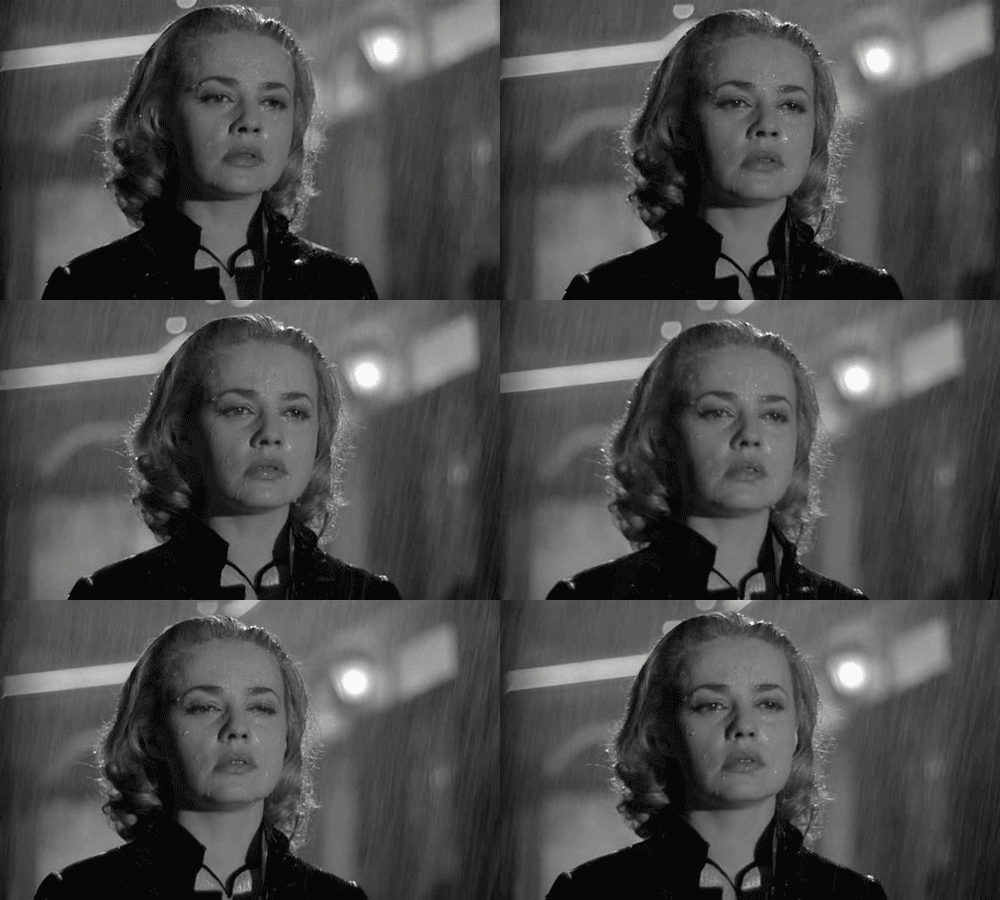
it’s emotional (Jeanne Moreau in Elevator to the Gallows)

The red pen is symbolic of marking. It’s viscous crimson ink, staining crisp white pages, is bedded in the history of giving feedback on written work. It stands out from blue or black writing, allowing corrections to be seen. That’s probably why the default colour for Microsoft Word tracked changes is red. It’s bold, noticeable, stark.

The red pen has also been at the centre of controversy. In 2008, 2013, and as recently as 2016, there were international articles arguing that marks made by red pens on student work were threatening and confrontational for students, and that teachers should stop marking with them. In 2010 Rutchick, Slepian, and Ferris found that teachers using red pens to correct essays marked more errors and awarded lower grades than teachers using blue pens. A 2013 study by Dukes and Albanesi was central to renewed furore, arguing that marking with red pens can upset students and lead to weakened teacher-student relationships. Some educators retorted that the whole idea was silly and continued to wield their red pens. Some schools responded with ‘rainbow marking’ policies in which teachers armed themselves with red-free sets of highlighters and pens. Yellow! Pink! Purple! Green! Blue!

This week a student asked me to look over a practice exam response he had done in his own time. I was sitting next to him and asked if he had a pen I could use to give him feedback on it. His immediate response: “Do you want a red one?”

Pat Thomson yesterday published this post about the ‘bleeding thesis’, explaining that doctoral students can feel like the pages are bleeding when they receive red scrawling annotations and red tracked changes on their drafts. I have heard high school students complain similarly about the ‘bleeding pages’ of their marked work. “Oh, my essay looks like it’s bleeding!”

When I was editing my PhD thesis I had a swag of Artline finline pens. My personal favourites were green, purple, and dark pink. When I was in a self-flaggelatory mood, I would use red. It felt like punishment, a dark culling of my words, permission to be ruthless with my writing.

Yesterday a colleague emailed me a draft paper and asked me to ‘scribble on it’, so I annotated it with my reactions, thoughts, and suggestions. Part of their email response to my annotations was “I feel like I am getting your feedback on a Lit essay I’ve handed in, and admit to feeling a certain amount of pride at the ticks and double ticks!” Yes, I ticked those parts of the paper that resonated with me or I felt were important (a hard English teacher habit to break). I know my students scour their marked work, counting the ticks. They often call out “I got a double tick!” And now that I think about it, I annotated my colleague’s draft in green pen.

Of course, it’s not really the pen that is important. It’s the quality of the feedback that matters. A tick can be meaningless (but nonetheless emotion-inducing) praise, unless there is an understanding of why it’s there. This 1984 study by Semke found that teacher-written corrections do not increase writing accuracy, writing fluency, or general language proficiency, and they may have a negative effect on student attitudes. Dylan Wiliam points out that feedback can help or hinder learning, and that the feedback-giver/feedback-receiver relationship is key to feedback’s effectiveness.

It is neither possible nor desirable to give great quantities of feedback. As an English teacher, I have to constantly navigate the balance between giving meaningful feedback to help students move forward, and balancing my marking workload. Over my career I’ve developed a suite of varied strategies to ensure students are constantly engaging in feedback over their work, without me constantly collecting and correcting workbooks or homework. I’ve found I can give every student some brief, immediate feedback verbally if I check homework in a lesson once students are working. I can set peer and self assessments designed to engage students with the task and the work so that they are empowered to give themselves and each other relevant feedback. I can work with individuals and small tutorial groups to give targeted feedback. I constantly ask myself: Who is doing the mental work? It is the student who needs to be thinking and working to improve; my correcting errors ad nauseum is going to have little impact.

But feedback, written and otherwise, is emotional. Sometimes feedback can feel collaborative and inspiring and propulsive and nurturing (a thank you shout out to my co-authors on various projects, and some generous reviewers!). Sometimes it can feel brutal and visceral and dismissive and unforgiving. Sometimes it’s a warm embrace and sometimes it’s a swift kick in the guts.

The harshest feedback I’ve seen hasn’t been from the ink of a red pen, but from anonymous peer reviewers for academic journals. This Twitter account might give you an idea of the kinds of feedback some academics receive about their work. It cites reviewer comments like, “You have put in a lot of effort answering a question that should have never been asked” and “The biggest problem with this manuscript, which has nearly sucked the will to live out of me, is the terrible writing style.”

We need to be ok with failure, as suggested by this post on self-esteem that a friend shared with me this week, and as I explain in this post, in which I share some harsh verbal feedback from one of my PhD supervisors. As I said in this post, receiving peer reviewed feedback can feel like simultaneously getting a high five and a punch in the face. One thing that doing a PhD, receiving feedback during the journal double-blind peer review process, and being a reviewer myself, have taught me, is that we need to train ourselves (and our students) to be resilient and interested receivers of feedback. By ‘interested’, I mean we need to be curious about what we might learn and open to listening to even that feedback which might hurt at first. If I find that a reviewer or colleague ‘just doesn’t get it’, I need to be able to take that as a sign that I could make my intention clearer.

As marketing consultant Jay Baer would say, when it comes to feedback we need to hug our haters. Or as a colleague of mine says, we learn most when we welcome complaints. It is through seeing our work through the eyes of others, and by being open to criticism, that we can figure out how to push our work forward, improve it incrementally, take it in a new direction, or defend it more vigorously.

Tweeting and blogging: Selfish, self-serving indulgences?

Narcissus by Caravaggio http://totallyhistory.com/narcissus/

This week I’ve been mulling over a post in the TES written by Claire Narayanan in which she argues that teachers’ time is precious and they should quietly get on with their jobs, not spend time writing about it. In encouraging teachers to be ‘do-rus not gurus’ she writes:

In a world where self-promotion has rather shamelessly crept into education, the real heroes are not those who we may follow on Twitter, read about in leadership manuals or hear speak at conferences, but those who are at the chalkface.

These are the teachers who seek no recognition beyond a set of decent GCSE results; a thank-you from their headteacher every now and again and, best of all: “Thanks Sir/Miss, I enjoyed that lesson”.

They haven’t got time to attend every single TeachMeet in their region, read every piece of research written, attend every conference around the country on their subject area or update their blog. Does that mean they don’t care as much as those who do? No chance – they’re too busy marking and planning.

I found this interesting and a little challenging. Of course no-one attends ‘every’ TeachMeet, reads ‘every piece of research written’, or attends ‘every conference around the country’, but the suggestion that ‘real teachers at the chalkface’ are too busy marking and planning to entertain attending professional development, reading research, or blogging, implies that those who do make the time for these activities are perhaps neglecting their teaching jobs. Otherwise, how would they have the time? It also implies that these activities aren’t a valuable use of teachers’ time.

I agree with Claire that we shouldn’t pursue gurus and heroes in education. My PhD reveals the importance of leadership that is deliberately invisible and empowering, rather than visible, focused on the leader, or driven by outward performance. I’ve spoken of the silent work of coaches and leaders. And as a full-time teacher and school leader who also tweets, blogs, and writes peer-reviewed papers and chapters, I know the tricky balance between self care, time with family and friends, and service to the profession and to my students.

I wonder, though, about the implication that those who are on Twitter or presenting at conferences are shameless self-promoters or narcissists seeking heroic guru status. Many of those who tweet and blog, I would argue, do so because they are interested in learning from others, sharing their own perspectives and experiences, and engaging with educators from around the world.

Part of what keeps me blogging is that it helps me think through ideas and get feedback from others. Another part is how useful I find the blogs of other people in helping or challenging my thinking. I also see blogging and academic writing as a service to the profession and a way to reclaim the narrative of education from those normally at its apex. It is why I am involved in the Flip the System series of books, which offer and value the voices of school practitioners—those working at the whiteboard, in the playground, and in the boardroom—that are often ignored in education reform, and yet are crucial voices to drive change in education. As Jelmer Evers and René Kneyber suggested in the first Flip book, teachers and school leaders can be agentic forces in changing education from the ground up by participating in global education conversation.

When I asked Claire on Twitter whether she saw all who tweet, share, blog, and present as shameless self-promoters, she responded, “Not at all. I’m all for sharing and learning. We all get on with the job in the way that suits us.” We seem to agree that different things work for different people. I don’t expect everyone to use their time as I do. There are benefits and costs to choosing to spend evenings, weekends, and holidays on professional activities or presenting at conferences. Last year I paid the price of going too hard for too long without a break.

For me, social media provides an avenue for sharing, learning, and connecting. I can tweet out my thoughts into the nighttime abyss, and somewhere, someone in the world is there to respond. I found this especially useful during the isolation of my PhD. I connected via social media with generous, supportive academics, researchers, and doctoral candidates from around the world who provided crucial advice and moral support.

My understanding of the world is broader for the conversations I have with those around Australia and the world, on social media and at conferences. These conversations and relationships allow me to see outside of my own context and my own perspective. They spill sometimes into productive collaborations that shape my thinking. I wrote here that:

In a world in which we are more connected than ever, we can be buoyed, empowered and supported by our connections…. We can pay forward and give back. We can … share our knowledge, contribute our time to help others on their journeys, listen to others’ stories, and celebrate others’ milestones.

Do I think we should acknowledge and celebrate the quiet daily work of committed teachers? Absolutely. Do I think we should encourage teachers to be mindful of workload, wellbeing, and self care? Yes, yes, yes. Do I think this is mutually exclusive from professional learning, engaging with research, interacting on social media, or writing blogs? No, I do not.

The oasis of writing

Sometimes we need an immersion in a cooling, calming place of our choosing. That might involve turning off our devices, turning away from social media, turning towards what nourishes us. It might be sitting in silence, or playing music loud. It might be the catharsis of working with our hands, or the release of letting them rest. It might be solitude or connection, work or play, stillness or movement, mindful or mindless.

School is currently out in Western Australia, and while I am working, I have been taking time out across the break to bathe in oases of sorts. I’ve been on a brief holiday with my family, pottered around the house, seen friends and indulged in another haven of mine: academic writing.

Those of you who write for a living or are in the throes of a PhD (Oh, the unicorn-dancing-in-a-champagne-waterfall highs! Oh, the despairing bottom-of-the-dark-pit lows!) might roll your eyes or baulk at writing as an oasis. But after a term of working full-time in an exciting but challenging newly-formed role in a school, selling a house, buying a house, moving house, parenting my two lovely children, and trying to maintain relationships with family and friends, I was ready for a break from the relentlessness. From feeling like the mouse on the wheel, full of urgency and repetitive motion. Not only that, but both social media and real life have had their share of challenges lately. Academic writing has been a welcome and nurturing reprieve; simultaneously mental work and a mental break. Academic writing continues to be like my PhD, which I sometimes managed to think of as a holiday from all-the-other-things, or intellectual me-time, although without the weighty pressure or looming examination. Papers and chapters are more bite-size and more varied, and pleasingly always at different stages; just as one becomes difficult, another is coming together or being accepted.

Of course academic writing is not easy or necessarily enjoyable. With it comes challenge, struggle, sometimes brutal feedback. It helps that the acwri I’m doing at the moment is writing I want to do. I’m engaged, interested, motivated, intrigued. I’m learning, growing, pushing at the boundaries of what I know and can do. Academic writing allows me to extend myself in different ways to my school role.

Some of this writing is solo, but I’m also writing papers and chapters collaboratively, something still pretty new to me. Perhaps the collaboration is the coolest part because working with others takes me out of my usual groove, my usual ways of thinking and writing. It gets me engaging with others’ words and these spur my words on. Our words are like gifts from a science fiction world; they shapeshift and take on different lives as they are passed back and forth between authors.

This kind of writing and collaboration is somewhere for a writer to luxuriate. Nestle in. Be cocooned by the writing while at the same time deliciously confronted by it. I brace for feedback but at the same time allow myself to be vulnerable and to be shaped. To read unfamiliar theory, try alternate approaches, or to tinker with new ways of theorising, researching and writing. To have one or more other writers to generate and energise.

It’s cool. It’s fun. It’s a welcome distraction from the daily rush of work during term time and the barrage of angry educators slinging accusations at one another on Twitter (thank goodness for my arguing on EduTwitter bingo card!). This holiday break I’ve worked on a solo-authored journal paper and a collaborative chapter so far. I’ve got one more collaborative chapter to look at over the next few days. I’m looking forward to it. Like a cup of tea at the end of the day after the kids have gone to bed, for my pracademic self, straddling as I do the worlds of school and academia, academic writing can be a moment of ‘aaaaaahhhh’, of indulgence, of me-time.

Writing productivity this Academic Writing Month #AcWriMo 2016

acwri at Melbourne airport

acwri at Melbourne airport

November isn’t just Movember and Dinovember. It’s also Academic Writing Month (#AcWriMo), the time for academics to publicly shout their writing goals from social media soapboxes everywhere. Ironically, at the moment work is taking over all my working and spare hours and my academic writing pipeline is suffering from inertia as a result. I haven’t been able to make the time to acwri, despite making constant lists that include acwri targets (respond to revisions! write draft paper! scope out argument! complete literature review!).

For me, academic writing is both unpaid work and a labour of love. While I don’t need academic publications for the work I do in my school, I write journal and conference papers because a) I think my research and writing have something to offer, something to say, and b) I enjoy the writing, the writing-thinking, the off-shoots of ideas from my PhD thesis that I now get to play with, and opportunities for co-authorship.

This blog both gets in the way of my academic writing and helps with it. It takes time and discipline to blog (I try to blog at least once a week, usually on a Friday), but I find that blogging keeps my writing wheels oiled and turning, which flows over into my scholarly writing. By blogging weekly, I never feel out of writing practice, even during these times when my academic writing slows to a barely perceptible drip.

Despite my inertia of the last few weeks, I share below some of my own approaches to academic writing productivity. I could call this ‘5 tips for productive writing’, but I agree with Naomi Barnes that tips aren’t always helpful.

……………………………………………………

Count more than you can count

I wrote last AcWriMo that successful writing is more than word counts. Sure, sometimes it’s motivating to hit a word count milestone. Every time I hit a 10,000 word number during my PhD felt like I was getting closer to somewhere, something, the end product.

If, like me, you write a lot and often too much, it can be satisfying to cull words, to watch the count go backwards. I cut 15,000 words from my PhD in the final editing stages. There’s joy in word cutting, too. Refining, pruning excess, making the writing better, stronger, clearer.

Sometimes it’s useful to use a Pomodoro timer or a bomb timer to give a sense of writing focus and urgency. I rarely use timers, but I often write to the time I have. One hour while the kids nap. Forty minutes between weekend commitments. Stolen moments before the family wakes. Having such little writing time means that I am highly absorbed when it comes. There’s no time to be distracted, dithery or unfocused. I prepare writing goals and materials for the times I map out, and when they arrive I write like a tropical cyclone.

Write where it works for you

I need quiet or a steady hum to write. Total silence works, but I can’t often get silence, or even solitude, at home, unless my husband takes our sons out.

A busy café with indiscernible noise also works for me. I love writing in cafes because a) I don’t feel alone as I‘m surrounded by people, b) I’m not distracted by domestic chores, c) there’s good coffee and d) it can make writing seem more pleasurable, like a holiday or an indulgence. I love the low hum of indistinguishable conversation as the soundtrack to writing.

I even considered acknowledging some of my favourite writing cafes in m PhD acknowledgments. The owners and baristas recognised me. I was the polite woman who would sit alone, drinking two coffees over two hours, tapping away at my keyboard or shuffling through annotated drafts. Quarantining myself in a public space for a specific block of time allowed and motivated me to just write.

Write when it works for you

Know your most productive times. I am at my best between 7am and 11am. This is when I zing with energy, ideas and the kind of focus that means that words and solutions come easily.

I am at my productivity worst from about 3pm to 6pm, during which I usually have the least physical and mental energy. Then I have a strange energetic renaissance between 8pm and 10pm, which are often the hours that I blog. Yet, sometimes in the evening I am too tired for anything but the most menial tasks: calendar entries, checking references, basic admin. I’ve learned that it’s better to close the laptop rather than stare uselessly in a kind of slo-mo catatonia.

To write my PhD, I had to leverage my best writing times and avoid my worst ones. There’s nothing more frustrating than spending time writing and not getting anywhere.

Use the in-between times

The shower, sleep, a walk, standing at the checkout, taking children to the park. These are all opportunities for cogitation and idea percolation. I often find, especially if I know I’ll be racing between commitments, I will deliberately plant a writing problem in my mind by thinking deeply on it for a time, and then let go of it, knowing that my brain will somehow continue to chip away at it while I do other things. Sometimes I revisit the problem mindfully, and sometimes a solution or idea will bubble up, unsolicited. Our writing solutions and growth often happen while we aren’t watching.

Work with others

I am new to co-authorship, but am finding that the writing relationships I am now nurturing push me beyond the kind of thinking I do on my own. I’m exploring new theorists and fresh methods. Collaborative writing can grow us beyond our writing selves.

……………………………………………………

Despite my inactivity thus far this #AcWriMo, I appreciate the social media reminders of the importance of academic writing, and of making time and space for it. This is true even for someone like me who is on the academia outer, an adjunct and a practitioner in another field.

I can give myself permission to ride the ebbs and flows of work, writing, parenting and being a friend/spouse/daughter/sister/colleague. For now I will keep scribbling my acwri lists, keep revisiting my acwri goals, keep putting my eye to my acwri pipeline. I’ll get it moving again soon.

How writing is like cake making. #acwri

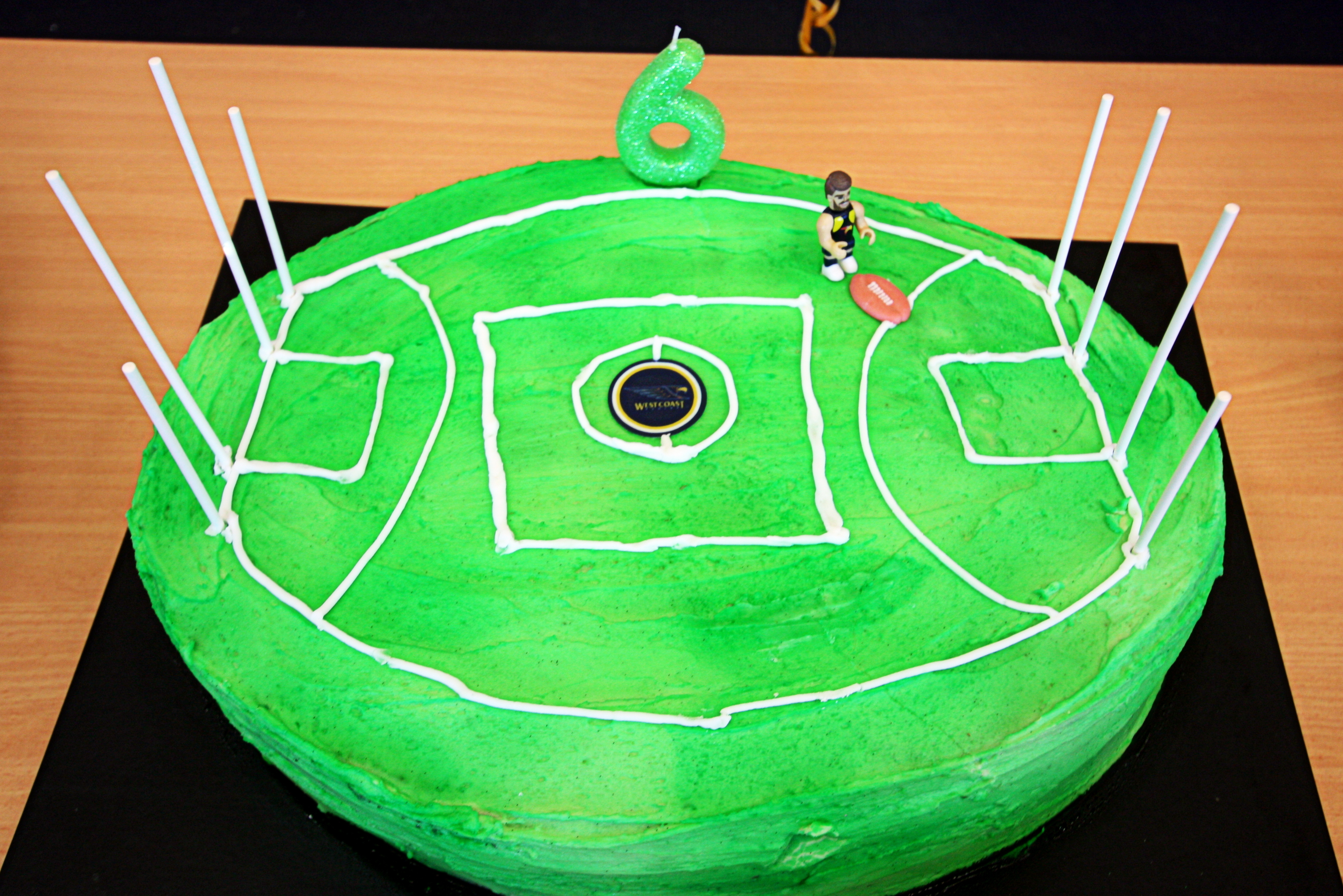
this week's home-made asymmetrical Aussie Rule football cake

this week’s home-made Aussie Rules football cake

Why cake ? Because joy and deliciousness are nutrients in their own right. ~ Jude Blereau

I make about two cakes a year, one for each of my children’s birthdays. One year ago, baking and decorating my eldest son’s cake prompted a blog post in which I compared making a novelty birthday cake to doing a PhD. This year, baking his double-layer chocolate cake (decorated as an AFL football field) had me thinking: this cake making business is a lot like writing, particularly academic writing.

My boys are 4 and (just) 6, so on my one-cake-per-child’s-birthday / two-cakes-per-year average, I haven’t baked that many cakes. Yet this week’s cake (pictured above), is the first cake that has felt stress-free to make, and first one for which I haven’t made big mistakes in the making. In the past my cake and icing mixes have split and curdled. I have broken cakes trying to get them out of the pan. There have been times when I decorated cakes the day before serving and the colours from the candy bled into the icing. Once, a heavy cake topper figurine sunk into the cake overnight. Earlier this year, I got a knife caught in the beaters while making icing, which resulted in me icing myself and the whole kitchen, including the ceiling. I didn’t feel quite the Nigella-esque image of domestic goddessery when I couldn’t see through my tears and icing-splattered spectacles.

This week there was none of the cake-anxiety drama. Baking and decorating were calm and enjoyable. Much of this was due to the knowledge and skills I have gained over time, as well as processes I have developed for this task. I knew to leave my ingredients out so that they were room temperature when I used them, preventing mixes from splitting. I knew to alternate mixing in dry and wet ingredients. I knew to take the time to cover the whole inside of the pan with carefully-traced-and-cut-and-placed bake paper so that the cake would slide out easily, with a now-practiced flourish, onto a wire rack. I knew to ice the cake while it was partly frozen to prevent crumbs in the icing, and to leave the extra decorations off until the icing was set so that the colours didn’t bleed. I had a familiar routine set out over a few days which made the process manageable. I also knew my materials better, what they could and couldn’t do. My expectations were managed. The cake was a bit lopsided, the icing a bit uneven, the drawn lines a bit skewwhiff. These imperfections were the marks of me as the maker, and I was ok with those idiosyncrasies. They were the ‘voice’ or the ‘me’ in the cake.

And so, from baking and decorating to writing …

My reflections on my journey as a novice baker and decorator remind me of my arc as an academic writer. The brief for each cake (footy! outer space! race track!), or each paper or chapter (this journal! that book! this field! that theory!), is different, requiring planning and consideration at the outset about how to proceed in order to reach a particular end point. Academic writing requires a nuanced understanding of its ingredients, materials and processes. The writer needs to understand, and be able to expertly manipulate, the language of particular disciplines and the language of particular journals. They build a growing knowledge of theories and literatures.

Like the baker, the writer develops a routine, a flow, an individualised writing process that works for them, including how to time their work, how to structure it, how to build layers of meaning, how to perfect and polish it in the final stages. They acquire tools and strategies for their work, things that make the work smoother and produce a better product. Some knowings and doings become internalized over time, with the writer having to think less about them, able to turn their attentions to refining their craft, developing deeper understandings and pushing the scope of their work beyond the limits of its previous iterations. Writers hone their voice, the ‘me’-ness in their writing, while watching out for their writing tics.

Like a cake made for a particular individual and a specific celebration, a piece of writing is often constructed with a particular audience in mind. Peer review of cake at a child’s birthday party is gentler than that in academia, but the party guest’s purpose is to appreciate and thank the host, while the peer reviewer’s purpose is to critically judge and improve the work. Once writing is published, more feedback comes in the forms of citations, downloads, reviews and social media shares. The audiences are different, but for both baking and writing there are accepted norms of feedback from others. A baker might dread the grimaced smiles of guests pretending to enjoy their cake while they leave slices unfinished, just as a writer might fear Reviewer 3’s scathing critique or the deafening silence of an uncited, un-clicked-upon piece, lying unread in physical and online spaces. Peer review is, after all, often like getting a punch in the face and a high five simultaneously.

While I am a sometimes-baker, I am a regular writer. I’m sure that if I baked with the constancy of my writing, it would improve markedly. I write something almost every day, for different purposes or different audiences. One distinction for me between baking and writing (obviously there are many differences!) is that I find I write my way into understanding, into knowing my own thinking and into interrogating my worlds and the writings of others. Writing is inquiry, identity work, illuminator. It is joy and struggle. And while a cake is devoured until only crumbs remain, writing lives on.

Textiles & academic writing: Material, process, product


This post, which could also be titled ‘remembering my 1990s feminist self’ is a re-emergence of some thinking I did a long time ago in my early years at university. After leaving school, I completed a Fine Art degree, followed by an Honours year. I’m writing this post as a way into self-inquiry, a way to write myself towards my hunch that my early days as a feminist-textile-artist-writer have underscored my more recent PhD work and academic writing. Big thanks to Katie Collins whose wonderful blog post on subversive material metaphors in academic writing sparked my thinking.

I was a painter from a young age, thanks to my artist mother, but I chose to study textiles as a major in my undergraduate Fine Art degree, rather than painting. This choice was due to the meanings inherent in textile materials, processes and products. A textile artist can weave in metal or print on latex. They can make work in the blacksmith forge or the sculpture studio. They can work with cardboard or furniture or paint or dye or thread or canvas or wire or plastic or found objects. The visceral and sensory experience of working with materials is central to the artistic process.

The materials a textile artist chooses, and the scale at which they magnify or miniaturise those materials, are deliberate meaning-making choices. The artist can choose needlework and hand-dying, or industrial Warhol-esque mass printing. They can applique or cut away. They can build or melt. They can assemble or destroy. They can stitch or slice. They can focus on the macro or the micro, staggering their viewer with enormous size or encouraging the viewer to come in, up close and personal.

Textiles is personal and political. It is also a subversive arena for artists, and often a feminist one. It pushes or rails against the stratification of ‘Art’, which has often meant the dichotomising of cerebral, thinking highbrow Art (upper-case ‘A’, often seen as done by men), and functional or decorative art (lower-case ‘a’, often associated with women and femininity). Historically, women were objects of art: she the body to be gazed at and sculpted. Or objects of art were personified as women: she the landscape to be scrutinised and painted.

The art historical devaluing of textiles pivots on its early treatment by critics, galleries and institutions. Aesthetic disciplines depend on recognised ‘powers that be’ to promote and uphold them. Early galleries and history books excluded textiles. Unlike painting and sculpture, textiles was historically seen as an unimportant discipline, undeserving of discussion, not worth deconstructing for message or meaning. The association of textiles with the devalued domestic space of the home, the opposite of the glorified public space of the art gallery, contributes to its dismissal.

So, why am I back here, thinking about textiles as feminist discourse or subversive act? Because Katie Collins’ post brought memories of my past self bubbling to the surface. And I am wondering to what extent my long-ago thinking and artistic practice, around the meanings inherent in working in and writing about textiles, has influenced my current and recent research and academic writing. On reflection, my PhD incorporated disruptive elements. While fitting largely within an accepted academic paradigm, it quietly challenged the ways that knowledge is traditionally written about. I used narrative method, literary metaphor and created three multimedia illustrations for the thesis, corporeal expressions of my thinking.

Now that I’m back in the eye of this needle, I need to think further about how textiles might provide a metaphor for research and academic writing.

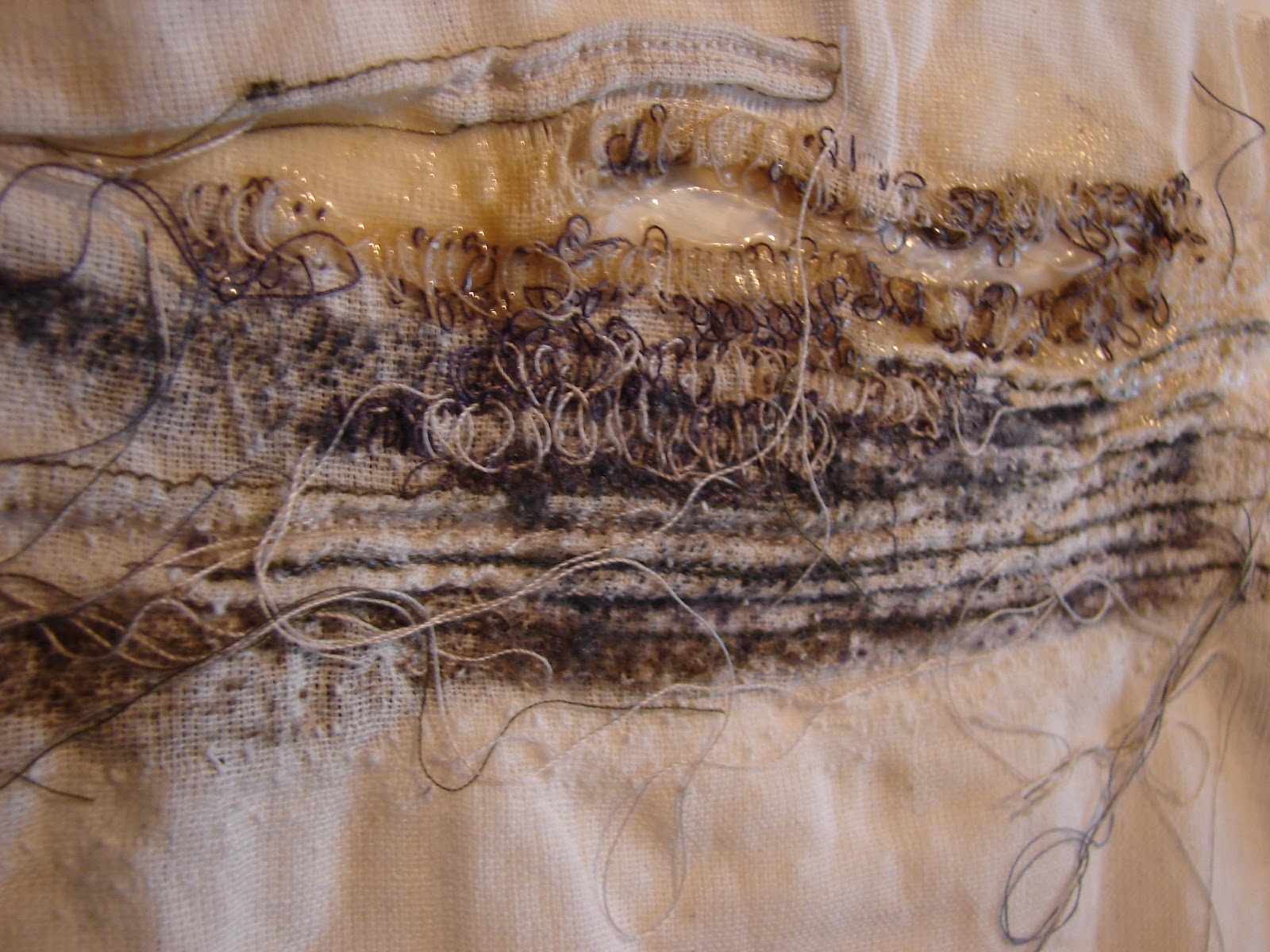
In the meantime, below I will type an extract from a paper that won me the Allport Writing Award in 1998, and was published in Textile Fibre Forum. It was an analysis of Vivienne Binns’ artwork Mrs Cook’s Waistcoat. The piece gives a sense of where my thinking was around textiles as feminist activism in the late 1990s. I have deliberately omitted an image of the artwork as I’m wondering if the text itself can paint the picture for you.

(For non-Australian readers, Captain James Cook was a British explorer who claimed to ‘discover’ the south eastern coast of Australia in 1770.)

_________________________________________

Extract from ‘Mrs Cook’s Waistcoat: Rewriting history through cloth’

by Deborah M. Netolicky (1998), Textile Fibre Forum, Volume 53.

Mrs Cook’s Waistcoat may be read as one woman’s attempt to rewrite and reinterpret human history. Here Vivienne Binns contributes to the discourse on journey, adventure, and historical significance, telling the pain-filled woman’s story of discovery and adventure—the burden of waiting and worrying, as opposed to doing and dying. Through this work she questions platitudes of the day, such as “men work and women weep”. Binns demonstrates that women were not passive, but were actively working contributing, storytelling, and recording their own histories, written in needlework.

Binns uses journey as metaphor, identifying with Mrs Cook’s expedition as expressed through the waistcoat for Mr Cook. She challenges the value placed on women’s histories and women’s work by challenging the notion that Mrs Cook’s journey was insignificant in terms of human history. She has chosen to elevate its significance, giving it voice, implanting it in the discourse of high art.

… Captain Cook’s wife is the “Mrs Cook” referred to by the title of the work which tells the story of her laboring over a waistcoat for her husband while he is away on a long voyage. The waistcoat mapnel is larger-than-life, describing the legendary reputation of Captain Cook in Australian myth-making, and the amplified importance that Binns intends to give to the making of the waistcoat.

Binns connects the historical representation and exploration of Cook’s journey with issues of women’s value, women’s history, and the construction of gender. In her version of this story, the ocean water is a metaphor for a bewitching, intoxicating vacillating, unpredictable femininity and female identity … Cook, the white, middle-class male, is discovering, navigating, defining, and fixing the limits of the Pacific Ocean. He is writing the experiences, histories, and memories of and for the water, which has no voice. It is formless, restless, intuitive, irrational, and passive, in need of taming, subjugating, explaining and defining by the rational, scientific logic of male discourse.

Nature is tamed by culture. Binns places herself in the middle ground. She associates herself as water, as a woman employing subconscious, intuitive processes – her own emotions, remembrances, and ideas about certain colours, materials, and ways of working. On the other hand, she calmly calculates, selects, and constructs her images, associating herself with the heroic explorer, just as the artist does on a continuous intellectual journey to discover new meanings. This marriage of antithetical metaphors reflects Binns’ concerns with shaping perceptions of women’s ways of knowing, living, researching, remembering, experiencing, and making. By yoking the two ways of working, she gives equal value to each.

…The waistcoat can be seen as a woman’s way of writing and recording history. Women write history in fabric, men write history in text. Binns makes Mrs Cook’s journey of waiting, sewing, and weeping, as valid as Captain Cook’s journey. The labour and time involved in making this waistcoat explain the wife’s dedication and devotion to her far-away husband. Binns questions the trivialisation of women’s roles surrounding issues of the domestic and ‘crafty’. … She uses the processes, materials, and experiences of women—traditional metaphors of women’s work—to weave a myth about women’s forgotten places in history.

Penetrated openings are created by slicing, cutting, and scarring the fabric, fabric that represents flesh as well a material. … Rolled up papers (the stuff of men’s work) penetrate exposed fabric (the stuff of women’s work); paper penetrates fabric; men’s work penetrates women’s work; culture penetrates nature. The slits in the fabric are peeled back like open sores, mirroring the multiple stab wounds that were the cause of Cook’s death. The ultimate satire of the story is that while Mrs Cook is lovingly creating the waistcoat for her husband, he is already dead, his stab wounds mirrored in her handiwork. This is reflected in the typed and hand-written text, which permeates through a layer of white paint: “Mrs Cook embroidered… this time the Captain did not return and the waistcoat remains unfinished”. This irony elevates her personal anguish, and points to the difference in men’s discourses and women’s ways of speaking through needlework.

…Binns … uses traditionally female and domestic techniques of women’s work: embroidery, pattern-cutting, and sewing. There is a sense of Mrs Cook’s physical involvement in this garment, her time, effort, and care. It is stitched, cut, glued. Elements, images, textures, and metaphors are exposed, denied, revealed, concealed, constructed, deconstructed, veiled, disguised, patterned, decorated slashed, sliced, torn, ripped, reconstructed. The piece is layered with the corporeal stuff of memory.

… Binns does not create a new reality, but reflects and reinterprets the existing one in a way that gives it new meaning. She puts one moment in one woman’s life under the microscope until it boils, making her audience reconsider women’s lives, women’s history and women’s art.