Anchoring, coping, organising: Post-It power

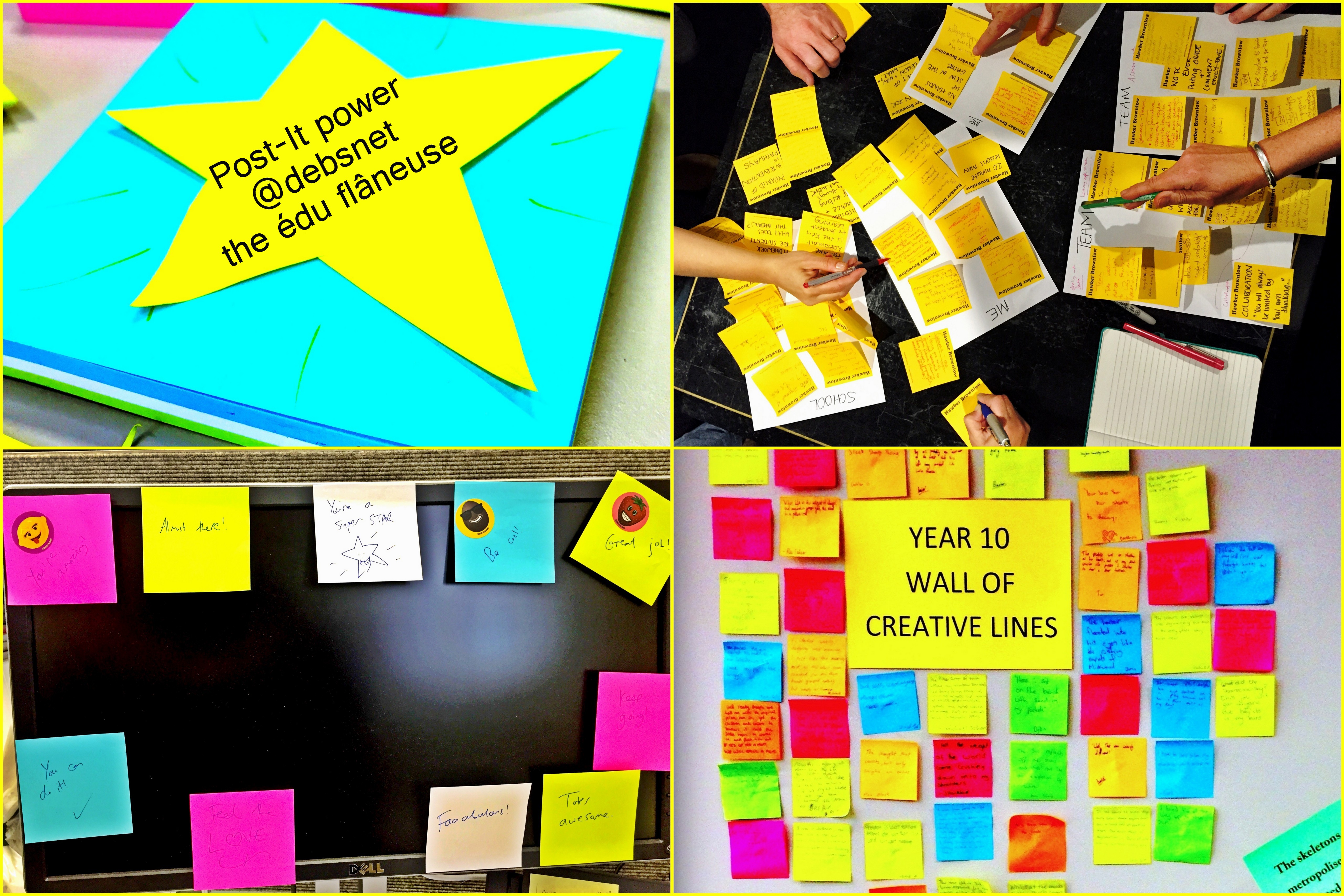
some of my Post-It moments

some of my Post-It moments

Great results, can be achieved with small forces. ~ Sun Tsu, The Art of War

Sometimes when it all seems too much, we need to distil all-the-things down to their essence. We need to simplify, to find a tangible anchor for the chaos of change or a reassuring system to help us bear the weight of pressure.

1940s Hungarian communist leader Mátyás Rákosi coined the term szalámitaktika or ‘salami tactics’. In order to gradually amass power, little bit by little bit, the idea is to attack a huge goal one tiny and deliberate slice at a time. When applied to big tasks or bold goals, szalámitaktika reflects the cliched saying ‘How do you eat an elephant? One bite at a time.’ It’s also reminiscent of Bill Murray’s title character in the 1991 film What About Bob? whose therapist prescribes him ‘baby steps’ to help him get through his day by focusing on literally putting one foot in front of the other. These simple approaches helped me to trudge my way through the work of a PhD. One step, one bite, one slice at a time.

At the moment educators in Australia are coming towards the end of our school year. Many of us dream that this is the time of year that we wind down, gently relaxing towards the summer holidays in a slow-motion dance of joyful teaching and leisurely planning for the next school year. Insert cocktail-drink-with-umbrella emoji.

The reality is that this time of year, for many of us, is manic, overwhelming and crushing in its pace and pressure. My way of dealing with the current mania is by tackling my to-do-lists with military precision and the salami-tactics baby-steps approach. My main arsenal in this operation? Trello? Spreadsheets? A wall of IdeaPaint scrawled with notes? No. It’s a stack of Post-Its.

The humble Post-It, an accidental invention born from a failed adhesive, has potent power. When Steve Jobs died in 2011, around the world people posted Post-It note messages on the windows of Apple Stores around the world. The Apple Store in Munich created a mural of Jobs’ face out of 4001 Post-Its. This month, these jewel-like beacons have been used in Subway Therapy in Manhattan, a post-US-election project incited by artist Matthew Chavez. Chavez set up a tunnel in the NYC Subway as a public art space onto which anyone could post their messages of support, optimism or hopelessness.

Post-Its can be used for collaboration. I’ve enjoyed getting staff or students to use them to draw together and reorganise ideas. Post-Its can be used for annotation, communication, display, feedback, personal notes and even for delight. Last year, a colleague was having a rough week. I took multi-coloured packets of Post-Its and covered her computer monitor with Post-It messages of ‘you can do it’ and ‘you’re awesome!’ and other such platitudes. It was silly enough to lift my colleague’s spirits. She left those notes there for some time.

But what I’m using Post-Its for now is to anchor me, organise me and help me cope with multiple work streams. I’ve used a Post-It note system for some time. I write a weekly or long-term to-do list on a Post-It, or more often a series of notes, and post them up in front of my desk. Sometimes I also have one or more desktop Post-Its going; these are my short term lists.

Importantly, as I complete tasks, I cross things off the Post-It list and triumphantly screw the Post-It up and throw it in the bin when the to-dos are done. The triumphant scrunching and tossing into the bin is an important ritualistic part of this method. It is in the closing of the fist, the flourish of the wrist and watching the note hit the trash that I feel a sense of accomplishment. This year I tried to move to a notepad system, but found that the notepad pages were too big; each could house an overwhelming list of to-dos that grew and grew and never seemed to be done. I could cross them off but I never felt that I was getting near the end of the list. I felt more despair and less success. I returned to Post-Its. They are small. They lend themselves to being do-able.

When I have a lot on the go at once, I adjust my Post-It system. Post-Its can be moved around and re-arranged. I can have different Post-Its for different categories of work. I can colour-code. I currently have a series of long-term and daily Post-Its on the go, but their manageable size means that I can feel a sense of accomplishment when I ‘finish’ one, or I can re-organise my thinking on a new note or series of notes.

My whole year has been about momentum, about putting one foot in front of the other, about being in motion. By deploying Post-It notes with military precision and ninja-like agility (or so I imagine), I am able to slice off one piece of salami, one bite of elephant, at a time. These unexceptional adhesive squares give me something tangible to hold onto in times of intense work. Their modest size allows me to celebrate small, daily successes, and I can breathe deeper and easier as I slowly watch my to-do lists dwindling, changing, or at least becoming more manageable.

It’s the little things.

Managing a rotation curation Twitter account: My week hosting @EduTweetOz

source: gettyimages

source: gettyimages

This week I’m experiencing my first time in the host chair of a rotation curation, or #RoCur, account.

I have followed @EduTweetOz for some time and noticed how different educators seem to breeze through the host chair. I’d never considered the thought they may have had to put into hosting. But once I was invited and then appointed for a week, I felt a greater responsibility than just doing what I do with my personal account, @debsnet. Was what I did and said in my personal account appropriate in a shared account? Surely I couldn’t just dip in and out as I saw fit, jumping down rabbit holes and leaping off on tangents, as whims arose? I felt I needed to have some clarity for myself in terms of how I would approach an account that is not my own; I’m just slipping on the robes for a week.

I was also aware that I needed to manage my time and wellbeing during the week, while honouring the account administrators, the @EduTweetOz community and the commitment I made to hosting. This week I am doing my usual working (teaching! marking! reports! planning for 2017!) and parenting, plus copy editing a textbook, reviewing an academic paper for an international journal and co-authoring a book chapter. So for me, planning how I would approach the account was as much about protecting my mental and physical health in a busy week as it was trying to do a good job. I didn’t want to feel anxious and guilty for letting the account down.

The thing is, there isn’t a clear set of protocols or measures for what doing a good job of hosting @EduTweetOz might be. The host is given carte blanche to manage the account for a week as they see fit. How do the administrators or followers measure a host’s success? Number of new followers? Number of tweets per day? Amount of engagement from others? Tone? Humour? Enthusiasm? Availability? Responsiveness?

Know thy purpose

In the uncertainty that comes with the freedom to do as I saw fit, I set myself my own purpose for the week. I was hoping to engage educators in discussion, and also highlight some of those voices in social media that I rely on in my own personal learning network. What a great opportunity to share with others the value of educators, academics and thinkers who energise and buoy me.

I’ve also been happy to add some of my favourite educators to those followed by the @EduTweetOz account. These were people I think will bring a richness to the community and the account’s timeline.

Be prepared

I knew I wouldn’t manage this week well without a plan, especially considering my multiple commitments. So before my week on the account began, I sat down and scoped it out. To what topics might I draw attention? Which tweeters’ and bloggers’ thinking could I share? My plan was loose but it gave me a sense of direction and I knew I wouldn’t run out of steam or ideas as the week wore on.

I decided to ask a question per day and made up a (regrettably long) hashtag to trace the conversations: #EduTweetOzSlowChat. I pre-prepared slides for each question and scheduled the daily question to be tweeted out each day at 4am Perth time, which is 7am Melbourne/Sydney time.

Scheduling those questions for when I am sleeping allayed some of my worries about being unavailable during the East coast mornings when much of the country is up and ready to engage. Each morning this week, by the time I wake up on the West coast I already have tweets to respond to on the account.

Consider voice

In my own Twitter account I am comfortable with my voice, the way I ‘speak’ and communicate. While I was absolutely comfortable with being myself during my @EduTweetOz week, I also felt a different sense of obligation to the account administrators. Is my authentic social media voice appropriate in an account administrated by others and on which I am a guest? Can I say exactly what I want in precisely the way I want? To what extent do I need to be tactful or restrained?

On my second day I found myself in amongst a lot of humour and parody, and I was wondering if it was ok to indulge in that, or if it might be seen as flippant, and if that mattered, or to whom it mattered (oh, the overthinking!). I found myself, in the first couple of days, hyper aware of what others might think. I have found my groove, though, and settled into it.

Different educators have different styles: friendly, supportive, provocative, intellectual, colloquial, personal, academic. That’s the beauty of a #RoCur account. @EduTweetOz sets this diversity up nicely by posting an interview with the week’s host as a kind of introduction; here’s mine.

Engage with community             

I was aware of the opportunity and responsibility that comes with 10K+ followers, more than double the amount of followers I have on my personal account. I know that if I magnify voices, accounts or tweets across the week, they will have some reach. On what basis am I making decisions about what to project into the Twitterverse from this account to which I briefly have the keys?

I decided to retweet most responses to the account, in order to amplify the conversations being had in that space, and as a mark of respect and appreciation. Most people have been applying the @EduTweetOz Twitter handle to their own tweets for real dialogue rather than blatant self-promotion.

So far, I’ve been pleased with my daily chat questions as a way to begin conversation. Interestingly, my first daily question was the most positive, and has received the least response. The questions that have been around more controversial or complex issues have incited the most community engagement.

I also attempted my first Twitter poll, which is still open for voting at time of writing. I figured that with a large, diverse following, I could canvas a range of community opinion. The options I offered in the poll were crowd-sourced, emerging from the day’s responses to my question around what causes educators to feel skeptical or despairing about education.

………………………………………………..

I still have a couple of days left of hosting the @EduTweetOz account this week. I’m enjoying the foray into a different social media experience. In addition to my own reflections, I can recommend this post that Aaron Davis wrote after he hosted the account last month. Both of us reflect that a rotation curation account comes with ethical decision making and an opportunity to give back to the village.

Meanwhile, I’m here all week. Try the veal.

Writing productivity this Academic Writing Month #AcWriMo 2016

acwri at Melbourne airport

acwri at Melbourne airport

November isn’t just Movember and Dinovember. It’s also Academic Writing Month (#AcWriMo), the time for academics to publicly shout their writing goals from social media soapboxes everywhere. Ironically, at the moment work is taking over all my working and spare hours and my academic writing pipeline is suffering from inertia as a result. I haven’t been able to make the time to acwri, despite making constant lists that include acwri targets (respond to revisions! write draft paper! scope out argument! complete literature review!).

For me, academic writing is both unpaid work and a labour of love. While I don’t need academic publications for the work I do in my school, I write journal and conference papers because a) I think my research and writing have something to offer, something to say, and b) I enjoy the writing, the writing-thinking, the off-shoots of ideas from my PhD thesis that I now get to play with, and opportunities for co-authorship.

This blog both gets in the way of my academic writing and helps with it. It takes time and discipline to blog (I try to blog at least once a week, usually on a Friday), but I find that blogging keeps my writing wheels oiled and turning, which flows over into my scholarly writing. By blogging weekly, I never feel out of writing practice, even during these times when my academic writing slows to a barely perceptible drip.

Despite my inertia of the last few weeks, I share below some of my own approaches to academic writing productivity. I could call this ‘5 tips for productive writing’, but I agree with Naomi Barnes that tips aren’t always helpful.

……………………………………………………

Count more than you can count

I wrote last AcWriMo that successful writing is more than word counts. Sure, sometimes it’s motivating to hit a word count milestone. Every time I hit a 10,000 word number during my PhD felt like I was getting closer to somewhere, something, the end product.

If, like me, you write a lot and often too much, it can be satisfying to cull words, to watch the count go backwards. I cut 15,000 words from my PhD in the final editing stages. There’s joy in word cutting, too. Refining, pruning excess, making the writing better, stronger, clearer.

Sometimes it’s useful to use a Pomodoro timer or a bomb timer to give a sense of writing focus and urgency. I rarely use timers, but I often write to the time I have. One hour while the kids nap. Forty minutes between weekend commitments. Stolen moments before the family wakes. Having such little writing time means that I am highly absorbed when it comes. There’s no time to be distracted, dithery or unfocused. I prepare writing goals and materials for the times I map out, and when they arrive I write like a tropical cyclone.

Write where it works for you

I need quiet or a steady hum to write. Total silence works, but I can’t often get silence, or even solitude, at home, unless my husband takes our sons out.

A busy café with indiscernible noise also works for me. I love writing in cafes because a) I don’t feel alone as I‘m surrounded by people, b) I’m not distracted by domestic chores, c) there’s good coffee and d) it can make writing seem more pleasurable, like a holiday or an indulgence. I love the low hum of indistinguishable conversation as the soundtrack to writing.

I even considered acknowledging some of my favourite writing cafes in m PhD acknowledgments. The owners and baristas recognised me. I was the polite woman who would sit alone, drinking two coffees over two hours, tapping away at my keyboard or shuffling through annotated drafts. Quarantining myself in a public space for a specific block of time allowed and motivated me to just write.

Write when it works for you

Know your most productive times. I am at my best between 7am and 11am. This is when I zing with energy, ideas and the kind of focus that means that words and solutions come easily.

I am at my productivity worst from about 3pm to 6pm, during which I usually have the least physical and mental energy. Then I have a strange energetic renaissance between 8pm and 10pm, which are often the hours that I blog. Yet, sometimes in the evening I am too tired for anything but the most menial tasks: calendar entries, checking references, basic admin. I’ve learned that it’s better to close the laptop rather than stare uselessly in a kind of slo-mo catatonia.

To write my PhD, I had to leverage my best writing times and avoid my worst ones. There’s nothing more frustrating than spending time writing and not getting anywhere.

Use the in-between times

The shower, sleep, a walk, standing at the checkout, taking children to the park. These are all opportunities for cogitation and idea percolation. I often find, especially if I know I’ll be racing between commitments, I will deliberately plant a writing problem in my mind by thinking deeply on it for a time, and then let go of it, knowing that my brain will somehow continue to chip away at it while I do other things. Sometimes I revisit the problem mindfully, and sometimes a solution or idea will bubble up, unsolicited. Our writing solutions and growth often happen while we aren’t watching.

Work with others

I am new to co-authorship, but am finding that the writing relationships I am now nurturing push me beyond the kind of thinking I do on my own. I’m exploring new theorists and fresh methods. Collaborative writing can grow us beyond our writing selves.

……………………………………………………

Despite my inactivity thus far this #AcWriMo, I appreciate the social media reminders of the importance of academic writing, and of making time and space for it. This is true even for someone like me who is on the academia outer, an adjunct and a practitioner in another field.

I can give myself permission to ride the ebbs and flows of work, writing, parenting and being a friend/spouse/daughter/sister/colleague. For now I will keep scribbling my acwri lists, keep revisiting my acwri goals, keep putting my eye to my acwri pipeline. I’ll get it moving again soon.

On the emotional, human dimension of teaching

A world map for World Teachers’ Day (photo by me)

On today, World Teachers’ Day*, I‘m going to reflect on my experience of teachers as a school student. I’ve written about what research indicates about ‘good teaching’, but this post shares my personal story of the teachers I remember, and how they shaped me as a teacher.

Growing up, but especially during high school, I didn’t want to be a teacher. I think partly this was because of my dislike for those in authority who saw their role as to uphold what I saw as petty rules. While on the one hand I was a geek who diligently completed my school work and strove for academic success, I did not want to fit into norms set by others. I skipped some classes. I didn’t see the point in wearing the school uniform, unless it was to shackle me to conformity as part of a homogenous group. One year in high school I called the State Education Department and checked their rules on wearing uniform, and then asked that they contact my school to explain that uniform was not legally enforceable. It turned out that the only enforceable guideline at the time was that students in government schools be neat and tidy in appearance. (Yes, I was that student.)

In Year 8, my English teacher insisted that I rewrite a creative story entitled ‘Stop, thief!’ Although I had worked hard and long to craft the story, she told me that a thief should not be good looking with a “chiseled jaw,” and that I was to rewrite him as ugly with a hooked nose and hunched back if I wanted to pass. This felt to me to be an unjust response, one that not only supported what I considered to be an unrealistic and one-dimensional stereotype, but one which failed to acknowledge my effort and deliberate authorial decisions. I wanted my villain to be good looking!

In Year 10, after approaching a teacher to transfer into his higher Mathematics class, I did not pursue the subject change after he told me he wouldn’t speak to me unless I tucked my shirt in.

These experiences contributed to my view of the identity of ‘teacher’ as authority figure and stickler for petty rules, an identity I had no desire to emulate.

After deciding eventually, and almost accidentally, to pursue teaching as a profession, my “I don’t want to be a teacher” sentiment morphed into “I never want to be a teacher like that but I do want to be this kind of teacher.”  As a teacher I am often an advocator for looser rules (such as encouraging mobile technology in class, rather than banning mobile devices) and am guilty of ignoring those rules which I think are there for control and assertion of authority, rather than for learning and developing students into self-regulating, autonomous, responsible, thinking individuals.

At school I connected with teachers who I thought cared about me and my learning, who gave me some scope to try alternative methods and pathways of learning, and who did unexpected things: the Literature teacher who helped the class read a difficult novel by providing coffee and breakfast while we listened to the audio book; the Mathematics teacher who differentiated to allow her students to feel success; the English teacher who would surprise the class by wearing elements of costume while enacting scenes from texts. 

I try to emulate these things in my own teaching, thinking of little ways to surprise and inspire. I began one lesson while standing on a chair, conducting with a pair of drumsticks I had confiscated. I take students to the river or the high street to write. I surprised a very serious class of International Baccalaureate Diploma students, with whom I had been doing difficult laborious text analysis work, by providing them with textas, pencils, reams of paper, and chocolate biscuits (Arnott’s Tim Tams and Mint Slices for my Australian readers). At the end of all our hard work trying to understand 800-plus page Anna Karenina, they were to spend a couple of hours creating a visual representation of the novel. The result was a thoughtful and inspired creation, a train driven by Tolstoy, in which each carriage visually represented a key moment in the novel, with a lit candle at the front of the train and a burnt-out candle at its end, representing Anna’s journey.

A later experience, as a postgraduate student in a class during my Graduate Diploma of Education, supported and developed these earlier experiences of the emotional dimension of being a student and of the impact of teachers and classrooms on student confidence. There I was, in a class of mature age Graduate Diploma of Education students. I was the youngest, at 20 years old, and the oldest among us was 62. We were asked to share our memories of the best and then the worst teacher we had ever had. What I noticed as my fellow students, themselves almost-teachers, responded to this question, was the emotions they seemed to experience as they recalled their memories of teachers who either inspired and encouraged them, or who made them feel small, exposed, and uncared about. I was reminded of the famous quotation, attributed to a number of people including Carl Buehner and Maya Angelou: “People will forget what you said, people will forget what you did, but people will never forget how you made them feel.”

It occurred to me during that Grad. Dip. Ed. class that the impact of a teacher, and their behaviour, on a student, each student, can be powerful and lifelong. That what for the teacher may be a throwaway line on a bad day, may for the student be a criticism which cuts deep and lasts a lifetime. It reminded me of the vulnerability of students and the turbulence of finding a sense of self throughout childhood and adolescence. This led me to continually reflect upon the effect I am having on students, my building of relationships, and my self-monitoring of things which may be seen by students as hurtful.

So while I often take an intellectual approach to teaching, looking to evidence, research and impacts, I think we also need to remember and recognise the deeply emotional, human experience of being both student and teacher. Happy World Teachers’ Day!

* World Teachers’ Day is held internationally on 5 October, but as this usually falls in the Australian school holidays, Australia celebrates it on the last Friday of October.

Personal and organisational vision

vision

The only thing worse than being blind is having sight but no vision. ~ Helen Keller

A key theme in literature about school change is the need for compelling, coherent, and shared vision. See, for instance, Hargreaves and Shirley’s 2009 The fourth way, Senge’s 2012 The fifth discipline, Fullan’s 2001 Leading in a culture of change or Fullan and Quinn’s 2016 Coherence. For Peter Senge, shared vision is one part of nurturing a ‘fearless and open community inquiry’. For Michael Fullan, not only is shared understanding and purpose of members of an organisation important, but any new initiative must be coherently connected with the culture, mission, and moral imperative of the school in order for the change to be sustained over time.

So vision is important, but in order to propel a school forward it must be shared. While the individual teacher is sometimes the focus of school reform (improve the quality of each teacher’s teaching!), it is collective expertise–in teams, schools and the profession–that can shift beliefs, practices and narratives in education.

We need to constantly consider the symbiosis between individual and group, teacher and school, person and system.

Personal vision, that of the individual, is sometimes overlooked in the conceptualisation of vision in education. Yet educators’ identities, emotions, lived experiences and visions (for the kind teachers and leaders we aspire to be, for the influences we aspire to have on our students and school communities) are an important ingredient in the educational landscape. In her 2006 book Seeing through teachers’ eyes, Karen Hammerness longitudinally explored four teachers’ visions, and how these evolved and were enacted over time. She found that teachers were continually searching for a place that aligned with their visions for their students and their classrooms; they were always looking for a match between their identity and their context.

So schools seek to develop commonality of vision and purpose, while individuals seek to align with their contexts in terms of their own beliefs, identities and the purpose that propels them in their work.

Schools are more than workplaces; they are organismic settings for learning, collaboration and transformation. At worst, they can be ill-fitting contexts or pits of anxiety. How we feel and fit in our context influences our work and our community, and the experiences of our students.

I’ve written before about Costa and Garmston’s notion of holonomy (see Cognitive Coaching: A foundation for Renaissance schools), which draws together the individual and the larger system, whether that be team, organisation, profession or system. Costa and Garmston base their conception of holonomy on Arthur Koestler’s work around the word “holon” as something which operates simultaneously as a part and a whole. The holon is independent and interdependent, disparate and united. Koestler combines the Greek word “holos” meaning whole, and the suffix “on,” which indicates a particle or part, in order to conceive of the holon as a part-whole.

Each person is both independent agent and interdependent part of the group, responsive to the larger system. Holonomous individuals, according to Costa and Garmston, possess the capabilities to maintain self-directedness while acting independently and interdependently; they are simultaneously self-regulating, responsive to the organisation and able to influence those around them. They are flexible and efficacious, simultaneously part and whole.

As I work in my own school in the arenas of professional growth and performance review, we are working towards, not just a shared vision, but also processes, practices and structures that are connected with the through-lines of our personal and organisational visioning, our shared beliefs, values and purpose.

Aligning what schools do with shared vision and purpose can be challenging work, requiring constant focus and attention to the relationship between intent and enaction. There are tensions to navigate if a school’s vision is at odds with external measures and expectations. Or if a school’s vision is at odds with those of its individuals.

How might schools find ways to address tensions between their contextual purpose, and an educational system that might rub against their grain? How might schools draw individuals into personal and organisational visioning? How might we each continue to kindle our internal purpose, that of our colleagues and that of our profession? I have some answers for my own context, but am continually asking these kinds of questions.

Research-informed education practice: More than lip service and shallow pools

stromatolites in shallow pools

stromatolites in shallow pools, Shark Bay

In a variety of educational contexts I have recently heard everyone from keynote speakers to respected educational practitioners talk about research in education, especially the notion of bringing a knowledge of research into schools.

The general gist of what I’ve been hearing is ‘we need research-informed practice’ and ‘we need to look to the best research to inform decision making in schools’. These are statements I absolutely agree with, but digging a little deeper has led to disappointment. When people have gone on to explain what they mean by those fashionable sweeping statements, they have mentioned one or two researchers or studies of which they are aware. These oft-mentioned authors or studies seem to be those that are highly promoted, wheeled out by well-funded organisations or publishers, or neatly packaged into half-day workshops or laminated sheets. Some are those promoted as a one-stop-shop of what works in education: the simple answer for which we’ve all been searching!

The problem is that education is not simple, and neither is research. Learning, teaching and school leadership, are highly complex and contextual. There can be no simple answer, magic wand, silver bullet or laminated sheet of pretty-looking graphs that can transform education. (I was, however, recently challenged to have a go at thinking about in which directions we might look in order to improve teaching and learning.) As Dylan Wiliam suggests, research can point us in profitable directions, illuminating those interventions on which we might best spend our time.

Research, too, is highly complex and multifaceted. To engage effectively with research, educators need to understand its limits and what it can offer. All research is limited. I’m well aware of the limitations of my own research. I know my research has something to offer, but that offering is a small nudge, a keyhole insight, a singular thread in a tangled web. Academic writers are constantly delineating the parameters of their work; what their work has done and can show, and what it hasn’t done and can’t show. Each study or paper or chapter illuminates a different part of the tangled web of research in education.

As educators teaching, or leading teachers, we need, not just to be able to spout a couple of scholarly names, assert that ‘so-and-so tells us that X doesn’t work’ or make decisions based on appearing to engage with research. We need to engage with, pore over and deeply interrogate—with a critical eye—a range of research. Jon Andrews points out that deeply influential people who penetrate huge educational conversations and decisions may be going unchallenged by the profession at large. Marten Koomen traces some of these influential figures and their spheres of edu-influence.

John Hattie’s meta-analyses are often referred to in education circles as examples of research that tells us what works; it is certainly his name that I am currently hearing most often in schools and at conferences. I respect Hattie’s work and that there are things it can tell us, but am skeptical about the ways in which it has been universally adopted as a ubiquitous beacon of research light in the edu-darkness. Dylan Wiliam, in his 2016 book Leadership for Teacher Learning, discusses the limitations of meta-analyses and their application in education, cautioning that “meta-analysis is simply incapable of yielding meaningful findings that leaders can use to direct the activities of the teachers they lead” (p. 96). Snook et al. and Terhart also present critical perspectives on Hattie’s book Visible Learning. This is just one example of how a particular set of results has become so widespread that it unquestioningly becomes part of the fabric of edu-talk.

We can’t pat ourselves on the back for unquestioningly consuming the most pervasive or seductively-packaged research. Gary Jones’ blog is a good place to start for those looking for considered sense-making around how schools might interact with research.

I am committed to playing a part in bringing the worlds of research and practice, theory and action, academia and schools, meaningfully and purposefully together so that they speak to and inform one another. It’s why I am pleased by the schools in Australia embracing school-university partnerships and internal roles like Head of Research. This recent report (by Tom Bennett, featuring Alex Quigley and Carl Hendrick) tracks some of the impacts, successes and challenges of Research Lead roles in schools in the UK.

I believe that schools can lead and generate research. They can develop roles and processes that bring critical organisational mindfulness to the movable feast of edu-research and how practitioners might navigate, probe and be informed by it. Let’s do more than wade in shallow pools of research literature or pay lip service to being research-informed. Instead, let’s find ways to lead and embed research thinking and informed decision making into the fabric of what we do.

Rethinking professional learning: an academic paper for JPCC

This week I’m thrilled to see my paper ‘Rethinking professional learning for teachers and school leaders’ published in the Journal of Professional Capital and Community. This journal, whose Editor in Chief is Andy Hargreaves, boasts an Editorial Board including Linda Darling-Hammond, Michael Fullan, Alma Harris, Karen Seashore Louis, Pasi Sahlberg, Helen Timperley and Yong Zhao. My paper appears in Volume 1, Issue 4, alongside a theoretical paper by Dennis Shirley. As an early career researcher, I couldn’t ask for more distinguished company.

Even more pleasing is that the journal is open access during 2016, so free for anyone to download and read. Open access to the paper means that it can be accessed by practitioners who so often don’t get to read and engage with the literature in (often pay walled) academic journals. In fact, it has already been downloaded (at today’s count) 1689 times. Wow. That’s a bunch more times than my PhD thesis.

The paper, which draws from the lived experiences of teachers, middle leaders (often a forgotten group in education literature) and executive leaders in one Australian school, outlines the findings of my PhD around what makes professional learning that transforms beliefs and practices. It discusses my study’s response to the questions:

  1. What is the role of professional learning on identities or growth?; and
  2. What professional learning is transformational?

My PhD found that transformational learning (as defined by Ellie Drago-Severson, 2009, as that which actively shifts cognition, emotion, and capacity) is: collaborative and individual; occurring in life, school, and work; and requiring elements of support and challenge. Not only was it lifelong, but it was life-wide. For these participants, it is life experiences, as well as professional experiences, that influence their professional beliefs and practices. The following is a table, which didn’t make the final cut of the paper, shows the range of features of professional learning found in my study.

tabulated findings around professional learning

tabulated findings around professional learning

This table shows the variety of experiences that educators in my study considered transformational for themselves. These experiences included relationships with family members; role models and anti-models of teaching and leadership; post graduate study; difficult life experiences; becoming a parent; and connecting with others at conferences or via social media. It included heutagogical (self-determined) learning, as I outlined for this blog post for the Heutagogy Community of Practice.

It also included, especially for leaders operating at an executive level, the time and space for silence, reflection and thinking. The research interviews themselves proved to be spaces of learning for some of the school leaders, who saw them as an opportunity to be listened to intently and to think deeply about their learning and leading.

The participants in my study had some important cautions about professional learning and about school interventions. They cautioned that a mandated approach to professional learning, even if differentiated, might not address the needs of all professional learners. They wondered about how to honour the individual teacher and the organisational priorities when leading professional learning in schools.

The paper concludes that, while my study intended to explore the ways in which educators’ experiences of professional learning form and transform their senses of professional identity, it found that it is not just professional learning, but life experiences that shape professional identities and practices. That is, our teacher selves and teacher actions are moulded by critical experiences that tangle with and shape our identities, lives, relationships, and emotions. The best professional learning, as suggested by this study, is highly individualised and knottily enmeshed with educators’ senses of self, of who we are professionally.

Anyone who teaches knows that we cannot separate our teacher selves from our non-teacher selves. As teachers our lives affect our learning and teaching, and our learning and teaching influences our lives. For many teachers, ‘life’ and ‘work’ are well beyond blurred. We are humans who teach and teachers who exist as humans in the world. The leaders in this study tended to describe themselves as either teachers who lead or as leaders who teach; they remained teachers in their identity self-perceptions. See this post for further musings about the notion of teacher identity, that ‘being a teacher’ stays with many of us beyond our years in the classroom.

One suggestion to emerge from this paper is that we would benefit from rethinking what it is that we consider and label as ‘professional learning’. Professional learning is not hours logged on a spreadsheet or entered into an app. It is not necessarily being in a room with other educators at a course or conference that is labelled ‘professional learning’ (although it might be). It is those critical moments across our lives and work that shape the core of who we are, in and out of the classroom and the boardroom. Professional learning can be personal, unexpected, unscheduled, nonlinear, messy, unbounded, and unacknowledged.

Can we redefine ‘professional learning’ in more expansive and flexible ways? How might we acknowledge those hours educators spend blogging, or studying, or tweeting, or visiting schools, or collaborating intensively, or volunteering in the service of others? How can leaders lead the learning of teachers in ways that honour their individual learning trajectories and their own agency? How might we rethink our systems and schools in order to focus, not on hours of what is easily labelled or effortlessly deployed (staff day scattergun PD, anyone?), but on what actually engages us and changes our cognition and our capacities?

Trust and support teachers: My New Voice Scholarship panel speech

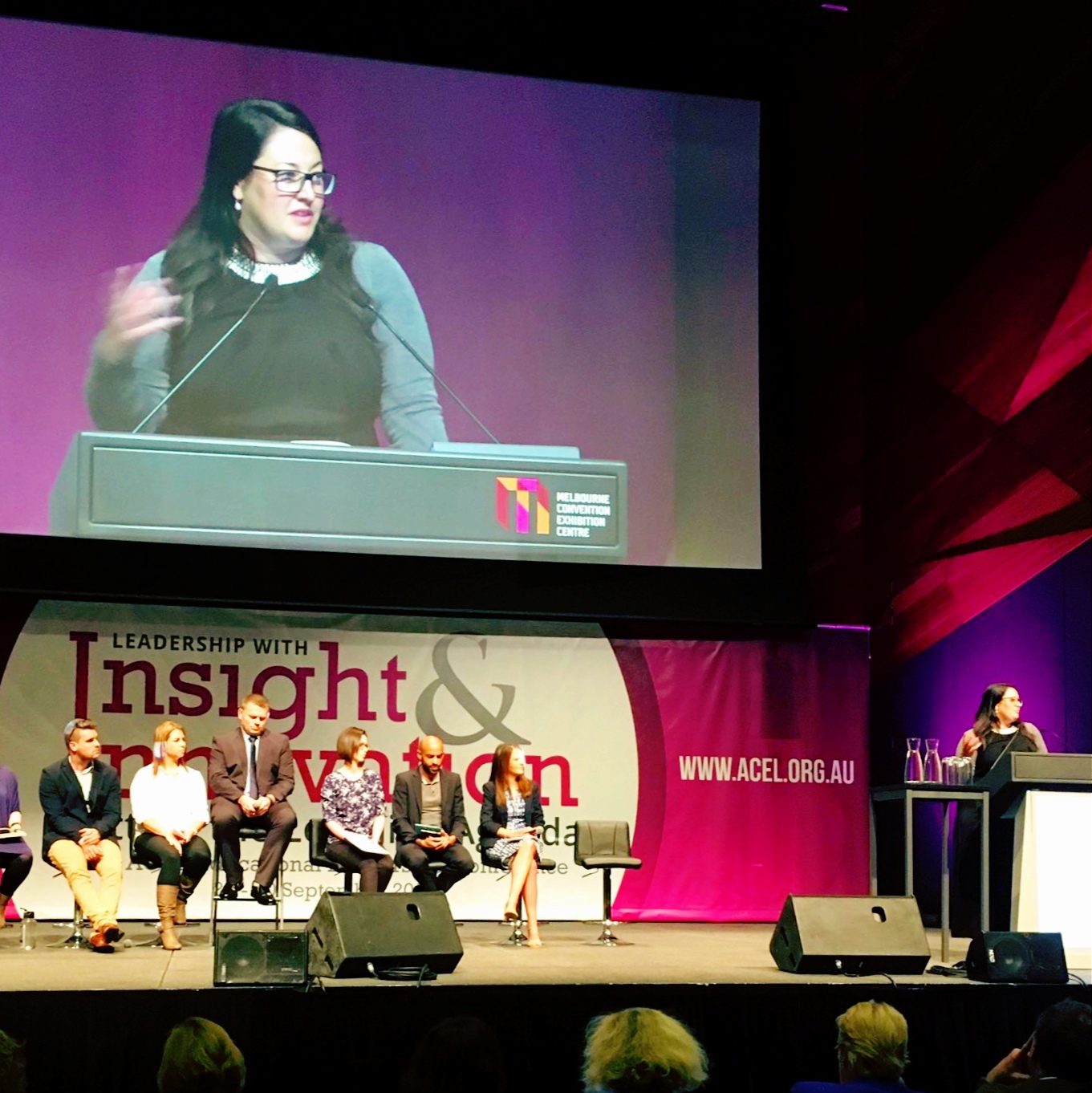
speaking yesterday at the Melbourne Convention Centre

speaking yesterday at the Melbourne Convention Centre

Yesterday I had the pleasure of speaking on a panel of ACEL New Voice Scholars (list of awardees here) at the Melbourne Convention Centre. As a representative of new Australian voices in educational leadership research, I spoke in front of an auditorium of 1200 educators in response to the provocation: ‘If you could wave a magic wand, how would you transform education?’

The following is a version of that speech (I tend to go off the cuff a bit, so it’s not identical). It is based on this think piece I wrote for the ACEL Perspectives publication which is more measured and referenced, and less rhetoric-laden than my speech. I’ve added links to other blog posts to this post, as feedback from those at the conference has been that they would like to know more about the school professional learning model about which I spoke.

Thank you to the Australian Council for Educational Leaders for offering me the platform-soapbox-orangecrate from which to speak passionately about what I think is important for leaders, teachers and students in our schools.

*                                                      *                                                      *

(Hello etc. …)

I am an English teacher by trade and have spent the last 17 years teaching and leading in schools in Australia and the UK. Most recently I have been leading a strategic project that developed a whole-school coaching model at my school, designed to do a number of things, including:

  • Improve teacher classroom practice;
  • Develop teachers’ capacities for reflection;
  • Depersonalise and open classrooms;
  • Develop a common language of practice; and
  • Improve the quality of professional conversation.

This intervention was strategically aligned, so it was top down in terms of being aligned with the strategic vision of the school, initiated by the principal and supported by the school board. But it was also middle out and bottom up, as the model was developed by teams of teachers, led by me. We took a deliberately slow process of prototyping, piloting, iterating and refining this context-specific intervention.

At the same time, while also parenting two small children, I completed a PhD in which I asked what it is that makes professional learning transformational and how school leaders can best lead professional learning for teachers.

(It was at this point that I said something like, “My doctorate was conferred in April, so if you see me around the conference, you can call me Dr Deb” which has resulted in everyone from the MC to delegates calling me ‘Dr Deb’ ever since!)

As someone who bestrides educational practice and research, I don’t believe there is a silver bullet or magic wand that can transform education, but I do believe we can work to positively influence it.

Two things we can focus on, in order to positively impact on our students’ learning, are the trust and growth of teachers.

At my school, we have developed a model for teacher growth that uses Cognitive Coaching, non-inferential lesson data, and the Danielson Framework for Teaching, to help teachers reflect on and grow their practice.

Non-inferential lesson data—that is, data that is, as much as possible, non-judgemental and informational—and shared standards of teaching, help our teachers to develop the depth and precision of their reflections on practice, while Cognitive Coaching helps teachers to surface their own thinking about how they can improve. Cognitive Coaching is not about solution-providing or advice-giving, but about mediating the thinking of teachers and helping them to find their own solutions to problems of practice, based on a belief in their internal capacity to do so. To paraphrase Dylan Wiliam: teachers know their own classroom and their own students best.

My PhD found that coaching, among other things, can transform teachers’ beliefs and practices. It also found that school leaders have an important part to play in leading the learning of teachers.

We need to avoid those policies and practices that pit teachers and schools against one another (such as merit pay), that promote competition and commodification, or that focus on external metrics, performative measures, rewards or punishments. These are all things that demotivate, de-professionalise and demean our profession.

To support teacher professional growth and improvement in practice, we need to focus on trusting teachers to be professionals with the capacity to grow. We need to properly support their growth through context-specific interventions for which we provide adequate training, sufficient time, appropriate resources, and processes to systematically review our effectiveness.

In this way, within our own schools, we can heighten teachers’ self-awareness, self-efficacy and collaborative expertise and positively influence student learning.

Should a coach be curious?

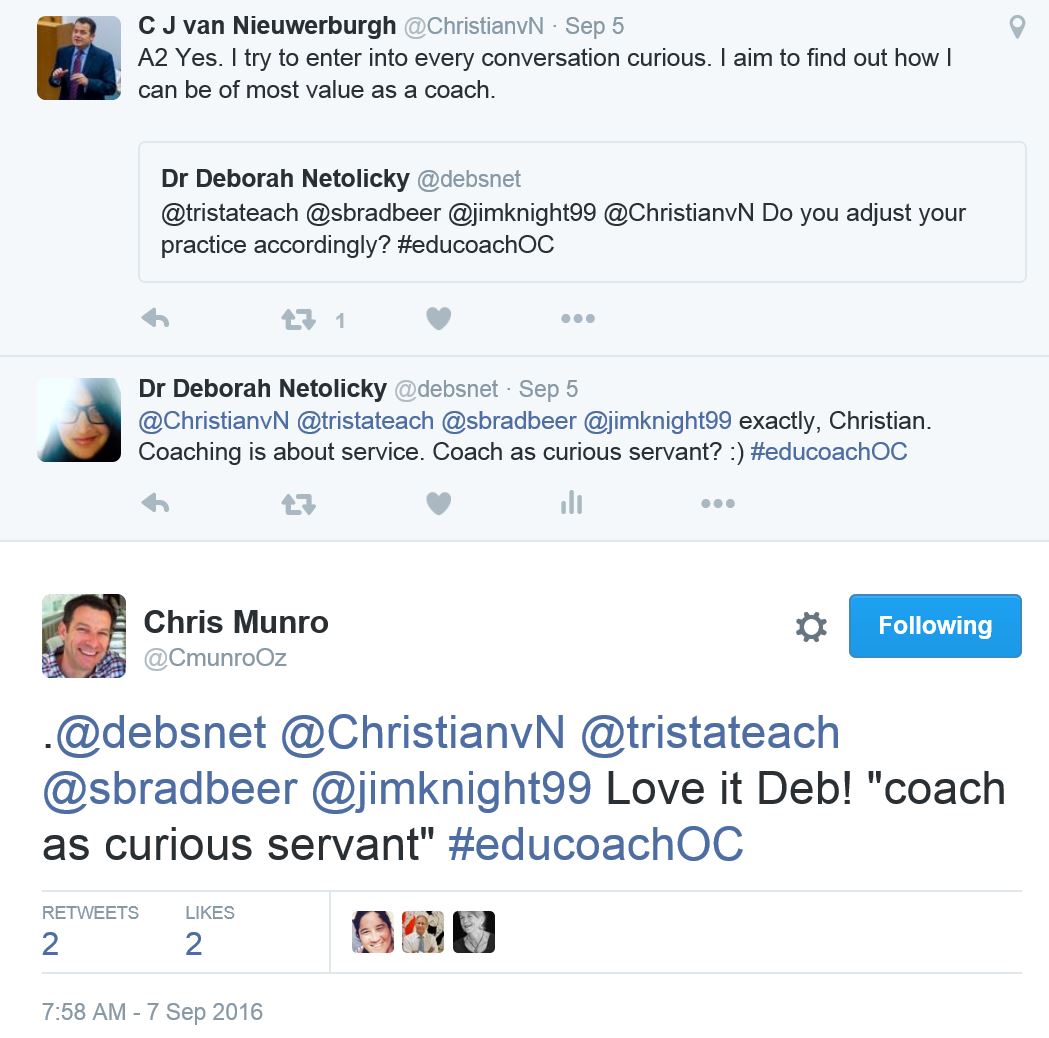
On Twitter recently I have noticed a few people talking about the qualities that a good coach might have. One of the qualities that has been raised more than once is that of being curious. During the last #educoachOC chat, I had this interchange with two respected voices in educational coaching, Christian van Nieuwerburgh and Chris Munro.

snippet of conversation from the last #educoachOC Twitter chat

snippet of conversation from the last #educoachOC Twitter chat

And it got me thinking. What might be the focus of a coach’s curiosity? Does being of valuable service as a coach involve being curious? Does being curious mean showing genuine interest in a coachee and demonstrating eagerness to hear the details of their experiences? Is it about paying close attention or finding out more? Does a coach’s desire to find out more make a coachee feel valued and empathised with, or does it sidetrack the purpose of the conversation?

The notion of coach curiosity rubs against the grain of Cognitive Coaching in which the coach–while encouraged to be open, inquiring, flexible, caring and compassionate–is instructed to set aside the following unproductive patterns of listening:

  • Autobiographical: This is ‘me too!’ listening in which the listener is compelled to share experiences of their own that they see as relevant to the speaker’s experiences. The coach needs to restrain their urge to be drawn into thinking or speaking about their own stories.
  • Solution: This is listening in which the listener is drawn to thinking up their own solutions to the listener’s problems. Rather than problem-solving, the job of the Cognitive Coach is to assume that a) the coachee knows their own context and problem best, and b) has the capacity to solve their own problems, using the coaching toolbox to help that person access their own internal capacities and thereby developing their self-efficacy.
  • Inquisitive: This is curious listening in which the listener wants to know more about the details of a particular situation. However, the purpose of a coaching conversation is not for the coach to know intimate details, or to provide advice, so what purpose does curiosity serve in a coaching conversation? Who is it helping?

This is what Art Costa and Bob Garmston write about inquisitive listening:

Inquisitive listening occurs when we begin to get curious about portions of the story that are not relevant to the problem at hand. Knowing what information is important is one critical distinction between consulting and coaching. As a consultant, a person needs lots of information in order to ‘solve the problem’. As a coach, a person needs only to understand the colleague’s perspective, feelings, and goals and how to pose questions that support self-directed learning. (Costa & Garmston, 2006, Cognitive Coaching: A Foundation for Renaissance Schools, p.65)

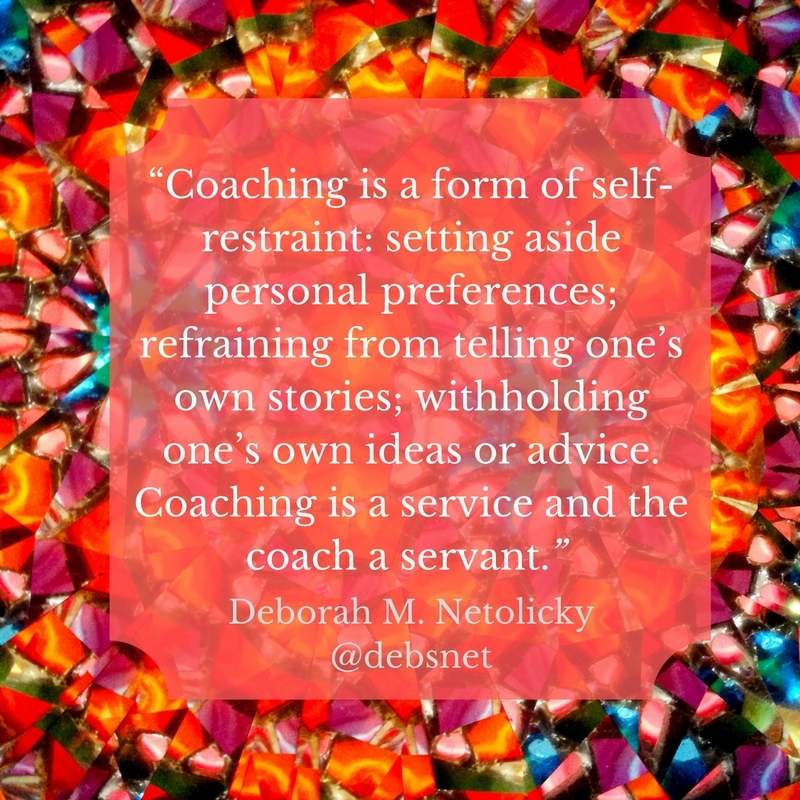
Coaching is a form of self-restraint: setting aside personal preferences; refraining from telling one’s own stories; withholding one’s own ideas or advice. Coaching is a service and the coach a servant. The coach is mirror, conduit, bucket in the well, water on the grass; a gentle influence that helps the coachee be the best version of themselves, and move towards where it is that they want to go with increasing capacity. In Cognitive Coaching this capacity development is focused around the Five States of Mind: consciousnesses, craftsmanship, efficacy, flexibility and interdependence.

So, should a coach be curious, or is curiosity a form of self-ish, rather than self-less, listening? If a coach’s questions are focused on seeking to understand the inner details of a coachee’s experiences, is that of value to the coachee? Often I find that as a coach I don’t need to know details. The coachee knows the details of their own situations and their thinking is benefited by being able to focus on where they want to go, rather than recounting minutiae for my benefit.

When I am being coached—my thoughts flying and forming and jelling and tumbling—I don’t necessarily want to be diverted by the well-intentioned interest of the coach. A coach’s curiosity to know more can sometimes take me from my own desire to move forward in my thinking, backwards or sideways to having to explain the specifics of my situation. My coach might not know the context or background of my issue, but I do. I don’t need help knowing the situation I am in; I need help to think my way to future solutions and successes. I want a coach to be present, to listen attentively, to hear, to paraphrase, and to ask me well-crafted questions that I haven’t thought to ask myself. Coaches might ask themselves: ‘If I’m being curious in this conversation, is that about me and what I want to know, or is it of benefit to the coachee?’

What do you think? Should coaches be curious, and if so, about what? If coaches are on a need-to-know basis, what exactly do they need to know?

Reflecting on my PhD graduation ceremony

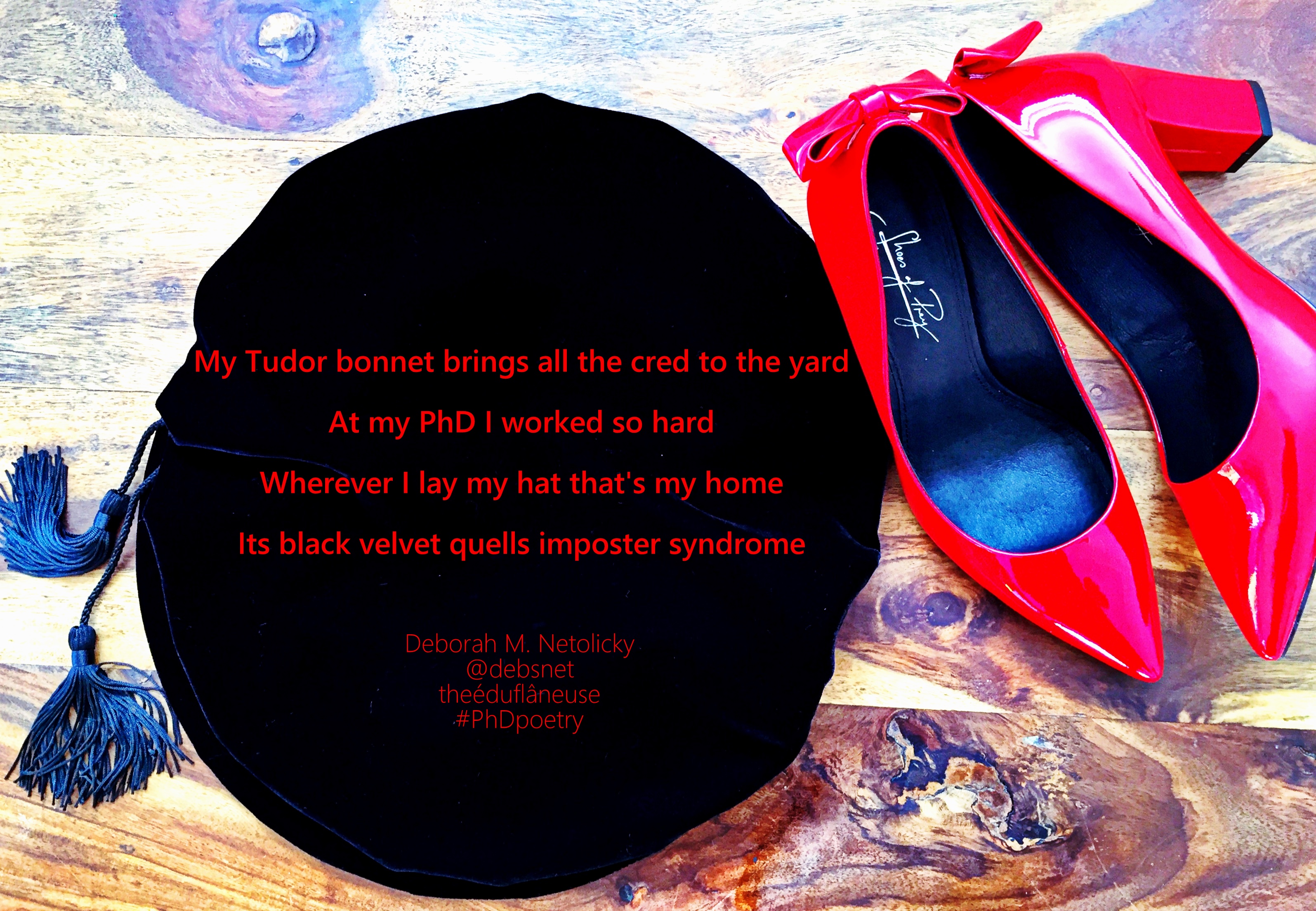
my Tudor bonnet and graduation shoes

my Tudor bonnet and graduation shoes

My Tudor bonnet brings all the cred to the yard

At my PhD I worked so hard

Wherever I lay my hat that’s my home

Its soft black velvet quells imposter syndrome

The PhD is seemingly never ending. Its end is emotional. Completion and post-PhDness is identity-bendingly confusing. And in Australia, with no viva or oral defense, there’s no clear end to the PhD. No full stop. Certainly no celebratory exclamation mark. I’ve reflected that my PhD ended with a whimper, not a bang.

So, while I have tended to avoid graduation in the past (only thus far attending my Grad. Dip. Ed. ceremony because my mum was graduating from her PhD that same night), the messiness of post-PhD identity wrangling, combined with an inner desire for a rite of passage or moment of celebration, drew me to attending my PhD graduation ceremony. While I have enjoyed some other milestones – submitting the finished thesis, having thesis amendments signed off, having the published thesis book in my hands, being conferred with the doctorate and getting the doctor title – a university graduation ceremony seemed to offer the acknowledgement and closure I felt I was missing. It was the last PhD milestone. The final carved stone obelisk at the end of one road and the beginning of another.

How I felt attending my graduation ceremony, 5 months after conferment of my degree

how I felt attending my graduation ceremony (5 months after conferment of my degree)

Graduation didn’t disappoint.

It was a great reason to design and purchase some graduation shoes, but also to procure a Tudor bonnet, age-old symbol of the doctorate. With its stiff round brim, silken tassels and floppy (impossibly-soft!) velvet top, this hat is at once unflattering, medievally ridiculous, and a long-standing symbol of scholarship. The red satin facings on the front and sleeves of the academic gown (which is burgundy at my university), and the accompanying Cambridge hood, represent the doctoral degree. Altogether it is quite the ensemble.

It was a lovely ceremony that allowed PhD graduates to feel acknowledged and respected for their achievements. We processed in past the seated audience, leading in the academic faculty procession, and were the first of the night to receive our degrees. Each of us was introduced, with our name and a blurb about our thesis (its title and description), at which point we walked across the stage to be personally congratulated by the Chancellor and to receive our degree. We were then invited up onto the stage to sit behind the Chancellor, professors and other academic faculty, a gesture welcoming doctoral graduates into the community of scholars.

Graduation was a wonderful opportunity to bring together some of the people who had been supportive during the PhD. It was an excuse to share this ritualistic formality with family and friends. As PhD graduates, we and our guests had VIP tickets that allowed us to mix with other PhDs, their families, their supervisors (including mine; I’m her 24th PhD completion), the faculty and distinguished guests, in a private room beforehand. There were more drinks and refreshments following the ceremony.

I can highly recommend attending your PhD graduation. After a journey that is often isolating, long and difficult, without a clear end, the ceremony was special, memorable and about coming together with your favourite people (and an applauding auditorium).

I now feel more able to rock those robes, not just with a saucy dash of red lipstick, but in terms of owning the achievement and assuming-subsuming-becoming the doctoral identity. I’m more ready to continue to move on from the PhD into The Next, The Beyond and The As-Yet-Unimagined-Faraway.

#graduationselfie #rockyourrobes

#graduationselfie #rockyourrobes #lovemybonnet