Ecosystems of work, study and relationships

Eduardo Kobra's Chelsea mural, photographed from the High Line in NYC in 2014

Eduardo Kobra’s Chelsea mural, photographed from the High Line in NYC in 2014. Because: relationships. And New York.

How do you do all the things?

I’ve made the conscious decision to be there for my kids while they’re little.

My husband is actually great. He makes the kids’ lunches on Fridays.

I can’t go for that promotion. I’m planning to get pregnant / I’d have to put my kids in after school and vacation care / My husband works full time.

I wish I had the support you do.

How does your husband cope when you’re away? Poor guy!

It’s not the role I wanted but I’m so lucky my work has allowed me to come back part-time after having children.

Wow, you’re amazing!

These are some of the comments that I’ve heard said to myself, to other women or by other women. Meanwhile, my husband has had comments directed his way such as:

How do you cope when your wife is away?

How did you manage while your wife did her PhD?

I bet you haven’t eaten a good meal in months.

Do you get your wife back now?

So it’s Daddy Daycare today?

Wow, you’re amazing!

There seem to be assumptions at work about both the nature of the PhD and the gendered nature of work, study and home. In this recent vlog, Professors Tara Brabazon and Steve Redhead talk about the relational aspects of the PhD experience. Tara talks about the online blogerature that links doing a PhD to divorce or relationship problems. I wonder why that is.

Maybe it’s because the PhD can feel like a lonely experience. It is a hard but wonderful slog that happens inside the head and on the keyboard of the candidate. It must be difficult for a partner or family member to understand what is actually happening for the person conducting research. Conversely, the PhD takes the candidate away from their partner or family or friends while they thrash about with their research and their thesis beast. I imagine that relationships can suffer and people in the candidate’s life can feel abandoned, left to their own brand of loneliness while the candidate furrows their brow in seemingly indulgent internal struggle, disappearing into inner worlds, or like I did, off to cafes to think and write.

The PhD also happens over a long time. Years. Sometimes three years and often longer. Four, five, six, seven, eight, nine, ten years in some cases. And one thing that is guaranteed across such a project is that life will happen. And get in the way. Inevitably, challenges will arise outside of the PhD, whether that be around health or finances or children or career or loss. In my three year candidature, I had some very tough personal times that had an impact on work and study, and on me personally. Life events can put a strain on our delicate ecosystems in which all our commitments interact.

I like Tara and Steve’s approach of supervising the PhD candidate’s whole life, including their web of relationships like partners and children. It takes a holistic view of the PhD, framing it as a collaborative work, rather than a lone journey.

Gender also seems to play a part in common comments about study, work, and their impacts on relationships. Why the frequent assumption that when a husband goes away, wheeling his case out the door with reckless abandon, all is as it should be, while when a wife goes away, she must fill the fridge and freezer with nutritious groceries and organic meals, pre-organise all child care arrangements and tape her itinerary and a list of important phone numbers to her husband’s forehead? Why the oft-joked-about assumption that a husband would struggle to run his own household or look after his own children? My husband and kids have a great time whenever I travel. Granted, they eat more chips and play more iPad than when I’m at home, but I am waved off and welcomed back by smiling faces, just the same as my husband when he goes away.

There are some who have fun with gender assumptions. On Twitter, the @manwhohasitall account makes fun of gendered comments often directed at women, by re-framing them for a male audience. This article on how to avoid a ‘manel’ (all male panel) gives some of the excuses used to exclude women from presenting and paneling.

Jacqueline Lunn here talks about the culture of women feeling grateful for part time work. I can certainly relate to the notion of being appreciative of being allowed flexibility in my workplace, rather than advocating for my bigger dreams, especially when I first returned to work from each of my maternity leaves. 

But I also acknowledge that working part time was a choice. I deliberately sought the time and flexibility that would allow me to do good work while being a good parent. I couldn’t, or rather wouldn’t, have accepted an amazing full time position while my children were pre-school age as I wanted to avoid using before, after school and vacation care if possible. I’m also well aware that my choices are highly personal and privileged. They have only been possible because of the support available to me, in the form of my mum, my husband, friends and bosses. That my husband runs his own business has meant that he has the kind of flexibility not often offered to men in the workplace. Why so few cries for men to ‘Lean out!’ of the workplace for a more balanced life and enriched relationships with partners, family and children?

The choices my husband and I have made are far from perfect; that is, they’ve involved compromise and prioritising. But they are what has worked for us at various times. They have been fluid and shifting choices, as situations evolved. 

Our individual and collective ecosystems of relationships, work and study are delicate and mercurial. My hope is that individuals, partners and families are increasingly able to make the choices that work for them at any given time, without being bombarded with judgement or assumptions from others or media.

The teachable moment: A vignette from Year 12 English

detail from 'Ophelia' by Sir John Everett Millais ~ source: www.tate.org.uk

detail from ‘Ophelia’ by Sir John Everett Millais ~ source: http://www.tate.org.uk

This week was one in which I seized on a teachable moment. I’m not talking here about Robert Havinghurst’s developmental moment, but Frederic Lozo’s notion that a high interest situation can lend itself to discussion of a particular topic. In Unit 4 of Year 12 ATAR English, we’re looking at perspectives, versions of reality, attitudes and values. These are terms with which students are familiar, but concepts that they sometimes struggle to apply effectively to the analysis of texts. We’re exploring how language works to construct viewpoints, and how audiences’ contexts work to make meaning.

As I listened to the radio on the way into work on Monday, I heard the audio of the comments of AFL heavyweights Eddie McGuire, James Brayshaw and Danny Frawley. The radio segment aired last Monday, but it was a blog post by Erin Riley that drew attention to it over the weekend.

Below is the transcript of the controversial Triple M radio segment for the Big Freeze event at the MCG last Monday. In it, the men laugh and joke about drowning female sports journalist Caroline Wilson, before calling her a “black widow” (a North American spider much like the Australian Redback spider that I discuss here). McGuire says he’ll pay $50,000 if she stays under the water, and Frawley says he will “hold her under” the water to make sure she doesn’t come back up.

McGuire: In fact I reckon we should start the campaign for a one-person slide next year. Caroline Wilson. And I’ll put in 10 grand straight away – make it 20. [laughter] And if she stays under, 50. [laughter] What do you reckon guys? Who else is up there? I know you’re in JB?

James Brayshaw: No, yep, Straight in.

Danny Frawley: I’ll be in amongst it Ed.

McGuire: Is Duck there?

Wayne Carey: Yes, I’m here mate.

McGuire: Duck’s in. Danny’s in – already spoken up.

Frawley: Yeah I’m in Ed.

McGuire: I could do an auction here today.

Frawley: I’ll actually jump in and make sure she doesn’t – I’ll hold her under, Ed.

McGuire: I reckon we could charge 10,000 for everyone to stand around the outside and bomb her.

Damien Barrett: I’m on Caro’s side now, Ed. I’m on Caro’s side these days, Ed.

McGuire: She’ll burn you like everyone else, mate. She’s like the black widow. She just sucks you in and gets you and you start talking to her and then bang! She gets you.

Brayshaw: If you ran that auction from down there, I reckon you’d start grabbing some bids out of the seats too. There’d be money piling in everywhere.

McGuire: It’ll be magnificent. I think we should do that next year. It’s all good for footy.

Brayshaw: Bloody oath.

I thought it was an opportunity to tease out key course concepts and text analysis skills with my class of Year 12 boys. Considering this audio as a text would also allow us to talk about the impacts of the language we use about other people, about feminist ideology, and about what might count as acceptable or unacceptable language directed at particular groups, and for whom.

So, I opened Monday’s lesson by playing my class the audio text of this exchange. The questions that led our analysis and discussion were:

  1. What is being valued in this text?
  2. What are the attitudes communicated by the text?
  3. What factors might influence the listener’s response?

The students individually wrote their responses, before we opened it up for a class discussion. Their initial responses ranged from ‘that’s threatening and derogatory’ and ‘they’re being sexist’ to ‘I don’t really see why it’s such a big deal’ and ‘no-one would make a fuss if those comments were about a man’. They pretty much spanned the range of comments being bandied about in new and traditional media. We were able to tease out these comments and explore how each listener’s own context, beliefs, values and attitudes influence their making of meaning. Students were able to challenge each other’s’ views. Some personalised the comments by thinking about women they knew, pointing out that Wilson was someone’s sister or mother or daughter. Most agreed that joking about drowning someone wasn’t “playful banter”. Some talked about the responsibility of those in the public eye to model decent behaviour and respect for other humans. Some questioned whether McGuire was in fact treating Wilson as an equal by saying something he would equally say about a man. Some talked about the text as a reflection of social issues, or of issues within the sporting culture of the AFL. They discussed what was ‘ok’ or ‘not ok’ to say, and why.

I was able to draw this discussion back to teaching points about our key course concept of perspectives. We considered Wilson’s perspective, and listened to her radio comments about the incident. We considered McGuire’s perspective and listened to his first apology (personal side note: yesterday’s first attempt at an apology missed the point so spectacularly that he issued a second apology today). We discussed how texts, and the way we make meaning from texts, reflect values, attitudes and perspectives. I then used this exercise to segue into looking at these concepts in a short story we had read the previous lesson.

The lesson, which emerged partly on the car ride to school, allowed me to seize on a topical news item around people and a context with which my class are familiar. I was able to use this material to present a real-world text example to teach key course concepts. My observation was that students’ responses to the studied short story, in the task that followed, were nuanced and insightful, possibly as a result of this lesson starter. Looking at their work from this lesson, I think they left understanding the terminology more clearly than when they arrived.

I was able to encourage students to reflect on their own assumptions, attitudes and values. For the English course, and for life, they need to be aware of themselves as consumers of information and responders to the language of others. They also need to consider and own the language they use. I do think it is important to be clear about respectful language towards others in our classrooms, but my teacher approach to McGuire et al.’s comments was not to rant from a feminist soapbox. While towards the end of the class discussion, I did briefly share my own response, and model self-reflection about why that was my response, my main techniques were questioning and managing class discussion, thereby drawing out and leveraging students’ own views. 

As a teacher, I think that part of my job is to encourage students be kind, thoughtful human beings willing to call out discrimination and advocate for others, even when it’s uncomfortable to do so. Importantly, the classroom needs to be space where unpopular opinions are heard and explored, not belittled and shut down. The classroom can provide a safe place for robust discussion, thoughtfully-argued disagreement, self-reflection and challenging of viewpoints.

Multiple ways of being: Teacher, researcher, coach, vegetable, fruit.

this post's peer review comment, memefied on the advice of Rachel Buchanan

this post’s comment on peer review, memefied on the advice of Rachel Buchanan

Part of what I love about the work of research and academic writing is that it is brain-bendingly hard. There is always more reading to be done. There is always more writing. It can always be better. It can always be improved. Scholarly thinking requires a constant state of being open to critique from self and others, to finding new ways of knowing, understanding and communicating. This week I’ve received two first round lots of peer review comments. Receiving peer review feels to me like getting a high five and a punch in the face simultaneously. There is always something good, to be celebrated, and something that is mercilessly criticised. It’s both encouraging and brutal.

My thus-far-neophyte experience of academic work, is reflected in Inger Mewburn’s post today. She points out that a scholarly identity is a critical and questioning one. It is one in which the academic or researcher becomes someone always in progress, always learning, always working towards a never-finished goal. Becoming a scholar, Inger suggests, is an acceptance (or at least understanding) that the work is never done.

Pat Thomson this week blogged about research as embodied practices and awarenesses. Pat describes her research practice as being an ingrained part of her. Not grafted on or carried around, but deeply etched into the core of who she is and how she operates. An automatic-pilot way of being. This reminds me of my experiences of the internalisation of teaching, coaching and research, which I notice becoming a part of the ways I operate. Through deliberate practice, I find that I am internally transformed.

As someone who bestrides—and intends to continue to straddle—the dual worlds of teaching and research, not to mention the world of coaching, I am interested in discussions about and expressions of professional identity. (Professional identity was also part of my PhD thesis.) A few months ago, Greg Ashman wondered what it would mean if a person who teaches at a university level identified themselves as a teacher, a potato or Napoleon. Stewart Riddle, school-teacher-turned-academic, who identifies as both teacher and scholar, responded with this satirical one-act play. I also had a go, at that time, at exploring identities and who gets to decide who and what we ‘are’; my conclusion was that we get to shape and define our own identities. I do think, however, that when the voices of teachers are sought, the definition of what ‘teacher’ means, in that context for that purpose, needs to be made clear.

Fascinatingly, to my English teacher self, the word ‘potato’, originally used (flippantly, I think) in Greg’s blog post, gained momentum, taking on a life of its own. Linda Graham used it in this post about who might engage with debates in education, and Naomi Barnes used it in this post about what it means to be a teacher. Naomi proposes that “Who are teachers?” has become a radical question. Then, today, a Twitter conversation, in which one person attempted to attach a label to another, turned into a string of potato wisecracks accompanied by potato GIFs, all relating to the notion of identity. This humorous exchange seemed to engage with the question of who gets to attach labels to who.

I wonder about the humble potato amid this flurry of attention. It’s a staple food, seen as part of the tuber and nightshade families. It’s a reliable, fundamental ingredient in many households and restaurants, and can be prepared in many ways. There are over 100 varieties of potato (personally, I lean towards buying the Royal Blue). Yet despite its ubiquity and versatility, it has become an insult and a joke. (And not just on edu-Twitter. This month the Google car was called an ‘ugly potato’.)

If a potato is shorthand for an academic who works and teaches in a university, I don’t qualify. I’m pretty sure I wouldn’t be accepted as this kind of potato, should I choose to identify as one. While I do some academic writing, have recently completed a PhD and have an affiliation with a university, I cannot claim potato-academic status. Insert sad face emoji.

Perhaps I could adopt as my identity totem another member of the nightshade family. I love the nightshades for their glorious variety. From toxic to medicinal, from ornamentals to weeds, from fruits to vegetables, from spicy to delicious, this family of flowering plants (including the under-appreciated potato) displays the phantasmagoric splendour of the natural world. Perhaps I am an aubergine. Glossy, slightly bitter, smoky and a teeny bit addictive.

The aubergine can be seen as a boundary spanner (a term recently introduced to me by Marten Koomen). It’s often seen as and cooked with vegetables, but is actually a fruit. It has a fancy French name as well as a number of alter egos (eggplant, guinea squash, melongene, garden egg). A vegetable-like fruit that is also called a squash, a plant and an egg! As a teacher-leader-coach-researcher-writer I feel an affinity with the aubergine, its multiple identities and its many labels. My boundary-spanning auberguine-esque self, sitting both astride and between worlds, wonders about my ways of being. Is it possible to embody multiple practices that belong to multiple roles?

If, as Will Durant said (in a quote often attributed to Aristotle),

“we are what we repeatedly do”

then what are we when we do multiple things as we move between multiple roles? How long does it take us to ‘become’ something in the first place? How long does it take for a researcher to stop being a researcher after they stop doing formal research? How long after a teacher’s last class, or coach’s last coaching conversation, or leader’s last formal moment of leading, before they are no longer teacher, coach or leader?

Or do some of our beliefs about the world, and ways of being in the world, become so much a part of us that we continue to embody them? Can we morph from one vegetable-fruit metaphor to another, shedding our potato-aubergine skins? Or do we carry them within us, always?

Gloss and light: On PhDs and education debates

by @debsnet

I love a good metaphor. I really do. I blog around metaphors a lot – coaching as strawberry picking, PhD thesis as stone sculpture, selves as kaleidoscopes, connections as webs. Additionally, my PhD data revealed participants’ identity metaphors, which I found invigorating and fascinating to map and interrogate. Metaphors help us to think in different ways. They provide a powerful vehicle and a coherent frame for defining our realities.

So I was interested to read of Brett Salakas’ use of metaphor in his Education Nation keynote this week, ‘PISA Pipe Dreams’. I wasn’t at Education Nation, so only have Twitter and this blog post by Brendan Mitchell on which to base my response. I tweeted some thoughts to Brendan and Brett after I had read the blog post. In my tweets, I noted that I agreed with Brett’s points that education and what works is contextual, that reliance on external testing metrics like PISA needs continued critique, and that education should begin with and be guided by its core purpose. I also had some wonderings around two metaphors Brett used, a couple of which I flesh out below.

Metaphor 1: The glossy PhD

This one got me thinking. Brett had a slide in which he outlined what he was not. One thing he was not, according to this slide, was “someone with a glossy PhD”. As a newly-doctored PhD, I found this way of looking at the Doctor of Philosophy amusing and bemusing. I understand that Brett was outlining his perspective to the audience (and the English teacher in me loves a good adjective), but my experience of the PhD is anything but ‘glossy’.

Gloss suggests both shininess and superficiality. It is shiny and lustrous. A gloss can be a veneer covering a lack of substance or hiding something sinister below the surface. Certainly, I popped champagne and luxuriated in the joy of the beautiful final thesis document, and I’m kind of looking forward to donning my graduation regalia. Yet, the experience of much of the PhD is about being down and dirty, not glossy and sparkling. And certainly not superficial.

To explain the messiness and struggle of the PhD, the rabbit hole became a metaphor for me. I was Alice, tumbling deep into a new world, on a journey of sense-making and self-making. I was simultaneously the rabbit, burrowing into dark earth. Digging, digging, digging, the light far behind me and the unilluminated darkness ahead. The PhD is all about embracing discomfort. It’s about persistence, sweat, tears, keystrokes, insomnia, the pit of despair and occasionally the triumph when breakdowns turn to breakthroughs. It’s the ultimate in transformative learning. And it is hard. Stories of struggle abound. It’s the opposite of gloss and glamour. It’s wailing at a computer screen while wearing your least fashionable pajamas. It’s furrowing your brow for hours at a time as you pour over literatures in an attempt to understand the world in new ways and through new eyes. It’s spending years obsessing over an issue about which you feel passion deep at your core. It is reading and writing and deleting and re-writing and gnashing teeth.

Am I someone with a PhD? Yep. Is it glossy? I don’t think so (although I might buy some fabulous shoes to wear to graduation). I’m someone deeply marked with that experience in the way I think, read, write, learn, talk, assess evidence, and work through critical feedback from others. I know more now about all that I don’t know. I still have the dirt of the rabbit hole beneath my fingernails and the scrapes on my knees from a personal and intellectual journey that was rough and wonderful, not soft and silken.

Metaphor 2: Be the light in the darkness

In his blog post, Brendan shared that the takeaway message from Brett’s keynote was that we as educators need to be beacons of positivity to stave off the darkness and the negativity. In some ways I agree with the notion of ‘being the light’. I tend to be someone who is less combative and more co-operative. I advocate for compassionate and graceful debate, rather than divisive attack. I celebrate and advocate, rather than confront or complain.

However, I also see some dangers in the notion that educators embrace being positive and shining light, without considering ‘the darkness’ or negativity. Some of the most famous stories have two sides, both deeply committed to their cause and believing that their position is right. Folk heroes like Robin Hood and Ned Kelly can be seen as criminal outlaws or people’s heroes, depending on point of view. The Star Wars Rebel Alliance can be viewed as the goodies, or as a rag-tag band of terrorists disturbing the order of the Galactic Empire. I’ve been in school leadership roles now for 15 years, and the more I have led, the more I have learned to value those who question or resist. I ask myself: What can we learn from the perspectives of those who don’t agree, don’t embrace new change, or who have negative things to say? Where are they coming from? How might this change be made meaningful for them? What might be missing? What might their points of view offer? Negative or oppositional voices are not ‘the darkness’, but rather alternate perspectives to be heard, understood and considered.

Bob Garmston and Bruce Wellman, in The Adaptive School: A source book for developing collaborative groups, point out that high functioning groups are not happy agreeable places. In fact, they say that low functioning groups tend to be polite and reluctant to engage in dialogue about differences. High functioning groups are ones that embrace cognitive conflict and graceful disagreement.

But not all disagreement is helpful. Unproductive conflict, Garmston and Wellman argue, includes disagreements over personalised, individually-oriented matters which are destructive and lead to decreased empathy and poorer decisions. Productive conflict, on the other hand, is where substantive differences of opinion are thoughtfully thrashed out in order to increase empathy, develop understanding and make better decisions. In productive disagreement, the aim is to understand conflicting viewpoints and honour all perspectives while working together towards a decision.

If the education community is to be a high functioning one, it too needs to be ok with being challenged and with productive disagreement. We need to poke around in the darkness, trying to understand and illuminate it. Finding ways forward in education is less about divisive arguments or staving off those with whom we don’t agree. It’s more about seeking to understand competing perspectives in order to agree on the why, how and what of education, so we can do the best job for our students.

Thanks to Brendan and Brett for getting me thinking.

Reflections on coaching after ISCAPPED 2016

ISCAPPED2

The International Symposium for Coaching and Positive Psychology in Education (ISCAPPED) happened in Sydney this week. It involved two days of keynotes, breakout sessions and corridor conversations by academics, pracademics and practitioners committed to researching, implementing and sharing their coaching and positive psychology work in schools around the world, and specifically in Australia. The yoking of two fields meant that it was possible to glean the differences in the arenas and the places at which they intersected. What stood out to me as a point of difference was the language used; while positive psychology sessions tended to use words like ‘self-esteem’ and ‘strengths’, coaching presentations were around ‘efficacy’ and ‘capacity’.

I presented twice at the symposium, once with colleagues, on the journey of our coaching model for teacher growth, and once on the coaching findings of my PhD research, which was set against the context of that school-based coaching model for teacher professional learning.

My colleagues and I outlined the story of the development of our model from its strategically-aligned beginnings, to its teacher-owned development and its whole-school implementation. Our presentation included a structured conversation that used some of the basics of Cognitive Coaching: the pattern of pausing, paraphrasing and posing cognitively-mediative questions, while setting aside the coach’s own patterns of unproductive listening. Our selection of coaches is based on beliefs that, while everyone is coachable and has the capacity to improve, not everyone can be a good coach.

I then shared my PhD research alongside Alex Guedes, who has also conducted research against the backdrop of a school-based coaching model for teacher capacity building. This presentation, which occurred under lights on the stage on which the keynotes were presented, covered the context, foci, method and findings of our PhD studies, with a particular focus on coaching. My findings, which I explore in more detail in this paper in the International Journal of Mentoring and Coaching in Education, include that coaching can be an empowering, identity-forming, relationship-building and language-shaping experience. They also include that coaching, while not a silver bullet, can be an effective part of positive organisational growth.

These findings resonate with Costa and Garmston’s notion of holonomy, in which the parts and the whole are both separate and together; the individual and the organisation grow and influence one another. Identities, language and understandings are collectively constructed. Congruent tools like Cognitive Coaching and the Danielson Framework for Teaching can be used to grow people, teams and systems, within environments and relationships of trust. In the coaching intervention that provided the context for my study, and that continues to operate in my school, non-judgemental data provides a ‘third point’ in coaching conversations, in order to depersonalise teacher reflections. Another third point is the Danielson Framework, our shared standards of teaching practice.

lucky enough to catch Vivid Sydney while we were there

lucky enough to catch Vivid Sydney while we were there

Coaching is hard cognitive work. This Monday, the #educoachOC Twitter chat will explore listening in a coaching context. I’ve recently been exposed to another string to the listening toolbox I use when coaching, which has thus far included careful listening for spoken language use, purposeful paraphrasing and watching eye movement to gauge what thinking is going on for the coachee. Recently, Bruce Wellman, author of The Adaptive School and Learning-focused supervision, came to work with my school on a variety of things. He worked with our team of coaches on something he calls non-verbal paraphrasing. He ran a workshop with us and shared his paper titled, ‘Nonverbal elegance when paraphrasing’.

Bruce couches this idea in research from anthropology, linguistics, cognitive science and neuroscience. Gesture, he explains, reduces the cognitive load of the speaker, saving energy by communicating information through body as well as spoken language. It is also primal in that gestures can reflect emerging or intuitive understandings. That is, our physicality can express those things we might not yet have words to express, or those things we are wrestling with between our knowing and not knowing.

In a coaching context, our brain’s mirror neurons help us to show empathy with the coachee, and we can also be deliberate about mirroring body language in order to be in rapport. Bruce suggests that additionally, we can “listen with our eyes”, watching for how someone’s body language extends, amplifies or makes clearer their thinking. Paying careful attention to how coachees use their hands—to explain concepts, sequence events or place people in their internal world—is a powerful listening skill. It allows the coach to paraphrase, not just the words the coachee uses, but also the physical referencing. Since doing this workshop I’ve noticed myself paying more attention to gesture, and trying to reflect back coachees’ gestures during my paraphrasing.

(Side note: As I type this I’m finding that I am gesturing between keystrokes as I try to figure out my ideas and the words I’ll use to express them. Perhaps that’s because Bruce Wellman’s concept of non-verbal paraphrasing is new to me, and my primal brain is helping me figure out my understandings. I’ve spoken a lot about writing as a mode of inquiry – writing to understand. I’m wondering now about gesturing as a mode of inquiry – gesturing to understand. *gesticulates wildly*)

So there are multiple skills to coaching, which can be honed and developed over time, but as Christian van Niewerburgh’s keynote pointed out, the coaching process and coaching skills aren’t enough. They are necessary but not sufficient. I agree with Christian when he says that transformative coaches are those who adopt coaching as a way of being. I also agree with him that coaching needs a theoretical and evidence base. Coaching isn’t a recipe on a laminated sheet. It is more than a process, a conversation or something anyone can do after a quick training session in which they are given a conversational formula.

Cognitive Coaching, which is the model in which I am trained and that my school uses in our context, is deeply rooted in research, and layered with multiple lenses and skills. The research base for Cognitive Coaching is most rigourously explored in Art Costa and Bob Garmston’s Cognitive Coaching text, now in its third edition (the previous editions were called Cognitive Coaching: A foundation for Renaissance schools). Other references include this 2003 paper on why Cognitive Coaching persists. These references and others (I have plenty!) tease out the reasons why coaching, done well, can be powerful and transformative.

Coaching is not mentoring, or telling, or advice giving, or passing judgement, or giving ‘helpful’ tips that make the feedback-giver feel like they’re being really useful. It is trusting in the capacity of the other person to solve their own problems, decide on their own trajectory of growth and consider how best to improve. The coach’s difficult work is in expertly and deliberately using a toolbox of knowledge and skills. These knowledge and skills are deliberately used as well as internalised and woven into the coach’s way of being, to help move the person’s thinking forward. That’s where the ‘cognitive’ in Cognitive Coaching comes in. The coach mediates thinking, because thought is what drives action. Changing thinking changes behaviour. It’s in the ‘a-ha’ moment, which cognitive coaches call ‘cognitive shift’, that individuals are transformed from the inside out. The magic is that the coach is mirror, conduit, provocateur and nudger, but it is the person being coached who does the thinking and finds their way.

Textiles & academic writing: Material, process, product


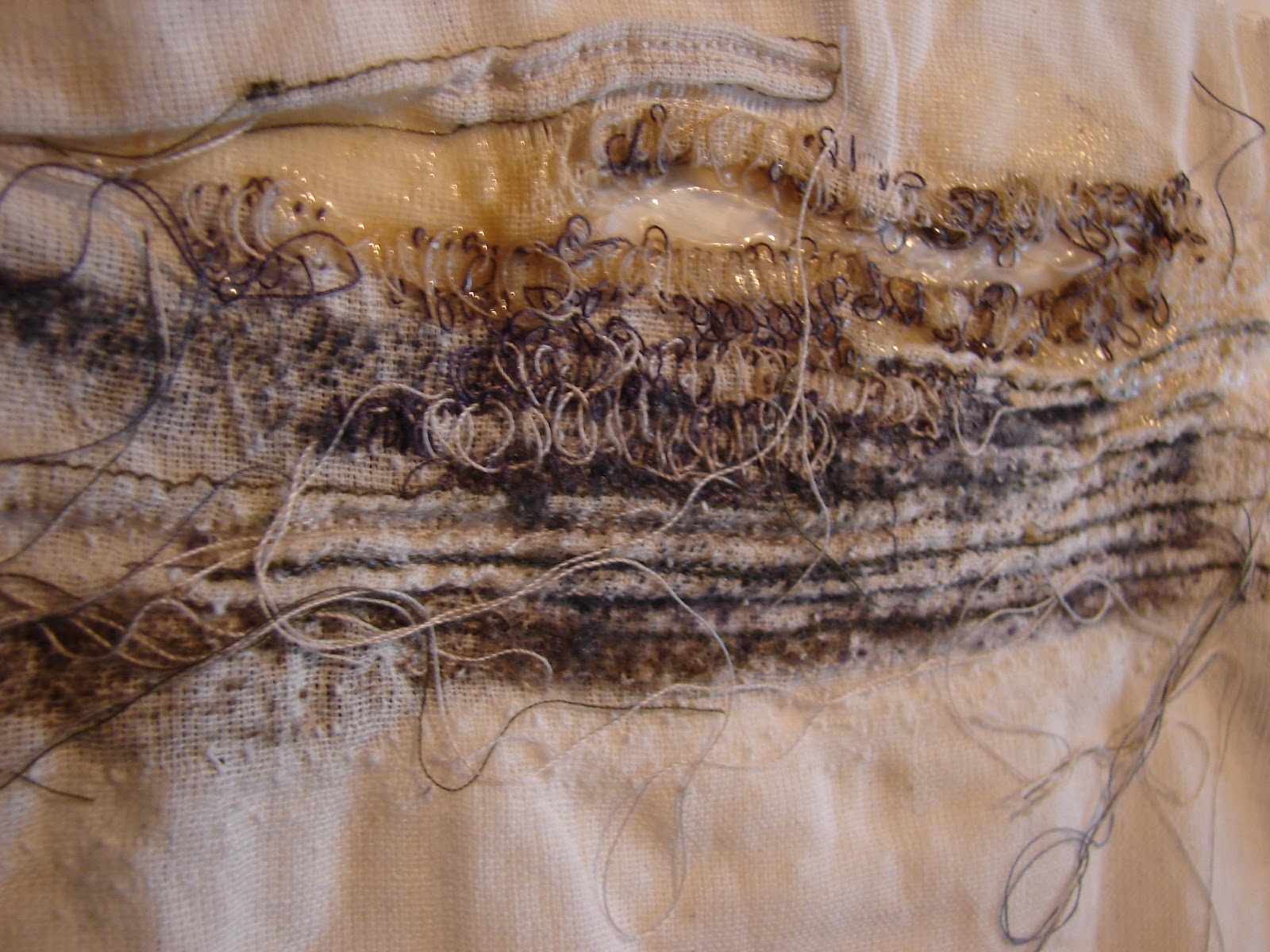
This post, which could also be titled ‘remembering my 1990s feminist self’ is a re-emergence of some thinking I did a long time ago in my early years at university. After leaving school, I completed a Fine Art degree, followed by an Honours year. I’m writing this post as a way into self-inquiry, a way to write myself towards my hunch that my early days as a feminist-textile-artist-writer have underscored my more recent PhD work and academic writing. Big thanks to Katie Collins whose wonderful blog post on subversive material metaphors in academic writing sparked my thinking.

I was a painter from a young age, thanks to my artist mother, but I chose to study textiles as a major in my undergraduate Fine Art degree, rather than painting. This choice was due to the meanings inherent in textile materials, processes and products. A textile artist can weave in metal or print on latex. They can make work in the blacksmith forge or the sculpture studio. They can work with cardboard or furniture or paint or dye or thread or canvas or wire or plastic or found objects. The visceral and sensory experience of working with materials is central to the artistic process.

The materials a textile artist chooses, and the scale at which they magnify or miniaturise those materials, are deliberate meaning-making choices. The artist can choose needlework and hand-dying, or industrial Warhol-esque mass printing. They can applique or cut away. They can build or melt. They can assemble or destroy. They can stitch or slice. They can focus on the macro or the micro, staggering their viewer with enormous size or encouraging the viewer to come in, up close and personal.

Textiles is personal and political. It is also a subversive arena for artists, and often a feminist one. It pushes or rails against the stratification of ‘Art’, which has often meant the dichotomising of cerebral, thinking highbrow Art (upper-case ‘A’, often seen as done by men), and functional or decorative art (lower-case ‘a’, often associated with women and femininity). Historically, women were objects of art: she the body to be gazed at and sculpted. Or objects of art were personified as women: she the landscape to be scrutinised and painted.

The art historical devaluing of textiles pivots on its early treatment by critics, galleries and institutions. Aesthetic disciplines depend on recognised ‘powers that be’ to promote and uphold them. Early galleries and history books excluded textiles. Unlike painting and sculpture, textiles was historically seen as an unimportant discipline, undeserving of discussion, not worth deconstructing for message or meaning. The association of textiles with the devalued domestic space of the home, the opposite of the glorified public space of the art gallery, contributes to its dismissal.

So, why am I back here, thinking about textiles as feminist discourse or subversive act? Because Katie Collins’ post brought memories of my past self bubbling to the surface. And I am wondering to what extent my long-ago thinking and artistic practice, around the meanings inherent in working in and writing about textiles, has influenced my current and recent research and academic writing. On reflection, my PhD incorporated disruptive elements. While fitting largely within an accepted academic paradigm, it quietly challenged the ways that knowledge is traditionally written about. I used narrative method, literary metaphor and created three multimedia illustrations for the thesis, corporeal expressions of my thinking.

Now that I’m back in the eye of this needle, I need to think further about how textiles might provide a metaphor for research and academic writing.

In the meantime, below I will type an extract from a paper that won me the Allport Writing Award in 1998, and was published in Textile Fibre Forum. It was an analysis of Vivienne Binns’ artwork Mrs Cook’s Waistcoat. The piece gives a sense of where my thinking was around textiles as feminist activism in the late 1990s. I have deliberately omitted an image of the artwork as I’m wondering if the text itself can paint the picture for you.

(For non-Australian readers, Captain James Cook was a British explorer who claimed to ‘discover’ the south eastern coast of Australia in 1770.)

_________________________________________

Extract from ‘Mrs Cook’s Waistcoat: Rewriting history through cloth’

by Deborah M. Netolicky (1998), Textile Fibre Forum, Volume 53.

Mrs Cook’s Waistcoat may be read as one woman’s attempt to rewrite and reinterpret human history. Here Vivienne Binns contributes to the discourse on journey, adventure, and historical significance, telling the pain-filled woman’s story of discovery and adventure—the burden of waiting and worrying, as opposed to doing and dying. Through this work she questions platitudes of the day, such as “men work and women weep”. Binns demonstrates that women were not passive, but were actively working contributing, storytelling, and recording their own histories, written in needlework.

Binns uses journey as metaphor, identifying with Mrs Cook’s expedition as expressed through the waistcoat for Mr Cook. She challenges the value placed on women’s histories and women’s work by challenging the notion that Mrs Cook’s journey was insignificant in terms of human history. She has chosen to elevate its significance, giving it voice, implanting it in the discourse of high art.

… Captain Cook’s wife is the “Mrs Cook” referred to by the title of the work which tells the story of her laboring over a waistcoat for her husband while he is away on a long voyage. The waistcoat mapnel is larger-than-life, describing the legendary reputation of Captain Cook in Australian myth-making, and the amplified importance that Binns intends to give to the making of the waistcoat.

Binns connects the historical representation and exploration of Cook’s journey with issues of women’s value, women’s history, and the construction of gender. In her version of this story, the ocean water is a metaphor for a bewitching, intoxicating vacillating, unpredictable femininity and female identity … Cook, the white, middle-class male, is discovering, navigating, defining, and fixing the limits of the Pacific Ocean. He is writing the experiences, histories, and memories of and for the water, which has no voice. It is formless, restless, intuitive, irrational, and passive, in need of taming, subjugating, explaining and defining by the rational, scientific logic of male discourse.

Nature is tamed by culture. Binns places herself in the middle ground. She associates herself as water, as a woman employing subconscious, intuitive processes – her own emotions, remembrances, and ideas about certain colours, materials, and ways of working. On the other hand, she calmly calculates, selects, and constructs her images, associating herself with the heroic explorer, just as the artist does on a continuous intellectual journey to discover new meanings. This marriage of antithetical metaphors reflects Binns’ concerns with shaping perceptions of women’s ways of knowing, living, researching, remembering, experiencing, and making. By yoking the two ways of working, she gives equal value to each.

…The waistcoat can be seen as a woman’s way of writing and recording history. Women write history in fabric, men write history in text. Binns makes Mrs Cook’s journey of waiting, sewing, and weeping, as valid as Captain Cook’s journey. The labour and time involved in making this waistcoat explain the wife’s dedication and devotion to her far-away husband. Binns questions the trivialisation of women’s roles surrounding issues of the domestic and ‘crafty’. … She uses the processes, materials, and experiences of women—traditional metaphors of women’s work—to weave a myth about women’s forgotten places in history.

Penetrated openings are created by slicing, cutting, and scarring the fabric, fabric that represents flesh as well a material. … Rolled up papers (the stuff of men’s work) penetrate exposed fabric (the stuff of women’s work); paper penetrates fabric; men’s work penetrates women’s work; culture penetrates nature. The slits in the fabric are peeled back like open sores, mirroring the multiple stab wounds that were the cause of Cook’s death. The ultimate satire of the story is that while Mrs Cook is lovingly creating the waistcoat for her husband, he is already dead, his stab wounds mirrored in her handiwork. This is reflected in the typed and hand-written text, which permeates through a layer of white paint: “Mrs Cook embroidered… this time the Captain did not return and the waistcoat remains unfinished”. This irony elevates her personal anguish, and points to the difference in men’s discourses and women’s ways of speaking through needlework.

…Binns … uses traditionally female and domestic techniques of women’s work: embroidery, pattern-cutting, and sewing. There is a sense of Mrs Cook’s physical involvement in this garment, her time, effort, and care. It is stitched, cut, glued. Elements, images, textures, and metaphors are exposed, denied, revealed, concealed, constructed, deconstructed, veiled, disguised, patterned, decorated slashed, sliced, torn, ripped, reconstructed. The piece is layered with the corporeal stuff of memory.

… Binns does not create a new reality, but reflects and reinterprets the existing one in a way that gives it new meaning. She puts one moment in one woman’s life under the microscope until it boils, making her audience reconsider women’s lives, women’s history and women’s art.

Harvesting good work: Reap what you sow

I’m not a farmer, not even a green thumb really. While I quite enjoy gardening and have a composter, I’ve learned to populate my garden with plants that survive on a healthy dose of neglect. (Side note on the composter: there is something joyful about shredding old copies of my PhD thesis drafts and feeding them to the worms.) Despite my lack of horticultural know-how, I’ve recently been considering the farming—and biblical—metaphor that you reap what you sow.

I often see others I admire reaping the rewards of their work. These people aren’t slaves to the performative measures of a neoliberal system, or narcissists seeking the spotlight of social media celebrity. They are humans–professionals, thinkers, theorists and practitioners–dedicated to work they believe is important. To doing it, sharing it, making a difference.

Since the final throes of my PhD in March, things have been happening in seemingly organic ways. Of course the PhD got done-and-fairy-dusted, and the thesis published online. The first paper from my PhD has since been published: ‘Coaching for professional growth in one Australian school: “oil in water”’, in the International Journal of Mentoring and Coaching in Education. I have another paper in press, due out next month. Two more are sitting on editors’ or reviewers’ desks. Two drafts are on the desk of a co-author. I have been interviewed on the Teachers’ Education Review podcast and on 2SER Sydney community radio. I had a piece published in The Conversation this week, about the dangers of pursuing performance pay for teachers. I am in discussions about bookish things, too.

And I’ve been on some kind of accidental-on-purpose conference circuit. AERA in DC in April. researchED in Melbourne in May. The International Symposium for Coaching and Positive Psychology in Education in Sydney in June (this Thursday and Friday). Heroism Science in Perth in July. For (little old) me, alongside my work at my school, all this seems like armfuls of hand-picked produce.

I’m not sure why I’m surprised at the pace of my recent schedule of outside-of-work commitments (also known as the unpaid-but-rewarding work that is academic writing and presenting), and the fact that I’ve started to be approached, rather than doing the approaching myself. But I am quietly bemused that I seem to be in a harvesting part of a cycle, even though I know that this is actually the result of hard and persistent work. The seeds for the current abundance were selected, sown and tended a while ago. Papers were written and reviewed (and reviewed and reviewed). Abstracts were drafted and submitted. Relationships were formed and cultivated. Presentations were prepared. Work was done. A lot of it. In my evenings and on my weekends and in my down time, and in all the little nooks and crannies of my life where I could fit reading, writing, collaborating, learning and connecting. Thank goodness for the wonderful people who support me, from my family and friends, to my colleagues and professional learning network, the Twitterati and my Voxer Squad.

I believe in doing good work. For me this is enacted in ways that are without a linear frame. I’m never quite sure where I’ll end up, or even where exactly I’m intending to go. It’s about doing work that I’m passionate about and feel is important, whether in service of my students, my coachees, my school, or knowledge in the world. In my writing, too, I often try things out, head down trails unsure of where they lead, double back, try again.

So, for now I continue to sow seeds I think are worth sowing. Write and research those things I think are worth writing and researching. Say things I think are worth saying. Teach what I think is worth teaching, in ways I think are most worth doing. Seek to learn those things I think are most worth learning.

The fun thing about this kind of sowing is that it’s like planting mystery seeds. I never quite know what influences or impacts something I do now might have in the future. It’s why the reaping feels like Christmas morning.

The best bit is how rewarding all the persistent and consistent hard work is. I like the work itself. I love the struggle and the triumph. I love the connections and the relationships that bubble up and take form. I love the unexpected rhizomatic results. A failed planting. A teeny green seedling reaching up from damp dark earth. A basketful of glossy fruit. A knotted beanstalk reaching up to the clouds.

Reflections on researchED Melbourne #rEdMel

I’ve landed back in Perth after a whirlwind trip to Melbourne for this year’s researchED conference. This post is an attempt to unravel the tangled threads in my head, after what was a big day of thinking, listening and talking.

On coaching: Our panel

Being on a panel with Corinne Campbell, Chris Munro and Jon Andrews was the highlight of the day for me. That included not only the panel presentation but the opportunity to be in the same place, at the same time, able to flesh out our ideas about coaching together (as well as plenty of other educational issues).

Founder of researchED, Tom Bennett, saw the four of us working together early in the day and joked that it was like four Avengers coming together in one movie. That struck a chord with me, because we are four individuals deeply committed to making a difference in our own contexts, in four different Australian cities. But we’ve come together across social media time and space to collaborate on #educoachOC, a monthly Twitter chat on coaching in education, which aims to centralise, clarify and tease out the global conversation around coaching in schools. I met Corinne and Chris for the first time at last year’s researchED conference in Sydney, the first Australian iteration. I hadn’t met Jon until yesterday, yet we’ve been collaborating for months, and talking about practice, writing, leadership and coaching.

So getting together with my fellow Avengers was like landing in my nerd heartland for a day. We are, however, less about avenging and more about advocating for supporting teachers and trusting in their capacities for improvement. Coaching was revealed in the panel discussion as an enhancement and growth process, not a deficit model for fixing underperformers.

Our panel seemed well-received, and I learned from my fellow panellists as we covered what we mean by coaching, why each of our schools adopted coaching, what it looks like in each school, the impacts we’ve noticed, and the broader implications for coaching in schools. We explored issues of trust, implementation and mandation. We considered the conference theme: how coaching might fit with ‘working out what works’. On the one hand coaching does not prescribe ‘what works’ to coachees, and yet coaching has been shown to work. It is a researched but contested approach to learning and growth, with coaching models varying in intent and execution. Coaching is about practitioners being given the time and space to work out what works, for them, in their contexts.

On research ethics: My presentation

My individual presentation was on a topic I later described on Twitter as the unsexy undergarments of research: ethics. Necessary and crucial, but often viewed as unexciting. I looked at ethical considerations and decision making, for teachers researching their own schools, using my PhD study as an example.

I shared this quote from Helen Kara’s book Creative research methods in the social sciences:

Ethics should underpin every single step of research, from the first germ of an idea to the last act after dissemination. And ethical problems require ethical decision-making – which allows for creativity.

Here, Helen reminds researchers that ethics is creative problem solving. It does have to be well-considered, systematic, respectful and just (see the Australian National Statement on Ethical Conduct in Human Research), but it doesn’t need to be tedious.

I outlined the ethical challenges in my PhD, and the ways in which I grappled with those and made decisions. My operationalising of ethical solutions included writing information letters and consent forms; using an independent interviewer to interview teacher participants (and a rigorous approach to protecting teacher identities); designing deliberate interview protocols; drawing data together into composite stories; and utilising metaphor to protect participants while making interpretive meaning.

I discussed the benefits and limitations to being a researcher embedded in one’s own context. Below are the implications and questions I ended with.

Evidence-based practice in education

Among other presentations, I saw two on using evidence and research in schools, one by Gary Jones and another by Ray Swann. What I enjoyed about both approaches to evidence-based and research-informed practice in schools, is that they promoted valuing of not only the ‘best available evidence’, but also the wisdom of practice of teachers and school leaders. That is, they valued tacit knowledge and the expertise that comes with lived experience. They also acknowledged the value-laden and culturally-influenced nature of using evidence in schools. I think these are important layers to understanding what works in schools, and how schools can work towards finding what is shown to work in other contexts, and how they might therefore pursue what works in their own.

What I enjoy about Gary’s work is that he provides explicit frames for applying systematic approaches to evidence-based practice. He manages to make sense of the complexities of evidence-based practice, in order to communicate it with clarity, and in a way that educators can understand and apply. I recommend reading his blog and his handbook for evidence-based practice.

The researchED Avengers?

Thinking back to Tom’s analogy of the Avengers, the crowd at researchED is kind of like a room of fantastical superheroes. Here were close to 200 educators—teachers, school leaders, researchers and professors, each with their own individual gifts, talents, passions, stories and arenas of expertise—spending their Saturday dedicated to learning, connecting and talking about working out what works in education. There were some great questions from the audiences in the sessions I attended. Those that got me thinking included:

“Who decides what the ‘best available evidence’ is and how do they decide?”

“Where should coaching happen and how long should a coaching conversation be?”

“If you were start your research again, would you make the same decisions?”

There were also great comments, questions and provocations from those educators on Twitter who were engaging with the conference hashtag from afar, adding another level of richness to the online and offline conversations.

When Dylan Wiliam popped into the speakers’ dinner, it added a further layer to discussions. Here was another educator coming out to talk education on a Saturday night, after coming straight from presenting at a national conference, and before getting up the next day to present all day again. For me, it was great to be able to discuss his new book, Leadership for Teacher Learning, the use of the Danielson Framework for Teaching, and performance pay.

Tom describes researchED as built on and powered by (I’m paraphrasing and embellishing here) blood, sweat, volunteers and fairy dust. That is, those supporting this conference, around the world—including participants, presenters and schools—care deeply about education. These are people dedicated to making classrooms and schools better places for better learning.

It was a pleasure to be part of the conversation for the second year in a row. I’ve been left with plenty to think about.

_____________________

And some more reading …

You can see my reasons for attending researchED Melbourne 2016 here.

Jon Andrews has shared his reflections on Melbourne’s researchED here.

Pamela Snow has written this post about her presentation at yesterday’s researchED on justice re-investment.

Greg Ashman wrote this post about his day at researchED.

Gary Jones wrote this post reflecting on Melbourne’s researchED.

Susan Bradbeer has written this post about her experience of researchED from afar, as someone who followed the conversation on social media and the blogosphere.

Tom Bennett had some reflections after the Melbourne event, published here on the TES blog.

You can see my reflections on researchED Sydney 2015 here.

Professional identity & professional learning: Reflections on my TER podcast interview

identity is liquid (aka Little Lagoon, Shark Bay)

identity is liquid (aka Little Lagoon, Shark Bay)

Recently I was interviewed by Cameron Malcher for the TER podcast about my PhD. You can listen to the interview, which was released on Sunday (it kicks in at the 35 minute mark). My favourite part of the podcast was Cameron’s concluding thoughts that were sparked by the interview. Below is not a blow by blow account, but a reflection on what we discussed.

What is professional identity?

In my PhD I defined identity as “ongoing sense-making process of contextually-embedded perceived-selves-in-flux”. It is a process rather than a product, a constant state of becoming. It is fluid rather than fixed. It is constantly shifting, as suggested by Fred Dervin’s notion of identity as liquid. It is socially constructed and contextual; that is, identities are co-constructed with others, and we are different versions of ourselves in different situations, with different people.

Factors that make up our professional identities include our beliefs, values and assumptions. Our identities are created and rewritten through language, through the ways we tell the stories of ourselves, to ourselves.

On the blogosphere and the Twitterverse there have been arguments about the disconnect between who owns identity and labels, suggesting that some think that identity is superimposed on us by others’ perceptions, while some believe that we own and make our own identities. The socially constructed nature of identities suggests that both have merit. We write ourselves for ourselves, and our self-perceptions rely on how others perceive and interact with us (although this interactions can be rejection of others’ perceptions, as well as acceptance).

Why consider professional identity in education?

Teaching is deeply personal. Part of the reason I brought professional identity together with learning, leading, and school change is that I think they are inseparable. Looking at education reform through the lived experiences and identities of those in schools is key to understanding its impacts. Professional learning and the leading of schools need to take teachers’ and leaders’ senses of selves into account, and engage with them.

Focus of my research

I conducted research within my own school and examined the stories of 14 teachers and leaders, including myself. The background context was a school-based teacher growth initiative.

I used narrative research to explore how these educators’ professional identities interacted with their learning and with school change. I was interested in what it is that shapes and shifts educators’ professional identity perceptions and in what ways schools and systems might work with a greater understanding of educator identities when designing and implementing education reform.

My narrative approach involved interviewing participants in ways that encouraged storytelling, including using coaching protocols, and then storying those data. It required me to be reflexive as the researcher. The experience of my PhD was personally and professionally transformative for me. I loved it, and it was incredible professional learning. In particular, the luxury of listening to educators’ stories was a joy and a privilege. I presented at AARE last year on my creative, literary approach to storying data, and this Saturday I’m presenting on my ethical decision making at the researchED conference in Melbourne.

Research findings

My research found that:

  • We professionally learn throughout our lives. Our professional learning encompasses life moments that are professional and personal, formal and informal, in schools and out of schools, singular and collaborative. Professional are shaped by good and bad experiences, by role models and anti-models.
  • Learning which taps into who educators see and feel they are, has the most impact on their beliefs, thoughts, behaviours, and practices.
  • Coaching and being coached is identity shaping, shifting teachers’ and leaders’ beliefs about learning and teaching.
  • The Danielson Framework for Teaching can be a useful tool for teacher self-reflection when used by teachers for their own growth.
  • School reform and school cultures which trust the capacities of teachers to reflect and improve is empowering and capacity building.

Implications of my research

With the caveat that my PhD was highly contexualised (considering the nature of the school and individuals I studied) the findings have something to offer the education world.

Firstly, there is a need to broaden the definition of professional learning, to allow teachers and schools to think more broadly about what it is that transforms educators, and who drives the professional learning of teachers. In my own leadership practice I am wondering how professional learning might be more autonomous and individualised. About how professionals might choose and follow, with support and opportunity, their own growth trajectories. About how schools and systems might acknowledge and encourage heutagogical (self-determined) learning.

Secondly, schools and systems can work from their own contexts to design and slowly iterate models of professional learning, from the bottom up and the middle out. As many scholars point out, effective education reforms are contextual. They cannot be lifted from one school or nation and dropped on another. Change in schools should be at a slow evolution-not-revolution pace, and based in assessing available evidence and current context.

As a result of my reading and research, I advocate for distributed and empowering leadership in schools, and school systems that trust teachers. I am a card-carrying, flag-waving fan of the Flip the System movement, which champions the agency and voice of teachers within their own systems. Teachers and school leaders have the internal capacity for analysis, reflection and growth. The individual should be honoured, valued and supported, within the holistic collective of the organisation and the system.

Santa Claus Phenomenon: The hidden magic of coaching & leading

It’s not until you’re a grown up that you realise Christmas doesn’t just ‘happen’. That magical day was pulled together by the incredibly stressed adults in your family. ~ Rosie Waterland in this post about Christmas

Sometimes in adult life we engineer magic. With glee we secretly make the miraculous and enchanting happen for others.

As parents, we realise how engineered the magic of Christmas is. We kind of know it when we discover that our parents are really Santa, but it’s not until we create Santa for our own children that we appreciate the hard work that goes into it.

All the preamble, that constant constructing of stories of Santa and reindeer and the intricate goings-on of Christmas Eve. Answering questions about store Santas and how Santa gets into the house and where the reindeer park the sleigh. Stealthy gift shopping, gift assembling and gift wrapping. On Christmas Eve there’s waiting until the children are definitely asleep and then assembling the gifts, artfully nibbling a cookie, enthusiastically chomping a carrot, dusting snowy footprints to the tree (and then closing the pet out so they don’t ruin the footprints overnight). This is magic that requires long term planning and strategic operation. 

Then: Christmas morning! Children wake. Santa’s magic comes alive. The Santa narrative seems not only possible, but real and wonderful. The children shower gratitude on the mysterious and benevolent figure of Santa. There are joyous cries of, “Thank you, Santa!” and “Santa got me exactly what I wanted!” How they glow with appreciation for the jolly red fellow and his generosity. Somehow he knew exactly what they needed at this point in their lives.

Of course, I do all of this because I enjoy the looks of amazement on my children’s faces and the thought that they feel part of something fantastical. But sometimes, as a parent, I secretly think, ‘It was us! It’s us you should be thanking!’ In these moments, I want my children to realise that all that joy is down to my husband and I. We contrived and concocted this whole thing. Of course I don’t ruin the magic. I encourage their belief and enjoy their wonder (they are currently 4 and 5). But part of me still sometimes wants recognition for all the hard work of being Santa and providing the magic.

Christmas Eve vignette from our place

Christmas Eve vignette from our place

There are two professional roles where I think this Santa Claus Phenomenon (no, it’s not a thing; I just made it up) plays out in professional life: the coach and the leader. It’s not that these roles are magical, but both have a sense of hard work going on behind the scenes, potentially without recognition from the recipient. Like the parents acting as Santa, both roles require the person to provide others with what they most need in that moment.

Coaching is hard cognitive work. In this post, I used the metaphor of the duck to describe the coaching experience; the duck’s legs paddle manically below the surface while above the water, all seems serene. So the coach works hard, but in order to be effective, this work needs to be imperceptible to the coachee. In fact, in order to best serve the coachee, the work of the coach needs to draw out and draw on the coach’s inner resources, so that they shine brightly. The coach is the hidden passageway or the mirror to self.

Similarly, a leader who empowers their staff can sometimes feel like the unsung hero. This kind of leadership is the subtle and invisible kind. Stepping back so others can step forward. Subtly coaching and nudging and encouraging and scaffolding. This isn’t brave sword-wielding white-knight stuff, the celebrated charismatic leader on the public stage. It’s about believing in and nurturing others’ capacities, in sometimes imperceptible ways. It is hard work with plenty of setting up and engineering for successes, but it’s done quietly in the background and sometimes no one sees this leader’s careful preparation and toil.

How do coaches who want to build the internal resources of their coachees, and leaders who aim to build their organisations by developing their people, interact with the Santa Claus Phenomenon? How do coaches and leaders celebrate or measure their wins? One way in a coaching conversation is in the responses to the question at the end in which the coach asks something like “How has your thinking shifted from the beginning of the conversation to now?” Leaders can know their own impacts by tracking the progress of their teams and individuals. But perhaps in both cases, others won’t notice the impacts, or the careful steps the leader conducted to get there.

I’ve written a paper for the Heroism Science conference that explores the idea of the less-visible leader. The leader who empowers. The coach who helps develop the coachee’s self-efficacy through layered and complex, but barely visible, practice. I wonder how this kind of leadership plays out in reality. Is the knowledge of one’s own impact enough? What happens when others don’t recognise that a coach or leader is engineering the magic? What if, from outside, it seems like the coach or leader isn’t doing anything? Is that as it should be–the noble but unseen work of coaching and leadership–or is it problematic?