Research as conversation: contemplating Wicked and the Mona Lisa

Something has changed within me. Something is not the same. I’m through with playing by the rules of someone else’s game. … It’s time to trust my instincts, close my eyes, and leap. ~ Elphaba, Wicked

This week I took my mum to Wicked the musical. It was the third time I’ve seen it, the first being in London’s West End in 2007. I still remember the goose bumps that raced up my arms as Elphaba rose into the darkness singing that she was “defying gravity”. After seeing the show with my mum, our talk turned to art, research, and my thesis. Yep, that’s how my mum and I roll. So how did Wicked prompt talk about research?

Wicked is an example of a literary and artistic work which inserts itself into a discussion. It adds to a conversation started by the 1900 L. Frank Baum novel The Wonderful Wizard of Oz and the 1939 film The Wizard of Oz. Loosely based on the 1995 Gregory Maguire novel Wicked: The Life and Times of the Wicked Witch of the West, it refers to the original story, reinventing, reimagining and conferring new meaning. It takes the Oz-Dorothy-Witches narrative from one of the value of journey, the longing for home and good triumphing over evil. It transforms the well known children’s story into a tale of the Other, accepting difference, embracing our authentic selves and fighting for what is right in the face of corrupt political systems. It takes the imagery of the written story and the film interpretation and recreates these in fresh ways through music, set design, costume (the shoes! the millinery!) and dialogue. Clever references to Dorothy’s story are woven into this back story about witches Elphaba and Glinda. In this way Wicked is a creative product which adds layers of meaning and injects new insights and perspectives into an existing story.

Artists also ‘speak’ to each other through their work. The long history of reimaginings of the Mona Lisa, a few of which I have juxtaposed below, illustrates how artists comment on each other’s work through their creations, adding to a dialogue about what art might be, how art might be created and what art might have to say about the world it inhabits.

art is conversation

art is conversation

Commenting on Da Vinci’s 1517 painting, Mona Lisa, or La Gioconda, in 1919 Marcel Duchamp drew a moustache and goatee on a cheap postcard reproduction, labelled it L.H.O.O.Q. (a pun) and exhibited it in a gallery. Duchamp’s appropriation and reinterpretation of one of the world’s most famous paintings brought into question its value and challenged the then-definition of fine art. In 1954, Salvador Dali produced a work in which he added his own eyes, moustache and hands filled with coins in Self Portrait as Mona Lisa, in a kind of artistic high five to Duchamp. Pop artist Andy Warhol used the Mona Lisa image in his 60s screen prints, blurring lines between high art and popular culture. In Warhol’s work, Mona is reproduced through the then-controversial-in-the-art-context screen printing process. She is repeated in primary colours to reflect assembly-line mass production, questioning the place of art in an increasingly mass-produced consumerist world. These artworks show how artists use their processes and subjects to talk to each other across time. Each uses subject and method to add a new layer of meaning, present a critique or pose a challenge to what has come before.

Research, too, is part of a conversation. Like writers and artists, theorists communicate with each other through their work over time. A literature review places research within the historic conversation. Where and with whom does it fit? Whom or what might it challenge? Research methods draw from what has come before. The approaches of old masters and contemporary talent become models to emulate, springboards from which to adapt or materials with which to weave new forms. Discussions and conclusions are places in which researchers form reimaginings and state contributions to the greater conversation, to existing knowledge.

Research writing, too, is steeped in academic tradition, in a conversation of form and language. Some choose to adhere strictly to the expectations of academic or dissertation genres, and some choose to push and challenge those boundaries. My thesis, while not a creative work in the sense that an arts thesis with exegesis might be, draws on literary as well as academic traditions. It uses a literary work as a conceptual frame in order to draw metaphorical meaning.

Some might not agree with seeing research as creative-product-in-historic-conversation, perceiving it as a lyrical idea which undercuts the systematic science of research. Of course research is logical and systematic. It can be viewed as science but it can also be seen as story, as creative work and even as sculpture. A recent post by Lara Corr on the thesis whisperer blog talks about the creative elements of research. She plays with the ideas of being a master builder and colouring outside the lines. Pat Thomson’s post on discussion chapter as flight influenced my posts about starting the discussion chapter and building a researcher identity through it.

In Wicked, Elphaba comes to a place in which she chooses a new path and embraces a new identity. Have you found a place in your research or work where you were able to defy gravity and fly? To add your layer to the conversation in which you are engaging?

As somebody told me lately, everyone deserves the chance to fly! And if I’m flying solo, at least I’m flying free. To those who ground me, take a message back from me. Tell them how I am defying gravity! ~ Elphaba, Wicked

Blogging under a pseudonym: the politics & ethics of anonymity in online communities

“Who are you?”

“No one of consequence.”

“I must know.”

“Get used to disappointment.”

~ William Goldman, The Princess Bride

Pinnacles shadow, by @debsnet

The literary world has a long history of authors who have written under pseudonyms. Charles Dickens, Stephen King, J. K. Rowling, Isaac Asimov, Agatha Christie, Benjamin Franklin, the Brontë sisters and Dr Seuss all had alternate author identities. Famous author-names Mark Twain and Lewis Carroll are pseudonyms. Yet while author pen names are an accepted reality of the literary world, blogging under a pseudonym often garners criticism and suspicion. I have read posts and comments in which people claim that blogging pseudonomically is about being secretive and hiding oneself behind a shield of cowardice.

For me blogging and tweeting are about being part of global conversations. Blogging allows me to expand my contribution to and engagement in those conversations in more depth than a micro 140-characters-at-a-time platform will allow. It allows me to reveal more of me, to make visible my thinking, to be transparent about my perspective.

I have written before about the ways that being connected with others online helps me to grow and to feel as though I have found my tribe of like-minded kindred spirits in contexts. This blog post, itself emerging from and at the same time inserting itself into a conversation, has arisen out of a chat today with Greg Thompson.

And yet I write this blog (the édu flâneuse) and tweet (@debsnet) from names which do not reveal my entire identity to the world. How can I make real connections in an online world in which I do not reveal my real name? What’s in a name? Is it the ticket to transparency and a guarantee of fidelity?

Those I have connected with seem to accept my authenticity despite being unable to pop my name into a search engine without first engaging in some interaction. I don’t feel that others respond to my online contributions with distrust, but I can’t be sure that some don’t look at this site or my Twitter profile and discount me as someone who lacks honesty or credibility. There are cautionary tales like this one from Corinne Campbell about the impacts of trusting people’s online identities.

There was recently some Twitter conversation about teachers’ considerations when sharing student work, within the context of the #IWishMyTeacherKnew hashtag. While it went viral, those such as Rafranz Davis questioned the issues of trust, privacy and ownership of the work and voice of others. Whose place is it to publically share details about others? In our world of relentless sharing, do we sometimes under-think the ethical ramifications of what we put online and who we might be exposing?

The pseudonymisation of my online identities is not for me about a rigorous building of a fake persona. I write very much as myself and happily share my posts with bosses, colleagues, professionals, friends and family. I discuss and share my blog with people I know in my personal and professional worlds. I enthusiastically introduce myself in real life to those people with whom I connect with online. I share my email address in direct messages on Twitter, thereby beginning lengthy conversations and sustained relationships. But while I don’t think my online persona is a controversial or argumentative one, I wonder about the ethics of publicising my self in terms of the potential ripples for others: my students, my school, my university, my research participants and even my own children.

My choice to exist online as a pseudonym is a result of grappling with issues of ethics. I have a name that is very easily traceable. One entry into Google and all public information about me is revealed, including where I work and study; who I teach and who I research.

At times I would quite like to publically claim the intellectual property in these posts. I could stamp my name on my blog and link it to my Linked In profile: ‘Look! It’s me!’ But I feel like I am being more respectful of my school, university, supervisors, students and research participants if I give them some cover between my words and their identities. My online identity isn’t only about me; I am the gatekeeper of others’ identities too.

Can we be part of a global conversation without full disclosure of who we are? Should we all be free to publically share ourselves and details of our contexts? Are there finer ethical issues at play in the blogosphere?

Perhaps there will come a time when I figure out a rationale for blogging under my name. Maybe when I submit my PhD thesis and publish papers, I’ll realise there is no such thing as ethical protection in an online world. In the meantime, I’ll endeavour to engage in global conversations in ways which are genuine, considered and with an awareness of how my words might impact on others.

Broome shadow, by @debsnetI hoped to keep this secret a little longer, because being Robert Galbraith has been such a liberating experience! It has been wonderful to publish without hype or expectation and pure pleasure to get feedback from publishers and readers under a different name. ~ J. K. Rowling

Reflections on the conference experience: Hawker Brownlow Melbourne 2015

Human interaction remains the key component of changing education. ~ Eric Sheninger
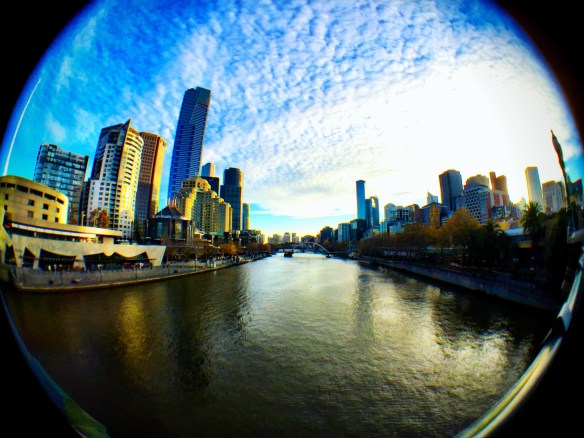
Yarra River, Melbourne

Yarra River, Melbourne

I have spent the last four days at the Hawker Brownlow Education Conference in Melbourne, an annual conference which brings big name educational thinkers together from around the world to present immersive sessions on educational issues of the moment. What follows is my reflection on the conference experience and the value of the conference model for learning.

I selected my conference sessions based on my particular areas of current interest. While Dylan Wiliam opened the conference by using William Schmidt’s warning against teaching an inflexible curriculum which is ‘a mile wide and an inch thick,’ my recent work in professional learning and effective school change has been an inch wide and a mile deep. The sessions I chose were therefore along this same vein and were intended to take me even deeper.

Many of the speakers’ points resonated with what I already know and affirmed my own thinking and practices. These added some layers of complexity to my existing understandings and acted as springboards for conversations around education.

Dylan Wiliam and Bruce Wellman pointed out that we learn when we are uncomfortable. Wiliam said, ‘we learn more when we’re wrong,’ while Wellman talked about the discomfort that comes with working towards understanding. He pointed out that teams and individuals need to be willing to squirm and grapple with challenging questions. A comfortable team is not a learning team.

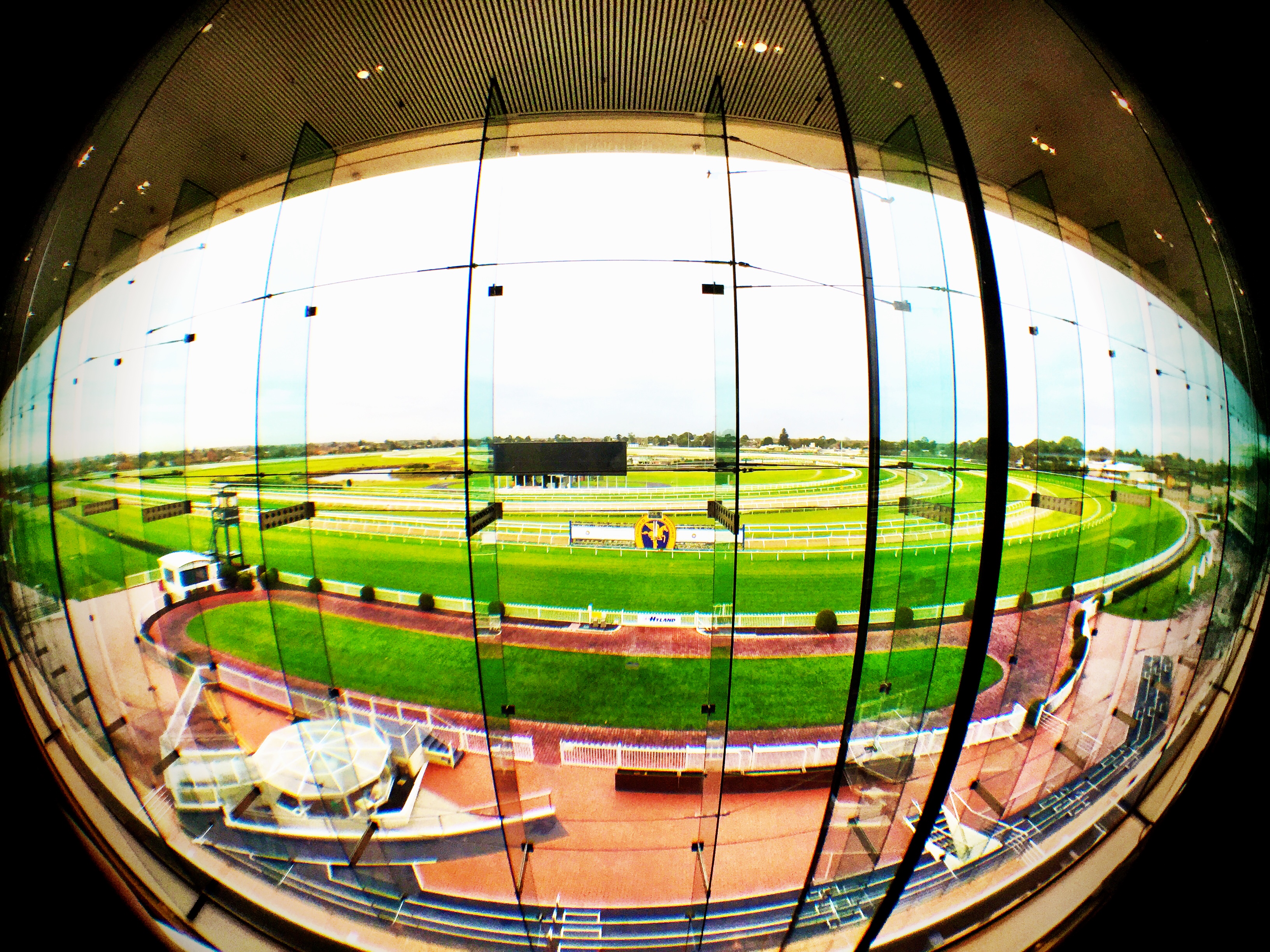
Caulfield Racecourse view from the HBE conference

Caulfield Racecourse view from the HBE conference

Learning communities were a thread which appeared in the sessions I attended. Wellman, co-author of The Adaptive School, discussed how skilful high-performing groups share intellectual and emotional space, which includes being comfortable with pauses in discussion. Silence is not the enemy of learning and collaboration, but an ally.

Wellman pointed out that being in the same room together does not make a group a community of learners. Anthony Muhammad added that a professional learning community is not a collaborative team which meets regularly, but a systemic contextually-embedded paradigm which raises collective knowledge through collective inquiry. Much like the Adaptive School material, which advocates ‘graceful disagreement’ as a norm of effective teams, Muhammad maintains that constructive, professional disagreement is the foundation of innovation.

Muhammad’s work at Levey Middle School reflects that of my own school in that it emerged out of the specific context of that school and where its community and practices were at. While our context is vastly different, we too have built our teacher growth model out of our school’s mission, vision, values, existing work and knowledge of our students, teachers and leaders.

Part of our model is based around how feedback and conversation might be deliberately harnessed in order to build teacher capacity and amplify the learning culture of the school. Wellman says that feedback is ‘in the moment, about the past, to affect the future.’ He points out that advice has very little impact on the advisee, and instead advocates for using clear, shared standards and a focus on learning, within an environment of trust. The focus on learning is about meeting the person where they are. ‘Wherever I meet you in your practice,’ he says, ‘we’re going to grow from there.’ He adds that, ‘We are starving our master teachers of rich conversations; they are hungry to talk about the whys of what they are doing.’

As outlined in Lipton and Wellman’s Learning-Focused Supervision, Wellman sees standards as rallying points for important conversations which set aspirations for goal setting and growth. My Australian school similarly uses Charlotte Danielson’s Framework for Teaching as a tool for developing shared understandings about teaching; and for reflection and data-based conversation around teaching practice. Our approach also gels with Wellman’s assertion that feedback should be customised and appropriate for the individual; one size does not fit all. Our model of teacher growth incorporates differentiation in terms of what sort of data teachers collect from their lessons and the ways in which coaches approach each conversation. As with the metaphor of the stage coach, our coaching model is about helping the coachee get to their desired destination.
Melbourne autumn

Melbourne autumn

One of Wellman’s points about data analysis was that, when looking at data, we should focus on analysing reasons for successes, rather than failure. What are the successful students or teachers doing? What knowledge and strategies do they have? How can we develop those in others? (He also has a great strategy for teams looking at student achievement data in which he employs prediction to engage people in their assumptions about what the data might hold, before revealing the data.)

At the end of the conference I met up with Eric Sheninger who had just landed in Melbourne for his first time working with Australian educators, districts and conferences (he will be keynoting at the EduTECH conference in Brisbane next week). I had tweeted a pile of books from the conference two days earlier, including Eric’s, with no idea that he was en route to Melbourne. Ours was an impromptu meeting which arose out of a morning Twitter conversation. We met up and chatted about our work, global educational thinkers, the world of connected educators and DIY professional learning. During our conversation, Eric pointed me towards some great apps which will be useful collaborative tools for my work with student and teacher learners, such as Verso, Tozzl and Padlet.

In addition, my first night in Melbourne had me meeting with some of my Twitter PLN – Greg Curran, Chris Munro and Jo Prestia – to discuss coaching in school settings, research journeys and approaches to school intervention implementation.

Both in and out of the conference I fielded questions about what my PhD is about. This was a great opportunity to hone my ideas about what is most important about my research and communicating that in effective ways.

So there were affirming moments in, and out, of the conference, which added nuanced layers to my thinking. Yet on reflection, I realise that much of what a conference can bring for the delegate are conversations with others, unexpected moments of collaboration, and the space and time to process and reflect. Although I was surprised at the lack of a backchannel at a national conference, by both presenters and delegates, – Where was the Tweetstream? – I found valuable connections with my own colleagues, other educators, presenters and connected educators who weren’t affiliated with the conference but were open to connecting in person.
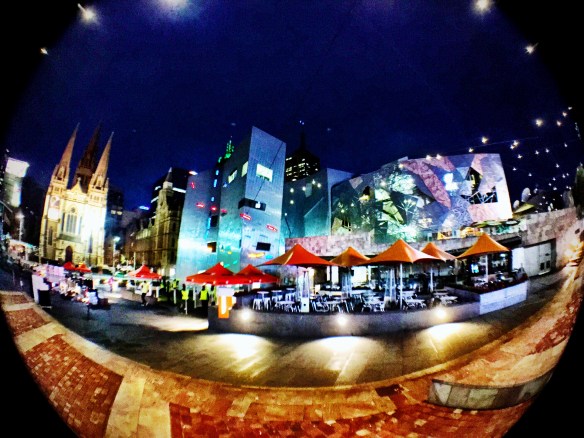
Federation Square, Melbourne
Federation Square, Melbourne
A PhD metaphor: Thesis as sculpture

I saw the angel in the marble and I carved until I set him free. ~ Michelangelo

Metaphors are something that I engage with when I am trying to make sense of something, and this has certainly been true as I have worked through the stages of my PhD.

I have previously explored the notion of a thesis as a sculpture, a collision of imagination and hard, systematic work. As I move towards the end of the first full draft of my PhD thesis, I have been reshaping this personal metaphor into a more specific vision inspired by the work and words of Italian Renaissance artist Michelangelo, who saw the sculptor as the free-er of sculptures from their stone slumber.

Seeing the Statue of David in the Galleria dell’Accademia in Florence was for me an almost spiritual experience. But perhaps even more magical to see and experience were the ‘Slaves’, unfinished figures twisting and writhing inside giant stone blocks. Lining the wide hall of the Galleria dell’Accademia, leading to David, they seem to be the tangible epitome of Michelangelo’s aim: to free existing figures from stone.

The metaphor of the researcher/Michelangelo and thesis/stone-sculpture works for me for a few reasons.

Firstly, like Anitra Nottingham’s metaphor of thesis-as-baking-a-cupcake, producing a thesis takes knowledge, skill, materials and creativity. The artist or researcher must know their materials and their methods. The researcher-sculptor learns, applies and refines their craft and their art. They must learn the basics, practise repeatedly and make many mistakes before their work begins to resemble the skill and originality to which they aspire.

Secondly, like Victoria Graham and Michelle Redman-MacLaren’s metaphor of research as swimming, it is hard and arduous work, requiring patience, persistence, sweat and a focus on doing your own best. Often working alone in his studio, the sculptor carves away at hard, unforgiving stone, systematically testing his tools and techniques against its surface. Some days his body aches. The mental and physical effort of the work keeps him awake at night. He makes excruciatingly slow progress, but sees his vision slowly come into view. Soon, it is no longer a rough cut slab of shapeless stone. The form starts to be revealed, loose but almost recognisable. And in the final stages, the sculptor uses small tools to polish and finely sculpt the finishing details, working obsessively on the most minute aspects.

Stone carving also reflects for me the process of the thesis. The researcher-sculptor begins with a purpose, a question, a vision, a method; but from those beginnings emerges something else. A figure twisting out from stone as a result of the influence of sculptor’s hand, mind, materials and tools. As the researcher-sculptor chips away, the thesis takes shape, influenced by the researcher-sculptor themselves, the pressure and techniques they apply, and the materials, data and methods with which they work.

Perhaps, also, art imitates artist. Seeing the ‘Awakening Slave’ writhing free from his block of marble seems a little like the PhD candidate emerging, through struggle, as a formed researcher from the PhD stone, or perhaps the PhD chrysalis.

There are differences, of course. Michelangelo became a master of his art, whereas the PhD researcher is an apprentice. And a PhD researcher makes mistakes, back tracks, double pikes, and tries again. It is not as though Michelangelo could gouge out a piece of marble, change his mind, and glue it back on, while retaining the integrity of the artwork. The metaphor isn’t perfect, but it allows me to inhabit the internal space of worker, tinkerer and creator, driven by my purpose while sensitive to my materials.

Is your thesis like a sculpture? What is your metaphor for your researcher self?

In every block of marble I see a statue as plain as though it stood before me, shaped and perfect in attitude and action. I have only to hew away the rough walls that imprison the lovely apparition to reveal it to the other eyes as mine see it. ~ Michelangelo

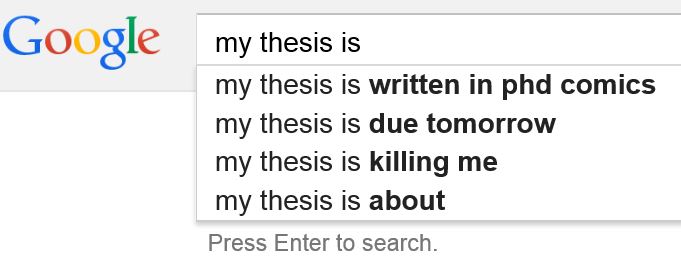
A Google search for 'my thesis is' won't give you inspiration.

A Google search for ‘my thesis is’ won’t give you inspiration.

Front load your work. Be an expert. Own your contribution.

You have brains in your head. You have feet in your shoes. You can steer yourself any direction you choose. You’re on your own. And you know what you know. And you are the guy who’ll decide where to go. ~ Dr Seuss

by @debsnet

sometimes the words slowly bleed onto the page

As a mid-career professional I often feel comfortable in my work in teaching and school leadership. I might come up against challenges, but I do so with a sense that I know what I’m doing and have a sense of how to make my way through them. ‘This is what I know how to do,’ I think to myself. And forward I go without a second thought.

There are times, however, when I cannot forge forward confidently. Becoming a parent, for instance, threw me into a new situation and a new role in which I had to start from scratch. I was a newbie who had to find my way into my parent-identity and a way of parenting which worked for me. The PhD is another something which throws people into a new deep end. I have written about my realisation that my discomfort zone is my place of growth, but that doesn’t make the experience of discomfort any more … comfortable!

I type this post from the throes of my current nemesis: the PhD Discussion chapter. I wrote last month about my feelings of paralysis before beginning this chapter, and how I eventually got started. And yet here I still am, four or so iterations later and still wrangling, dancing with, building and un-building my discussion.

Part of my struggle is around scholarly confidence, reflected in the notes from my last PhD supervision meeting which read a bit like this: ‘too much other people’, ‘less others, more you’, ‘put your ideas up front.’

It seems I am clinging to the literature. I still want to prove to my reader that I have read everything I can get my hands on and I know my stuff. That I’m not a masquerader or pretender. And it seems I do this by citing and paraphrasing and putting up front the work of Others.

You know Others. In the mind of the novice researcher they deserve capital letters of knowledge because they are experienced, frequently-published, well-renowned academics, not researchers-in-training or Doctors-in-waiting.

And yet in the Discussion and Conclusion of the PhD I know I must identify myself as an expert. A person worthy of a capital letter (like a ‘Ph’ or a ‘D’). I keep reminding myself that I am an expert in my own research and that I can stand on the front foot when I discuss my findings and what they mean in the world.

So my current notes-to-self for the Discussion chapter are:

– Stop trying to prove my worth through literature.

– More me. Less others.

– Front load my work.

More than just a process of writing, this is a process of becoming. Becoming a researcher. Becoming a researcher who knows she is a researcher, feels like a researcher and makes knowledge claims like a researcher. It’s taking me many molasses-slow drafts to find my expert voice and a way of writing which foregrounds my own research and my own academic voice, while still situating my research within the existing literature. But step by step I am getting closer.

And I’ve been reading Dr Seuss’s Oh the places you’ll go! to my children recently so I am armed with the mantra that with brains in my head and feet in my shoes, I can move mountains. One painstaking word at a time.

You’re off to great places! Today is your day! Your mountain is waiting. So… get on your way! ~ Dr Seuss

You're off to great places, by @debsnet

the édu flâneuse atop an Icelandic glacier


On teacher evaluation & the New York APPR reforms: a view from Down Under

There are no such things as limits to growth, because there are no limits to the human capacity for intelligence, imagination, and wonder. ~ Ronald Reagan

NYC skyline, by @debsnet

As part of the Education Transformation Act of 2015, New York State is reforming its Annual Professional Performance Review (APPR) and Teacher Effectiveness rating system.

Grant Wiggins in his open letter to Governor Cuomo calls the APPR reforms a “step backward” which disempowers teachers.

NY Middle School Principal Lisa Meade voiced her concerns here and put out the call out to New York educators to respond to the proposed teacher evaluation reforms. Educator Christina Luce added to the conversation in her post, asserting that, while she supports an annual professional reflection and review, the proposed reforms are narrow, punitive and make “an already horrendous evaluation system even worse”.

While I am not a New York educator, I felt compelled to offer a perspective from a different system. My visits with schools and educators last October helped me to learn about how teacher evaluation is approached in New York. While some of the challenges faced were global, shared with Australian schools, some were surprising to me. I wrote various posts documenting my reflections in New York including:

  • My visit to a school in Westchester which opened my eyes to the constraints on New York schools in teacher evaluation;
  • My visit to a school on the Upper East side which reminded me about the need for schools to find teacher evaluation and growth processes appropriate to their context;
  • Meeting Ellie Drago-Serverson at Columbia University to discuss the best environments and practices to facilitate adult learning;
  • Meeting with Charlotte Danielson and Cindy Tocci around effective applications of the Framework for Teaching for teacher growth and evaluation; and
  • Meeting with New York City professional development provider Teaching Matters, an organisation which bases its work in a belief about the capacity of teachers to be leaders and for schools to be vibrant places of distributed leadership.

slice of harlem, by @debsnet

The proposed APPR reforms seem to make an already limited system of scoring even narrower, based on data that I imagine does little to reflect a holistic picture of a teacher, their teaching, and their students’ learning. While the use of these kinds of data for measuring teacher effectiveness have been questioned (see for instance this post and this post by Grant Wiggins), I have instead focused on how these reforms sit with my own beliefs about teacher learning.

Costa and Garmston in this paper talk about safety, but not comfort, being a prerequisite for learning, pointing out that the brain works in such a way that if we do not feel safe, we cannot think and learn. They note that sensory signals entering the brain travel first to the thalamus, then to the amygdala or threat detector, and then to the neocortex where thinking happens. “If threat, fear, pain even in the most minute portions are perceived, neurological and chemical processes occur which prepare the system for survival, not reflection.” While learning often happens in a space of what they call ‘disequilibrium’, or what I call the discomfort zone, there needs to be safety and trust for thinking, reflection and growth to occur. The New York teacher effectiveness system does not seem to allow for a safe environment of learning and growth, but rather opens up the potential for fear and a fight-or-flight response.

This notion of safety-but-disequilibrium is supported by Ellie Drago-Severson’s concept of high-support high-challenge ‘holding environments’ as the optimal environments for adult learning. By Dan Pink’s work on motivation which he notes is extinguished by punitive approaches. By David Rock’s work which shows that carrot-and-stick approaches result in resistance. In reflections by Robert Evans that teachers resist externally imposed change. By the Adaptive Schools foundational concepts of trust and of honouring both the individual and the system.

Upper East Side, NYC, by @debsnet

In light of how the brain works and how thinking and motivation are ignited, the New York teacher evaluation system, current and proposed, doesn’t make sense to me. It is a punitive deficit model which assumes that teachers are underperforming, unprofessional and in need of external measures to bring them up to scratch. In a recent paper, Dylan Wiliam points out that “each teacher has a better idea of what will improve the learning of their students, in their classroom, in the context of what they are teaching them, than anyone else.” Teachers should be trusted to be professionals and given the support, and challenge, to grown on their professional journeys.

My school’s teacher growth model is based on a belief in the capacity of teachers. It is based in a belief that everyone is coachable. That is, that teachers want the best for their students and that they are fully capable, with support, of setting goals, analysing data and improving their practice in ways which most benefit their students.

Wiggins is right when he says these reforms disempower teachers. Surely if we want teachers to get better, it isn’t scoring them we should be primarily concerned with, but growing them. Teachers should receive ongoing support to refine their practice and focus on becoming increasingly better at serving their students’ pastoral and learning needs. I absolutely agree with regular performance check-ins and goal setting work, but I also believe in teachers.

My hope for any school system would be that teachers are given opportunities for growth born out of a belief in their capacities and in their important work with our children, rather than public scorecards based on questionable measures.

New York, I’m thinking of you, your teachers, your school leaders and your students.

NYC, by @debsnet

Can and should teachers be (viewed as) researchers?

Sarajevo bullets, by @debsnetWhen we respect teaching as an intellectual activity and give teachers the opportunities to raise serious questions about what they teach, how they teach and the larger goals for which they are striving, they can play a dramatic role in transforming their institutions. ~ Peter Senge, Schools that Learn: A Fifth Discipline Fieldbook for Educators, Parents, and Everyone who Cares about Education

This month – April 2015 – is the month in which Dylan Wiliam argued in the TES magazine that teaching cannot and will not be a research-led profession, in which Tom Bennett responded that evidence-based education is dead (but that evidence-informed education lives), and in which John Hattie was quoted in a TES article as saying that teachers should not try to be researchers and that ‘I don’t have any time for making teachers researchers.’ In response to his own question, ‘Asking teachers to be researchers?’ he replies, ‘They are not.’

In this article Hattie is also quoted as saying that teachers should use the “literacy and sensibility of research to inform their practice” and that the worlds of research (by academics, not teachers) and teaching should “orbit together”. This resonates with Tom Bennett’s assertion that teaching be evidence-informed (but not evidence-based) and with the mandate of researchED which is to raise research literacy in the teaching profession and promote conversations between teaching and academic communities (my post about researchED Sydney 2014 is here).

As someone whose identity straddles ‘teacher’ and novice ‘researcher’ (as a PhD candidate coming towards the end of my PhD journey) I agree that research should inform teaching, leading and educational practice, and that worlds of education and the academy should work in collaboration. I am not sure, however, that we should draw a divisive line with ‘teacher’ on one side and ‘researcher’ on the other.

When I read the TES article which presented quotes from Hattie, a number of questions arose for me. What does Hattie mean when he says that teachers are not (and perhaps cannot be) researchers? What is his definition of ‘researcher’?

Is he discouraging teachers from reading academic literature and collecting data to inform their practice? Is he telling teachers they cannot be (taught to be) systematic thinkers who investigate, trial, collaborate, communicate and utilise scholarly literature and evidence to inform their practice?

Many teachers have been involved in action research projects, or Masters or PhD dissertations. Are these teachers, too, incapable of conducting and applying research thinking and methods? For me this is an issue of identity, of sense of self. Am I a teacher who researches? A researcher who teaches? A teacher and a researcher? Is Hattie suggesting that these identities are unavailable to me?

Is research in a real educational context by a real educator less valid than that of an academic from a university?

Many have responded to this conversation. Kevan Collins, chief executive of the Education Endowment Foundation, warns against encouraging teachers not to pursue evidence, as he articulates in this TES article.

Teacher Chris Parsons explores how the teaching profession might strategically develop its use of evidence to inform practice.

PhD candidate Charlotte Pezaro, writing for the Australian Association of Educational Research, explores ways in which academics and teachers might interact.

Policy analyst Patrick Watson in this post argues that we need to identify research which is worthwhile for informing practice, build the research-literacy of teachers and encourage action research to facilitate reflection and deeper understanding.

The 2012 Grattan Institute report ‘Catching Up: Learning from the best school systems in East Asia’ asserts that high-performing school systems view teachers as researchers, continually developing their knowledge base through practices such as professional reading and action research. My PhD cites examples of literatures which promotes participatory action research as transformative for individual practice and collaborative cultures. All research and all researchers have limitations. I wonder what the impact is of viewing teachers as researchers and of encouraging teachers to think of themselves as researchers. How does it shape teachers’ identities, self-perceptions and practices if they are encouraged to be consumers, curators, engagers and creators of research? Perhaps it is partly a question (to reflect Dweck’s work) of developing a research mindset.

One of Wiliam’s points is that research cannot tell us what could be only what we already know. If we are always basing our practice on what has been done, we aren’t innovating or trialling new possibilities. Teaching and schools should be about more than doing what has been done and what is known; it should be about moving forward and even about innovation and creativity.

Perhaps teachers who see themselves as researchers could call themselves ‘teachers as innovative, research-literate, reflective, evidence-informed, systematically-thinking, data-using-and-interrogating practitioners who drive their own learning and improvement in regards to what benefits their students.’ Or maybe that’s a bit long.

While I understand that the issue of whether teachers can or should be researchers is nuanced, complex and riddled with semantic argument, I (as someone who identifies as teacher and researcher) would like to think we can view teachers as researchers, by my definition, if not by Hattie’s.

Everyone is coachable: we are all capable of change & growth

All who wish to continually improve their craft … never lose the need to be coached. ~ Art Costa & Bob Garmston

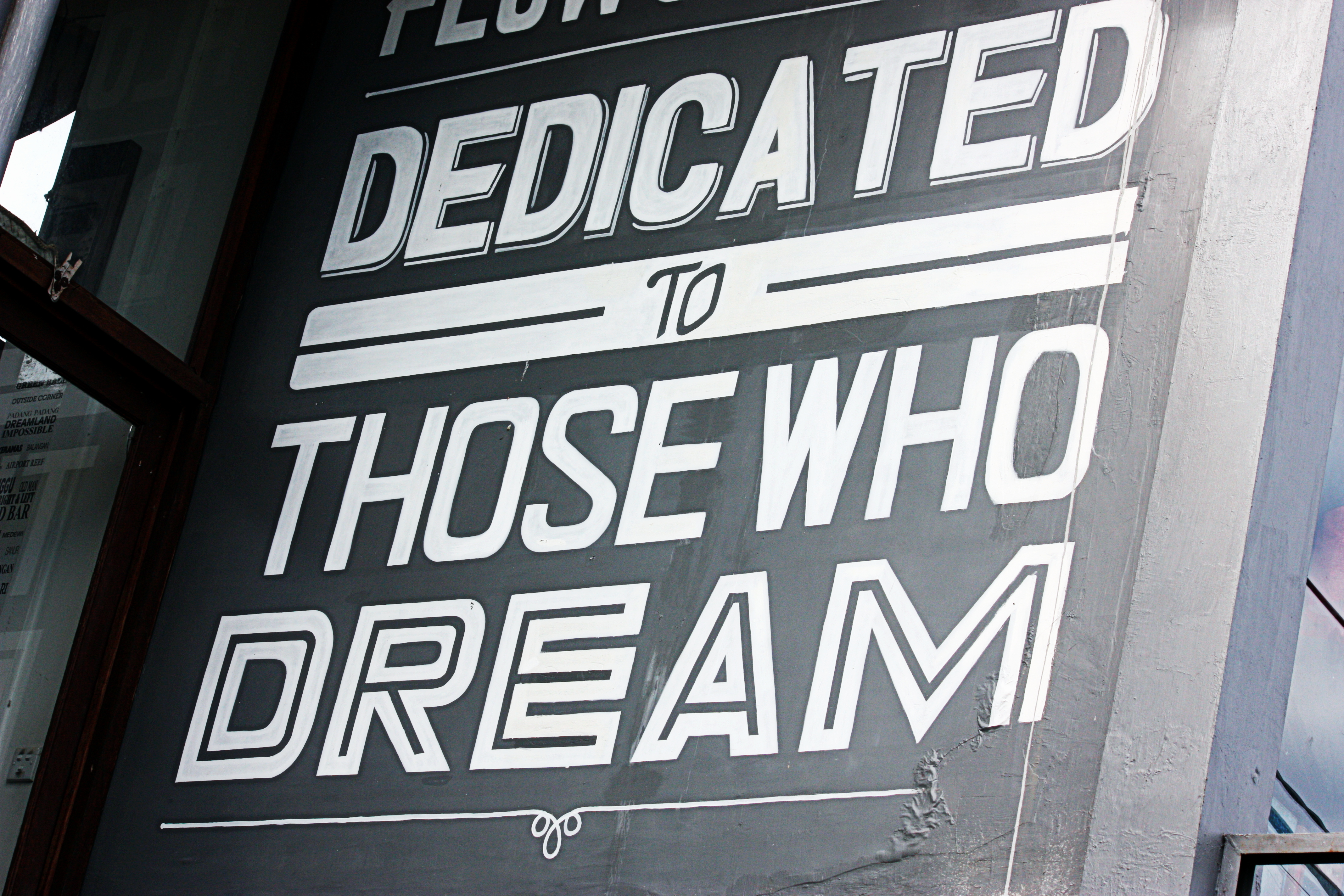
dedicated to those who dream, by @debsnet

I was recently asked a question on Twitter: ‘Are some teachers un-mentorable?’ My response was along the lines of, ‘No-one is unmentorable or uncoachable; a person always has the capacity for growth.’ This belief underpins my ideas about school change and my school’s teacher growth model on which I presented at researchED conference in Sydney and ACEL in Melbourne.

In scholarly literatures, coaching (sometimes used interchangeable with the term ‘mentoring’, such as in the writings of Ellie Drago-Severson, who I talked with last year) seems to be divided into expert coaching and peer coaching.

Expert coaching involves an expert or master who provides guidance to a less-experienced apprentice. This includes Jim Knight’s instructional coaching in which the expert instructional coach provides judgements, feedback and suggestions, based on their expertise.

The other kind of coaching is peer or reciprocal coaching in which someone is paired with those of a similar level of expertise. These peers proceed to coach or mentor each other in a collaborative and non-hierarchical way. This approach, which is intended to develop a collaborative learning culture as well as the individual’s practice, includes models like instructional rounds, in which teachers form small professional learning groups which collectively work to enhance their practice.

Both coaching trends are based on use of data for growth (in a teaching sense, this would be some kind of classroom observation data) but are underpinned by different principles and beliefs. Expert coaching models assume that people learn best when someone with more knowledge and experience provides them with specific, targeted feedback for improvement, while the peer coaching models assumes that it is by working together that we can improve.

One form of coaching which can be conducted by a peer or an expert is Costa and Garmston’s Cognitive Coaching which is based in brain research like this which suggests that we are most likely to grow when we do thinking ourselves, rather than receive thoughts doled out by others. Cognitive Coaching focuses on developing individuals as self-directed learners who consciously reflect upon, conceptualise and apply understandings from one experience to the next. It is a data-based, non-judgemental, developmental and reflective model for conversations for planning, reflecting and problem resolving, as well as a tool for developing professional communities that value interdependence and individual capacity for self-directed learning.

The goal of Cognitive Coaching is the growth of individual and organisation through the development both of autonomy (of the individual) and interdependence (the development of a holonomous organisational culture in which individuals function as both autonomous, independent individuals and interdependent, responsive members of the larger system).

Unlike expert models of coaching which involve specific coach feedback, judgements and suggestions, Cognitive Coaching involves mediated processing. The Cognitive coach does not offer judgements, feedback or advice, but asks ‘artfully vague’ questions or presents impartial observational or other data, followed by silence, in order to encourage the cognitive and reflective processes of the teacher. There is certainly an art to the asking of well-crafted cognition-provoking questions, as I have found in my journey as a coach. This approach is intended to create personal change through new connections in the brain and reconstruct knowledge through a conscious, reflective approach to new experiences.

By avoiding positive and negative value judgements and opinion, by coaching ‘without manipulation,’ Cognitive Coaching aims to transform an individual’s beliefs about learning and refine their cognitive maps by encouraging them to talk and think about their decisions. In this way, talking aloud leads to examination and refinement of choices and behaviours.

The use of a Cognitive Coaching process for teacher learning and development is supported by Charlotte Danielson’s work (you can find my conversation with Charlotte here) in which she notes that mentors, supervisors, evaluators and colleagues should beware of imposing their own styles or preferences when observing. The question is not “Is this how I would do it?” but “Given the context, what is appropriate?” She also advises that classroom observations must be accompanied by conferences before and after observed lessons.

My own experiences as cognitive coach and coachee have shown me the power of this kind of coaching to allow people’s own internal resources to kick in to gear, their own passions and thinking to light up, and their confidence to solve their own problems and forge their own paths to soar. It has shown me the power of really being listened to and being given a safe, trusting place in which to verbally explore situations. It has also shown me that when you own your ‘a-ha’ moments, the learning sticks. Change happens. Practice shifts.

So, returning to the question of the uncoachable or unmentorable teacher, I wonder about the intent of the coaching or mentoring.

Cognitive Coaching aims to ‘convey a valued person from where they are, to where they want to be.’ There are some important assumptions being made here. The person is valued. They are assumed to be motivated and capable of reflection and growth. And they are helped on their learning journey to a destination to which they aspire. This model of coaching is not a deficiency model based on where the manager wishes the person would go or what an expert has identified as an area of growth. It is about the person. And. Where. THEY. Want. To. Go.

Do I believe that absolutely any teacher, any person, can be coached or mentored into professional growth? Absolutely.

We believe that all human beings are capable of change, that we continue to grow cognitively throughout our lifetime and that we all possess a vast reservoir of untapped potential. ~ Art Costa & Bob Garmston

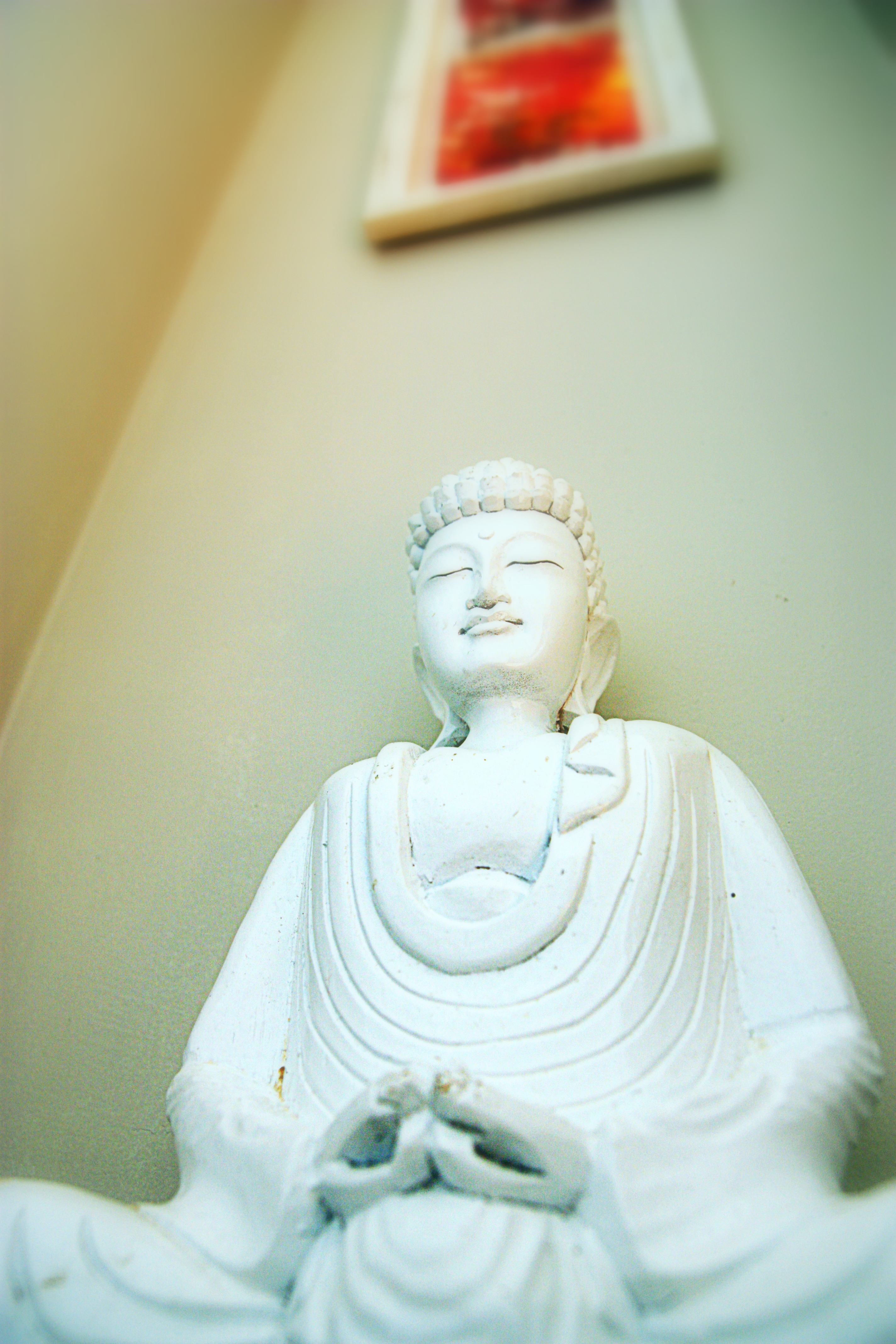
buddha, by @debsnet

Writing the PhD discussion chapter: from fear to flight

Don’t believe what your eyes are telling you. All they show is limitation. Look with your understanding. Find out what you already know and you will see the way to fly. ~ Richard Bach, Jonathan Livingston Seagull

flight, by @debsnet

Since beginning my PhD two and a half years ago, I have plugged away at my thesis, chipping at it bit by agonisingly small bit, sometimes having to retrace my steps or throw out whole sections of work. But it has progressed through dogged persistence, slow laborious work and a measure of creative problem solving. I have even found it to be wonderful celebrated ‘me time’ as I explained on the PhD Talk blog.

Yet as my big book pushed towards 100,000 drafted words, I arrived at the discussion chapter and … duhm duhm daaahhhhhhm … suddenly I screeched to a stop, paralysed by fear. After fairly consistent, if often brain-bending, progress, I had come to a standstill. Up until this point, my metaphors of PhD candidature had served to propel me forward through even the biggest challenges and hard-to-hear feedback. My PhD had been an elephant I had to eat one deliberate bite at a time, or a sculpture I needed to craft carefully, or a journey in which I put one footstep in front of the other (another nice metaphor is this one of the PhD as swimming). Yet, despite my supervisors’ assurances that the discussion chapter was just one more eatable bite, one more takeable step, I was immobilised.

Matt Might’s illustrated definition of the PhD, which I had initially found grounding, now seemed terrifying. While it demonstrated that a PhD need only push the boundary of knowledge a teeny tiny bit, it also reminded me that a doctorate is all about having an original contribution to the body of knowledge. An. Original. Contribution. Which. Pushes. Bends. And. Remakes. The. Boundary. Of. Knowledge. And the discussion chapter is where I need to – as Inger Mewburn (the Thesis Whisperer) says – not just state my findings but explain what my findings mean.

So after two and a half years of reading (and reading and reading), interviewing, analysing and writing (and writing and writing and writing), I found myself at a point at which I needed to explain what it all means. And to have the (as Inger puts it) scholarly confidence to assert my research as having an original and worthwhile contribution.

In my paralysis of PhDcrastinating I found Emma Burnett’s blog posts which helpfully explained how she planned to approach her discussion chapter and also what she actually did. These kinds of explications by PhD candidates are useful material for others as they approach different stages of thesis wrangling.

Pat Thomson, my go-to blogger on all things academic writing, describes the discussion chapter through the metaphor of taking flight. She explains that the discussion chapter is the place to “be your own expert, to fly where no other researcher has flown before.” No pressure. Her metaphor of discussion-chapter-as-taking-flight reminded me of Richard Bach’s allegorical novella Jonathan Livingstone Seagull in which the non-conformist seagull Jonathan works tirelessly, often on his own and sometimes as an outcast, towards a kind of flight never before achieved by any seagull. His passion-driven, sometimes lonely and relentlessly-perfectionist journey to ultimate flight could certainly be a metaphor for the PhD narrative (although as Pat Thomson reminds us, the PhD is not a lone journey, but collaborative work).

@debsnet & @patter Twitter discussion

In a useful Twitter conversation, Pat explained to me that the discussion chapter is a synthesis and interpretation of findings which takes them to a new theoretical level. Discussion is not a repeat or recap, but a presentation of a new reading of the research which links findings to literatures. As Pat’s blog post explains, this is the place for interpretation and theorisation. Taking it to the next level. As she suggests, it’s the time to earn the ‘Philosophy’ part of the PhD.

*      *      *

Eventually I found a mental space in which I could put some words to the page (just one word in front of the other, I told myself; get it down), and I got started on the … duhm duhm daaahhhhhhm … discussion chapter.

Firstly, I went back to my research questions, which had emerged from the literature review, and used these as a frame for my discussion. Then I went back into my literature chapter and pulled out the threads which related to those research questions, especially those areas in which I had identified gaps or areas for further embellishment or new perspectives. Then I went back to my data (in my case, three chapters of storied interview data from three different groups). While the end of each of my data chapters included some synthesis and interpretation of that data set, the discussion chapter was the time to bring all the threads – all literature and all data – together. My intention was to identify clearly what I had found and how this was related to existing literatures. After writing an initial draft which was more summary than analysis or insight, I left it. It was a start.

Now, after giving myself permission to take a break and finding some mental space and clarity through travel, I have returned to the chapter. As I write I am asking myself: What does my data mean (within the parameters of the research questions)? What established trends are affirmed or challenged by my study? What findings are surprising? What from my research is new in terms of, or absent from, the literatures in my area?

The chapter is still in draft form, but instead of standing still, mute and frozen, I am flapping my wings with a sense of how and where I’m going. Soon enough I’m sure I will take flight.

(For an update on how my approach to the discussion chapter evolved, the follow up is here.)

He was not bone and feather but a perfect idea of freedom and flight, limited by nothing at all. ~ Richard Bach, Jonathan Livingston Seagull

paper planes by @debsnet

Travel and presence: doors to clarity and joy in life and work

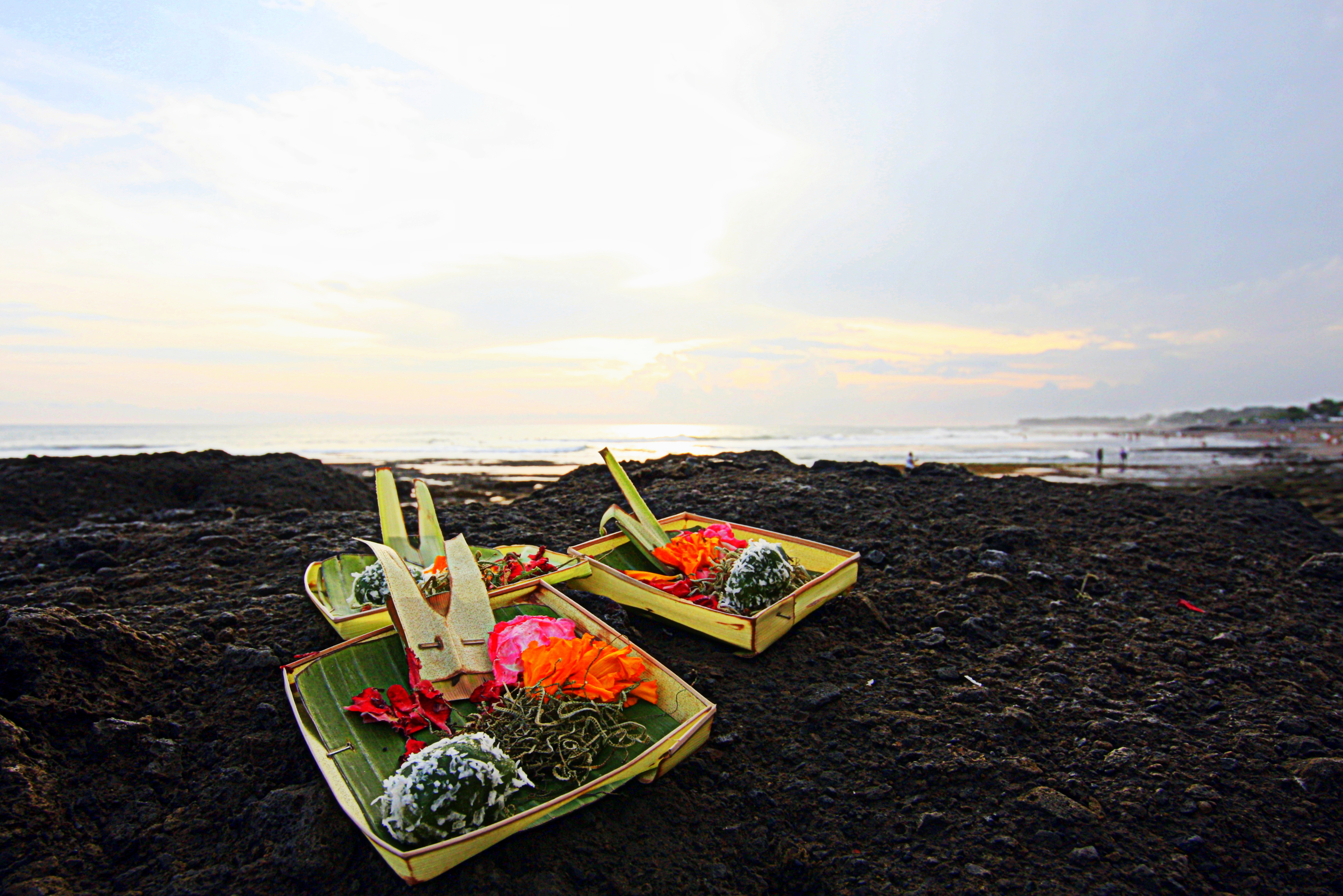
offerings, Canggu, Bali, by @debsnet

table of offerings being made

Wandering re-establishes the original harmony which once existed between man and the universe. ~ Anatole France

In 1964 Baudelaire described the flâneur (or for my purposes, the flâneuse) as “lover of universal life” who “enters into the crowd as though it were an immense reservoir of electrical energy.” He describes flânerie as the mirroring of crowd and environs, in which the flâneur is a “kaleidoscope gifted with consciousness, responding … and reproducing the multiplicity of life and the flickering grace of all the elements of life.”

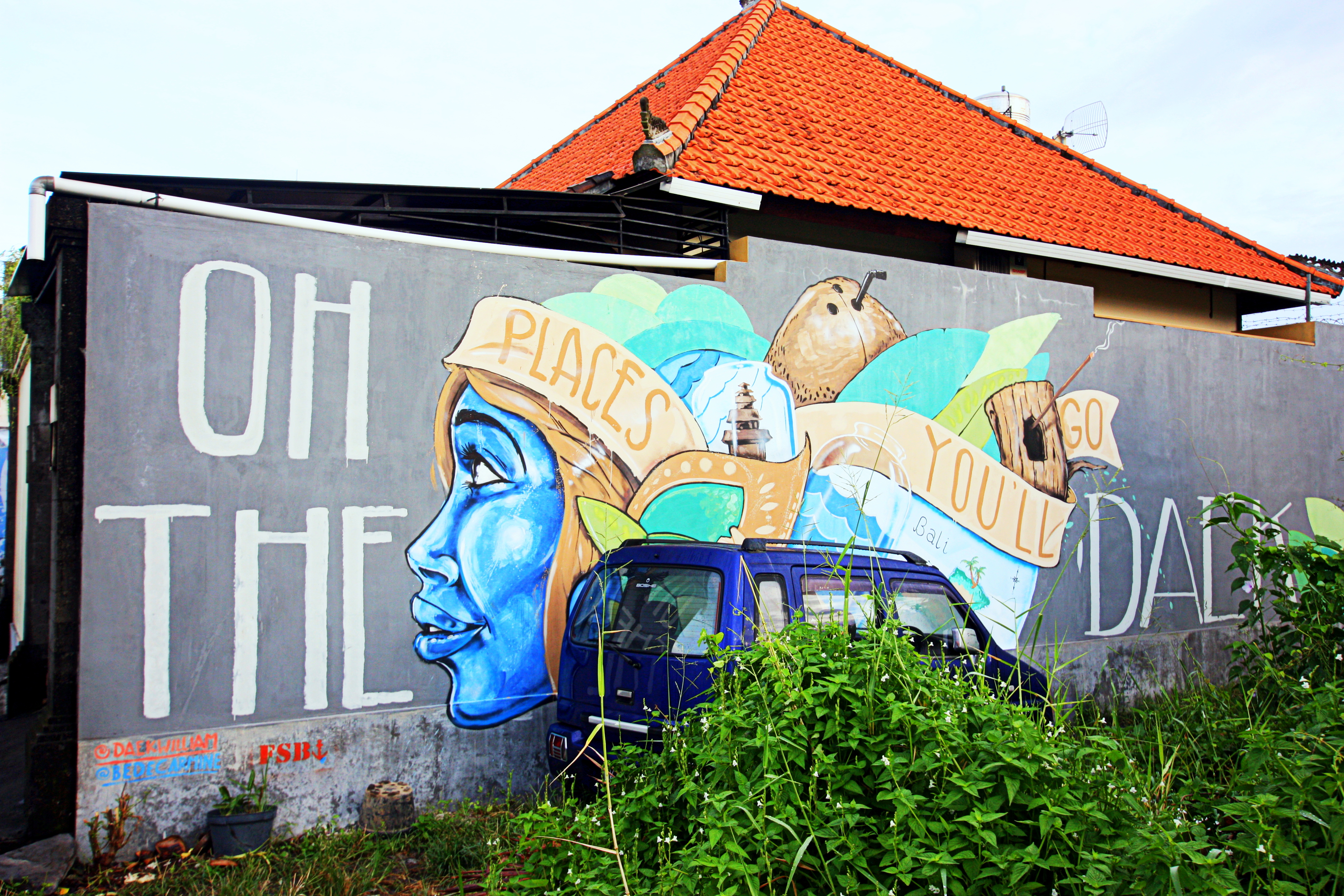
Oh the places you'll go! Canggu mural

Oh the places you’ll go!

As the édu flâneuse, then, I am mindful of channelling this notion of the reflective mirror or refractive kaleidoscope, of being an absorber of words, worlds and wonders. While I try to find awe and gratitude in the everyday, travel is the perfect opportunity for practising the flânerial mindset of intense attentiveness and expansive wide-openness.

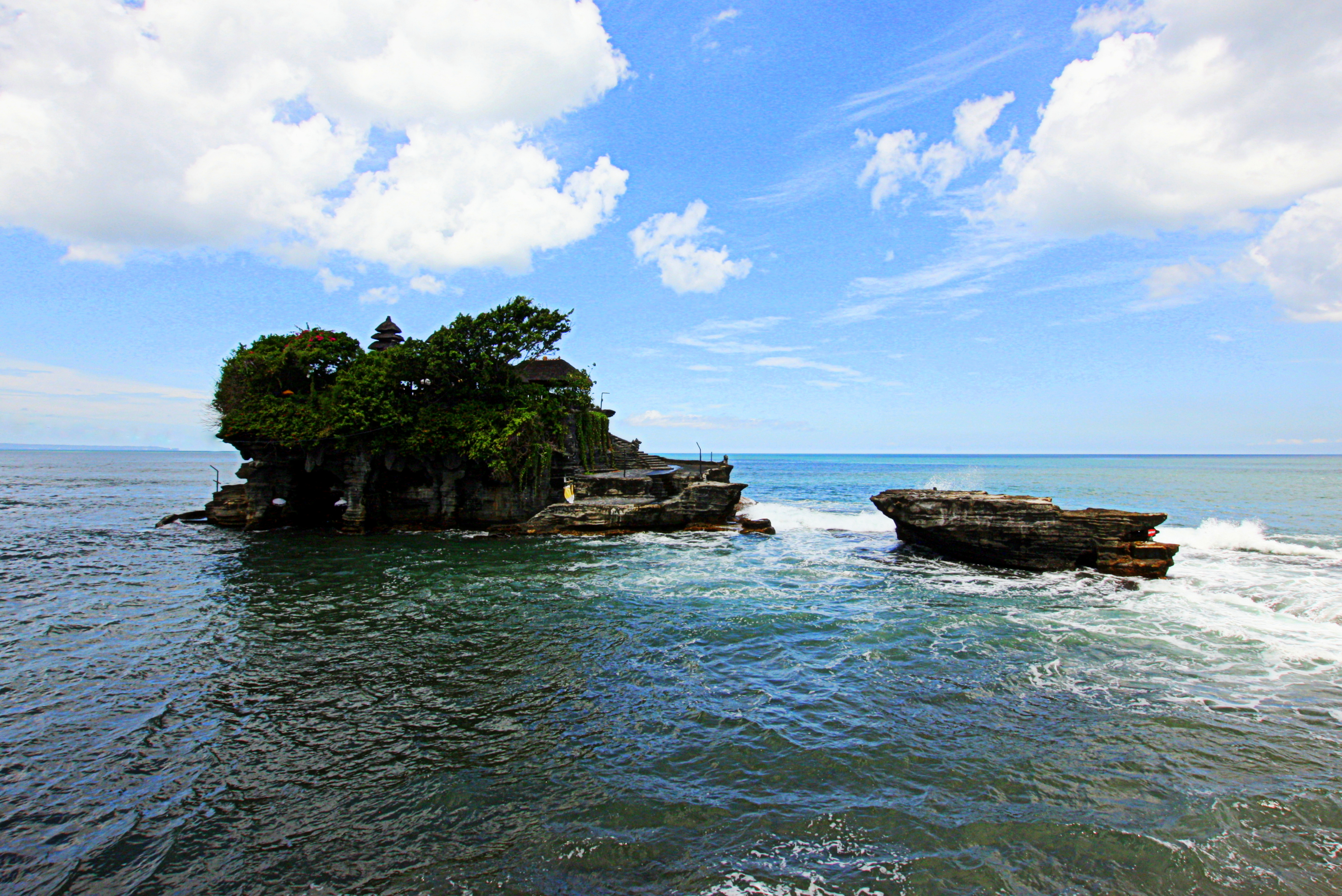
Tanah Lot, Bali, by @debsnet

Tanah Lot temple

My recent trip to Bali, in which I gave myself permission to take a break from work and PhD study (and also blogging and even engaging professionally on Twitter), was the perfect opportunity to embrace flânerie and presence (one of my 3 words of 2015). As well as unplugging from constant mental and physical engagement in work and study, I was focused on the travelling mindset, defined by Alain de Botton as being about heightened receptivity. As Adriano di Prato writes on his blog ‘Permission is Triumph’ we must each say ‘yes’ to living our lives in the way we choose.

offerings on Echo Beach rocks

offerings on Echo Beach rocks

While I left home in a flurry of jumbled thoughts, to-do lists, marking piles and thesis pages, I have returned almost delirious with relaxation, centeredness and acute awareness of the present moment. The act of travel, and its immersion in people and places, has allowed me to re-ground myself, reflect and practise receptivity, allowing me to (hopefully) return to daily life, work and research with renewed clarity, purpose and joy.

Ayana Resort infinity pool, Bali, by @debsnet

infinity pool at Ayana Resort, Jimbaran

My experiences away included those with my husband, children and friends. But they also included solo flânerial entanglements in environment. Early morning walks often provide these moments for me. In the past I have watched the sun rise above iconic landmarks including Venice’s St Mark’s Basilica and Prague’s Charles Bridge. There is something magical about being alone in the first quiet golden light of day, watching a city wake up, before it is caught in the throes and machinations of its daily grind. This trip was no exception.

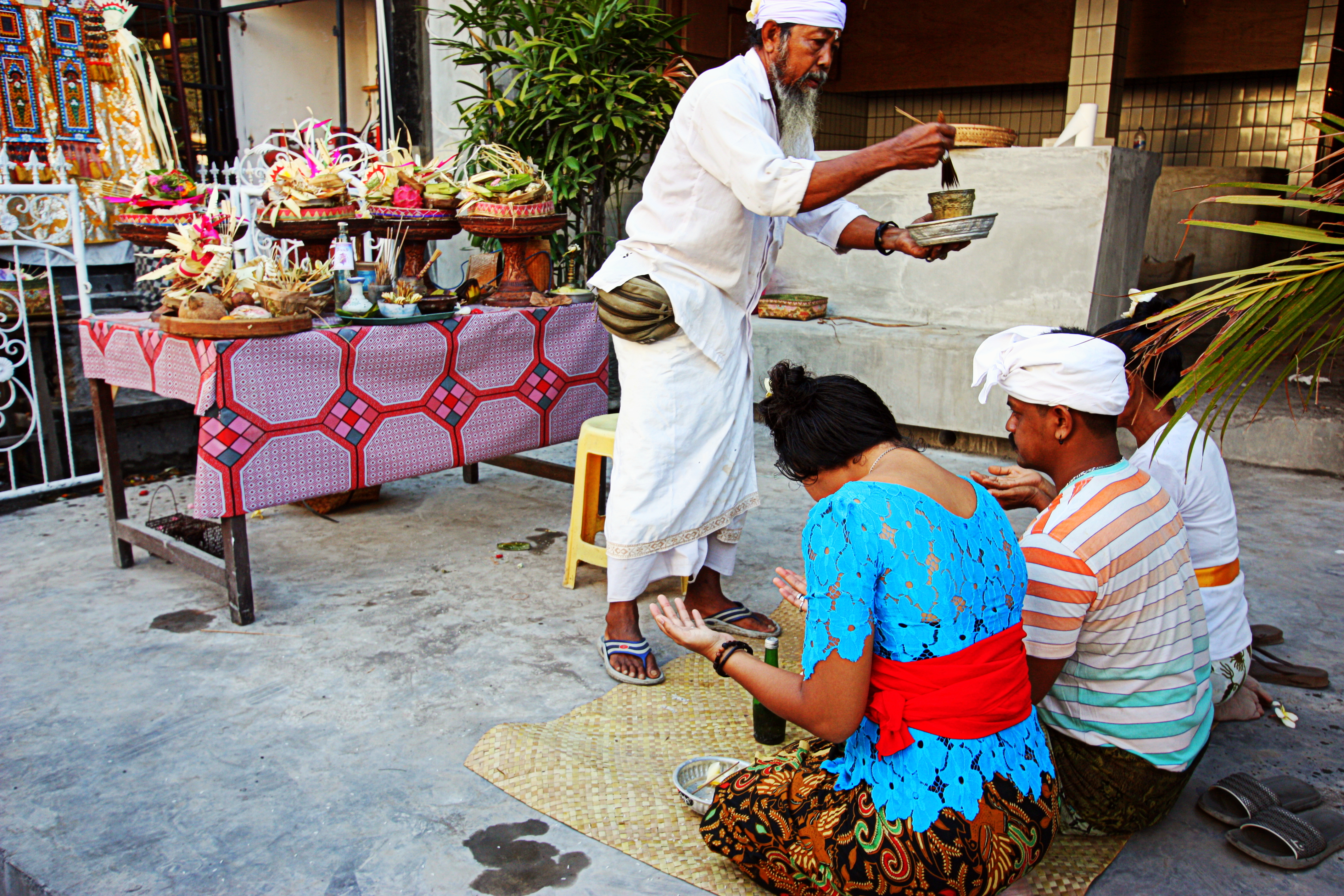
Tumpek Wayang ceremony, Seminyak, Bali, by @debsnet

Tumpek Wayang ceremony, Seminyak

One morning, as I wandered through the streets of Seminyak at dawn, I happened upon a Tumpek Wayang ceremony in which three individuals were led by a holy man in ritual. I was first drawn to this small ceremony by the sounds – the pealing of bells and the twittering of a small caged bird. I drew closer and sat nearby to watch as the ceremony continued, with prayers, offerings and sacred rites conducted with grace and in luxuriant colour. I have since discovered that Tumpek Wayang occurs every 210 days and that its purpose is to honour the god of art and artists, Sanghyang Iswara. After it had finished I was able to talk to the people about the ceremony, its significance and what it meant to them, such as the use of holy rice (bija) for blessings and to bring their god to themselves by placing the rice on their forehead and also by eating it.

basket of petals, Bali, by @debsnet

basket of petals

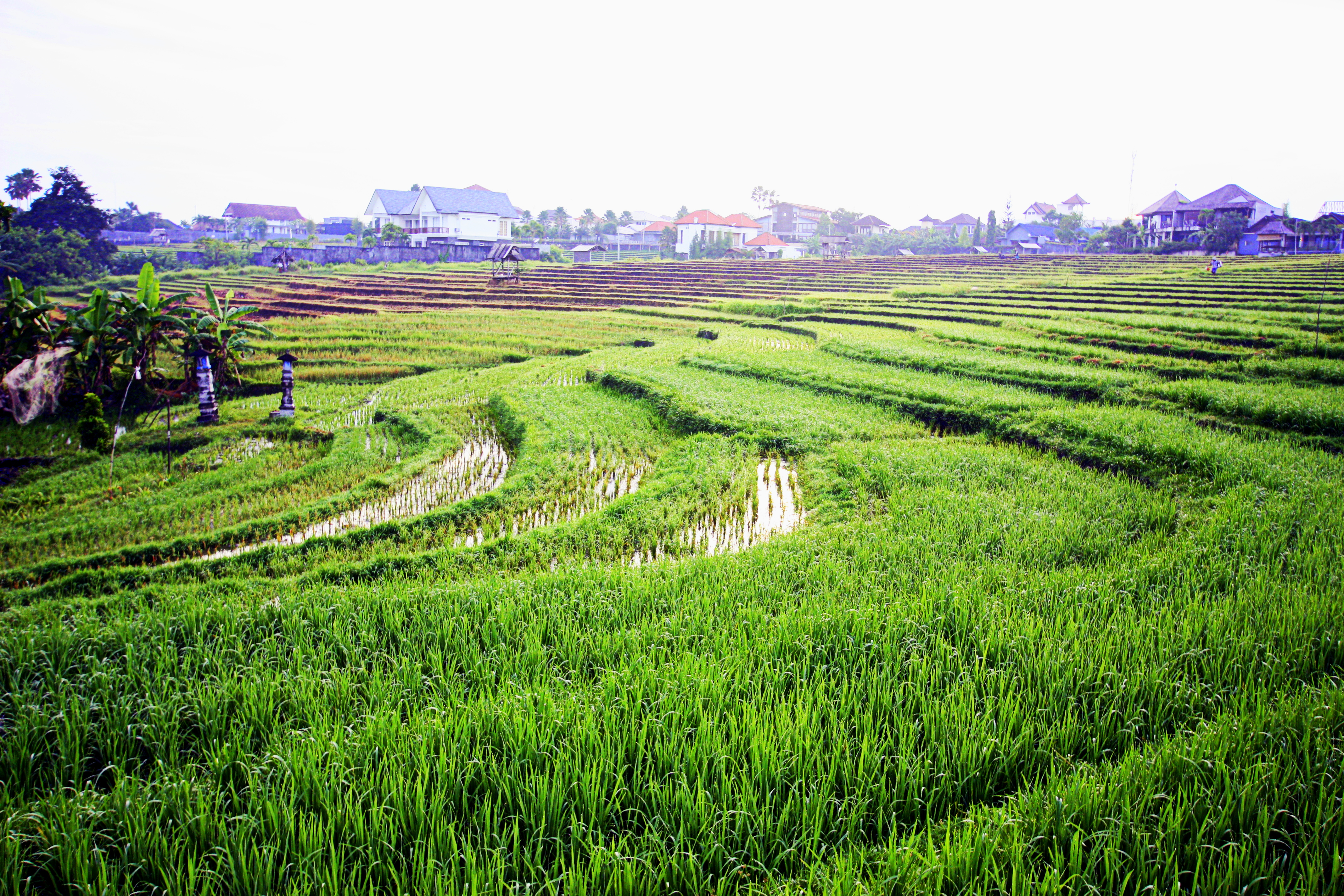
Another morning, wandering through Canggu rice paddies at sunrise, I encountered a Balinese man, or he encountered me, and we began to talk. He asked me if I was a spiritual person, and we spent the rest of the walk discussing spirituality, blessings, meditation, music and love. ‘Love,’ he said, ‘is when the heart smiles.’ We talked about the meaning of Engelbert Humperdinck’s lyrics ‘there goes my everything’ and the role of music in life and self. I don’t speak Indonesian and this man’s English was limited, but we connected at a moment in time and managed to communicate across cultural and language barriers.

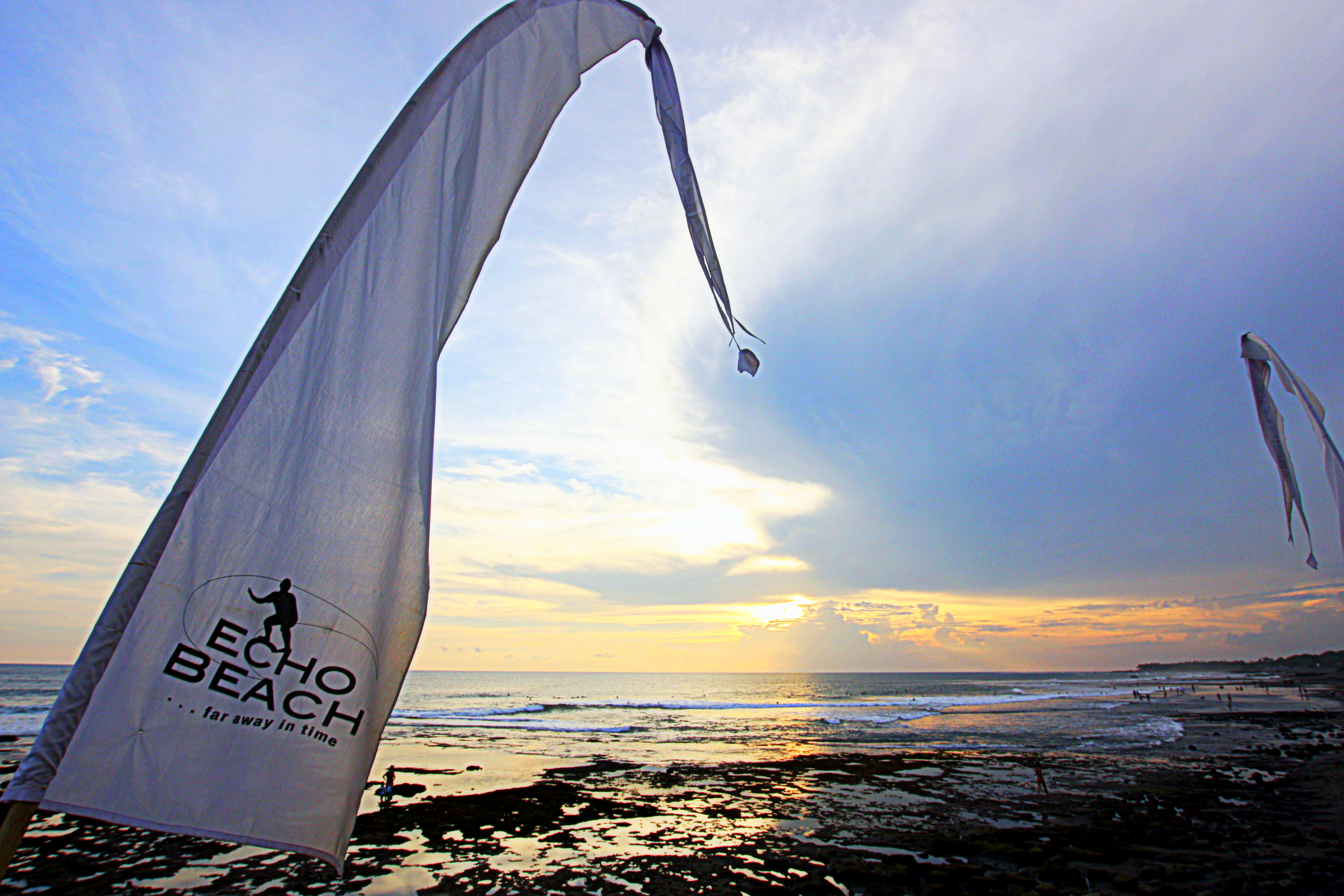
Echo Beach sunset, Bali, by @debsnet

Echo Beach, far away in time

These experiences, as well as other small moments like watching the sunset colours change or talking to a woman as she made the morning’s offerings from baskets of soft petals, allowed me to connect presence, self and world, experiencing it in open, receptive and reflective ways.

Vue Beach Club, Canggu, Bali, by @debsnet

beach club sunset

I have returned from my trip hopeful that I can hold on to this feeling of openness-to-noticing and use my flânerial Spidey senses as a tool to keep me centred on my axis. I am considering how I might bring the idea of paramaterising my commitments to work and PhD into my weekly existence. How might I make attentive noticing and openness to unexpected conversation a daily practice? How might I take more regular self-care breaks in order to restore clarity, increase productivity and protect wellness?

When you take your attention into the present moment, a certain alertness arises. You become more conscious of what’s around you, but also, strangely, a sense of presence that is both within and without. ~ Eckhart Tolle

Canggu rice paddies, Bali, by @debsnet

Canggu rice paddies