Small actions matter: Rhizomes, butterflies and flywheels

In schools and other complex human organisations, long-term predictions are notoriously difficult. The interconnectedness of parts of the system (people, practices and contexts) means that cause and effect are rarely linear or tidy. We often find ourselves searching for the ‘one thing’ that might make a big difference, yet change is hard to correlate to particular actions.

Complexity theorists remind us that human systems are characterised by emergence, sensitivity to initial conditions, and constant adaptation. Three metaphors help us think about the dynamics of small actions in complex systems: rhizomes, butterflies, and flywheels. Each offers a different lens on how change happens, how momentum builds, and how leaders might navigate the tangled ecosystems of schools.

Change is unpredictable

Gilles Deleuze and Félix Guattari conceptualise change not as hierarchical or linear, but as rhizomatic: networked, subterranean, and multi-directional. Rhizomes grow in unpredictable ways. They spread laterally, pop up unexpectedly and resist containment and control. Seeing change as rhizomatic invites us to let go of the illusion of control and the comfort of neat linear narratives of change. It encourages us to ask: What are we noticing? What do we know and how do we know it? What remains unseen or unknown?

This perspective foregrounds the distributed, relational nature of change in school, where ideas sprout in unexpected places, and influence flows through conversations, relationships, and shared practice as much as through strategy and policy documents.

Tiny events create major disturbances

Art Garmston and Bruce Wellman offer thinking that has long shaped how I conceptualise schools and the teams within them. They remind us that organisations, especially schools, are non-linear dynamical systems. In such environments, small actions matter, sometimes in ways we expect and sometimes in ways we do not. Their principle that “tiny events create major disturbances” reveals that small, seemingly insignificant actions can lead to large, unpredictable consequences.

Like Edward Lonenz’s well-known chaos theory metaphor, that “a butterfly flapping its wings in Brazil could set off a tornado in Texas” this concept reminds us to consider the sensitivity of conditions, the unintended side effects of actions, and the potentially amplified impacts or big differences in outcomes that can come from small moments, incremental changes or a single decision.

Seeing schools in this way means accepting their complexity and the tangled ecologies of relationships, rhythms, priorities and actions. In complex systems, conditions matter and every decision and action, no matter how small, creates side effects, some intended and some unintended. In schools, a seemingly insignificant decision – a timetable adjustment, an offhand comment, a minor tweak to a process – can disrupt a system or, equally, enable it to evolve in generative ways.

Creating positive momentum

While the butterfly effect helps us understand how small actions can create big, unpredictable disturbances, the flywheel effect points out how small actions can create slow, steady, cumulative momentum that eventually becomes self-sustaining. Popularised by Jim Collins in Good to Great, the flywheel effect describes how disciplined, consistent, small actions, in the same direction over time, build persistent and powerful momentum.

A flywheel is heavy. At first, each push barely moves it. But each push adds to the previous one. Over time, as the result of many small, aligned actions over time, the accumulation of effort creates acceleration. Eventually, the flywheel turns under its own momentum. Over time, these small efforts compound, generating stability, coherence, and direction. While the butterfly effect warns us about unpredictable amplification, the flywheel effect teaches us about the power of intentional accumulation.

The little things are the big things

In schools, new practices emerge in pockets and innovation bubbles in hallways. Culture is built in daily conversations or eroded in micro moments of mistrust or disappointment. Much of what shapes work in schools is subtle or easy to overlook. The effects of incremental change are often chaotic, unmeasurable, or invisible, until suddenly they are not. Hindsight is always clearer than foresight.

If we are looking to harness the momentum of the flywheel, we need to be intentional about what we tweak, what we amplify, and how we act in alignment with each other as a team and a community. There is no single breakthrough moment or heroic actor that leads to long term improvement. Small gestures and tiny actions, aligned across an organisation, shape the future of the place.

Leading in complexity

Leading, then, means navigating complexity with care, curiosity and coherence. It means tuning in to people, patterns and feedback. It means careful noticing, sense making, listening, holding our assumptions lightly, stepping gently where possible, and connecting with others in order to keep our eyes and ears open for unintended disturbances and gems of opportunity. As we work together with shared purpose, we can collectively build positive, directional, values-aligned momentum over time.

Together, these metaphors (rhizomes, butterflies and flywheels) invite us to accept the paradoxes of leading in complexity. Change is unpredictable, yet also shaped by intentional, cumulative action. Tiny events can derail a system, and tiny events can strengthen it.

Our task as leaders is to embody these truths simultaneously by being strategic and adaptive, tuning in to what might be emerging while committing to the steady work of building momentum over time. In doing so, we honour both the unpredictability and the possibility inherent in non-linear dynamical systems, and we help cultivate systems that are thoughtful, resilient, relational, and capable of evolving in values-aligned ways.

Strategic planning for schools

Source: Angeleses on pixabay

Strategic vision as the north star

A strategic plan is a key part of any school’s trajectory to improvement, and strategic planning is an exercise in alignment, coherence and prioritisation. It is at once a a relational journey of sense‑making and community building, and a rational process of setting goals and allocating resources. It helps us to know: What is most important to this school at this time? On what are we focusing our efforts? Asking ‘Is this aligned with our strategy?’ is clarifying. Clear strategic vision acts as a guiding light to filter out the noise and multiple possibilities of all the good things that could be done, to help the entire organisation to work in unison to travel in a common direction, toward distinct shared aspirations.

Polaris, the north star, has been used for navigation and wayfinding for generations due to its constancy. A strategic plan articulates a school’s visible and unwavering north star, communicating the purpose and priorities from which decisions at all levels cascade, so that the school remains on course. The hardest part is often prioritisation – choosing to focus on a core set of goals, which might come at the expense of other directions. Sharp prioritisation ensures that goals are not diluted, and that short term pressures do not distract from longer term aims. In this way, strategy shapes what is resourced, focused on and invested in. It anchors, frames and guides the thinking and doing of all in the organisation.

Looking behind and ahead, together

Strategic planning involves co-design, with multiple stakeholders, that integrates past, present and future. It involves undertaking a simultaneous looking back, looking forward, and an anchoring of ourselves in the now. In schools this means honouring heritage and values, listening deeply to the people who make up the community, and scanning the educational landscape for emerging trends and innovations.

A strategic planning process:

  • Revisits the school’s history, values, mission and non‑negotiables to ensure continuity of purpose and identity;
  • Engages students, families, staff and alumni, to understand their values, aspirations and circumstances; and
  • Examines current educational research to anticipate how future shifts might shape priorities.

The Australian Education Research Organisation found that the effective features of a school strategic plan are:

  • Compelling mission and vision statements.
  • Specific, sharp and select goals, approaches and practices.
  • Content on goals, approaches and practices aligns with the evidence on ‘what works’ for school improvement.
  • Defined processes for monitoring and evaluation that are data-informed, and contain clear performance measures and time frames.
  • Coherence within and across documents (for example, across multi-year and annual plans).

Starting with purpose, mission, values and vision, and revisiting these regularly, ensures alignment with the school’s core identity and legacy, and coherence across documents, years and teams. Engaging widely and listening deeply facilitates a strategy that is shared by diverse stakeholders and that serves the community. Immersion in research, evidence and trend forecasts keeps plans forward focused so that the educational offering has future students and the future world in mind.

As a lead up to my school’s next strategic plan, I have been working alongside the executive team to explore current and future trends in education and schooling. We undertook a PESTLE analysis of the political, economic, social, technological, legal and environmental factors at play. We found that the future of education is increasingly learner-centred, holistic, and broad ranging in its measures of success and mechanisms for credentialling learning. Personalised learning is progressively enabled by AI. Social and emotional learning, wellbeing provisions, and staff support, are intensifying priorities.

In line with the shifting global education environment, as schools plan strategically, they will need to:

  • Align their offerings with future skills, competencies, and emerging industries.
  • Adapt with the ways in which students learn and demonstrate their learning.
  • Prioritise inclusion, mental health and wellbeing – of students, families and staff.
  • Consider workforce strategies that care for staff and support professional longevity.
  • Be clear on digital strategy and technological innovation, including ethical complexities and human impacts.
  • Stay abreast of evolving regulatory and compliance expectations.
  • Plan for climate and sustainability priorities.

Active, adaptive planning

While strategy is often aspirational, it also needs to be actionable and achievable. If the strategy is the north star, the plans that follow are the route maps, instruction manuals, and assembling of the team and equipment required to get there.

In schools, what we publish to the wider community are often the overarching goals or core pillars of the school’s strategy – the shared priorities. The agreed areas of focus are then supported by ongoing planning, communication, implementation, reporting, monitoring and evaluation. Resources, budgets, structures and development opportunities are aligned to the strategy. Actions and timelines are outlined and performance measures are formulated. The community should see the strategic priorities in action – in projects, programs, publications, facilities, stories, events, opportunities, and daily behaviours. As principal, I work with the board and the executive team to constantly review and report on our strategic work plan, monitoring progress against strategic goals and associated actions.

Strategic planning is not a one-off event or static brochure. Plans are adaptive to evolving circumstances, trends, evidence and community aspirations, through a constant process of listening, innovation and co-iteration. They should be referenced regularly, communicated about relentlessly, and their implementation visible. School strategy comes to life through how we show up, how we collaborate, how we engage students and community, where we invest, the decisions we make, and the stories we tell.

Reflections on professional nourishment

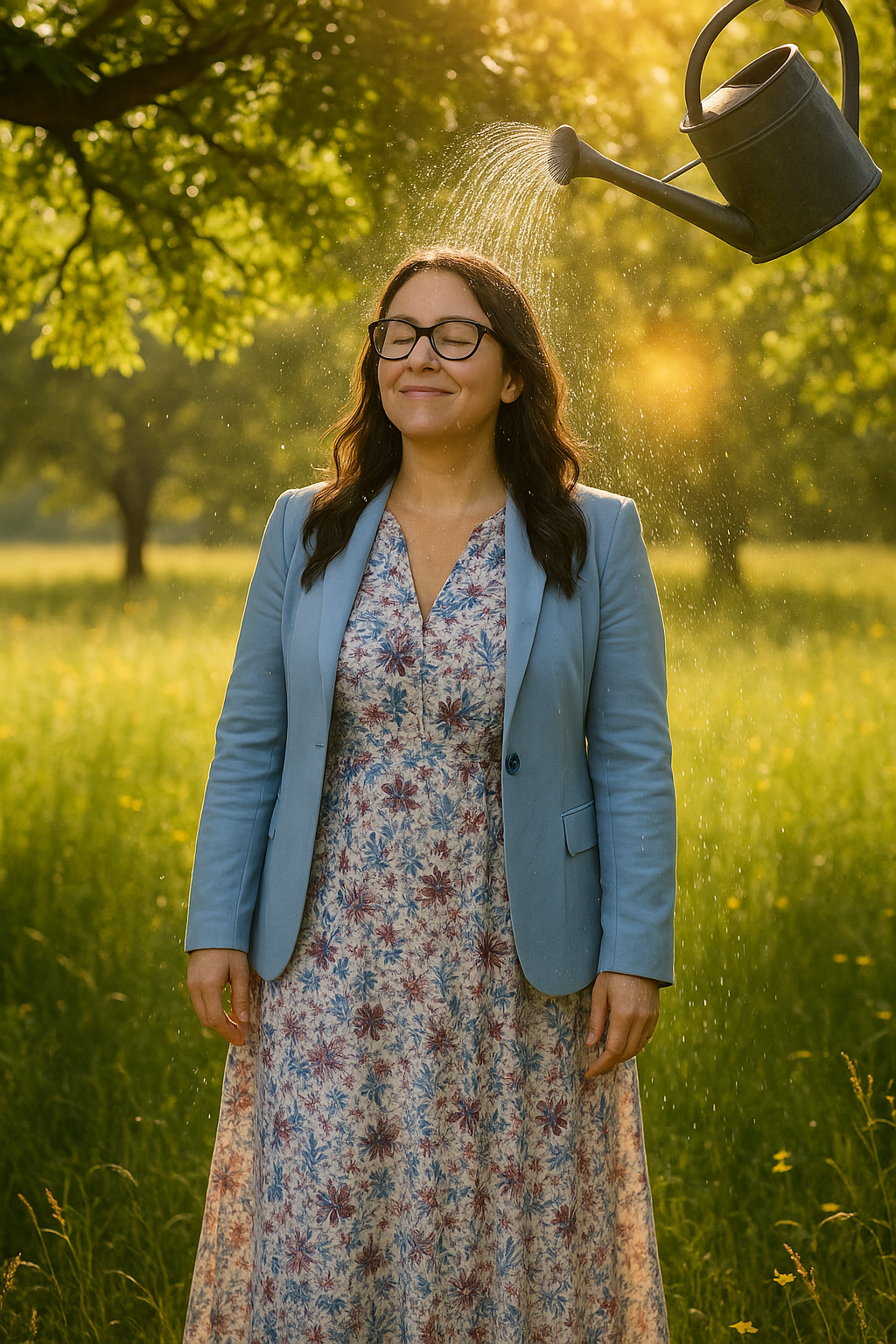
Image created with ChatGPT

The profound privilege and the weighty responsibility of serving as a school principal lies in the depth of the humanity of the role combined with the incredible sense of duty and the complexity of the role’s many moving parts. Independent school principals have been described as CEOs, responsible for strategic oversight and management of learning and teaching, daily operations, finances, risk, resources, communications, stakeholders and culture. A 2008 Australian report described principalship as “the best job in the world with some of the worst days imaginable,” encapsulating the intense reward and intense challenge of the role, which can be simultaneously fulfilling and depleting.

I have appreciated recent invitations to share my advice for aspirant school principals, and to speak about my experience in building contributions and networks beyond my immediate school environment. These opportunities for reflection, coupled with the regular release of research reports and media stories indicating the increasing ill-being of those working in schools, have led me to consider what might be described as ‘professional nourishment’. How do those of us leading in schools fill our cups to build buoyancy and resilience that sustain us as we serve the people in our communities, and navigate significant, serious and sometimes surprising complexities?

Like other people-facing roles in schools, principalship is inherently relational and involves the living of relationships throughout the extensive ecosystem of a school. Deb Dana’s concept of finding ‘glimmers’ in our day to uplift us reminds us to seek out sparks of joy and micro-moments of presence. Those of us working in schools can experience nourishment in our roles as we engage in the many and varied student experiences, community events and lives of students, families and staff. There is satisfaction and pride in witnessing the personal growth and achievements of students, sharing in the triumphs and challenges of families, and working alongside inspiring and dedicated colleagues. A ‘glimmer’ might be a conversation with a child in the yard, a thank you email from a parent, visiting a classroom to see a colleague teach, a conversation with an old scholar, attending a performing arts production or sports game, sharing dinner with the boarders, or witnessing a student or staff member overcome a challenge.

Professional nourishment can also come from deliberate reflection on and intellectual engagement in the work. This blog, for example, provides me with one way to share research, practice and thinking. It also engages me in writing as a practice of clarifying, synthesising and developing my thinking. Writing and podcasting provide unique opportunities to participate meaningfully in local, national and global dialogues around education and leadership. A range of platforms can immerse us in diverse perspectives and enable us to actively contribute to wider educational conversations. Ensuring there is time and space for thought, innovation and intellectual engagement, can help to reconnect us to the strategic direction of our schools and the ‘why’ of what we do.

One worry I have about artificial intelligence is that, while it is trained on human writing and coding, using it as a shortcut to exploring and communicating ideas might reduce our time and capacity to sit with, contemplate, and work through complex ideas. Formal or informal writing can be utilised, not just for its resultant output, but for its process of cognitive working out. When I begin writing, I do not know exactly where a piece will take me. The writing process is focused on internal growth and ‘thinking through’ or ‘thinking out loud’, rather than efficiency and end product. In a recent episode of The Edu Salon podcast I talked about the marination of ideas in the human brain as an important part of how we understand more deeply and move our thinking forward. Quiet reflective practice–in which we take the time to pause, interrogate our assumptions, tease out ideas, and carefully consider experiences–can provide an anchor for us to find clarity in the complexity of our work.

When I think of what is professionally nourishing, there is a special place for professional relationships and networks. I am incredibly grateful for those mentors, peers, colleagues and friends to whom I can reach out. Professional organisations and conferences (such as, in Australian education, AHISA, ACEL, AARE and ICSEI) can provide educators with inclusive communities of practice where ideas are shared, respectfully challenged, and refined in a safe and collegial space. Trusted relationships in which we share and talk through problems of practice, provide meaningful connection and mitigate the isolation of our role.

Those leading in schools can work to sustain ourselves by cultivating meaningful professional relationships, prioritising reflective practice, and actively participating in broader educational networks. Learning and connecting beyond our immediate environments can enhance our practice, enrich our schools, pay forward our expertise into the wider educational landscape, and help to sustain us in our roles.

The global landscape of educational leadership

On 31 October, UNESCO launched the 2024/5 Global Education Monitoring (GEM) Report, Leadership in Education: Lead for Learning, which engages with Sustainable Development Goal 4 ‘Quality Education’. The report explores global research and practice in educational leadership, capturing the current landscape, possibilities, practices and challenges of leadership in education around the world.

Below, I briefly summarise some of my key takeaways from the GEM Report.

Impact: School leadership matters

The report notes that leadership in schools is second only to teaching in the classroom for its capacity to impact on student outcomes and experiences. If we are to improve outcomes for students, it is vital to understand the impacts, influence and ingredients of school leadership.

The report notes that those principals who have a significant positive impact on schools tend to set transformative directions, use policies and reforms to drive purposeful change, enable safe and positive environments, build relationships, develop people, provide feedback, manage resources strategically, and work to improve classroom teaching. It also notes that school principals in Australia have been reporting higher levels of stress, burnout and depression in recent years (with women reporting this more than men), with workload quantity, lack of time for engaging with important work, and the seeming impossibility of managing life outside of the job, being major reported causes.

Australia’s Professional Standards for Principals, developed by the Australian Institute for Teaching and School Leadership in 2014, define the principal’s role as focused on five areas: leading teaching and learning, developing self and others, leading improvement and change, managing the school, and working with the community. Based on the work of Ken Leithwood, the GEM Report identifies four key roles of the school leader as: setting expectations and vision, focusing on learning and leading instruction, fostering collaboration, and developing people to improve school outcomes.

Autonomy: There can be no leadership without the opportunity to make decisions

The context for leadership affects those things a leader does in setting expectations, such as sharing vision, holding high expectations, setting a personal example, representing the community, and staying abreast of trends, data and information to inform decision making. Standards and accountability mechanisms for schools and school leaders vary from system to system and school to school. The GEM Report found that in 20 high-income countries, the more principals had the primary responsibility for human and financial resource decisions, the more likely it was that a country would be among those ranked more highly in terms of average performance in mathematics.

School leaders have more chance to make a positive difference if they have autonomy, support and well-defined responsibilities. Education systems need to empower school principals with sufficient autonomy to manage financial and human resources and to make decisions related to teaching and learning. Autonomy must, however, come with adequate support, sufficient resourcing and appropriate accountability measures.

Collaboration: School leaders cannot and should not lead alone

School leaders are not solo heroes, but part of an enmeshed ecosystem of influence. As I often say, leading is an action and a way of being, not a role or a formal title. All can lead. In schools, this might mean senior leaders, middle leaders, teachers, school services staff, students, parents and community members.

Shared school leadership and collaboration among empowered stakeholders strengthens decision making, contributes to enacting a shared vision, and leads to lasting improvements in educational outcomes and school cultures. School leaders have a central role to play in developing school culture and climate; maintaining a safe, healthy school environment; raising resources strategically, building networks; managing risk; nurturing collaboration; enabling others to act; and consulting with families and community.

School leaders who build the capacity of others, ensure they are accessible, provide training and resources, foster a collaborative environment, involve others in decision making, are involved in collaborative structures and processes, and distribute leadership among and across the organisation, are more likely to see the school’s vision realised.

Schools can promote shared school leadership by establishing clear communication channels, ensuring transparent decision-making processes, implementing regular feedback mechanisms, ensuring clarity of roles, and recognising unique contributions. School leaders can keep track of staff professional development needs, provide individualised professional support and mentoring opportunities, ensure evaluation of practice, and reward good performance.

Collaborative relationships (such as those built through committees, teams and other collaborative structures) strengthen governance, improve decision making, enhance accountability, and foster inclusive and resilient environments. Fostering safe, inclusive and culturally responsive environments is key to ensuring a climate of care and challenge where collaboration can thrive, where shared vision can be realised, and where all students, staff and wider community can flourish.

Leading through professional conversation

Schools are human ecosystems full of all the complexities, uncertainties, wonder, pain and joy that comes with living a human life. As we begin a busy year ahead, it is worth remembering that education and leadership are deeply human, and that it is a privilege to be with people in conversation, and to sit with them and share in their human experience.

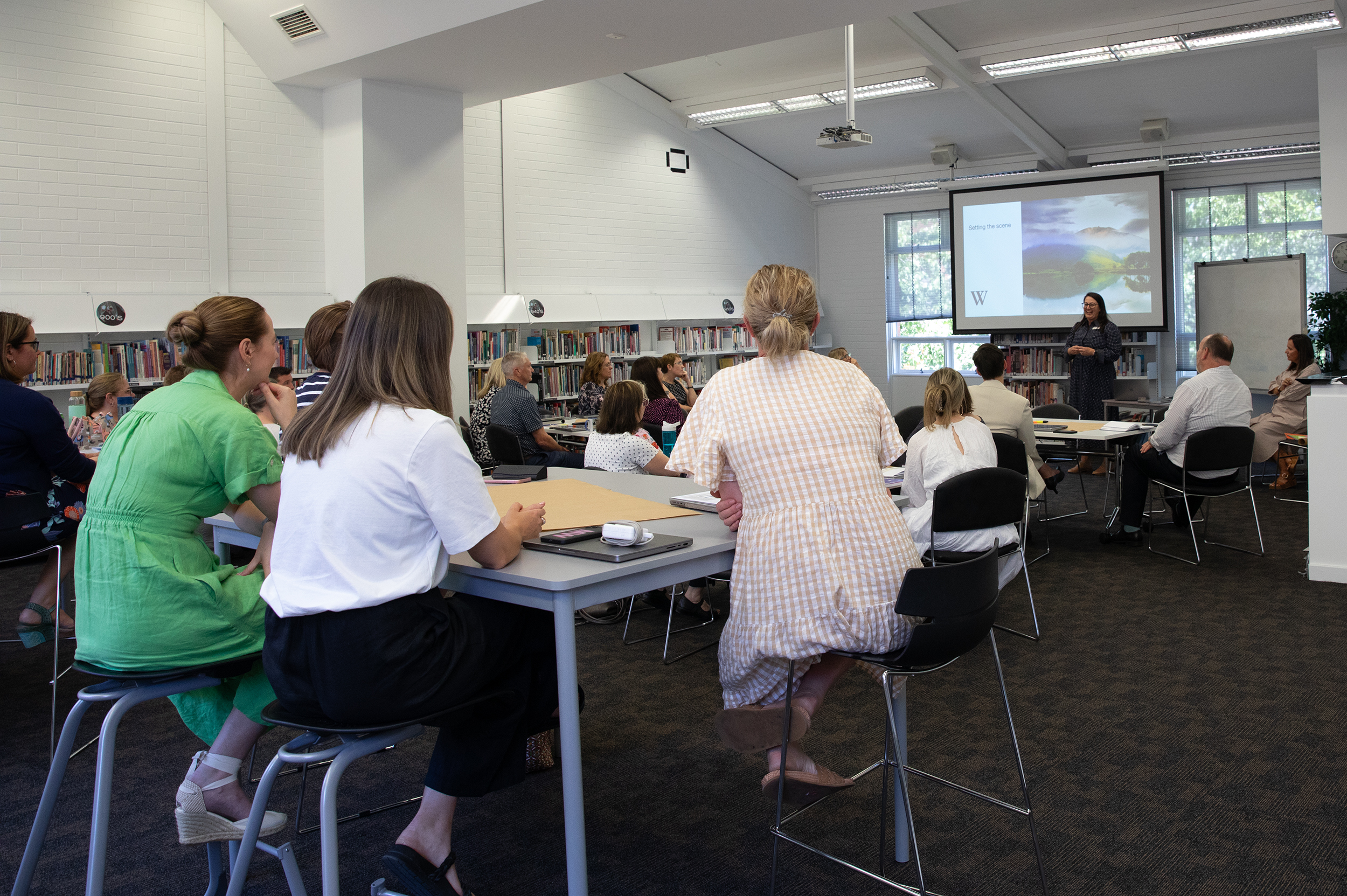
Today a colleague and I presented to leaders in roles across the school on leading teams through intentional conversations, including coaching and more direct ‘difficult’ conversations. While we focused on conversations with colleagues, much of the discussion was also relevant to all sorts of potential conversations in all sorts of contexts. Below are some reflections on what was presented and discussed.

Leading teams is more than administration and organisation. It involves working alongside people and seeking to understand the needs of each person in the team: their goals, aspirations, challenges, and areas of growth. It means regular, meaningful check ins with each member of the team, creating a safe and non-judgmental space for team members, and balancing this with clear expectations and accountabilities.

High performing teams take shared responsibility for their shared purpose. They think of the work as ‘our work’ that can be collaboratively achieved, focusing on ‘together we can’, rather than ‘that’s not my job’ or what Jan Robertson calls ‘climates of dependency’ in which staff wait for leaders to tell them what to do.. High performing teams embody positive cultures of collaboration. They focus their energies on supporting and growing people, not on setting up internal competition or a deficit view in which people need surveilling and ‘fixing’. In high performing teams, it is understood that everyone deserves the opportunity to learn and improve, supported by clear expectations, shared vision, open communication, and effective feedback practices. Members are able to gracefully disagree and engage in robust, respectful discussion. They are additionally able to leave any discussion as a united team, even when a decision has not gone the way of an individual or small group.

Robert Kegan and Lisa Lahey refer to the concept of ‘semantic space’; the language-rich environment embedded in organisations. The semantic space of a workplace is ‘how we talk around here’: what we talk about, how we speak to one another, what kinds of language we use, what kinds of questions we ask, and how we respond when approached for a conversation.

It is always worth asking: How DO we talk around here? And then, how COULD we talk around here that might have more positive, productive outcomes for those in our care and community? How might we engage in professional conversations that are both compassionate and rigorous? In which we seek to listen and understand before telling or judging? In which we balance support and accountability, administration and leadership?

People are at their best when they have autonomy, feel their work has meaning, feel they have impact and influence, and have the efficacy to do their job. We can develop our teams by being intentional about the kinds of conversations we have to support and develop team members. Candi McKay describes schools as places where reflection on practice and collegial conversations should be viewed as opportunities to grow and learn, and where staff should expect to be engaging in thoughtful conversations and relying on their leaders to listen and ask questions that push at the margins of their capacity.

Considering the semantic space of our organisations includes considering organisational trust, and how we might foster a psychologically safe space for staff, in which it is ok to take risks, be vulnerable and reflect honestly. This includes inviting and listening to a range of feedback and providing confidential, non-judgmental spaces for staff to reflect on practice and generate ways to approach problems.

There is a place for coaching as a vehicle for staff to develop autonomy and self-directedness. John Whitmore famously defined coaching as “unlocking people’s potential to maximise their own performance. It is helping them to learn rather than teaching them.” In my book, Transformational Professional Learning, I define coaching as a collaborative process by which a coach acts as mediator, mirror, and conduit for the coachee’s own thinking, in order to develop self-directedness and self-efficacy, and to move the coachee towards an improvement or solution that is owned by them.

Coaching takes an investment in time and involves really listening to the other person, being in their service in the conversation, being present, and seeking to listen to understand. The tools of coaching include pausing to allow the other person to continue their train of thought. In Cognitive Coaching we are asked to ‘set aside’ our own conversational needs by refraining from autobiographical (‘me, too!’), inquisitive (‘tell me more about’), and solutions-giving (‘I’ve got an answer for you’) talk. Paraphrasing allows the coach to check in with the person to help them clarify their thought, problem, goal or solution. Questions begin with ‘what’ or ‘how’ and use plural forms and tentative language. What strategies could you implement? What options might be available to you? Taking a coaching approach to a conversation assumes that the coachee knows more about their own situation than the coach does, that everyone has the capacity to learn and grow, and that we all have the capacity to solve their own problems.

Of course, there are times for mentoring conversations, or performance-based conversations, or direct conversations in which an issue must be addressed. Once we know what kinds of conversation are available to us, we are empowered to ask for what we need. For example, we might say, “I am not sure what to do in this situation, and I would really appreciate you listening to help me talk through it,” or “I am stuck and am looking for some advice and wise counsel to help me move forward.” When someone comes to a leader for a conversation, they can ask, “How can I be of support to you in this conversation?”

We talked in today’s session about the need for compassion in conversation, of pre-supposing the best of people, of rehearsing tricky conversations with a trusted colleague, and of being fully present in our professional interactions.

Rather than seeing conversations or pop-ins as an interruption to our to-do list, we can remind ourselves that, as Rachel Lofthouse has said: ‘The talk is the work’. To support others through intentional conversation is a gift.

Challenge and change in 2023: What if you fly?

Source: @cocoparisienne via Pixabay

During primary school, my children learned loosely about growth mindset. At times, they came home with mantras such as “I can’t do it … yet”, “I can reach my goals”, and “If it doesn’t challenge you, it won’t change you.” Over the last couple of years, challenge and change have been thrust upon us in spades. ‘Change fatigue’ has taken on a whole new layer of meaning. The Collins Dictionary 2022 word of the year was permacrisis, meaning an extended period of instability and insecurity. This state of ongoing uncertainty is reflected in our exhaustion and concerns about global crises and individual stresses, and the erosion of our individual and collective appetite and energy for facing challenge.

As we enter 2023, concerns about the economy, war, and the climate continue to intensify. The 2022 Mission Australia Youth Survey of 18,800 Australians aged 15-19 found that our young people are concerned about the environment, equity, discrimination, and mental health, and that their personal challenges included academic stress, school workload, anxiety, depression, and relationships. Societies, industries, workplaces, families, and individuals have needed to adapt and re-imagine at a rapid pace. Workplaces, such as Deloitte, are developing increasingly flexible ways of working that allow employees autonomy and choice.

While there is a sense that we are emerging from three years of pandemic-related restrictions and after-effects, wellbeing, inclusion, and agency are areas for continued development. Many of us have found ourselves reconsidering what is important. Some have turned to travel, adventure and personal change, while others have turned to stability, certainty, and returning to home base. Many of us have rethought how we spend our time, including what we do with the time we have and who we spend it with. This includes time with self, family, and work, with the ‘great resignation’ and ‘quiet quitting’ trends showing a paradigm shift in how people are choosing to live their lives. I have always done work that provides me with a sense of purpose, gets me out of bed in the morning, aligns with my values, and makes a contribution to others. Finding meaning and fulfilment are now more important than ever, for our communities and society, as well as for our own individual wellbeing.

When change is all around, and forced upon us, it can be difficult to open up rather than turn inward, to move forward rather than coast along or retreat. I’ve just finished reading Lessons in Chemistry by Bonnie Garmus. At one stage in the novel, set in the 1960s, the main character Elizabeth Zott challenges others to act with courage to design their own futures based on their aspirations and talents, rather than on what they or others might expect of them. The character, who is unapologetically herself despite the constant judgement of others, encourages us to embrace change and move forward without allowing limiting beliefs to hinder us.

“Courage is the root of change – and change is what we’re chemically designed to do. So when you wake up tomorrow, make this pledge. No more holding yourself back. No more subscribing to others’ opinions of what you can and cannot achieve. … Design your own future.”

Lessons in Chemistry

While denial about obstacles and Pollyannaism are unhelpful, in 2023 our task is to find the courage and energy to continue to challenge ourselves, each other, and our organisations to move forward in directions that result in positive outcomes for all. We need to continue to balance competing needs, and navigate tensions such as providing stability while also working towards context-embedded innovation, and supporting wellbeing while maintaining high expectations and forward momentum. We need to co-design the future.

Courage and change do not need to be loud and fast. While we may need to be bold in our intent, it is consistent, incremental nudges and small regular steps that allow us to move forward. The following poem by Australian poet Erin Hanson encourages us to question our concerns about failure, and to take the leap into those opportunities that may result in growth and success.

“There is freedom waiting for you,
On the breezes of the sky,
And you ask ‘What if I fall?’
Oh but my darling,
What if you fly?”

Erin Hanson

A useful starting point for what leaps we might take is to ask ourselves is: What do we want to have achieved by this time next year (or in five years or thirty years)? And if we were to fast forward to this time next year, what will it look like if we’ve been successful?

When I wrote my book, Transformational Professional Learning, I put a message on my bathroom mirror that read: “If you wait until you’re ready, you’ll wait forever. Start now.” Starting now is better than waiting for the ‘perfect time’, even if starting now means doing so slowly, quietly, cautiously, gently, and with close attention to those around us.

It’s 2023. Let’s start!

Metaphor as a way of considering future alternatives for educational leadership

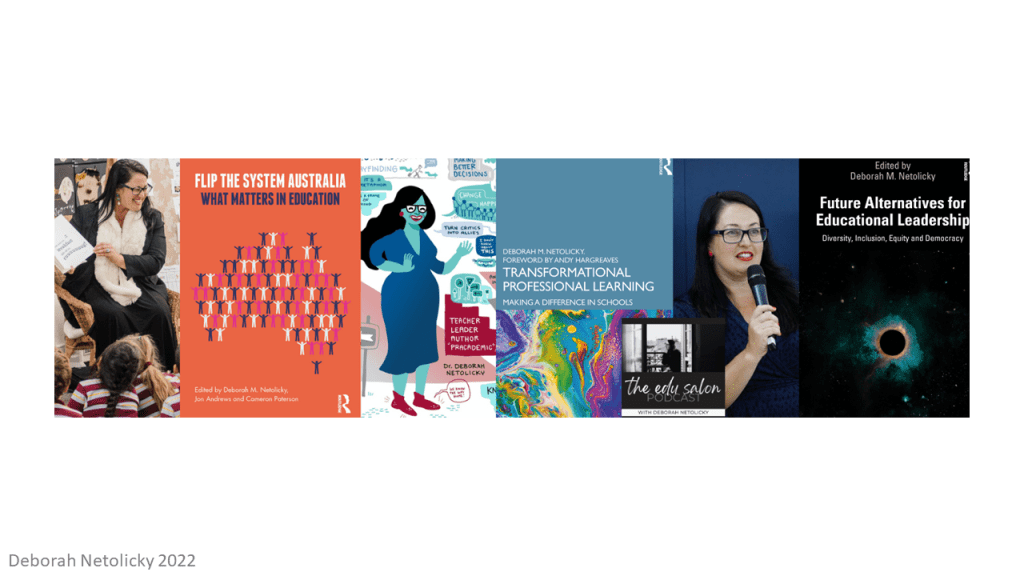
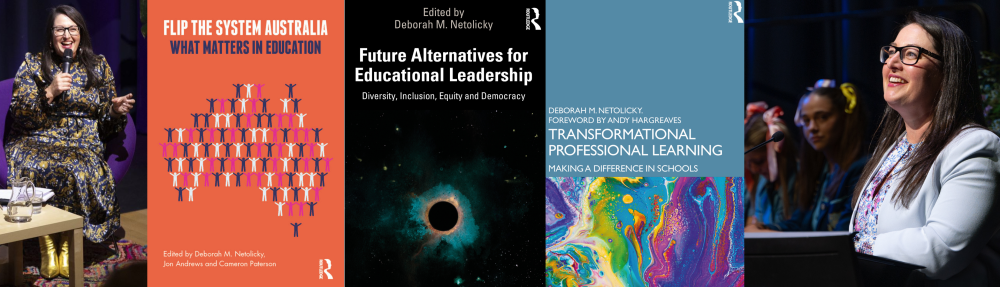
Last week I had the pleasure of presenting a keynote to the Australian Council for Educational Leaders National Conference in Sydney. The presentation was based, in part, on the edited book Future Alternatives for Educational Leadership.

In exploring what leadership looks like now, and what it might look like next, as the book does, I shared some unusual metaphors for leadership, from educational scholarship, that could help to move our thinking beyond normalised paradigms of leadership as largely male, white, and about the individual. These were:

  • The Cheshire Cat (Netolicky, 2019) representing the deliberately visible-invisible leader who navigates fluidity of role, and intentionally provides others with what they need at any given time.
  • The punk rock principal (Heffernan, 2019) as the leader who sees themselves as part of a band, and who is willing to consider and potentially resist compliances and expectations.
  • Network leadership (Azorín, Harris, & Jones, 2021) in which leading is collective, networked, and a social practice.
  • Leadership as a social movement (Rincón-Gallardo, 2021) in which leaders participate as a learners, craft strategy, forge collective commitment, shape the public narrative, and ignite others to action.
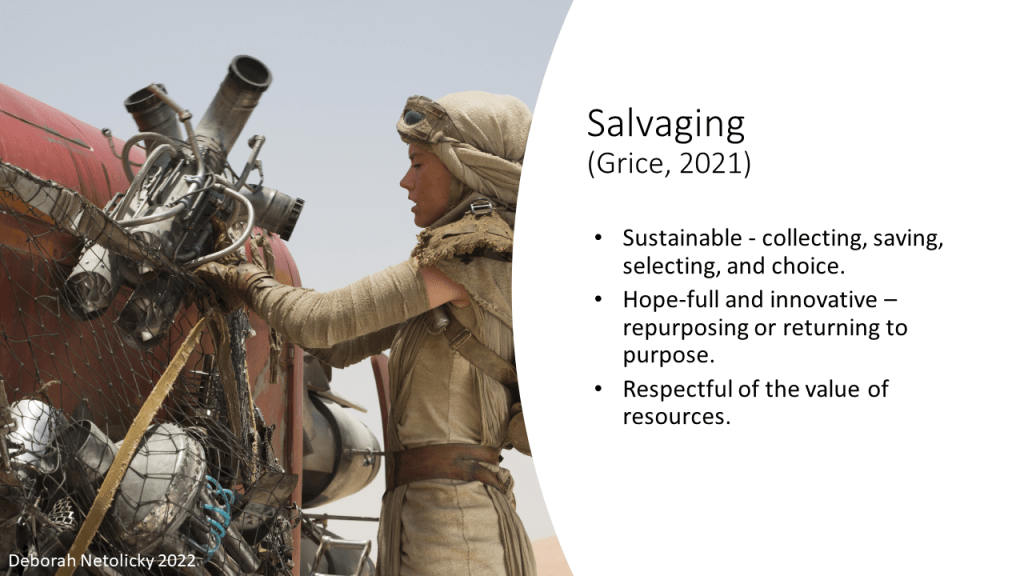
  • Leading as salvaging (Grice, 2021) as a practice of hope and sustainability that involves collecting, saving, selecting, respecting the value of resources, and repurposing or returning to purpose.
  • Wayfinding leadership (Netolicky & Golledge, 2021) in which leaders know and reflect on self, know and respond to their environment, navigate roadblocks, use instruments fit for purpose, and balance tensions by simultaneously applying systematisation and intuition, strategy and empathy.

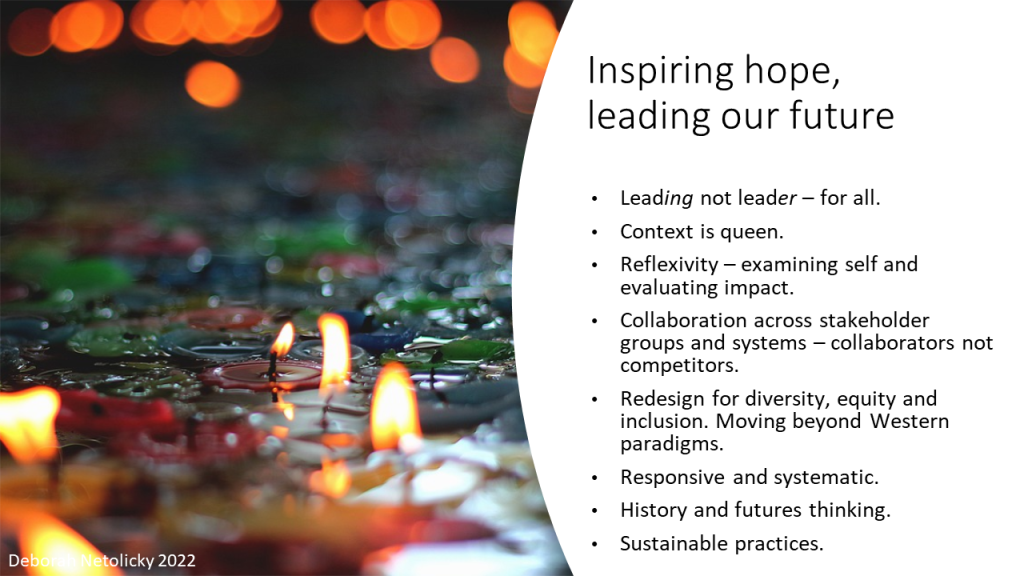
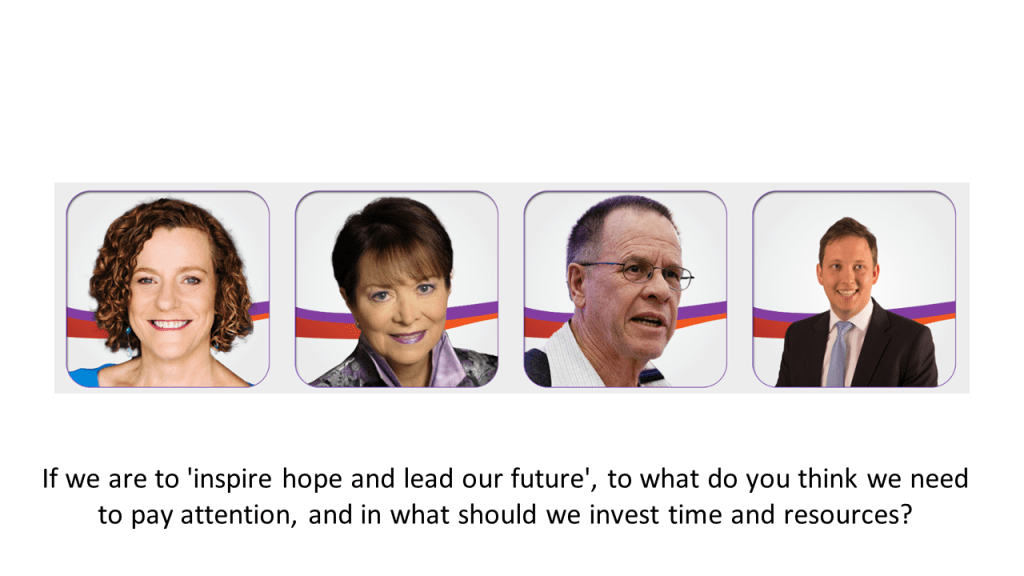
The theme of the conference was ‘inspiring hope, leading our future’, and my takeaways for the audience were that we benefit from:

  • A focus on leading as a practice for all, rather than the leader as a person or title.
  • Knowing that context is queen, including knowing our people and honoring tradition while engaging in futures thinking.
  • Applying reflexive practice by examining self and evaluating impact.
  • Seeing ourselves, as educators and leaders, as collaborators rather than competitors, working together across stakeholder groups and systems.
  • Redesigning for diversity, equity, and inclusion.
  • Considering sustainable practices, for our schools, our staff, ourselves, and the planet.
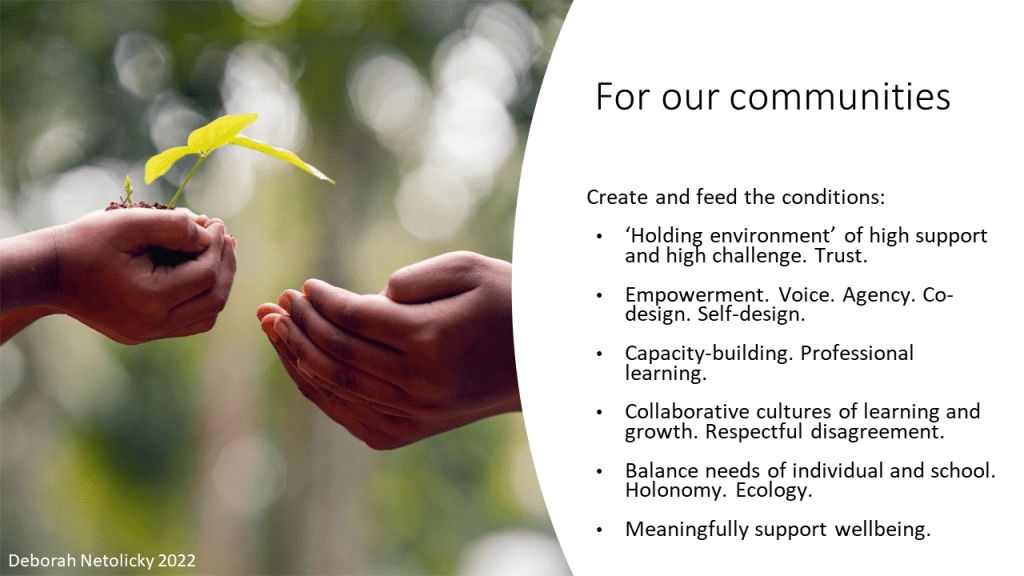
  • Creating and feeding the conditions for an ecosystem of high trust, high support, high challenge, and respectful disagreement.
  • Empowering, building the capacity of, meaningfully inviting the voices of, and co-designing with others.

A core belief of my presentation, and of the conference, was the importance of humanity at the centre of our work as teachers and school leaders.

My slide deck is below.

The Edu Salon podcast: 6 months since its launch

There are close to 3 million podcasts and 140 million podcast episodes in existence, with 440,000 education podcasts alone. It was into this landscape of a firehose of content and a cacophony of voices that I launched my podcast, The Edu Salon, at the beginning of 2022.

Why start a podcast, especially in such a saturated market? As a listener, I enjoy the long form nature of podcasts as an intimate speaking and listening medium. There is an authenticity to the unscripted spoken word that allows for free-ranging storytelling and immersion in topics. For me, launching a podcast was about providing a space, or holding the space, for meaningful connection and rich conversation around education. It was about sharing important voices and diverse perspectives, with a focus on education as a service to humanity, democracy, equity, and community. I have a long and exciting list of potential guests.

While there is an overwhelming amount of podcasts and podcast content out there, according to Listen Notes almost 100,000 podcasts officially ‘died’ in 2021. Some statistics indicate that about 75% of existing podcasts have ‘podfaded’, and are no longer publishing new episodes. Podcast experts say that of new podcasts, half don’t make it past Episode 7. Apparently a further 50% of that 50% don’t make it to Episode 14, and only 20% of podcasts make it beyond one year.

The Edu Salon has today published its 14th episode. Episodes are 40-45 minutes long, released fortnightly on a Sunday morning (Australian time) and each features a wide-ranging conversation with a guest from around the world. Guests so far hail from Australia, Ireland/Spain, the USA, Canada, England, Mexico and Scotland/Hong Kong. They range from professors and researchers to teachers, school leaders, advisors, and consultants.

Episodes to date are as follows.

My podcast set up is low-tech. I have a portable microphone and a decent set of headphones. I subscribe to a platform that allows me to record interviews with guests remotely. And I use the basic features of free audio-editing software to get episodes ready for release.

Conversations are unscripted, although I share with guests the final five questions I will ask, the first of which is fast becoming my favourite: What is something unexpected that many people might not know about you? I have discovered some fascinating things about people. Hosting these conversations reminds me a little of conducting the narrative interviews for my PhD. It isn’t often in our busy lives that we are deeply listened to by someone seeking to understand more about us and our thinking. Guests often comment that they appreciate the opportunity to talk and enjoy the conversation. One remarked that it was ‘like therapy’. As the host, I am energised and nourished by the opportunity to spend time in deep dive conversations with great minds and inspiring practitioners in the education space. I am incredibly grateful to my guests for their time, knowledge, and generosity in sharing their expertise and experience.

While The Edu Salon is focused on the field of education, I get fantastic feedback from listeners in a range of industries who tell me that the content (around topics such as leadership, learning, collaboration, diversity, equity, and culture) is transferrable to work and life outside of education.

The Edu Salon is hosted on Soundcloud, and is also available through Apple PodcastsSpotifyAmazon MusicGoogle Podcasts and Audible. You can join the conversation on Twitter and Instagram @theedusalon.

Breaking bias

Australia was recently ranked overall 50th in the global gender gap (including 70th in ‘economic participation and opportunity’ and 99th in ‘health and survival’, but equal 1st in ‘educational attainment’). But while gender remains an issue worth discussing, our discussion needs to move beyond ‘women’ and consider complex structures and practices of power and equity. An article in yesterday’s Guardian by Sisonke Msimang argues that white women’s voices and anger are now being presented as central and as relatable, while the voices and stories of “Aboriginal women, women in hijab, women whose skin is far ‘too’ dark, and women who live on the wrong side of town; who can’t go to university and who will never report from parliament or file stories in newsrooms” are ignored. She adds that “Black women have pioneered the landscape of courage. … everywhere you look there are Black women who continue to be punished for loudly wearing their anger.”

As I reflect on the IWD 2022 theme of ‘break the bias’ I continue to consider how to acknowledge my own biases and privileges, and seek to understand the ways in which I help or hinder the project of diversity, inclusion and equity. I know that posting a blog post, photo or hashtag does little to address existing biases and their impacts on groups and individuals. I know that action and advocacy are needed in micro and macro contexts, and that sometimes appropriate action might be to speak less, take up less space, or question my own way of being in the world. I am proud of edited books such as Future Alternatives for Educational Leadership (which features 19 women out of 25 authors) and Flip the System Australia, but know these are imperfect in their attempts to share a diverse range of voices.

The following blog post is on the WomenEd website as part of a suite of worldwide reflections for International Women’s Day 2022.

Source: @PIRO4D on pixabay

Each year, International Women’s Day is surrounded by questions as to why the day is needed. Yet a dig into data from any country shows that gender equity is far from a reality. Recently, the COVID-19 pandemic has exacerbated gender inequities, as this UN policy brief and this UN technical briefattest. There has been an increase in unpaid domestic and caring duties often taken up by women, an increase in gender-based violence, a decline in the availability of reproductive health services, and lack of women’s representation in pandemic planning response.

The 2022 International Women’s Day theme is ‘Break the Bias’. But how do we ‘break’ bias when it’s unconscious, unacknowledged, or invisible? With so much complexity in the social world, accepting stereotypes, tropes, and assumptions about gender can make the world a simpler place with less cognitive load, easier judgments, and faster decision making. But left unchallenged, biases can block, hinder, and harm individuals and groups in society and in organisations.

The education world should look at how bias might be influencing school communities and students’ experiences of learning, living, and being in the world. In schools, sometimes the racial, ethnic, ability, sexuality, and gender diversity of the staff does not match the diversity of the student and parent community. Sometimes there is a lack of diversity in the community, or in the teaching or leadership staff. Conscious and unconscious biases of those overseeing staff recruitment and promotion can influence who is recruited, who is promoted, and who is overlooked. Biases of educators can affect response to student behaviour.

The questions we ask of ourselves and of others can help us to understand our own biases, to challenge the biases of others, and to encourage different ways of being and behaving. In a recent conversation with Jacob Easley II on my podcast, The Edu Salon, he challenged educators to take the time to explore their professional identities, beliefs, and purpose. He suggests that a place to start is with the question of why a person is entering the teaching profession: “Is it really to work with certain types of students, and not others, those who are more like me, and not those who are different from me?” This is something we should all ask ourselves. How do we respond (to a student, parent or colleague) when someone is not ‘like me’?

We can break open, or splinter bias, if we ask good questions. How about: Do we like to teach those students mostly like ourselves? To what social issues do we draw our organisation’s attention? What and who do we ignore or pay little attention to? Who is visible, celebrated, and recognised? Who is ignored or ridiculed? Who do students see ‘out in front’ at assemblies and events? Who do the school community see in middle and senior leadership?

Do we hire mostly people like ourselves, or do we seek to recruit a diverse workforce? To whom (if at all) do we offer flexible work options? While it may seem fair to apply the same decision-making framework for all people, aiming for meritocracy can perpetuate existing advantage. Is it more equitable to consider the varying needs and barriers of individuals, and to seek to tackle those barriers on a needsbasis? What is our approach to a situation with which we are unfamiliar or to someone whose experiences and perspectives are vastly different from our own? Do we engage in uncomfortable conversations? Do we dismiss or seek to understand concerns?

We can ask these questions of ourselves and others. From there, here’s what else I think we can do.

  1. Interrogate our responses. Be ok with not knowing, with learning, discomfort, and respectful challenge. Be willing to listen and to learn. Work to identify biases in ourselves and our organisations, and the barriers and inequities they create.
  2. Anchor ourselves in our values. Be brave enough to know what kind of individual and what kind of organisation we aspire to be. ‘The community won’t accept this without resistance,’ is not a good enough reason to remain stagnant on issues of equity, social justice, diversity, and meaningful inclusion.
  3. Educate and advocate. Stand up. Support. Resist. For example, when someone is critiqued for their cultural dress or accent, speak out. When someone is not being considered for a role or promotion, question why or point to attributes and experience that may have been ignored.
  4. Implement practices and structures that support mitigating bias, such as transparent and consistent recruitment processes with diverse representation across the decision makers, thoughtful leave policies (including flexible and generous parental leave and carer’s leave), options for flexible working where possible, and an organisational culture in which staff are trusted and professional expectations take into account a diversity of life responsibilities.

We all have influence, and we all have a responsibility to take bias seriously and to engage with its realities and ramifications, even and especially when those biases work in our individual favour. If there is one thing the pandemic has taught me, it’s that we need to work for the greater good over the individual good.

This year’s IWD pose reflects ‘break the bias’.

5 anchors for leading in a time of crisis

image source: krystyna-rawicz.blogspot.com

At times of volatility, catastrophe and trauma, we often feel like ships in a stormy sea, searching for something to hold tight to, a way to steady ourselves. Here are five anchors to steady and guide school leadership in this time of pandemic-induced global emergency.

  1. Vision and values

In simpler times—when we could leave our homes for any reason at all, congregate in groups of any size, travel far and wide, and find any grocery on any shelf of any supermarket—school leaders thought a lot about vision. Schools have always sought to develop commonality of vision and purpose, while school staff have sought to align with their school contexts in terms of their own beliefs, identities and the purpose that propels them in their work.

Shared vision remains more important than ever, and school leadership in a time of crisis means holding strong to values, principles and vision, as anchors to our decision making.

  1. Navigating tensions

Leading during a pandemic has brought to the forefront of my thinking one of the findings of my PhD: that leadership involves a tightrope-walk between priorities. Leaders constantly navigate tensions: the collective and the individual, accountability and autonomy, the bottom line and the greater good.

Leaders simultaneously make decisions with a view of the dance floor as well as from the balcony, (or, if you like, from both the trenches and the war room). They must consider a range of impacts (individual, organisation, wellbeing, learning, service provision, performance, staffing, financial implications, management of resources, sustainability of business) while keeping all of their individual people in mind. To make effective decisions, they must know the intricacies and idiosyncrasies of their contexts, but also best practice occurring elsewhere and the best available evidence of what is likely to work.

In a time of crisis, leaders must act swiftly and with foresight, but also with careful consideration of options, consequences and side effects of actions taken. They must communicate with clarity and purpose, but also with empathy and humanity.

And in a crisis, perfection is the enemy of progress. As Dr Michael Ryan, Executive Director of WHO, recently explained in regards to emergency response:

“You need to act quickly … Be fast, have no regrets. You must be the first mover. … If you need to be right before you move, you will never win. … Speed trumps perfection. … Everyone is afraid of the consequence of error, but the greatest error is not to move. The greatest error is to be paralysed by the fear of failure.”

Leaders must act quickly, and yet know that they may make mistakes and have to evolve and adapt as advice and conditions change.

  1. Safety before learning

In our independent report Thinking about Pedagogy in an Unfolding Pandemic, my co-authors and I say that now is a time for ‘Maslow before Bloom’. What we mean, of course, is that a time of global crisis, grief, trauma and instability is a time to put health, safety and wellbeing first; before curriculum, pedagogy and assessment. At this time more than ever, we must consider humans before outcomes, students before results, wellbeing before learning.

Learning is, of course, important. Our jobs as school leaders, teachers and educators, are to ensure the very best learning outcomes for our students, within the parameters of the unusual emergency circumstances in which we presently find ourselves. But learning (and especially assessment) should not be prioritised above basic human needs.

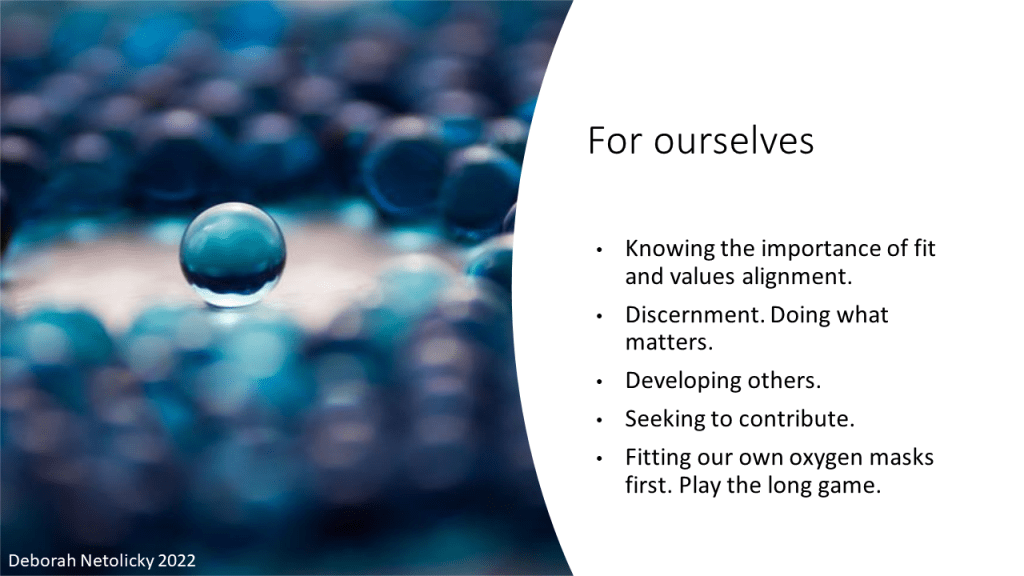
As time goes on during this pandemic, all those in our communities will be touched by the social, emotional, physical, mental, financial and human impacts of COVID-19. We need to pull back on notions of accountability and focus our efforts on compassion and togetherness. We need to continue to know our people, check in with them even at a distance, and interrogate how we can best support them through this time. It’s also important for leaders to fit our own proverbial oxygen masks so that we can continue to help and serve those in our communities.

  1. Trusting and supporting teachers

Trust throughout the educational system, and of teachers, is key to ensure a collective approach on all fronts to best serve our school communities during this crisis. Rather than a top-down one-size-fits all approach to education, teachers can and should be trusted to lead.

There are challenges. Time and support are needed to help teachers develop the appropriate competencies and confidence to pivot to, and thrive in, distance learning models. Yet, the nature of a global pandemic is such that the pace of change is brisk and biting. There is little lead-in time and so decision making happens quickly, on the best advice of the day, which can change at any time. Just look at the pace of government announcements. It nonetheless remains important that teachers feel trusted and supported to make the best decisions for the students in their contexts.

In a time of crisis, we need to pare education back to its essentials. Doing less and expecting less goes against the grain of our normal ways of operating, especially in a our profession, in which teachers often measure themselves by how much they provide.

My message to teachers remains similar to my advice on Day 1 of distance learning at my school:

  • Do your best with what you know and can do. This isn’t like ‘normal’ school and it isn’t going to mirror ‘teaching as usual’. It’s teaching during a pandemic while juggling working from home and schooling our own children; while the parents of the children we are remotely teaching are working from home and possibly dealing with financial hardship, health challenges and family complexities we cannot imagine. Students, too, will be going through a multitude of challenges, many of which we will not know about as we lead and teach at a distance.
  • Keep it simple. Start with the learning intentions, pare back to essentials, rethink ways to gather evidence of student learning, find efficiencies and set professional boundaries and routines.  Less is more.
  • Trust your professional judgement. Teachers know themselves and their students. Do what works. Be ok with less. Be ok with easing back on expectations of yourself, students and parents.
  • Be kind to yourself and others. This is distance learning during a global pandemic. It is continuing our students’ education while in the midst of a major health, societal and economic crisis. There will be a multiplicity of very real challenges for students, teachers and parents during this time. Maslow before Bloom!
  1. Community

Schools are more than places where learning happens. The closure of schools around the world has highlighted the ways in which schools help to address inequities, and how schools act as spaces of safety, nourishment, connectedness and support for many. Everyone—students, teachers and parents—is missing ‘school’ and all that  it provides (much more, it turns out, than classroom lessons and assemblies). Video conferencing can provide some semblance of person-to-person check-ins, but there is nothing like being in a room with a class and gauging their responses with the rich data that being there together provides.

For many students, families and teachers, the loss of onsite schooling is felt deeply. We know, though, that we are staying at home to keep ourselves, those we love, and those who are vulnerable, safe. It needs to be done and so schooling must innovate.

However, enthusiasm for opportunities for education reform must not overtake the current conversation. Yes, we are rethinking education. Yes, we can later consider what kind of normal we want to return to, and what we are happy to leave behind. Yes, we can be deliberate about continuing some of the current crisis innovation into our future realities. Life, work, school, pedagogy, assessment and university entrance may never be the same again. But we must consider connectedness and community.

While crises can lead to individualistic thinking in which every person is looking out for themselves, we will best survive this by considering the ways in which we can continue to knit together as families, school communities and a global community.

Supporting one another, connecting in new ways and building a sense of solidarity and ‘we’re in this together’ is what will get us through (to use a Game of Thrones reference) The Long Night. So let’s be in this, together, with generosity of spirit, open communication and empathy.