
Three trends shaping education in 2026

‘School Time’, c. 1874, Winslow Homer. Source: National Gallery of Art, Washington

2025 has been marked by geopolitical upheaval, accelerating climate impacts, and rapid technological change, with wars, political transitions, and record-breaking natural disasters shaping the global backdrop for schooling. In Australia, wider international conflicts have played out locally in the most devastating of ways, reminding us that global instability is never abstract for school communities. Professionally, my year has been anchored in culture building, strategic clarity and community connection. In my work this year as a principal, board member, and listener in education communities, I have been struck by how often the same tensions surface, regardless of context.

At the end of 2024, I reflected that personalised learning, GenAI, and holistic wellbeing were three foci of schools and education systems. Now, at the end of 2025, these trends still ring true, but the emphasis has shifted and the tensions educators are navigating have become sharper. This year, what I have noticed is a recalibration of priorities and a fine-tuning of how these are enacted. Schools are embracing AI and technology while leaning more deliberately into human experiences, strengthening care and belonging as protective factors for all in their communities, and confronting workforce challenges as questions of continuity and sustainability.

Balancing technology and humanity

In 2025, artificial intelligence has become increasingly embedded into our personal and professional lives. Used well, technologies can accelerate and sharpen thinking, and take on lower order tasks to free human cognition for higher-order work. Young people are using AI in a wide range of ways, including to assist with homework, writing, study and content creation. In some cases, they are turning to AI chatbots for mental health advice or emotional support, raising concerns about the quality, safety, and appropriateness of such use. Teachers are using AI for curriculum and assessment design, administration support, learner inclusion through accessibility tools, and to accelerate planning and feedback. Parents are using AI to write communications, including to schools. In July and November, the TES reported a rise in AI-generated parent complaints in UK schools, adding workload and procedural complexity for educators.

At the same time, there are counter moves that increasingly encourage presence, dialogue, and relationality. One policy attempt to redraw digital boundaries is Australia’s Social Media Minimum Age (SMMA) Framework which now requires social media platforms to take reasonable steps to prevent under-16s from holding accounts. School phone bans, screen reduction policies, and technology-free spaces are becoming more common as ways to privilege presence and relationships. The risks and limitations of AI have resulted in a resurgence of oral assessments, viva voce examinations, dialogic classroom practices, and deliberate attention to social interaction in classrooms and playgrounds.

Schools are articulating clear principles regarding what we automate, what we protect, and what guardrails we put in place to ensure that technologies support learning and wellbeing without undermining attention, learning, and agency.

Schools as ecosystems of care and belonging

In 2025, we have moved beyond seeing wellbeing as an individual trait or responsibility, toward understanding it as an outcome of conditions such as relationships, routines, safety, belonging, and trust. While schools are primarily places of learning, they are increasingly understood as ecosystems where learning, mental health, identity, and community intersect. The wellbeing of those in schools is shaped by how the environment ‘holds’ people, especially when the world beyond the school gates feels unstable.

This shift extends beyond children and young people to include the adults in school communities. Staff wellbeing is being reframed as a collective responsibility, shaped by leadership practices, relational trust, and organisational design, encompassing more than wellbeing programs or stand-alone initiatives. Parents and alumni are also part of the human ecology of schools, and their experiences and wellbeing feed back into the health of the wider community.

As the World Happiness Report shows, belonging is a protective factor across the lifespan, grounded in our connection to others and to community. Increasingly, schools are positioning themselves as places that wrap around children, families, and staff, providing continuity and care in times of social complexity. Care, in this sense, is part of the architecture of learning and growth – an enabling condition for both academic and holistic success. In practice, this has meant schools investing more intentionally in relational and wellbeing roles, community partnerships, and consistent routines that ground and support.

Education workforce challenges

Education workforce challenges have continued to be a persistent theme across 2025, with reporting consistently pointing to teacher shortages, workload pressure, and the declining attractiveness of teaching as a long-term career. Early-career attrition remains an ongoing concern. Teachers and school leaders report feeling overloaded and fatigued, with expanding expectations around rising student complexity, increased administration, compliance, documentation, and parent communication, all cited as pressures on the education workforce. The emotional intensity and ‘invisible labour’ of principalship has been explored by Jane Wilkinson and colleagues, such as in this recent report on emotional labour in increasingly diverse and often volatile school settings.

Emerging solutions have focused largely on system design, such as reducing administrative burden, expanding mentoring and induction for early-career teachers, and attempting to improve workforce planning.

Schools have been rethinking leadership distribution, how to support professional growth, and what a focus on retention, as well as recruitment, might look like. They have been considering how to design work that people can sustain, by clarifying purpose and protecting time. For example, schools are exploring how timetabling might address workload and provide teaching staff with balance, and how assessments might be reduced and reporting requirements refined. Schools are also reviewing meeting practices, protecting collaboration time, enhancing role clarity, making professional expectations clear, and reviewing staff wellbeing supports. Critically, they are considering what can be de-implemented, and focusing on fewer initiatives. Doing fewer things better helps to enable strategic coherence, galvanise shared purpose, and lessen feelings of overwhelm.

To 2026

As 2025 has unfolded and 2026 waits to unfurl, these three trends point to questions about the purpose of schooling: What are schools for, what do we value in education, and how do we iterate school environments to serve our communities with care and coherence?

As we move into 2026, those working in schools are returning time and again to strategy and intent. Schools are increasingly attuned to unintended consequences and misalignments that might disrupt their purpose or fracture their community. The choices schools make—about technology, care and work—are shaping not only learning outcomes, but the kind of communities schools are, and continue to become. While aiming for continuous improvement, those of us working in schools will continue to iterate and adjust course to tune the balance between technology and humanity, efficiency and care, innovation and sustainability.

Small actions matter: Rhizomes, butterflies and flywheels

In schools and other complex human organisations, long-term predictions are notoriously difficult. The interconnectedness of parts of the system (people, practices and contexts) means that cause and effect are rarely linear or tidy. We often find ourselves searching for the ‘one thing’ that might make a big difference, yet change is hard to correlate to particular actions.

Complexity theorists remind us that human systems are characterised by emergence, sensitivity to initial conditions, and constant adaptation. Three metaphors help us think about the dynamics of small actions in complex systems: rhizomes, butterflies, and flywheels. Each offers a different lens on how change happens, how momentum builds, and how leaders might navigate the tangled ecosystems of schools.

Change is unpredictable

Gilles Deleuze and Félix Guattari conceptualise change not as hierarchical or linear, but as rhizomatic: networked, subterranean, and multi-directional. Rhizomes grow in unpredictable ways. They spread laterally, pop up unexpectedly and resist containment and control. Seeing change as rhizomatic invites us to let go of the illusion of control and the comfort of neat linear narratives of change. It encourages us to ask: What are we noticing? What do we know and how do we know it? What remains unseen or unknown?

This perspective foregrounds the distributed, relational nature of change in school, where ideas sprout in unexpected places, and influence flows through conversations, relationships, and shared practice as much as through strategy and policy documents.

Tiny events create major disturbances

Art Garmston and Bruce Wellman offer thinking that has long shaped how I conceptualise schools and the teams within them. They remind us that organisations, especially schools, are non-linear dynamical systems. In such environments, small actions matter, sometimes in ways we expect and sometimes in ways we do not. Their principle that “tiny events create major disturbances” reveals that small, seemingly insignificant actions can lead to large, unpredictable consequences.

Like Edward Lonenz’s well-known chaos theory metaphor, that “a butterfly flapping its wings in Brazil could set off a tornado in Texas” this concept reminds us to consider the sensitivity of conditions, the unintended side effects of actions, and the potentially amplified impacts or big differences in outcomes that can come from small moments, incremental changes or a single decision.

Seeing schools in this way means accepting their complexity and the tangled ecologies of relationships, rhythms, priorities and actions. In complex systems, conditions matter and every decision and action, no matter how small, creates side effects, some intended and some unintended. In schools, a seemingly insignificant decision – a timetable adjustment, an offhand comment, a minor tweak to a process – can disrupt a system or, equally, enable it to evolve in generative ways.

Creating positive momentum

While the butterfly effect helps us understand how small actions can create big, unpredictable disturbances, the flywheel effect points out how small actions can create slow, steady, cumulative momentum that eventually becomes self-sustaining. Popularised by Jim Collins in Good to Great, the flywheel effect describes how disciplined, consistent, small actions, in the same direction over time, build persistent and powerful momentum.

A flywheel is heavy. At first, each push barely moves it. But each push adds to the previous one. Over time, as the result of many small, aligned actions over time, the accumulation of effort creates acceleration. Eventually, the flywheel turns under its own momentum. Over time, these small efforts compound, generating stability, coherence, and direction. While the butterfly effect warns us about unpredictable amplification, the flywheel effect teaches us about the power of intentional accumulation.

The little things are the big things

In schools, new practices emerge in pockets and innovation bubbles in hallways. Culture is built in daily conversations or eroded in micro moments of mistrust or disappointment. Much of what shapes work in schools is subtle or easy to overlook. The effects of incremental change are often chaotic, unmeasurable, or invisible, until suddenly they are not. Hindsight is always clearer than foresight.

If we are looking to harness the momentum of the flywheel, we need to be intentional about what we tweak, what we amplify, and how we act in alignment with each other as a team and a community. There is no single breakthrough moment or heroic actor that leads to long term improvement. Small gestures and tiny actions, aligned across an organisation, shape the future of the place.

Leading in complexity

Leading, then, means navigating complexity with care, curiosity and coherence. It means tuning in to people, patterns and feedback. It means careful noticing, sense making, listening, holding our assumptions lightly, stepping gently where possible, and connecting with others in order to keep our eyes and ears open for unintended disturbances and gems of opportunity. As we work together with shared purpose, we can collectively build positive, directional, values-aligned momentum over time.

Together, these metaphors (rhizomes, butterflies and flywheels) invite us to accept the paradoxes of leading in complexity. Change is unpredictable, yet also shaped by intentional, cumulative action. Tiny events can derail a system, and tiny events can strengthen it.

Our task as leaders is to embody these truths simultaneously by being strategic and adaptive, tuning in to what might be emerging while committing to the steady work of building momentum over time. In doing so, we honour both the unpredictability and the possibility inherent in non-linear dynamical systems, and we help cultivate systems that are thoughtful, resilient, relational, and capable of evolving in values-aligned ways.

Wayfinding as a frame for leadership

Source: Pexels on pixaby

“It’s not down in any map; true places never are.” Henry Melville

I’ve returned from the Association of Heads of Independent Schools of Australia, held in Aotearoa New Zealand, where the theme of the conference was the Māori proverb Ka mua, ka muri: Walking backwards into the future. This proverb reminds us that we move forward by knowing and facing what is behind us, by understanding and accepting our stories and histories, and by drawing on wisdom learned through challenge.

Dame Farah Palmer’s keynote invited leaders to think like wayfinders, being guided by a range of values and knowledges. I was reminded of the chapter I wrote with Claire Golledge, published in 2021 – ‘Wayfinding: Navigating complexity for sustainable school leadership‘. In the chapter, we explore wayfinding as a way to conceptualise the complex, nuanced work of the leader.

School leaders are faced with a role in which there is often no map for the complex challenges they face, as they tackle a multiplicity of factors and expectations within dynamic environments. School leaders lead their schools through constant flux, heightened accountabilities, curriculum change, harmful media narratives, and education policy reform, not to mention climate crises, economic disruption, political unrest, pandemics, and social inequity. Over time, leaders build a map of sorts, of tried-and-tested routes for the various circumstances they face. However, there are times when well-worn paths have not been trodden in the direction in which a leader needs to go.

The metaphor of wayfinding shifts attention from the singular leader hero to an ongoing practice of leading that is purposeful, relational, iterative, and anchored in context. Drawing on Indigenous oceanic navigation as a discipline of presence, discernment, and collective endeavour, in our chapter Claire and I explore how leaders might find their way amid uncertainty and complexity. Below, I provide a quick tour of our reflections.

Orienting ourselves

Wayfinding begins with orientation. A ‘you are here’ dot on a map provides us with a sense of where we are in the bigger picture, and of the various environs we need to be aware of as we navigate our way. Our orientation can be enriched by recognising the past. Leaders need both the bird’s-eye map and the ground view, holding the wider context and network of possible routes in mind while noticing the small markers that matter today (a parent’s email, a child’s expression, a teacher’s hesitation).

Simultaneous path-following and free-ranging

There are times in leadership that feel like route following: enacting policy, upholding procedures, attending to scheduled activities. But leadership constantly throws us into free-ranging navigation: emergent dilemmas, contradictory demands, storms that arrive unforecast. Wayfinding accepts this duality. We have our charts and our maps. We are steadied by our values. And we adapt to the unknown and unpredictable ethically and judiciously.

Knowing self, knowing context

Wayfinders learn the environment and themselves. Tuning into context and conditions is essential when we are leading and finding our way to the best decision. Knowing ourselves means knowing our values, understanding our non-negotiables, and reflecting on our past to lead with identity-awareness and vulnerability.

Navigating roadblocks

The best laid plans and the most detailed maps are no match for unexpected conditions. No Through Road. Wrong Way Go Back. Slippery Surface. Falling Rocks. Kangaroos Ahead. Navigating the unexpected means applying decisiveness when required alongside intuition and reponsiveness, in order to course correct as an when divergence is required.

Instruments fit for purpose

Like traditional navigators, school leaders need to carry and deploy a plurality of instruments fit for a range of possible purposes. In our chapter, Claire and I argue for both/and instruments: data and narratives; policy and ethics; consultation and clarity of decision; shared language and careful messaging. We need to be sense-led, evidence-informed, attuned to the limitation of our tools and alert to the human impacts.

Walking backwards into the future

Much of the work of the leader requires courage, creativity, a strong network of trusted colleagues, and a constant state of responding to circumstance, honouring the past while looking to the future, considering the needs of individual and of the collective, and overseeing structures and operations while being responsive to changing circumstance and human complexity.

A wayfinding approach to leading balances intuition with strategy, the human with the operational. If we consider ka mua, ka muri in our leadership, we remember to look back as we move forward. We hold the past gently while we step into the future, honing our judgement and allowing it to be informed by past, present and future time and place.

Reference:

Netolicky, D. M., & Golledge, C. (2021). Wayfinding: Navigating complexity for sustainable school leadership. In Future alternatives for educational leadership (pp. 38-53). Routledge.

Reflective school leadership for renewal

Image: by freephotocc on pixabay

Being in the busy

In Australia, we are deep in the kaleidoscope of Term 3, and the life of a school leader is filled with sports games, concerts, school and community events, teaching, meetings at every time of day and night, walks around the yard, crossing duty, yard duty, site visits, interviews to be conducted, speeches to be given, problems to be solved, projects to be managed, strategy to be implemented, situations to be responded to, and communications to be crafted. It is full. It is vibrant. It is deeply rewarding and rooted in community, purpose and service.

When the term is upon us and all around us, our boundaries and protective practices can slip away. Tasks multiply. Weekends are for catching up. Nights are for remembering the to-do list. Perhaps we skip the gym or pilates or our run or meals or time with our family or time with our self. Reflection shrinks. Creativity waits for its moment. Pondering is squeezed out. Strategic thinking is delayed until ‘later’.

School principals can feel unable to separate the personal from the professional and can be overwhelmed by the all-consuming, complex and ambiguous nature of the work (Drago-Severson, 2012). In Australia, the annual Principal Occupational Health, Safety & Wellbeing Survey consistently reports school leader experiences of high stress, burnout, sleep problems, anxiety and depression.

Prioritising renewal

Ellie Drago-Severson (2012) points out that for school leaders to sustain themselves in their work, they must find ways to replenish their inner resources. She proposes reflective practice as a potential ‘holding environment’ or ‘growing space’ for school leaders that can have a positive impact on teacher growth and school climate. That is, when leaders find time and space for reflection and renewal, for sharing their dilemmas, and for receiving and seeking support, everyone in the school benefits.

How and where might those times and spaces be found for school leaders?

Metaphors for reflective practice

Pat Thomson (2019) suggests that school leaders’ systematic engagement in reflective practice might benefit from borrowing from the arts, particularly the metaphor of ‘the studio’. Artists, too, can think about their work most of the time. For them, the studio provides a productive site for this immersive thinking – for experimental ideation, boundless reimagining and creative generating. The studio is a place of imagination and empathy where tensions can be explored, and where not knowing, unknowing and messiness are welcomed. It is a place of respite from certainty and accountabilities, and for integrating theory and practice. The studio provides permission and a protected space for the artist to be, become and inquire.

As a lifelong artist who has painted in oils and acrylics since I was 6 years old, and whose Bachelors and Masters degrees are in Fine Art, the metaphor of the studio resonates with me. There might be other metaphors that offer ways of thinking about how and where leaders can engage with reflective practice. The kitchen could be a site of creation, nourishment, simmering and slow craft. The garden is a place to plant seeds, tend to ideas and cultivate soil. The night sky provides a vast expanse of possibility for noticing, and embracing silence, darkness and seasonality. These metaphors might help school leaders to imagine their own sacred and safe space for reflective practice.

Carving out time and making space

I am working to more consistently engage in reflective practice that is deeper and wider than micro ‘third space’ moments between activities (Fraser, 2012). I have this year been experimenting with crafting small sanctuaries of thinking and being – journalling, a yoga class, reading, writing, podcast listening, podcast recording, and conversations with trusted colleagues and mentors. I wonder how and when to ensure longer periods of deep thinking beyond the day to day.

Renewal is not an indulgence and cannot be an afterthought. We all benefit from spaces that spark play, experimentation, creative thinking and idea generation. Our studio space is not an interruption to the work, but a key part of our work. Fostering reflective practice helps to support people whose energy is sustained, whose purpose is sharpened, and whose reserves are replenished, to allow them to serve their communities.

For more about reflective practice, listen to the latest episode of The Edu Salon podcast, featuring Kristen Douglas.

References

Drago-Severson, E. (2012). The Need for Principal Renewal: The Promise of Sustaining Principals through Principal-to-Principal Reflective Practice. Teachers College Record, 114(12), 1-56.

Fraser, A. (2012). The Third Space. Random House.

Thomson, P. (2019). Thinking about the school most of the time: studio as generative metaphor for critical reflection. Journal of Educational Administration and History, 51(2), 87-102.

Strategic planning for schools

Source: Angeleses on pixabay

Strategic vision as the north star

A strategic plan is a key part of any school’s trajectory to improvement, and strategic planning is an exercise in alignment, coherence and prioritisation. It is at once a a relational journey of sense‑making and community building, and a rational process of setting goals and allocating resources. It helps us to know: What is most important to this school at this time? On what are we focusing our efforts? Asking ‘Is this aligned with our strategy?’ is clarifying. Clear strategic vision acts as a guiding light to filter out the noise and multiple possibilities of all the good things that could be done, to help the entire organisation to work in unison to travel in a common direction, toward distinct shared aspirations.

Polaris, the north star, has been used for navigation and wayfinding for generations due to its constancy. A strategic plan articulates a school’s visible and unwavering north star, communicating the purpose and priorities from which decisions at all levels cascade, so that the school remains on course. The hardest part is often prioritisation – choosing to focus on a core set of goals, which might come at the expense of other directions. Sharp prioritisation ensures that goals are not diluted, and that short term pressures do not distract from longer term aims. In this way, strategy shapes what is resourced, focused on and invested in. It anchors, frames and guides the thinking and doing of all in the organisation.

Looking behind and ahead, together

Strategic planning involves co-design, with multiple stakeholders, that integrates past, present and future. It involves undertaking a simultaneous looking back, looking forward, and an anchoring of ourselves in the now. In schools this means honouring heritage and values, listening deeply to the people who make up the community, and scanning the educational landscape for emerging trends and innovations.

A strategic planning process:

  • Revisits the school’s history, values, mission and non‑negotiables to ensure continuity of purpose and identity;
  • Engages students, families, staff and alumni, to understand their values, aspirations and circumstances; and
  • Examines current educational research to anticipate how future shifts might shape priorities.

The Australian Education Research Organisation found that the effective features of a school strategic plan are:

  • Compelling mission and vision statements.
  • Specific, sharp and select goals, approaches and practices.
  • Content on goals, approaches and practices aligns with the evidence on ‘what works’ for school improvement.
  • Defined processes for monitoring and evaluation that are data-informed, and contain clear performance measures and time frames.
  • Coherence within and across documents (for example, across multi-year and annual plans).

Starting with purpose, mission, values and vision, and revisiting these regularly, ensures alignment with the school’s core identity and legacy, and coherence across documents, years and teams. Engaging widely and listening deeply facilitates a strategy that is shared by diverse stakeholders and that serves the community. Immersion in research, evidence and trend forecasts keeps plans forward focused so that the educational offering has future students and the future world in mind.

As a lead up to my school’s next strategic plan, I have been working alongside the executive team to explore current and future trends in education and schooling. We undertook a PESTLE analysis of the political, economic, social, technological, legal and environmental factors at play. We found that the future of education is increasingly learner-centred, holistic, and broad ranging in its measures of success and mechanisms for credentialling learning. Personalised learning is progressively enabled by AI. Social and emotional learning, wellbeing provisions, and staff support, are intensifying priorities.

In line with the shifting global education environment, as schools plan strategically, they will need to:

  • Align their offerings with future skills, competencies, and emerging industries.
  • Adapt with the ways in which students learn and demonstrate their learning.
  • Prioritise inclusion, mental health and wellbeing – of students, families and staff.
  • Consider workforce strategies that care for staff and support professional longevity.
  • Be clear on digital strategy and technological innovation, including ethical complexities and human impacts.
  • Stay abreast of evolving regulatory and compliance expectations.
  • Plan for climate and sustainability priorities.

Active, adaptive planning

While strategy is often aspirational, it also needs to be actionable and achievable. If the strategy is the north star, the plans that follow are the route maps, instruction manuals, and assembling of the team and equipment required to get there.

In schools, what we publish to the wider community are often the overarching goals or core pillars of the school’s strategy – the shared priorities. The agreed areas of focus are then supported by ongoing planning, communication, implementation, reporting, monitoring and evaluation. Resources, budgets, structures and development opportunities are aligned to the strategy. Actions and timelines are outlined and performance measures are formulated. The community should see the strategic priorities in action – in projects, programs, publications, facilities, stories, events, opportunities, and daily behaviours. As principal, I work with the board and the executive team to constantly review and report on our strategic work plan, monitoring progress against strategic goals and associated actions.

Strategic planning is not a one-off event or static brochure. Plans are adaptive to evolving circumstances, trends, evidence and community aspirations, through a constant process of listening, innovation and co-iteration. They should be referenced regularly, communicated about relentlessly, and their implementation visible. School strategy comes to life through how we show up, how we collaborate, how we engage students and community, where we invest, the decisions we make, and the stories we tell.

Reflections on professional nourishment

Image created with ChatGPT

The profound privilege and the weighty responsibility of serving as a school principal lies in the depth of the humanity of the role combined with the incredible sense of duty and the complexity of the role’s many moving parts. Independent school principals have been described as CEOs, responsible for strategic oversight and management of learning and teaching, daily operations, finances, risk, resources, communications, stakeholders and culture. A 2008 Australian report described principalship as “the best job in the world with some of the worst days imaginable,” encapsulating the intense reward and intense challenge of the role, which can be simultaneously fulfilling and depleting.

I have appreciated recent invitations to share my advice for aspirant school principals, and to speak about my experience in building contributions and networks beyond my immediate school environment. These opportunities for reflection, coupled with the regular release of research reports and media stories indicating the increasing ill-being of those working in schools, have led me to consider what might be described as ‘professional nourishment’. How do those of us leading in schools fill our cups to build buoyancy and resilience that sustain us as we serve the people in our communities, and navigate significant, serious and sometimes surprising complexities?

Like other people-facing roles in schools, principalship is inherently relational and involves the living of relationships throughout the extensive ecosystem of a school. Deb Dana’s concept of finding ‘glimmers’ in our day to uplift us reminds us to seek out sparks of joy and micro-moments of presence. Those of us working in schools can experience nourishment in our roles as we engage in the many and varied student experiences, community events and lives of students, families and staff. There is satisfaction and pride in witnessing the personal growth and achievements of students, sharing in the triumphs and challenges of families, and working alongside inspiring and dedicated colleagues. A ‘glimmer’ might be a conversation with a child in the yard, a thank you email from a parent, visiting a classroom to see a colleague teach, a conversation with an old scholar, attending a performing arts production or sports game, sharing dinner with the boarders, or witnessing a student or staff member overcome a challenge.

Professional nourishment can also come from deliberate reflection on and intellectual engagement in the work. This blog, for example, provides me with one way to share research, practice and thinking. It also engages me in writing as a practice of clarifying, synthesising and developing my thinking. Writing and podcasting provide unique opportunities to participate meaningfully in local, national and global dialogues around education and leadership. A range of platforms can immerse us in diverse perspectives and enable us to actively contribute to wider educational conversations. Ensuring there is time and space for thought, innovation and intellectual engagement, can help to reconnect us to the strategic direction of our schools and the ‘why’ of what we do.

One worry I have about artificial intelligence is that, while it is trained on human writing and coding, using it as a shortcut to exploring and communicating ideas might reduce our time and capacity to sit with, contemplate, and work through complex ideas. Formal or informal writing can be utilised, not just for its resultant output, but for its process of cognitive working out. When I begin writing, I do not know exactly where a piece will take me. The writing process is focused on internal growth and ‘thinking through’ or ‘thinking out loud’, rather than efficiency and end product. In a recent episode of The Edu Salon podcast I talked about the marination of ideas in the human brain as an important part of how we understand more deeply and move our thinking forward. Quiet reflective practice–in which we take the time to pause, interrogate our assumptions, tease out ideas, and carefully consider experiences–can provide an anchor for us to find clarity in the complexity of our work.

When I think of what is professionally nourishing, there is a special place for professional relationships and networks. I am incredibly grateful for those mentors, peers, colleagues and friends to whom I can reach out. Professional organisations and conferences (such as, in Australian education, AHISA, ACEL, AARE and ICSEI) can provide educators with inclusive communities of practice where ideas are shared, respectfully challenged, and refined in a safe and collegial space. Trusted relationships in which we share and talk through problems of practice, provide meaningful connection and mitigate the isolation of our role.

Those leading in schools can work to sustain ourselves by cultivating meaningful professional relationships, prioritising reflective practice, and actively participating in broader educational networks. Learning and connecting beyond our immediate environments can enhance our practice, enrich our schools, pay forward our expertise into the wider educational landscape, and help to sustain us in our roles.

The power and privilege of school communities

Image source: Helen Lopes on unsplash

In schools, every decision comes back to what is in the best interests of the student. The purpose of school might be described as to ensure academic success and secure post-school pathways for young people, or to prepare them for the world beyond school. Much of my career has been in the learning and teaching space, focused on academic results, effective teaching practices, developing learning cultures, and facilitating meaningful opportunities for collaboration and growth. While learning, teaching and academics are core business in schools, the purpose of schools is also to holistically support each student to thrive cognitively, emotionally, physically, socially, morally and spiritually. Further, schools aim to support young people to become good, principled people and savvy, responsible citizens with a keen sense of civic responsibility and the desire to make a positive contribution.

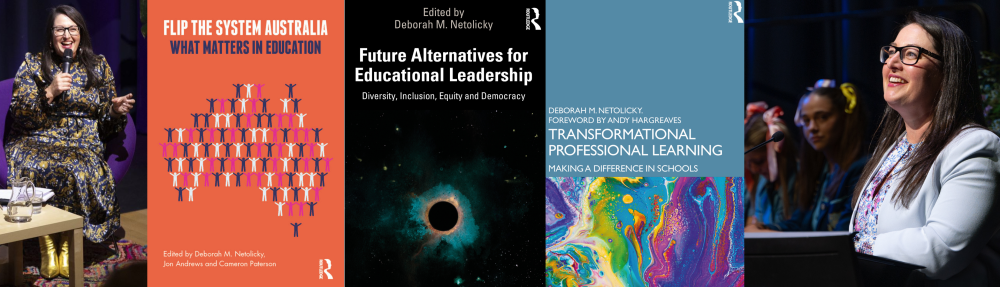
In the coming week I will be presenting at the International Congress for School Effectiveness and Improvement (ICSEI). In one session, I will be reflecting on a book I edited: Future Alternatives for Educational Leadership: Diversity, Inclusion, Equity and Democracy. In the conclusion of that book, as I reflected on the impacts of the COVID-19 pandemic, I wrote that during the pandemic, “schools have been revealed as socioeconomic enablers and vital points of connectedness, relationality, socialisation, community and socio-emotional-financial support for families” (2022, p.213). That sentiment continues to resonate. As well as being learning communities, schools are additionally communities of being, belonging, becoming, connecting, and buoying.

More than a group of individuals clumped in one environment, community is the act of collectively coming together. A community allows the group to share a sense of purpose and identity, and simultaneously for each individual to embody and explore their own unique purpose and identity. The very word community finds its roots in the Latin communis, meaning ‘shared by all’ or ‘common’. In fact the word munis means to be ready to serve. More than merely sharing a place, this etymology reminds us that community is about what values, experiences and lives we share, and that community is about service. Being intentional about community means deliberately focusing on what connects us rather than what divides us, and on how we can help others. As communities, schools focus on being environments of open dialogue and safe cultures of trust, with shared traditions, shared stories, and support networks that extend beyond classrooms, staff rooms and parent functions.

While students are at the heart of schools and their purpose, school communities include old scholars, families, staff, and wider community. School leaders work in fellowship with their school communities. As a school principal, I am often in the privileged position of sharing in the lives of those in my school community. It is in viscerally human and often private moments, such as when I am with someone who might be experiencing grief or difficulty, that I find myself reflecting on how to act with empathy and compassion while working to do the thing that will most serve and support the person or family in that moment. I focus on presence and service while accepting the discomfort and complexity of our shared humanity.

In my recent conversation with Karen Spiller OAM CF on my podcast, The Edu Salon, Karen expressed the need for principals to feel the hurt of their community, and to also be tough enough to sustain themselves in supporting those in their community through difficult times. There is a need for those leading in, with, and for community to reflect upon how we engage in a way that allows us to keep doing the work. As the sayings go, we need to fit our own oxygen masks before helping others, and we cannot pour from an empty cup. Serving and leading others is only possible when we ourselves are able to be resilient and well.

As communities, schools are people places. Each school offers members of its community more than academic courses, co-curricular opportunities, and wellbeing programs. I often say to students and staff that leading is an action and a way of being, and that leading is about others, not about self. Schools allow opportunities for us to wrap around and walk alongside people through life’s many experiences, in sadness and joy, challenge and achievement, despair and hope. That is an incredible privilege.

The global landscape of educational leadership

On 31 October, UNESCO launched the 2024/5 Global Education Monitoring (GEM) Report, Leadership in Education: Lead for Learning, which engages with Sustainable Development Goal 4 ‘Quality Education’. The report explores global research and practice in educational leadership, capturing the current landscape, possibilities, practices and challenges of leadership in education around the world.

Below, I briefly summarise some of my key takeaways from the GEM Report.

Impact: School leadership matters

The report notes that leadership in schools is second only to teaching in the classroom for its capacity to impact on student outcomes and experiences. If we are to improve outcomes for students, it is vital to understand the impacts, influence and ingredients of school leadership.

The report notes that those principals who have a significant positive impact on schools tend to set transformative directions, use policies and reforms to drive purposeful change, enable safe and positive environments, build relationships, develop people, provide feedback, manage resources strategically, and work to improve classroom teaching. It also notes that school principals in Australia have been reporting higher levels of stress, burnout and depression in recent years (with women reporting this more than men), with workload quantity, lack of time for engaging with important work, and the seeming impossibility of managing life outside of the job, being major reported causes.

Australia’s Professional Standards for Principals, developed by the Australian Institute for Teaching and School Leadership in 2014, define the principal’s role as focused on five areas: leading teaching and learning, developing self and others, leading improvement and change, managing the school, and working with the community. Based on the work of Ken Leithwood, the GEM Report identifies four key roles of the school leader as: setting expectations and vision, focusing on learning and leading instruction, fostering collaboration, and developing people to improve school outcomes.

Autonomy: There can be no leadership without the opportunity to make decisions

The context for leadership affects those things a leader does in setting expectations, such as sharing vision, holding high expectations, setting a personal example, representing the community, and staying abreast of trends, data and information to inform decision making. Standards and accountability mechanisms for schools and school leaders vary from system to system and school to school. The GEM Report found that in 20 high-income countries, the more principals had the primary responsibility for human and financial resource decisions, the more likely it was that a country would be among those ranked more highly in terms of average performance in mathematics.

School leaders have more chance to make a positive difference if they have autonomy, support and well-defined responsibilities. Education systems need to empower school principals with sufficient autonomy to manage financial and human resources and to make decisions related to teaching and learning. Autonomy must, however, come with adequate support, sufficient resourcing and appropriate accountability measures.

Collaboration: School leaders cannot and should not lead alone

School leaders are not solo heroes, but part of an enmeshed ecosystem of influence. As I often say, leading is an action and a way of being, not a role or a formal title. All can lead. In schools, this might mean senior leaders, middle leaders, teachers, school services staff, students, parents and community members.

Shared school leadership and collaboration among empowered stakeholders strengthens decision making, contributes to enacting a shared vision, and leads to lasting improvements in educational outcomes and school cultures. School leaders have a central role to play in developing school culture and climate; maintaining a safe, healthy school environment; raising resources strategically, building networks; managing risk; nurturing collaboration; enabling others to act; and consulting with families and community.

School leaders who build the capacity of others, ensure they are accessible, provide training and resources, foster a collaborative environment, involve others in decision making, are involved in collaborative structures and processes, and distribute leadership among and across the organisation, are more likely to see the school’s vision realised.

Schools can promote shared school leadership by establishing clear communication channels, ensuring transparent decision-making processes, implementing regular feedback mechanisms, ensuring clarity of roles, and recognising unique contributions. School leaders can keep track of staff professional development needs, provide individualised professional support and mentoring opportunities, ensure evaluation of practice, and reward good performance.

Collaborative relationships (such as those built through committees, teams and other collaborative structures) strengthen governance, improve decision making, enhance accountability, and foster inclusive and resilient environments. Fostering safe, inclusive and culturally responsive environments is key to ensuring a climate of care and challenge where collaboration can thrive, where shared vision can be realised, and where all students, staff and wider community can flourish.

Reflecting on 2023 as we move into 2024

2023 was a year of the increasing impact of generative Artificial Intelligence, devastating international conflicts, a global economic downturn, a King’s coronation, the Barbie movie, climate crises (with 2023 the hottest year on record), the Australian referendum on an Indigenous Voice to Parliament, the Matilda’s playing in the semi-final of the FIFA Women’s World Cup, and financial pressures for households due to rising interest rates and inflation. Educators engaged with AI, VR, AR, entrepreneurship, micro credentialling, evolving curriculum priorities, personalisation, complex wellbeing issues, youth mental health crises, workload pressures, workforce shortages, cybersecurity, sustainability, and equity. 2023 was the first year since 2020 when everything seemed ‘back’ and ‘on’. Many people I have spoken to have commented that to them the year felt full and fast.

For me, 2023 was a big year of growth and memory making. I moved with my family from Perth to Adelaide. This meant buying a new family home (and then renovating it while living in it), our two children beginning at their new school and in new sporting teams, and our family exploring our new city and state.

I began as Principal at Walford Anglican School for Girls, where this year we launched our 2023-2025 Strategic Plan, a new scholarship, a wellbeing dog program, staff learning communities, and a staff wellbeing committee. We refreshed the school’s values in consultation with students and introduced values awards. We engaged extensively in Reconciliation, service, enterprise learning, a glowing IB PYP evaluation, and designing bespoke senior secondary pathways for students. We undertook significant stakeholder consultation as part of a review and redesign of the uniform. We reviewed the shape of the school day and the café menu, and built new play spaces for our early and junior years. I have learned much about traffic safety and significant trees. We enjoyed community events and incredible showcases of student talent and hard work.

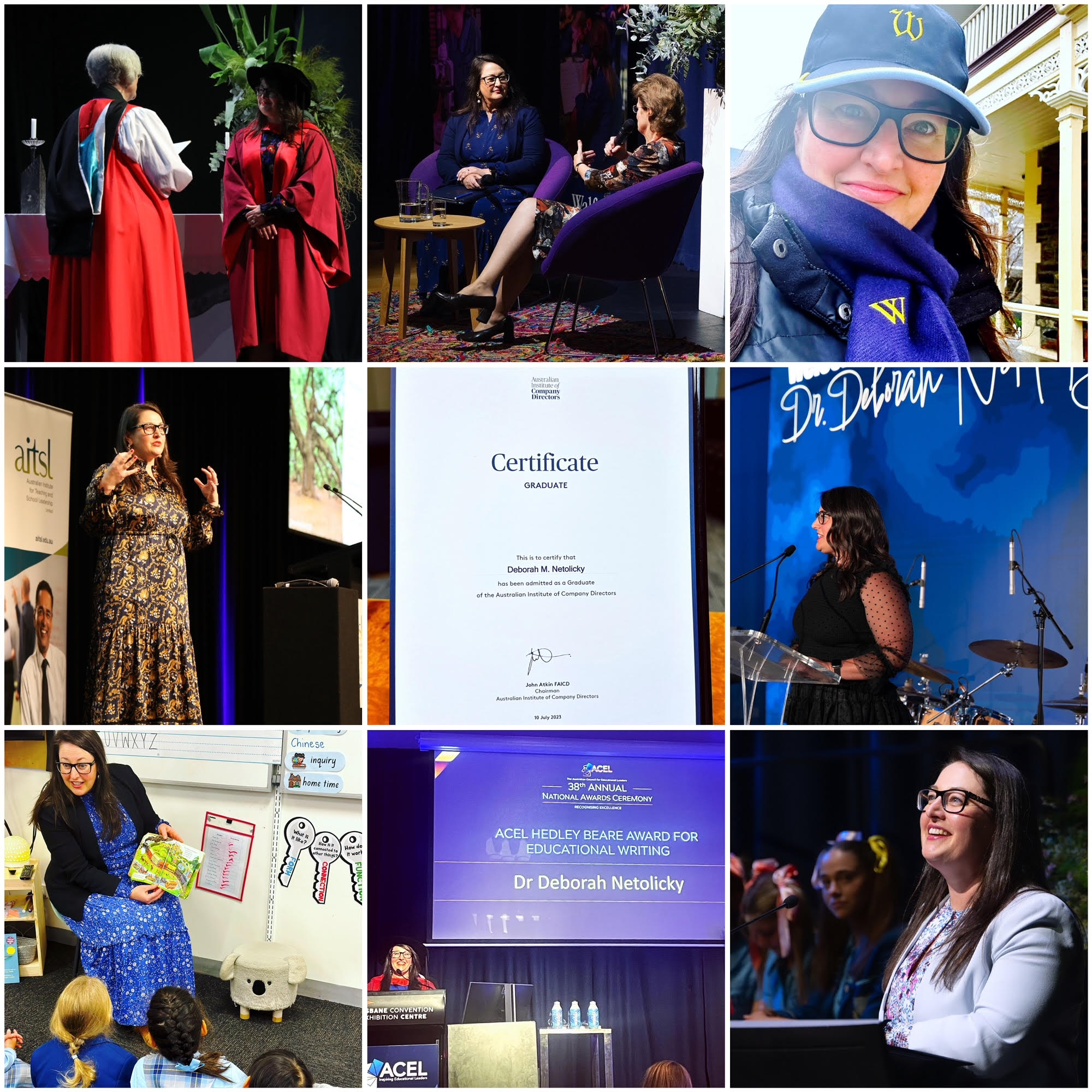
Additionally, this year I was appointed as Adjunct Senior Fellow at the University of Adelaide, and a Member of Editorial Advisory Board for the Journal of Professional Capital and Community. I completed and graduated from the AICD Company Directors Course. I recorded and released nine episodes of The Edu Salon. I co-authored the book chapter ‘Grappling with Pracademia in Education: Forms, Functions, and Futures’ with Paul Campbell and Trista Hollweck, published in the book Professional Development for Practitioners in Academia. I presented a keynote at the AITSL National Summit for Highly Accomplished and Lead Teachers. With Summer Howarth I presented to school leaders at an ACEL SA ‘Hot Topic’ event, and alongside Kevin Richardson at an AHISA SA event for aspirant principals. It was an honour to be awarded the ACEL Hedley Beare Award for Academic Writing, and to be listed on The Educator’s Most Influential Educator List and Hot List of innovative Australian educators. I travelled to Bali, Kangaroo Island, Rottnest Island, Cairns, Melbourne, Sydney, and Perth, and celebrated 20 years of marriage.

2024 is a new year, filled at this early stage with uncertainty, as well as hope and possibility. I wish all in my network a wonderful year ahead, and one in which you find joy, meaning, peace, and time to nourish, replenish and rejuvenate yourselves amongst the challenges the year will undoubtedly bring.

On Educational Writing

Last night, I had the remarkable privilege of receiving the ACEL Hedley Beare Award for Educational Writing from the Australian Council for Educational Leaders at the National Awards Ceremony.

Educational writing has been something I have done to give back to the education space, to connect with others, and to encourage others in schools to be part of the narrative about schools. My Google Scholar profile summarises much of this work.

Below I share my acceptance speech.

 I am incredibly honoured by the distinct privilege of receiving this award tonight.

As I think about Professor Hedley Beare, after whom this award is named, and his significant writing and contribution to education, I am in awe of his 18 books, 40 book chapters and hundreds of journal articles. I look at the list of previous awardees, including those that are incredibly well-known in education, such as Robert Marzano, John Hattie, Pasi Sahlberg, and Viviane Robinson. I feel humbled that my name has now been added to this list.

Receiving this award has me reflecting on why I write and what I have written. As a child I wanted to be an author, and I tried to write my first novel at around 8 years old. I think I got to about 30 pages and 3 chapters before I gave up that novel, but I still remember the main character, Lesley, and her Nancy-Drewe style adventures.

My educational writing has been borne out of a commitment to the teaching and school leadership profession, a desire to speak out into and help to shape education narratives, and the sense of nourishment I get from reading the writing of others, being informed by it in my thinking and practice, and from collaborating with others in writing projects.

I have been reflecting on what I like to think of as the ‘family tree’ of educational leadership and educational writing in Australia. Of the educational leaders who have supported me through my career, of the educational writers and researchers who have engaged me in conversation, in the colleagues in schools and the academy who have worked alongside me, engaged me in robust debate, and encouraged me.

Writing about education has been something I have done while working full time in schools. Some of my recent writing has been around the still-fairly-emerging concept in education of ‘pracademia’ – a concept that thinks of practice and research as both/and rather than either/or. Trista Hollweck, Paul Campbell and I define pracademia as the plurality of spaces, and the space itself, occupied by those interacting within, between, and beyond the domains of practice and academia, and involving the components of identity, community and engagement. For me, pracademia as a concept encapsulates the valuable networks and constructive collaboration between educators across and between education spaces. This is a space I feel I have inhabited as I have written from my work inside schools and sought to contribute beyond the walls of the schools in which I have worked.

This year’s ACEL conference theme—Learning from the past, Leading for the future—encapsulates what we need in education: to honour and seek to understand our past, while working to serve our students and communities into the future.

Some of the takeaways of the edited book, Future Alternatives for Educational Leadership, are that leadership requires intuition, adaptive responsiveness, and continuous learning, combined with systematic, critical, and intentional work. That educational leaders need to be reflexive in their practice, actively seeking to examine, interrogate, and challenge our beliefs, practices, and the norms and structures operating in our schools and systems. That leadership should work to balance the needs and care for each individual with the needs and care of the whole. It is about knowing our contexts and communities and responding to their needs. About openly addressing complex or difficult issues and looking for ways forward, even if these turn out to be unsuccessful. About making space for diversity of perspectives and knowledge systems, including those of Indigenous and culturally marginalised groups. Doing good, not looking good. Doing the right thing, not the popular thing. Serving others and focusing on the humanity of our work. Leading from the past and for the future requires creative, critical, and novel approaches, balanced with appreciation for, understanding of, and learning from history and tradition.

Writing for me has been sustaining, and it is wonderful to think that my contribution to educational writing is something that might support and positively influence others. Really, though, it is the ecosystem of educational writing, in which we connect with others and build upon the work of others, that is most valuable. We are better together. We are better because of who has come before, and we are better when we support those who will come next.

As I reflected on accepting this award tonight, I thought back to my PhD thesis, which used Alice’s Adventures in Wonderland as a metaphor for education, professional identity, professional learning, and school change.

The last lines of my thesis explore the hope I have for educational writing – that listening to the stories of others and sharing a range of perspectives might transform us individually, collectively, and as a profession. I will finish by reading some lines from the final passage:

Alice remembered how she had fallen slowly down the strange and marvellous rabbit hole, touching the creased spines of books and the smooth wood of ornaments as she fell down, down, down. She thought of those she had met and whose stories she had heard along her curious journey.

She had known who she was when she got up that morning, but Alice had changed so many times since then! The process of adventuring down the rabbit hole and through all the tangled paths of Wonderland had been a cocoon in which she had been transformed, and from which she had emerged ablaze with new colours and fresh insights.