The magic of great teachers

Columbia Pictures

Amid ongoing concern about teacher shortages and teacher burnout, celebrating and trusting teachers is crucial. As education increasingly integrates trends such as generative and agentic artificial intelligence, the role of the teacher remains vital. Teachers and their classroom practice make a measurable difference to student learning and achievement. Teachers have been found by research to be the most influential school-based variable in improving student learning and achievement. 

I was recently asked to comment on what makes a great teacher, as part of News Corp’s ‘Australia’s Best Teachers’ campaign. It got me thinking about my early days of teaching, and my days as a student. Teachers are often pivotal figures in the lives of young people. We all remember a great teacher from our own schooling. For me, it was my Year 12 Literature teacher, Penny McLoughlin, or Miss Mac as we called her. Miss Mac would bound into our classroom, her eyes glittering with excitement about the day’s lesson. She exuded a love of literature, a passion for the power of language, and a deep care for all her students. We could tell that she loved her subject, that she planned lessons thoughtfully, and that she cared about us as learners and people. I didn’t know it then, sitting in that Year 12 class, but I would go on to teach high school English and Literature for more than 20 years, to undertake academic research into what it is that makes a great teacher, and to become a school principal who witnesses the daily dedication and profound impact of the teachers in my school.

So, what is it that makes a great teacher? Great teachers beautifully balance expertise, craft and care. They seamlessly blend curriculum mastery and rigorous academic standards with systematic teaching, compassionate understanding, and a curiosity about students’ interests, abilities, and lives outside the classroom. There is a well-known line, often attributed to Maya Angelou, that rings true in the classroom: “People will forget what you said, people will forget what you did, but people will never forget how you made them feel.” Great teachers recognise the interconnected nature of academic success and wellbeing. They create classroom environments of high expectations and high care in which students feel safe while also being challenged to do their best.

Great teachers are experts who have the student at the centre of their work. They are specialists in curriculum (what they teach), in pedagogy (how they teach) and in their own students (who they teach). They systematically and purposefully design learning opportunities that inspire critical thinking and meaningful engagement in learning. They judiciously apply a range of strategies to the students in front of them. They provide meaningful, precise and compassionate feedback to help each child improve. Clear feedback, given with genuine care, encourages students to see feedback as an opportunity to grow.

Great teachers differentiate and personalise learning for students, responding to student needs in ways that are adaptive, flexible, evidence-informed and grounded in knowledge of learning and teaching. Teachers constantly check on student understanding and assess student progress, often in subtle ways that a student or observer might not notice. Responsive practice enables teachers to tailor their approach according to the dynamic needs of each child, classroom, and cohort. Great teachers are themselves curious learners who engage in professional learning that enables them to reflect critically on their practice, refine their approaches, and grow professionally.

Teachers continue to show up with expertise, empathy and excellence in their classrooms every day. Recognising and championing great teachers for the excellent and important work they do, such as through a kind word or a thank you note, can make the world of difference in a teacher’s day. Teachers: your quiet impact is noticed and your work matters greatly.

Reflections on professional nourishment

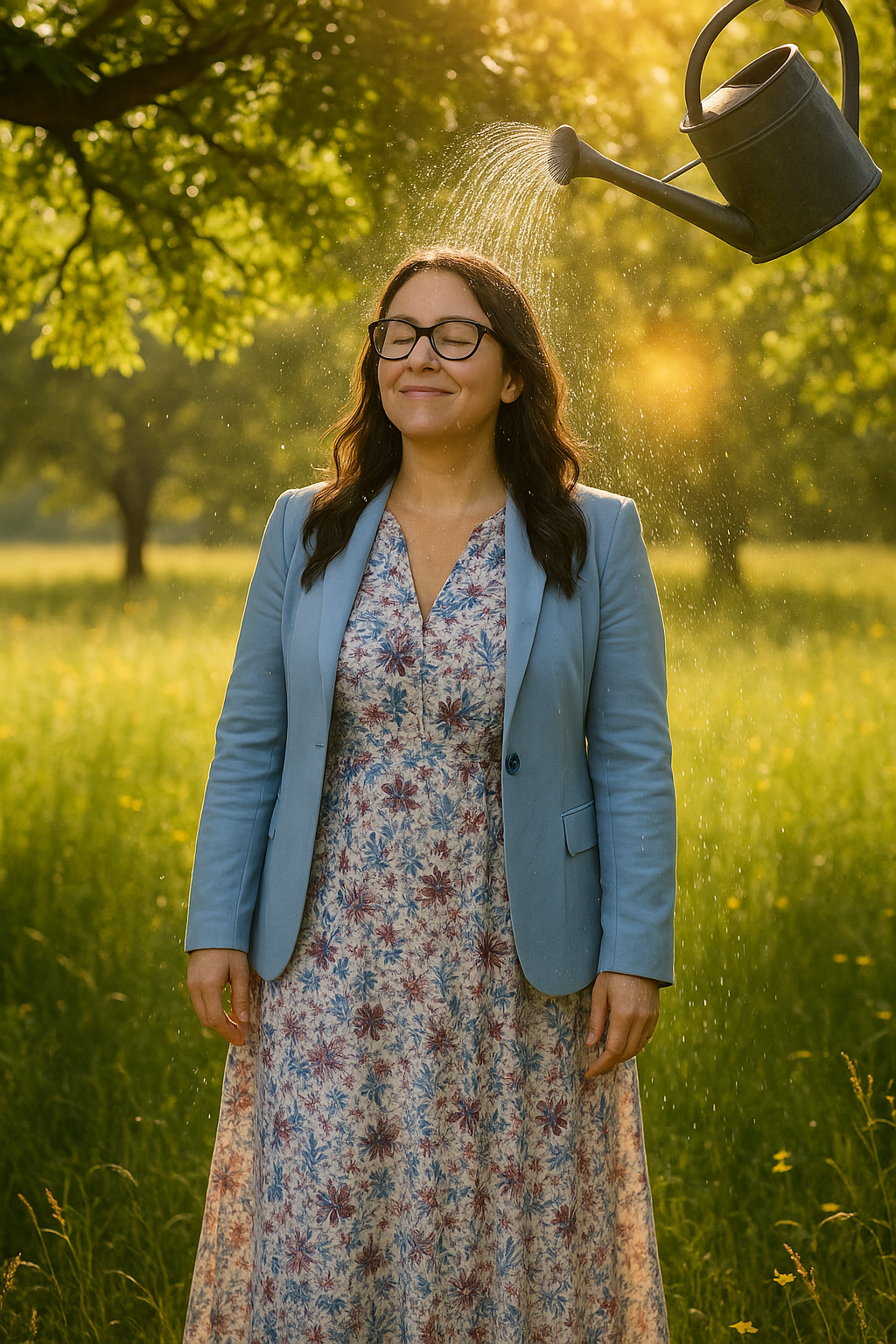
Image created with ChatGPT

The profound privilege and the weighty responsibility of serving as a school principal lies in the depth of the humanity of the role combined with the incredible sense of duty and the complexity of the role’s many moving parts. Independent school principals have been described as CEOs, responsible for strategic oversight and management of learning and teaching, daily operations, finances, risk, resources, communications, stakeholders and culture. A 2008 Australian report described principalship as “the best job in the world with some of the worst days imaginable,” encapsulating the intense reward and intense challenge of the role, which can be simultaneously fulfilling and depleting.

I have appreciated recent invitations to share my advice for aspirant school principals, and to speak about my experience in building contributions and networks beyond my immediate school environment. These opportunities for reflection, coupled with the regular release of research reports and media stories indicating the increasing ill-being of those working in schools, have led me to consider what might be described as ‘professional nourishment’. How do those of us leading in schools fill our cups to build buoyancy and resilience that sustain us as we serve the people in our communities, and navigate significant, serious and sometimes surprising complexities?

Like other people-facing roles in schools, principalship is inherently relational and involves the living of relationships throughout the extensive ecosystem of a school. Deb Dana’s concept of finding ‘glimmers’ in our day to uplift us reminds us to seek out sparks of joy and micro-moments of presence. Those of us working in schools can experience nourishment in our roles as we engage in the many and varied student experiences, community events and lives of students, families and staff. There is satisfaction and pride in witnessing the personal growth and achievements of students, sharing in the triumphs and challenges of families, and working alongside inspiring and dedicated colleagues. A ‘glimmer’ might be a conversation with a child in the yard, a thank you email from a parent, visiting a classroom to see a colleague teach, a conversation with an old scholar, attending a performing arts production or sports game, sharing dinner with the boarders, or witnessing a student or staff member overcome a challenge.

Professional nourishment can also come from deliberate reflection on and intellectual engagement in the work. This blog, for example, provides me with one way to share research, practice and thinking. It also engages me in writing as a practice of clarifying, synthesising and developing my thinking. Writing and podcasting provide unique opportunities to participate meaningfully in local, national and global dialogues around education and leadership. A range of platforms can immerse us in diverse perspectives and enable us to actively contribute to wider educational conversations. Ensuring there is time and space for thought, innovation and intellectual engagement, can help to reconnect us to the strategic direction of our schools and the ‘why’ of what we do.

One worry I have about artificial intelligence is that, while it is trained on human writing and coding, using it as a shortcut to exploring and communicating ideas might reduce our time and capacity to sit with, contemplate, and work through complex ideas. Formal or informal writing can be utilised, not just for its resultant output, but for its process of cognitive working out. When I begin writing, I do not know exactly where a piece will take me. The writing process is focused on internal growth and ‘thinking through’ or ‘thinking out loud’, rather than efficiency and end product. In a recent episode of The Edu Salon podcast I talked about the marination of ideas in the human brain as an important part of how we understand more deeply and move our thinking forward. Quiet reflective practice–in which we take the time to pause, interrogate our assumptions, tease out ideas, and carefully consider experiences–can provide an anchor for us to find clarity in the complexity of our work.

When I think of what is professionally nourishing, there is a special place for professional relationships and networks. I am incredibly grateful for those mentors, peers, colleagues and friends to whom I can reach out. Professional organisations and conferences (such as, in Australian education, AHISA, ACEL, AARE and ICSEI) can provide educators with inclusive communities of practice where ideas are shared, respectfully challenged, and refined in a safe and collegial space. Trusted relationships in which we share and talk through problems of practice, provide meaningful connection and mitigate the isolation of our role.

Those leading in schools can work to sustain ourselves by cultivating meaningful professional relationships, prioritising reflective practice, and actively participating in broader educational networks. Learning and connecting beyond our immediate environments can enhance our practice, enrich our schools, pay forward our expertise into the wider educational landscape, and help to sustain us in our roles.

Reflecting on 2023 as we move into 2024

2023 was a year of the increasing impact of generative Artificial Intelligence, devastating international conflicts, a global economic downturn, a King’s coronation, the Barbie movie, climate crises (with 2023 the hottest year on record), the Australian referendum on an Indigenous Voice to Parliament, the Matilda’s playing in the semi-final of the FIFA Women’s World Cup, and financial pressures for households due to rising interest rates and inflation. Educators engaged with AI, VR, AR, entrepreneurship, micro credentialling, evolving curriculum priorities, personalisation, complex wellbeing issues, youth mental health crises, workload pressures, workforce shortages, cybersecurity, sustainability, and equity. 2023 was the first year since 2020 when everything seemed ‘back’ and ‘on’. Many people I have spoken to have commented that to them the year felt full and fast.

For me, 2023 was a big year of growth and memory making. I moved with my family from Perth to Adelaide. This meant buying a new family home (and then renovating it while living in it), our two children beginning at their new school and in new sporting teams, and our family exploring our new city and state.

I began as Principal at Walford Anglican School for Girls, where this year we launched our 2023-2025 Strategic Plan, a new scholarship, a wellbeing dog program, staff learning communities, and a staff wellbeing committee. We refreshed the school’s values in consultation with students and introduced values awards. We engaged extensively in Reconciliation, service, enterprise learning, a glowing IB PYP evaluation, and designing bespoke senior secondary pathways for students. We undertook significant stakeholder consultation as part of a review and redesign of the uniform. We reviewed the shape of the school day and the café menu, and built new play spaces for our early and junior years. I have learned much about traffic safety and significant trees. We enjoyed community events and incredible showcases of student talent and hard work.

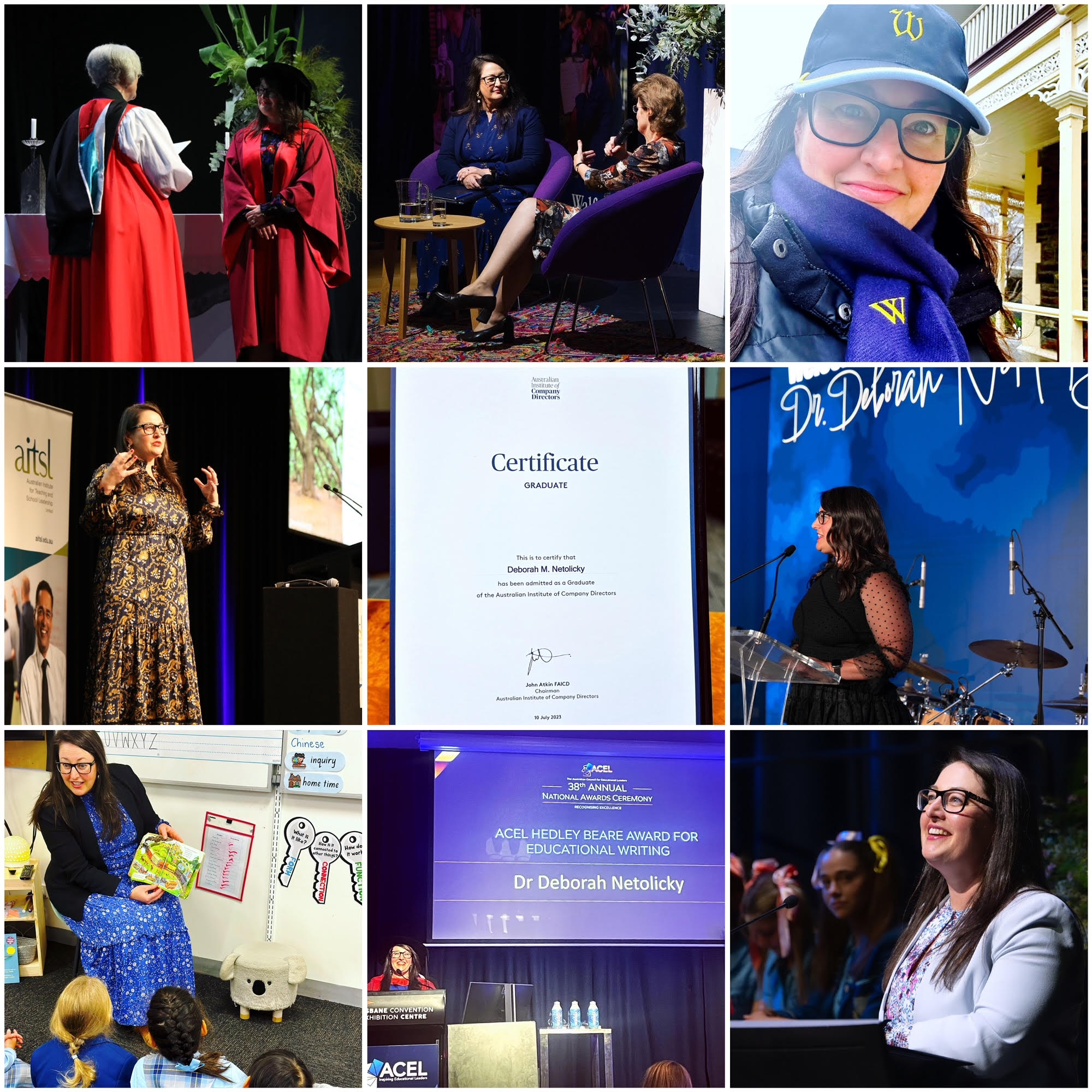
Additionally, this year I was appointed as Adjunct Senior Fellow at the University of Adelaide, and a Member of Editorial Advisory Board for the Journal of Professional Capital and Community. I completed and graduated from the AICD Company Directors Course. I recorded and released nine episodes of The Edu Salon. I co-authored the book chapter ‘Grappling with Pracademia in Education: Forms, Functions, and Futures’ with Paul Campbell and Trista Hollweck, published in the book Professional Development for Practitioners in Academia. I presented a keynote at the AITSL National Summit for Highly Accomplished and Lead Teachers. With Summer Howarth I presented to school leaders at an ACEL SA ‘Hot Topic’ event, and alongside Kevin Richardson at an AHISA SA event for aspirant principals. It was an honour to be awarded the ACEL Hedley Beare Award for Academic Writing, and to be listed on The Educator’s Most Influential Educator List and Hot List of innovative Australian educators. I travelled to Bali, Kangaroo Island, Rottnest Island, Cairns, Melbourne, Sydney, and Perth, and celebrated 20 years of marriage.

2024 is a new year, filled at this early stage with uncertainty, as well as hope and possibility. I wish all in my network a wonderful year ahead, and one in which you find joy, meaning, peace, and time to nourish, replenish and rejuvenate yourselves amongst the challenges the year will undoubtedly bring.

Social media for teacher professional learning

Teaching is forever an unfinished profession … never complete, never conquered, always being developed, always changing. Grundy & Robison, 2004

One thing that is emerging from my PhD research into teacher learning is the power of social media, Twitter in particular, as a professional learning tool and community.

For educators and researchers, Twitter means we can find like-minded individuals, even when those in our own organisations don’t share our passions or practices.

Social media connects us outside of our physical sphere – our schools, districts and countries – to professionals, thinkers and writers around the world who generate and share information, ideas, practices and activism which inspires, incites or affirms us.

Imagine my delight when global school change titan Andy Hargreaves responded to my first (ever) blog post. Here was social media linking me to one of education’s thought leaders whose work shapes my classroom teaching, my school leadership practice and my PhD research.

In 2013, Kathryn Holmes, Greg Preston, Kylie Shaw and Rachel Buchanan published a paper which found that “Twitter is a valuable conduit for accessing new and relevant educational resources on the internet and also as a viable means of social support for like-minded educators. The cost effective nature of the microblogging platform ensures that it can act as a medium for sustained professional development, while leaving the individual participants to control and take ownership of the learning.” So Twitter can be socially and intellectually supportive, and it can facilitate and drive sustained engaged learning which is owned by the individual.

Jon Tait explains Twitter’s role as professional development platform in his blog post and has designed this infographic to summarise Twitter uses for teachers.

JonTait_TwitterTeacherInfographic

As I move for the first time from content curation to content creation (this being my second-ever blog post), the functions of the professional social media world and those who engage in it are a point of reflection.  Who will read my words and see my images? Who will interact with my thinking and add their own? How might social media support, connect and educate me?