Cartoons to communicate science? #scicomm

With the knowledge of science we can solve resource limitations, cure diseases, and make society work happily–but only if people can figure out what in the world scientists are talking about and why they should care. ~ Randy Olson, Don’t be such a scientist

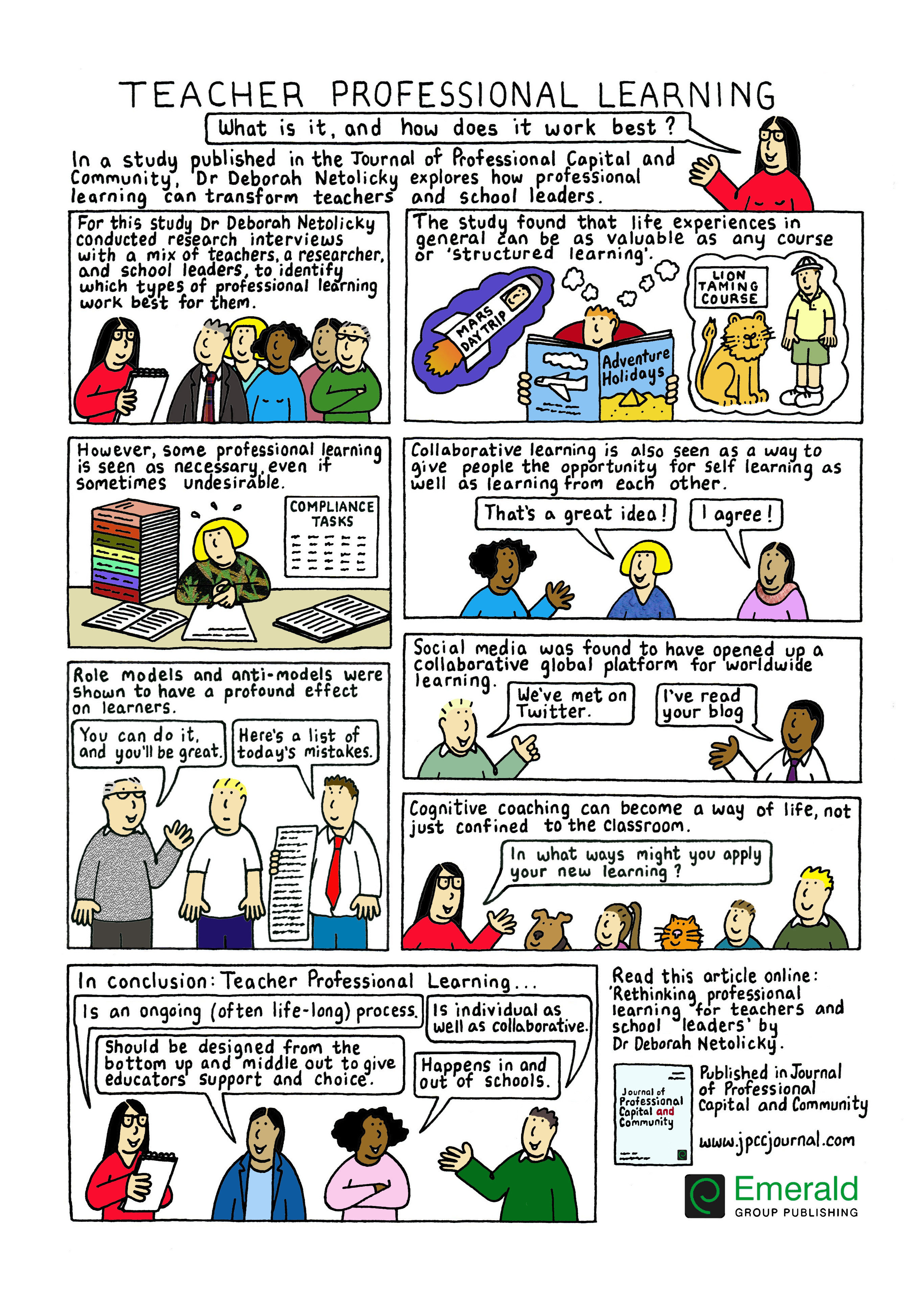
In 2015 the Oxford Dictionary word of the year was the ‘face with tears of joy’ emoji. This year I have seen PhD researchers communicate their theses via emoji on Twitter. Today Emerald Publishing and the Journal of Professional Capital and Community released the following cartoon abstract of my peer-reviewed paper ‘Rethinking professional learning for teachers and school leaders’. The paper itself, which has so far been downloaded over 4000 times, is open access, and I have also blogged about it.

What do you think of the notion of a cartoon or graphical abstract of a research paper? Is this a way forward for science communication? Can we use visual language to make research more accessible and more widely read? Could you or would you be open to designing a cartoon strip or graphic-novel-style summary of your research?

designed by Emerald and posted here on JPCC website: http://jpccjournal.com/teacher.htm

designed by Emerald and posted on the JPCC website

Writing productivity this Academic Writing Month #AcWriMo 2016

acwri at Melbourne airport

acwri at Melbourne airport

November isn’t just Movember and Dinovember. It’s also Academic Writing Month (#AcWriMo), the time for academics to publicly shout their writing goals from social media soapboxes everywhere. Ironically, at the moment work is taking over all my working and spare hours and my academic writing pipeline is suffering from inertia as a result. I haven’t been able to make the time to acwri, despite making constant lists that include acwri targets (respond to revisions! write draft paper! scope out argument! complete literature review!).

For me, academic writing is both unpaid work and a labour of love. While I don’t need academic publications for the work I do in my school, I write journal and conference papers because a) I think my research and writing have something to offer, something to say, and b) I enjoy the writing, the writing-thinking, the off-shoots of ideas from my PhD thesis that I now get to play with, and opportunities for co-authorship.

This blog both gets in the way of my academic writing and helps with it. It takes time and discipline to blog (I try to blog at least once a week, usually on a Friday), but I find that blogging keeps my writing wheels oiled and turning, which flows over into my scholarly writing. By blogging weekly, I never feel out of writing practice, even during these times when my academic writing slows to a barely perceptible drip.

Despite my inertia of the last few weeks, I share below some of my own approaches to academic writing productivity. I could call this ‘5 tips for productive writing’, but I agree with Naomi Barnes that tips aren’t always helpful.

……………………………………………………

Count more than you can count

I wrote last AcWriMo that successful writing is more than word counts. Sure, sometimes it’s motivating to hit a word count milestone. Every time I hit a 10,000 word number during my PhD felt like I was getting closer to somewhere, something, the end product.

If, like me, you write a lot and often too much, it can be satisfying to cull words, to watch the count go backwards. I cut 15,000 words from my PhD in the final editing stages. There’s joy in word cutting, too. Refining, pruning excess, making the writing better, stronger, clearer.

Sometimes it’s useful to use a Pomodoro timer or a bomb timer to give a sense of writing focus and urgency. I rarely use timers, but I often write to the time I have. One hour while the kids nap. Forty minutes between weekend commitments. Stolen moments before the family wakes. Having such little writing time means that I am highly absorbed when it comes. There’s no time to be distracted, dithery or unfocused. I prepare writing goals and materials for the times I map out, and when they arrive I write like a tropical cyclone.

Write where it works for you

I need quiet or a steady hum to write. Total silence works, but I can’t often get silence, or even solitude, at home, unless my husband takes our sons out.

A busy café with indiscernible noise also works for me. I love writing in cafes because a) I don’t feel alone as I‘m surrounded by people, b) I’m not distracted by domestic chores, c) there’s good coffee and d) it can make writing seem more pleasurable, like a holiday or an indulgence. I love the low hum of indistinguishable conversation as the soundtrack to writing.

I even considered acknowledging some of my favourite writing cafes in m PhD acknowledgments. The owners and baristas recognised me. I was the polite woman who would sit alone, drinking two coffees over two hours, tapping away at my keyboard or shuffling through annotated drafts. Quarantining myself in a public space for a specific block of time allowed and motivated me to just write.

Write when it works for you

Know your most productive times. I am at my best between 7am and 11am. This is when I zing with energy, ideas and the kind of focus that means that words and solutions come easily.

I am at my productivity worst from about 3pm to 6pm, during which I usually have the least physical and mental energy. Then I have a strange energetic renaissance between 8pm and 10pm, which are often the hours that I blog. Yet, sometimes in the evening I am too tired for anything but the most menial tasks: calendar entries, checking references, basic admin. I’ve learned that it’s better to close the laptop rather than stare uselessly in a kind of slo-mo catatonia.

To write my PhD, I had to leverage my best writing times and avoid my worst ones. There’s nothing more frustrating than spending time writing and not getting anywhere.

Use the in-between times

The shower, sleep, a walk, standing at the checkout, taking children to the park. These are all opportunities for cogitation and idea percolation. I often find, especially if I know I’ll be racing between commitments, I will deliberately plant a writing problem in my mind by thinking deeply on it for a time, and then let go of it, knowing that my brain will somehow continue to chip away at it while I do other things. Sometimes I revisit the problem mindfully, and sometimes a solution or idea will bubble up, unsolicited. Our writing solutions and growth often happen while we aren’t watching.

Work with others

I am new to co-authorship, but am finding that the writing relationships I am now nurturing push me beyond the kind of thinking I do on my own. I’m exploring new theorists and fresh methods. Collaborative writing can grow us beyond our writing selves.

……………………………………………………

Despite my inactivity thus far this #AcWriMo, I appreciate the social media reminders of the importance of academic writing, and of making time and space for it. This is true even for someone like me who is on the academia outer, an adjunct and a practitioner in another field.

I can give myself permission to ride the ebbs and flows of work, writing, parenting and being a friend/spouse/daughter/sister/colleague. For now I will keep scribbling my acwri lists, keep revisiting my acwri goals, keep putting my eye to my acwri pipeline. I’ll get it moving again soon.
Research-informed education practice: More than lip service and shallow pools

stromatolites in shallow pools

stromatolites in shallow pools, Shark Bay

In a variety of educational contexts I have recently heard everyone from keynote speakers to respected educational practitioners talk about research in education, especially the notion of bringing a knowledge of research into schools.

The general gist of what I’ve been hearing is ‘we need research-informed practice’ and ‘we need to look to the best research to inform decision making in schools’. These are statements I absolutely agree with, but digging a little deeper has led to disappointment. When people have gone on to explain what they mean by those fashionable sweeping statements, they have mentioned one or two researchers or studies of which they are aware. These oft-mentioned authors or studies seem to be those that are highly promoted, wheeled out by well-funded organisations or publishers, or neatly packaged into half-day workshops or laminated sheets. Some are those promoted as a one-stop-shop of what works in education: the simple answer for which we’ve all been searching!

The problem is that education is not simple, and neither is research. Learning, teaching and school leadership, are highly complex and contextual. There can be no simple answer, magic wand, silver bullet or laminated sheet of pretty-looking graphs that can transform education. (I was, however, recently challenged to have a go at thinking about in which directions we might look in order to improve teaching and learning.) As Dylan Wiliam suggests, research can point us in profitable directions, illuminating those interventions on which we might best spend our time.

Research, too, is highly complex and multifaceted. To engage effectively with research, educators need to understand its limits and what it can offer. All research is limited. I’m well aware of the limitations of my own research. I know my research has something to offer, but that offering is a small nudge, a keyhole insight, a singular thread in a tangled web. Academic writers are constantly delineating the parameters of their work; what their work has done and can show, and what it hasn’t done and can’t show. Each study or paper or chapter illuminates a different part of the tangled web of research in education.

As educators teaching, or leading teachers, we need, not just to be able to spout a couple of scholarly names, assert that ‘so-and-so tells us that X doesn’t work’ or make decisions based on appearing to engage with research. We need to engage with, pore over and deeply interrogate—with a critical eye—a range of research. Jon Andrews points out that deeply influential people who penetrate huge educational conversations and decisions may be going unchallenged by the profession at large. Marten Koomen traces some of these influential figures and their spheres of edu-influence.

John Hattie’s meta-analyses are often referred to in education circles as examples of research that tells us what works; it is certainly his name that I am currently hearing most often in schools and at conferences. I respect Hattie’s work and that there are things it can tell us, but am skeptical about the ways in which it has been universally adopted as a ubiquitous beacon of research light in the edu-darkness. Dylan Wiliam, in his 2016 book Leadership for Teacher Learning, discusses the limitations of meta-analyses and their application in education, cautioning that “meta-analysis is simply incapable of yielding meaningful findings that leaders can use to direct the activities of the teachers they lead” (p. 96). Snook et al. and Terhart also present critical perspectives on Hattie’s book Visible Learning. This is just one example of how a particular set of results has become so widespread that it unquestioningly becomes part of the fabric of edu-talk.

We can’t pat ourselves on the back for unquestioningly consuming the most pervasive or seductively-packaged research. Gary Jones’ blog is a good place to start for those looking for considered sense-making around how schools might interact with research.

I am committed to playing a part in bringing the worlds of research and practice, theory and action, academia and schools, meaningfully and purposefully together so that they speak to and inform one another. It’s why I am pleased by the schools in Australia embracing school-university partnerships and internal roles like Head of Research. This recent report (by Tom Bennett, featuring Alex Quigley and Carl Hendrick) tracks some of the impacts, successes and challenges of Research Lead roles in schools in the UK.

I believe that schools can lead and generate research. They can develop roles and processes that bring critical organisational mindfulness to the movable feast of edu-research and how practitioners might navigate, probe and be informed by it. Let’s do more than wade in shallow pools of research literature or pay lip service to being research-informed. Instead, let’s find ways to lead and embed research thinking and informed decision making into the fabric of what we do.

Rethinking professional learning: an academic paper for JPCC

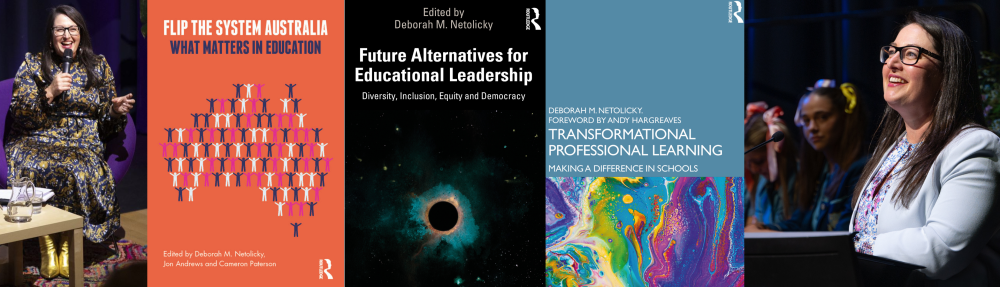
This week I’m thrilled to see my paper ‘Rethinking professional learning for teachers and school leaders’ published in the Journal of Professional Capital and Community. This journal, whose Editor in Chief is Andy Hargreaves, boasts an Editorial Board including Linda Darling-Hammond, Michael Fullan, Alma Harris, Karen Seashore Louis, Pasi Sahlberg, Helen Timperley and Yong Zhao. My paper appears in Volume 1, Issue 4, alongside a theoretical paper by Dennis Shirley. As an early career researcher, I couldn’t ask for more distinguished company.

Even more pleasing is that the journal is open access during 2016, so free for anyone to download and read. Open access to the paper means that it can be accessed by practitioners who so often don’t get to read and engage with the literature in (often pay walled) academic journals. In fact, it has already been downloaded (at today’s count) 1689 times. Wow. That’s a bunch more times than my PhD thesis.

The paper, which draws from the lived experiences of teachers, middle leaders (often a forgotten group in education literature) and executive leaders in one Australian school, outlines the findings of my PhD around what makes professional learning that transforms beliefs and practices. It discusses my study’s response to the questions:

  1. What is the role of professional learning on identities or growth?; and
  2. What professional learning is transformational?

My PhD found that transformational learning (as defined by Ellie Drago-Severson, 2009, as that which actively shifts cognition, emotion, and capacity) is: collaborative and individual; occurring in life, school, and work; and requiring elements of support and challenge. Not only was it lifelong, but it was life-wide. For these participants, it is life experiences, as well as professional experiences, that influence their professional beliefs and practices. The following is a table, which didn’t make the final cut of the paper, shows the range of features of professional learning found in my study.

tabulated findings around professional learning

tabulated findings around professional learning

This table shows the variety of experiences that educators in my study considered transformational for themselves. These experiences included relationships with family members; role models and anti-models of teaching and leadership; post graduate study; difficult life experiences; becoming a parent; and connecting with others at conferences or via social media. It included heutagogical (self-determined) learning, as I outlined for this blog post for the Heutagogy Community of Practice.

It also included, especially for leaders operating at an executive level, the time and space for silence, reflection and thinking. The research interviews themselves proved to be spaces of learning for some of the school leaders, who saw them as an opportunity to be listened to intently and to think deeply about their learning and leading.

The participants in my study had some important cautions about professional learning and about school interventions. They cautioned that a mandated approach to professional learning, even if differentiated, might not address the needs of all professional learners. They wondered about how to honour the individual teacher and the organisational priorities when leading professional learning in schools.

The paper concludes that, while my study intended to explore the ways in which educators’ experiences of professional learning form and transform their senses of professional identity, it found that it is not just professional learning, but life experiences that shape professional identities and practices. That is, our teacher selves and teacher actions are moulded by critical experiences that tangle with and shape our identities, lives, relationships, and emotions. The best professional learning, as suggested by this study, is highly individualised and knottily enmeshed with educators’ senses of self, of who we are professionally.

Anyone who teaches knows that we cannot separate our teacher selves from our non-teacher selves. As teachers our lives affect our learning and teaching, and our learning and teaching influences our lives. For many teachers, ‘life’ and ‘work’ are well beyond blurred. We are humans who teach and teachers who exist as humans in the world. The leaders in this study tended to describe themselves as either teachers who lead or as leaders who teach; they remained teachers in their identity self-perceptions. See this post for further musings about the notion of teacher identity, that ‘being a teacher’ stays with many of us beyond our years in the classroom.

One suggestion to emerge from this paper is that we would benefit from rethinking what it is that we consider and label as ‘professional learning’. Professional learning is not hours logged on a spreadsheet or entered into an app. It is not necessarily being in a room with other educators at a course or conference that is labelled ‘professional learning’ (although it might be). It is those critical moments across our lives and work that shape the core of who we are, in and out of the classroom and the boardroom. Professional learning can be personal, unexpected, unscheduled, nonlinear, messy, unbounded, and unacknowledged.

Can we redefine ‘professional learning’ in more expansive and flexible ways? How might we acknowledge those hours educators spend blogging, or studying, or tweeting, or visiting schools, or collaborating intensively, or volunteering in the service of others? How can leaders lead the learning of teachers in ways that honour their individual learning trajectories and their own agency? How might we rethink our systems and schools in order to focus, not on hours of what is easily labelled or effortlessly deployed (staff day scattergun PD, anyone?), but on what actually engages us and changes our cognition and our capacities?

Schools can lead and generate research #AHISA16

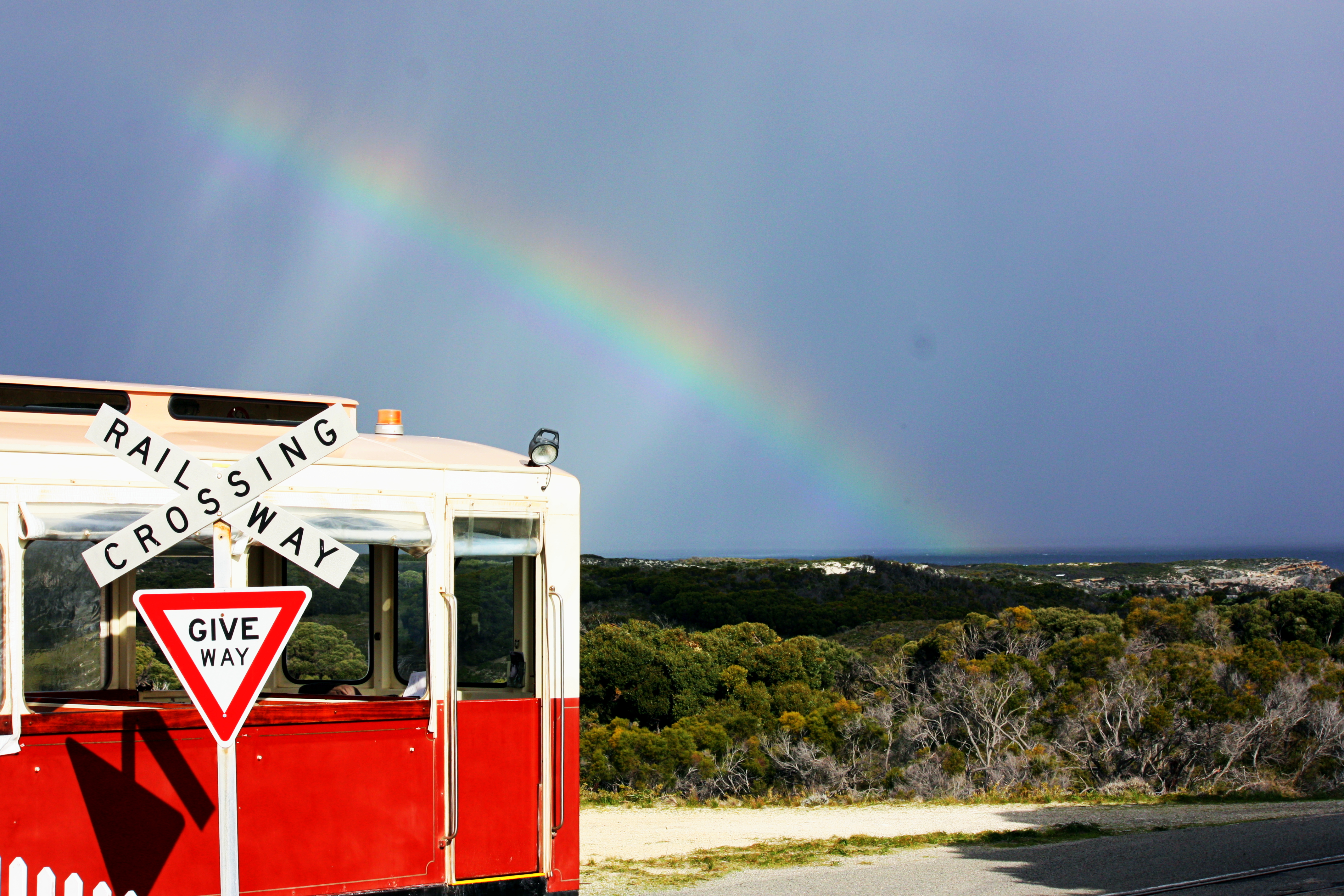
Rottnest rainbow, by Deborah Netolicky

This week I’m attending the AHISA (Association of Heads of Independent Schools of Australia) conference, which brings school leaders from around Australia together for a few days of visiting schools, conferencing, and networking. In my daily life, conversing with educators, many of whom I’ve never met, in other spaces and places tends to happen through social media (Twitter, blogging, Voxer). This week, however, via the AHISA conference, I’ve had the pleasure of catching up with those I have met and know well: my first principal and a variety of leaders with whom I have worked in Perth, Melbourne, and London. As someone who has worked in independent schools in Australia and the UK (for over 16 years, except for 6 months at a London comprehensive) this conference visit has been in some ways like watching my career flash before my eyes, as I’ve reconnected with various colleagues I’ve worked with at various times and places across the last decade and a half. It’s a reunion and a catch up with those I’ve worked over the years, a chance to talk with current colleagues about how the conference relates to our current work, and a place to make new connections with school leaders from around the nation.

In the conference sessions, I’ve been following a thread that is important for my own current work: professional learning for teachers and leaders, especially that emerging deliberately out of specific contexts. These sessions are relevant to me and my school because I have led a whole-school, evidence-based strategic intervention: a coaching-for-professional-growth model. This role has involved, since 2012, canvassing research literatures, writing papers, presenting to the school Board each year, and leading teams of teachers to prototype and iterate a context-specific model to support teacher and leader growth. This intervention was top-down (driven by the school’s strategic vision) as well as middle-out and bottom-up (developed by teams of teachers, led by me and overseen by the school Executive). It has meant generating data around the impacts of our work and tracing the influence of the model on teaching, learning, leading, school culture and the organisational language of professional conversation.

At the AHISA conference, the best workshop presentations for me have been those that have outlined how a school or system has applied systematic, research-informed, evidence-generating methodologies, with a clear aim.

Dr Gary Jones (2016) points out that schools can use evidence to make better decisions. He elevates the following from Barends, Rousseau and Briner (2014) as a frame for evidence-informed decision making in education:

  • Asking: translating a practical issue or problem into an answerable question;
  • Acquiring: systematically searching for and retrieving the evidence;
  • Appraising: critically judging the trustworthiness and relevance of the evidence;
  • Aggregating: weighing and pulling together the evidence;
  • Applying: incorporating the evidence into the decision making process; and
  • Assessing: evaluating the outcome of the decision taken.

Evidence might include: published academic research that quantitatively or qualitatively analyses empirical data; data, facts, and figures gathered from the school; specialised professional experience and judgements of relevant practitioners; and values, views, and concerns of relevant stakeholders. Schools can value and consider a range of research, as well as tacit knowledge and the richness of their own context.

As Dylan Wiliam points out in his 2016 book Leadership for Teacher Learning (and elsewhere), research cannot tell teachers and schools what to do, but can inform their decision making and their efforts. We can look to research for likely-to-be-productive avenues in education, rather than for recipes or silver bullet solutions to be unquestioningly followed.

In fact, schools can lead research, not just follow it. They can generate research, not only consume it. School leaders and teachers can be researchers, can apply research thinking, and can be critical questioners of research literature. They can challenge each other, participate in respectful debate, investigate contradictory positions, or consider multiple possibilities. They can pilot, prototype, and iterate new ways of doing things, while collecting data on the progress and impacts of interventions.

It has been great this week to connect with past, current, and future colleagues at the AHISA Leading, Learning, and Caring conference. It has been even more pleasing to see the work of some educators and schools in applying evidence-informed and data-generating design thinking to their complex work. Still, there are those who could more rigorously interrogate their assumptions, practices, and uses of research literature. There are those from whom others would benefit if they contributed their thoughts to edu-dialogues. Many of us would benefit from listening more closely to others. Whether affirming, querying, or dissenting, it is a range of thoughtful voices from multiple perspectives that together can shift the narrative, practice, and evidenced understanding of education.

PhD: The gift that keeps on giving

my bespoke graduation shoes

my bespoke graduation shoes

I submitted the PhD last October. I finished my corrections in March. My doctorate was conferred in April. I wrote blog posts about completion: how it felt, struggling with my doctorness, what happens in Australian PhD examination.

So it should feel long ago done-and-dusted by now, right? I should have nothing left to say about the PhD.

Yet I still have PhD reflections and I feel as thought I am still having PhD experiences. I’ve remained in a doctoral Voxer group because the after-the-PhD bit still feels like part of the PhD journey. I continue to blog about the PhD as I am still reflecting on its processes, products and outcomes, some of which emerge overtime.

Here are some of the ways that the PhD keeps on giving …

Academic writing

The wonderful thing about completing the thesis and having it passed is that it frees you up to write more tightly-woven pieces from your PhD literature, method, data and findings. Pat Thomson has recently written a very useful post on how to find journal articles in and from the doctoral thesis. You can look for interesting pieces relevant to particular journals, new ways of looking at your data, specific fields in which your work has something to add. This bit—in which you realise that your work has something to offer scholarly conversations and that you can create new offshoots of writing so that it to be heard in appropriate fields—is empowering and even fun. I’m even becoming better at seeing peer review as a growth process in which I am privileged to participate, rather than an ordeal to be endured.

The three solo-authored peer-reviewed journal articles I’ve had published (or accepted for publication) so far include one on coaching as a professional learning intervention, one around the use of literary metaphor as method in academic writing and one on my findings around professional learning (in press). I have a co-authored paper on method that is under review. I have an ethics paper I’m working on with my supervisors. I have a book chapter in preparation which re-considers my school leader data through a new lens, in a previously unfamiliar field. I have more ideas about what bits and pieces of my thesis might have to offer before I retire it. The more I read and write, the more possibilities I see for reporting on or re-seeing my PhD work.

Acknowledgements

I’ve been told that my PhD adds credibility to my voice when I present and to the work that I do. My thesis has been downloaded from the university website over 250 times since it was uploaded in March. I’m not sure where this number sits in terms of metrics for dissertations, but it does suggest that my thesis is being read (or at least filed away with the intention of reading it).

I’ve been acknowledged via the 2016 ACEL New Voice in educational Research scholarship, which I’ll be receiving in Melbourne in September. My thesis has also been nominated for the Outstanding Research Award in Cognitive Coaching.

Formal recognition of the completed work of the PhD remind me of its worth. Informal feedback, too, in which scholars or PhD candidates get in touch with me to let me know how my work has been influential for them, is also thrilling.

Graduation and the floppy hat

While I’ve been conferred my doctorate and therefore can call myself ‘doctor’, my actual graduation ceremony isn’t until next month.

This is when I get to go up on stage to receive my printed degree. I didn’t attend graduation for my undergraduate degree, but for the PhD I feel like I need this rite of passage, this moment of celebration. To embrace the pomp and find closure in the ceremony. It’s somehow not enough to get the piece of paper delivered to my letterbox.

Unlike Finnish Doctors of Philosphy, who get to wear a top hat and sword as part of their regalia, I get to don a gown, a red-satin-lined hood and the black velvet Tudor bonnet (aka the floppy hat). While I joke that I’ll be wearing my doctoral headgear to the Spring Racing Carnival (Melbourne Cup Day, here I come!), it’s likely that I’ll get more wear out of my graduation shoes, which I designed for the occasion (via Shoes of Prey). After tweeting the above photograph of my shoes, Hilary Davidson pointed me towards her great article on shoes as magical objects, the perfect symbol of PhD power, transformation and completion.

Continuing my research

While my choice has been to continue to work in my school (rather than, for instance, pursuing an alternate career in academia), I’ve also been recently appointed into an honorary research associate role at my university, which allows me to continue to read, research and write in academia after graduation. So I continue to bestride the worlds of practitioner and scholar. Each world, each role and each project informs the others and shapes me.

*                                  *                                  *

So the PhD is done-but-ongoing.

I’m still pursuing doing good work with good people. I’m still thinking, writing and researching around my PhD, although in many ways I can feel myself moving on from it and away from it. The bound thesis is like a frozen snapshot, capturing a moment in time. So, too, each academic paper. As I grow as a scholar, an educator and a writer, I feel freed to frame my PhD data in new ways and to apply alternate theoretical lenses.

Like a pair of shiny red shoes, the finishing of a PhD is both end and beginning. Designed, created and seductively new. Ready to be enjoyed until worn-out, grown-out-of or kicked to the back of the wardrobe. While in many ways I feel that I’m moving away from the PhD, it also continues beyond its end, a shoe that continues to fit and bring joy. For now.

Harvesting good work: Reap what you sow

I’m not a farmer, not even a green thumb really. While I quite enjoy gardening and have a composter, I’ve learned to populate my garden with plants that survive on a healthy dose of neglect. (Side note on the composter: there is something joyful about shredding old copies of my PhD thesis drafts and feeding them to the worms.) Despite my lack of horticultural know-how, I’ve recently been considering the farming—and biblical—metaphor that you reap what you sow.

I often see others I admire reaping the rewards of their work. These people aren’t slaves to the performative measures of a neoliberal system, or narcissists seeking the spotlight of social media celebrity. They are humans–professionals, thinkers, theorists and practitioners–dedicated to work they believe is important. To doing it, sharing it, making a difference.

Since the final throes of my PhD in March, things have been happening in seemingly organic ways. Of course the PhD got done-and-fairy-dusted, and the thesis published online. The first paper from my PhD has since been published: ‘Coaching for professional growth in one Australian school: “oil in water”’, in the International Journal of Mentoring and Coaching in Education. I have another paper in press, due out next month. Two more are sitting on editors’ or reviewers’ desks. Two drafts are on the desk of a co-author. I have been interviewed on the Teachers’ Education Review podcast and on 2SER Sydney community radio. I had a piece published in The Conversation this week, about the dangers of pursuing performance pay for teachers. I am in discussions about bookish things, too.

And I’ve been on some kind of accidental-on-purpose conference circuit. AERA in DC in April. researchED in Melbourne in May. The International Symposium for Coaching and Positive Psychology in Education in Sydney in June (this Thursday and Friday). Heroism Science in Perth in July. For (little old) me, alongside my work at my school, all this seems like armfuls of hand-picked produce.

I’m not sure why I’m surprised at the pace of my recent schedule of outside-of-work commitments (also known as the unpaid-but-rewarding work that is academic writing and presenting), and the fact that I’ve started to be approached, rather than doing the approaching myself. But I am quietly bemused that I seem to be in a harvesting part of a cycle, even though I know that this is actually the result of hard and persistent work. The seeds for the current abundance were selected, sown and tended a while ago. Papers were written and reviewed (and reviewed and reviewed). Abstracts were drafted and submitted. Relationships were formed and cultivated. Presentations were prepared. Work was done. A lot of it. In my evenings and on my weekends and in my down time, and in all the little nooks and crannies of my life where I could fit reading, writing, collaborating, learning and connecting. Thank goodness for the wonderful people who support me, from my family and friends, to my colleagues and professional learning network, the Twitterati and my Voxer Squad.

I believe in doing good work. For me this is enacted in ways that are without a linear frame. I’m never quite sure where I’ll end up, or even where exactly I’m intending to go. It’s about doing work that I’m passionate about and feel is important, whether in service of my students, my coachees, my school, or knowledge in the world. In my writing, too, I often try things out, head down trails unsure of where they lead, double back, try again.

So, for now I continue to sow seeds I think are worth sowing. Write and research those things I think are worth writing and researching. Say things I think are worth saying. Teach what I think is worth teaching, in ways I think are most worth doing. Seek to learn those things I think are most worth learning.

The fun thing about this kind of sowing is that it’s like planting mystery seeds. I never quite know what influences or impacts something I do now might have in the future. It’s why the reaping feels like Christmas morning.

The best bit is how rewarding all the persistent and consistent hard work is. I like the work itself. I love the struggle and the triumph. I love the connections and the relationships that bubble up and take form. I love the unexpected rhizomatic results. A failed planting. A teeny green seedling reaching up from damp dark earth. A basketful of glossy fruit. A knotted beanstalk reaching up to the clouds.

Why I’m going to researchED Melbourne #rEdMel

Research evidence is essential to the task of improving outcomes for young people, but research will never be able to tell teachers what to do, because the contexts in which teachers work are so variable. What research can do is identify which directions are likely to be the most profitable avenues for teachers to explore. ~ Dylan Wiliam, Leadership for Teacher Learning, 2016

Why would a Western Australian fly to Melbourne for a one day conference? Here’s why researchED is drawing me to the East this May: cognitive conflict and robust discussion around educational matters.

In drawing together academics and education practitioners working in schools, researchED conferences are less about transmission of information and more about provocations and conversations. researchED’s tagline is ‘working out what works’, and those that gather at its events around the globe are interested in working out what works in education, for the benefit of the world’s children. The website tells us researchED’s mission:

researchED is a grass-roots, teacher-led organisation aimed at improving research literacy in the educational communities, dismantling myths in education, getting the best research where it is needed most, and providing a platform for educators, academics, and all other parties to meet and discuss what does and doesn’t work in the great project of raising our children.

Whether individuals come from Australia, Europe or the USA (all locations where researchED events have been held) they share the goal of bridging the gap between research and classroom practice.

As Dylan Wiliam points out, research cannot tell teachers and schools what to do, but it can inform the decisions educators make, and help them follow trails most likely to be beneficial for their students. Tom Bennett, the founder and director of researchED, says that researchED’s mission is to “to make teachers research-literate and pseudo-science proof.” That is, teachers need to be critical consumers, curators and questioners of information and of evidence.

Gary Jones, who is coming from the UK to present at and attend researchED Melbourne, has written an excellent guide to evidence-based decision making in schools. He points out a number of popular ideas in education that are not backed by evidence and reminds educators of the need to be conscientious, judicious and explicit in their use of evidence to make decisions and shape practices.

I’ve made my view clear that teachers can and should be researchers. Taking research into account, enacting practitioner-research practices, and engaging with scholarly literatures, is important in an educational world focused increasingly on accountability, performativity and rapid change. Sometimes, the best thing for a teacher or school to do is to press ‘pause’ and ask some critical questions of the evidence they are accepting or the practices in which they are engaging.

As a teacher and school leader who has recently completed a PhD, I can see the benefits of research thinking to the school environment. It means applying carefully considered and thoughtfully designed methodologies to decision making and innovation. It means trusting in teachers to be a core part of school reforms. Research becomes, not an add-on, but a way of being which is embodied and enacted by educators as they go about their important work.

researchED is part of a global movement to give teachers voice and agency in their work, their schools and their systems, while ensuring that school leadership and classroom practice is informed by research and evidence. Conversation between academics, researchers, leaders, policy makers and teachers can help all involved in education to best serve the students at the heart of our education systems. A wonderful publishing example of this kind of movement is Jelmer Evers and René Kneyber’s book Flip the System, which brings together the voices of teachers, academics and education experts in order to reclaim the space of education discourse for those working as cogs in the neoliberal machine.

So I’ll see you at researchED Melbourne. There will be interesting research and practice shared. There will be classroom perspectives and scholary ones. There will be graceful disagreement. I’m looking forward to presenting among the diverse voices, and learning from them.

(Here is my post on last year’s researchED conference in Sydney, at which I also presented.)

Brighton Bathhouses

Academic activism: Scholars, let your moral passion drive you #aera16

Iwo Jima at sunrise

Iwo Jima at sunrise

The theme of much of my day at the AERA conference yesterday was around scholarly activism. This post, which also shares a few of my photo snaps from DC, reflects on what yesterday’s sessions had to teach me about being a scholar. This comes at an important point in my journey. Now that the PhD is done, I’m thinking about what work I’ll do next in my school, my research and my academic writing.

In one roundtable session, a paper by Stefani Relles and Randy Clemens used the metaphor of punk rock for academics who use DIY scholarship in their quest for social justice. They theorized punk rock scholarship as grounded, activist and disruptive, using comparisons to skateboarders, graffiti artists and musicians of the punk movement. I reflected that a punk rock scholar might circumvent or disrupt traditional academic practices by self-publishing, using social media, blogging, or embracing open access and saying no to pay-walled publishing. But there was discussion at the roundtable about the extent to which an academic can be an outlaw. How disruptive can one be within the system, which places particular norms, pressures and metrics on those working within the academy? How might academics navigate the need for a pay check and tenure with their passion for social justice? Is it a case of corporate Bruce Wayne by day and vigilante Batman by night?

Similar issues emerged in a six-paper session about post-qualitative methodologies in which scholars were pushing at the boundaries of, dissolving, or letting go of, accepted Western ways of knowing and researching. Audience questions included those about how to exist within an academy while challenging or dismissing much of what it holds to be true or important.

Georgetown blossoms

Georgetown blossoms

Yesterday the notion of scholarly activism also emerged in a panel of what some might call superstar or celebrity academics. A discussion between Michael Fullan, Andy Hargreaves, Linda Darling-Hammond and Diane Ravitch was moderated by Washington Post education reporter Valerie Strauss. One theme which emerged was the importance of researching and writing from a burning core of moral passion. In discussing their books, the authors talked about what had inspired and driven them to write. In each case it was a sense that a book needed to be written, an argument needed to be made, something had to be said, an idea or group needed to be mobilised. Their writing was framed as political activism and advocacy. It had an emotional and moral component. Andy Hargreaves noted that writing should be based on the nobility of an idea.

Diane Ravitch’s story pointed to the need for persistence with moral purpose. She told the audience that her best-selling, award-winning book The Death and Life of the Great American School System: How Testing and Choice are Undermining Education was initially turned down by 15 publishers. At 77 years of age she is also an example of the power of social media and blogging. Her blog has more than 14,000 posts with more than 27 million page views. This speaks to the opportunities for scholars to leverage social media and the blogosphere to communicate their work and their messages to wide audiences. Tweeting and blogging can be scholarly writing practices.

Jefferson

Jefferson

I wonder about how much career stage and level of influence make a difference to the extent to which it is possible to disrupt the status quo. As a PhD candidate, I pushed at the boundaries of the traditional in my thesis, but I was also keenly aware of the need for my dissertation to be recognizable (by the all-important examiners) as an acceptable academic text. I pushed and agitated, but within the limits of what I thought I could get away with while still passing the PhD. Are those earlier in their careers, or in universities on contracts, less able to agitate, disrupt and advocate? Or is it again a case of Diana Prince sometimes, Wonder Woman at others? Clark Kent and Superman? The acceptable academic versus the one fighting for what they believe at their core to be the most important work?

The AERA conference itself is in some ways an exercise in homogeneity. While with about 18,000 in attendance, there is a wide range of topics being covered, most attending are dressed in variations of the same theme. Outwardly, there is an expectation of the academic, graduate student and educator. Do we wear our capes beneath our clothing? Is it our words and our work that are the heroes and the punk rockers?

Yesterday answered many of the questions I’ve been asking myself about what work to choose to do next. I think the answer might be simple. Do the work you believe at your core to be important. Say what needs to be said. Be guided by moral passion, social justice and fundamental purpose.

Folger Shakespeare Library

Folger Shakespeare Library

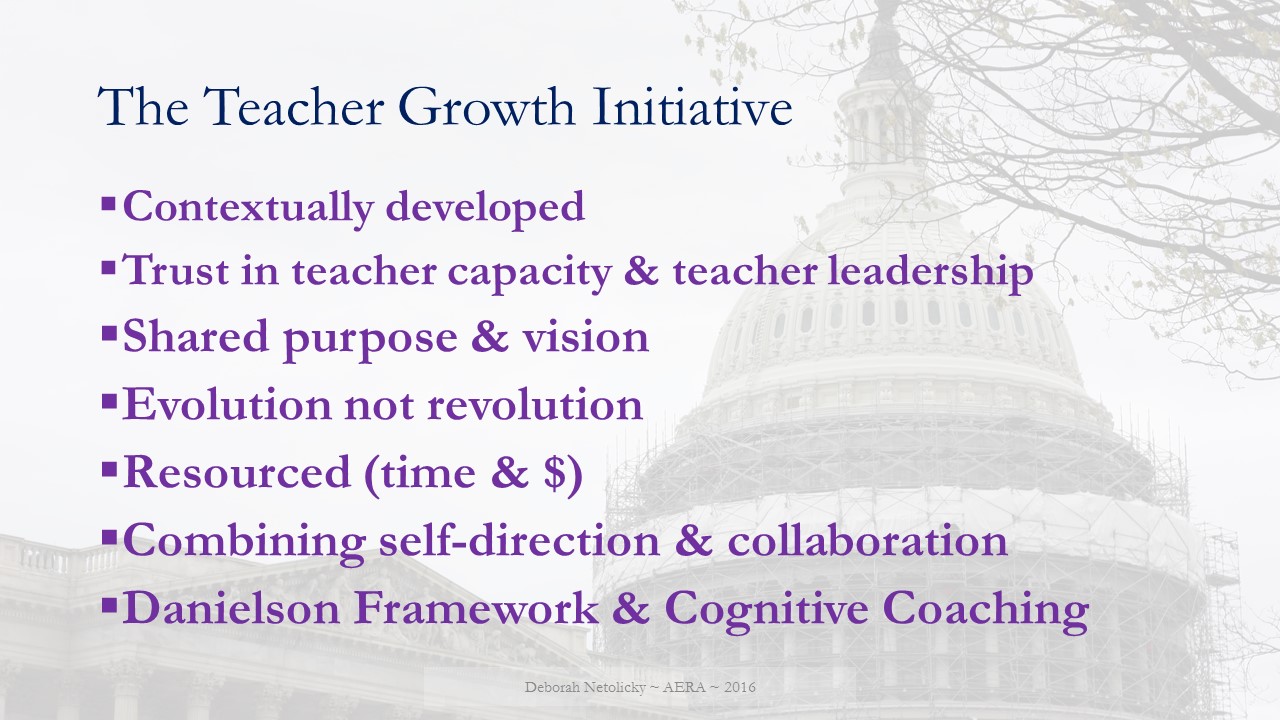
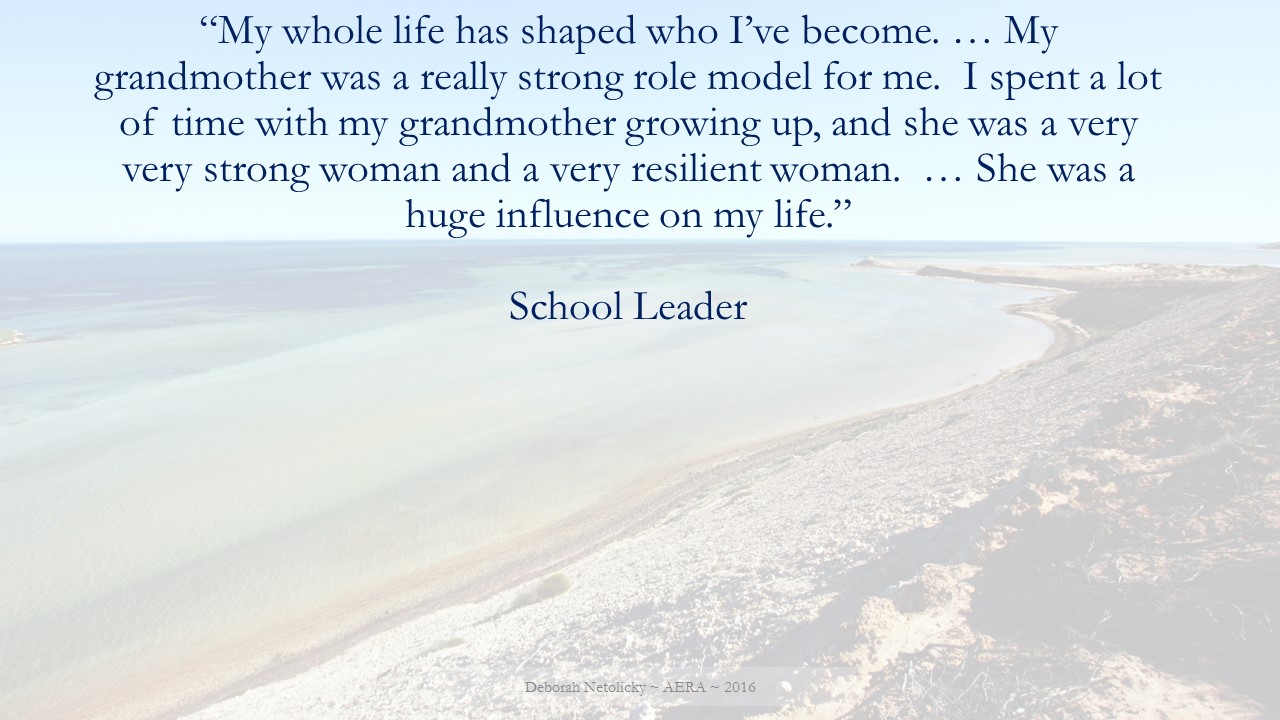
On professional learning: My #AERA16 presentation slides

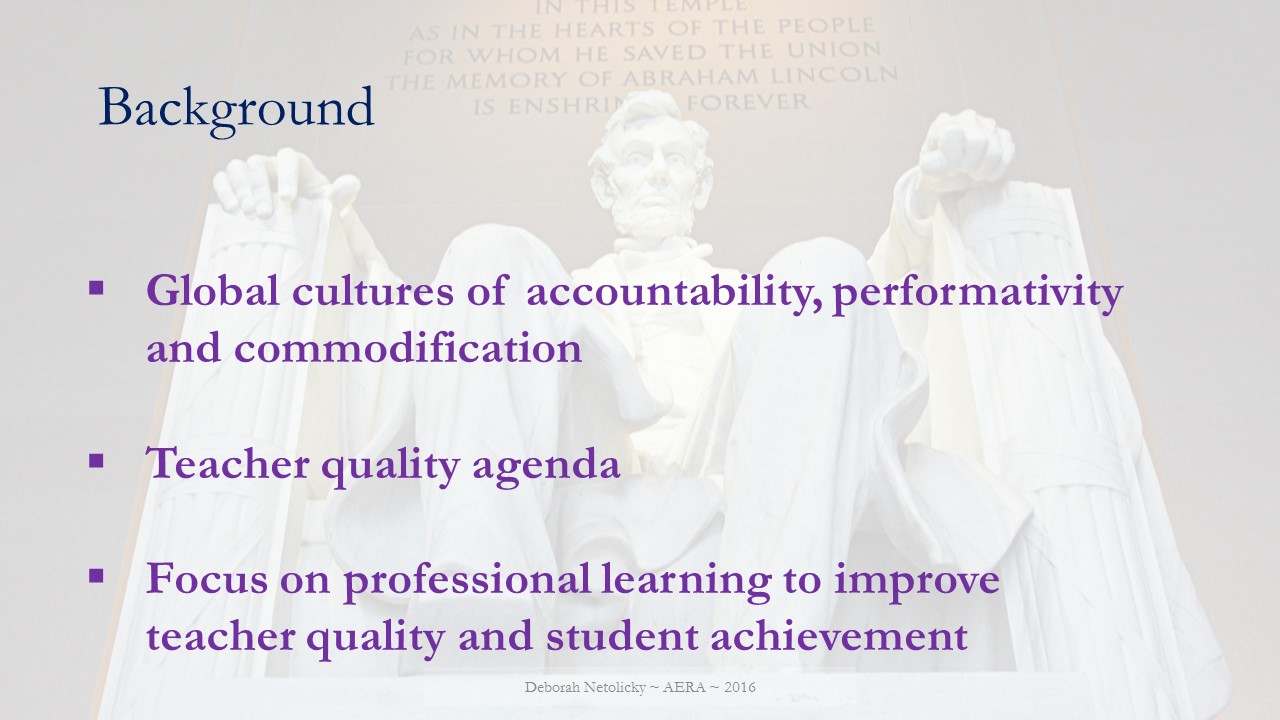
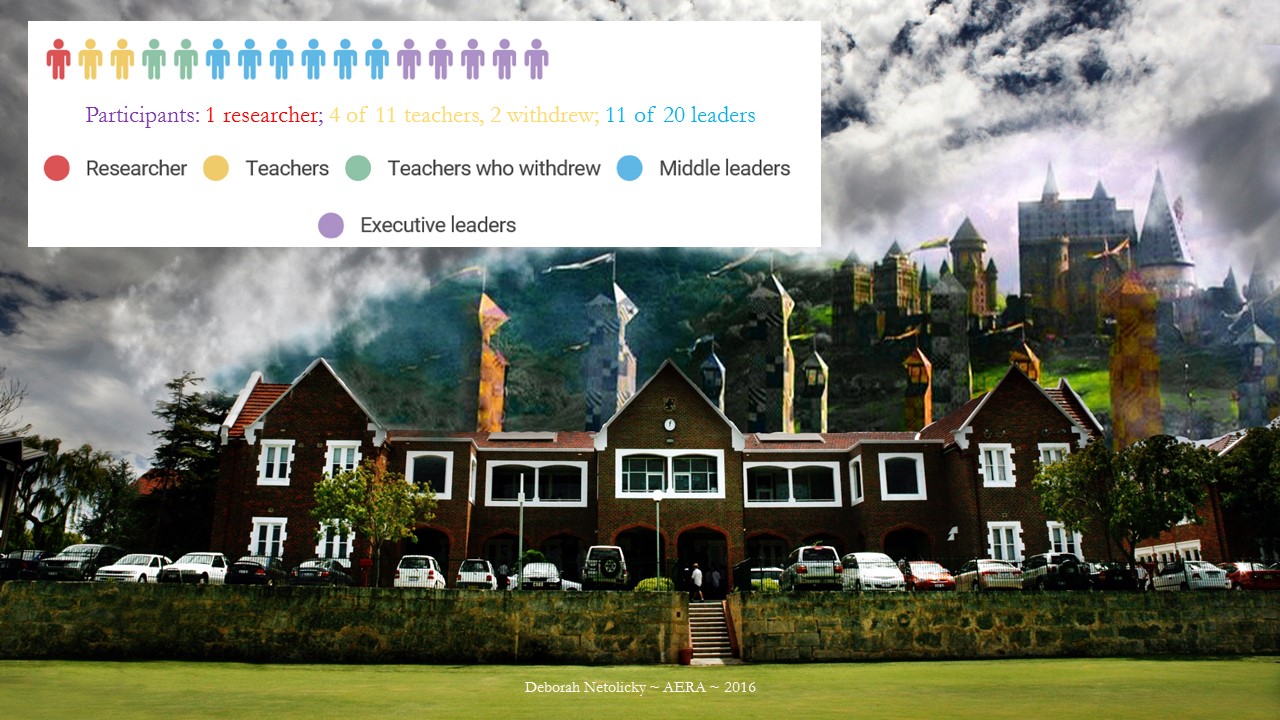
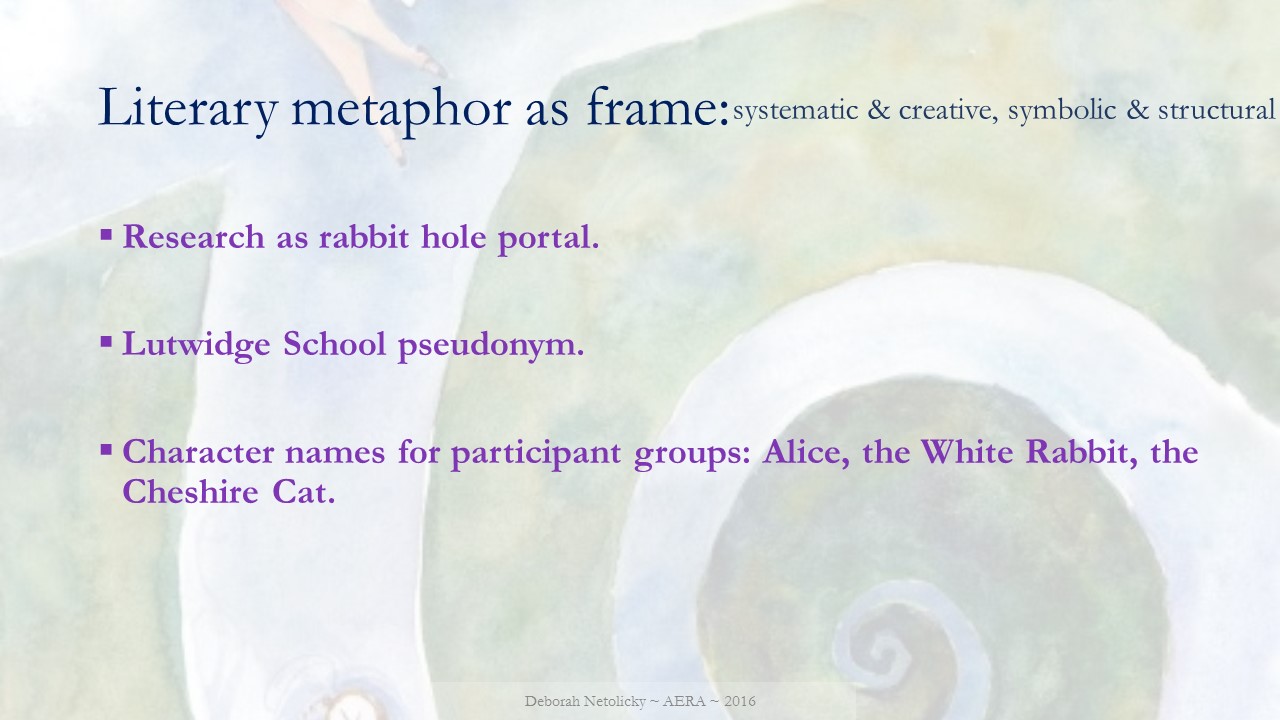
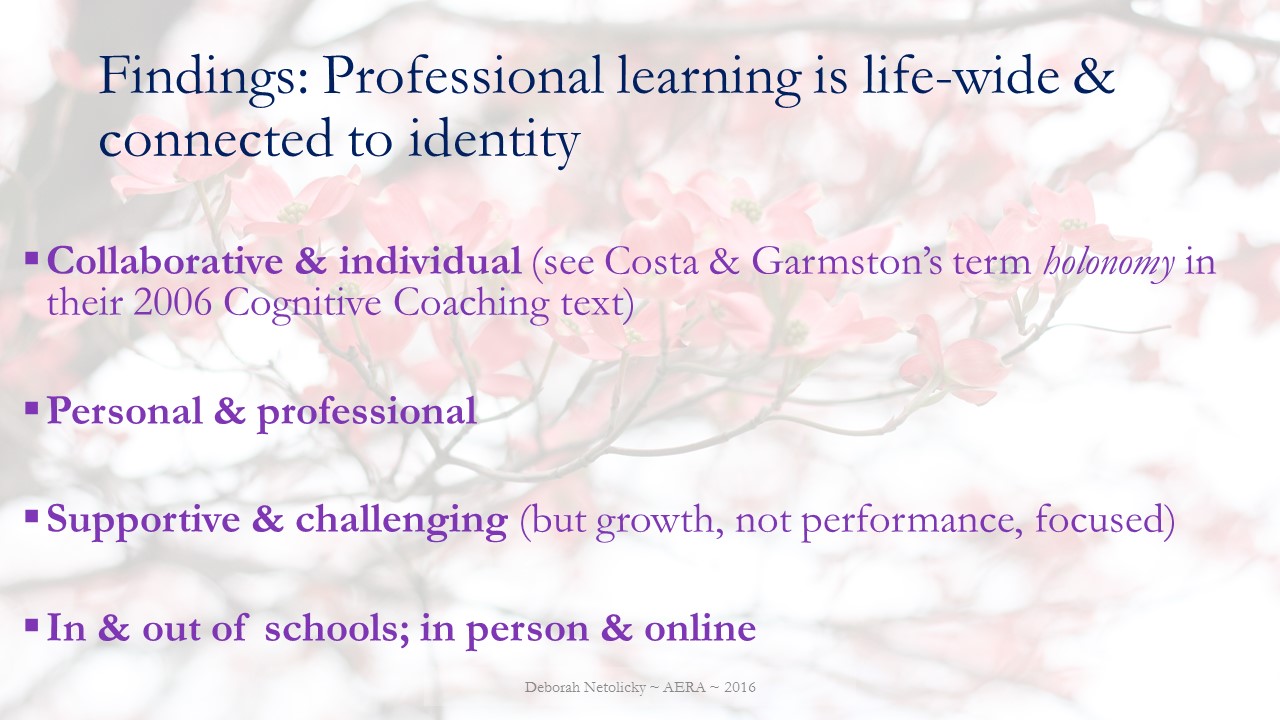
Yesterday I presented a paper in Washington DC at the American Educational Research Association national conference, in its 100th year. This particular paper outlines my PhD’s general findings around professional learning for teachers and school leaders. It was great that more than 50 people turned up to the session, in which four papers on professional learning, including mine, were presented. The papers were a complimentary combination that really spoke to each other; I learned a lot from my co-presenters. We had plenty of generous feedback and robust discussion which spilled out into the hallway for almost an hour after the session ended, and then beyond.

My full paper will be available in the online repository when the 2016 papers go live. In the meantime, here are copies of my presentation slides. The slides were designed for me to talk to, not read from, so much of the content is thin. That is, they’re light on text and light on references (see the paper for more depth), but you’ll get a sense of my main points. Of course I didn’t get through them all and ended up skipping over the participant quotes (19 slides in 12 minutes? What was I thinking? #overexcited #lessonlearned).

If you’re interested in more, my dissertation, which looks at professional learning in more depth, as well as its interactions with professional identity and school culture and change, can be downloaded here.

From my experience so far I can highly recommend the AERA national meeting. It’s a friendly conference with an impossibly wide range of interesting and important work being shared, and connections being made.

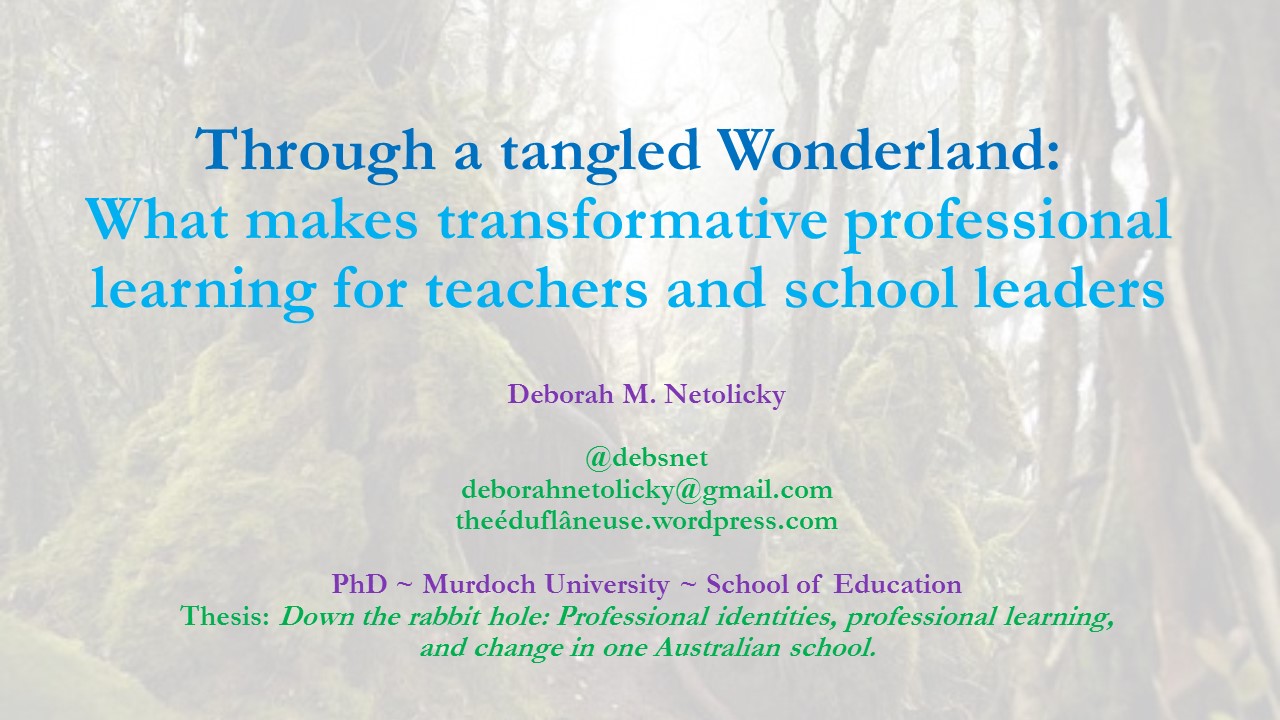
Slide1

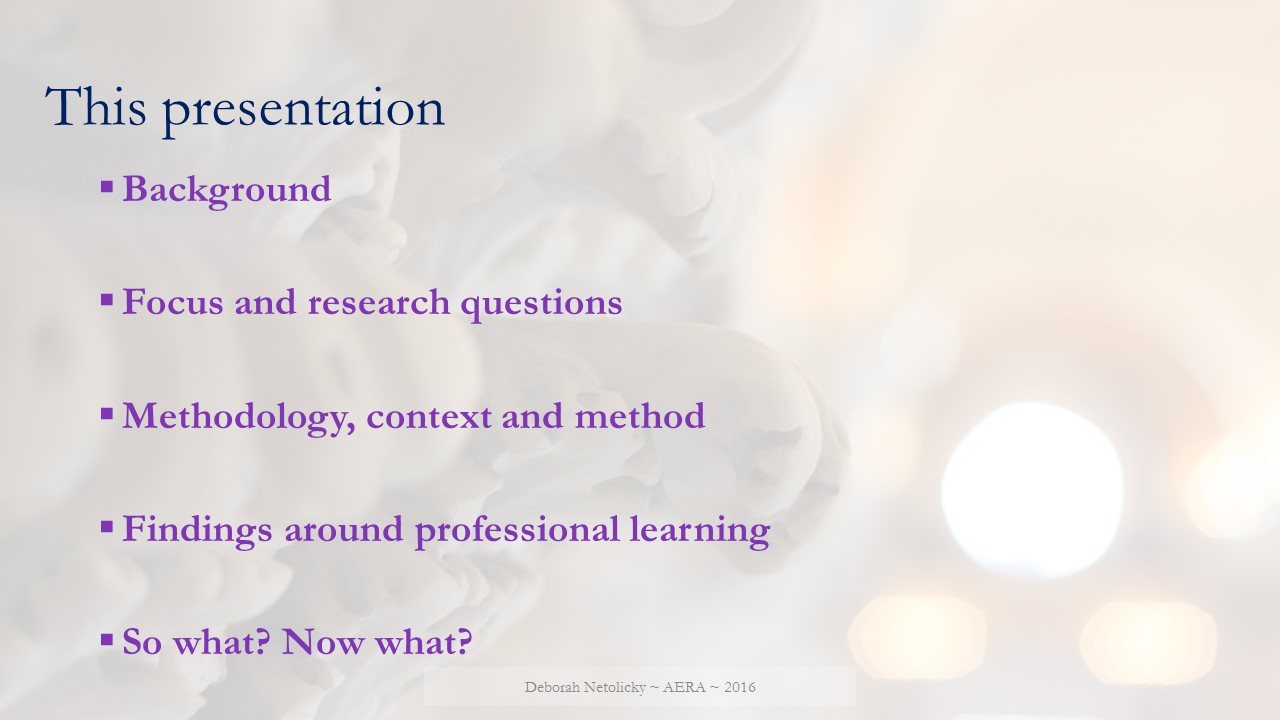
Slide2

Slide3

Slide4

Slide5

Slide6

Slide7

Slide8

Slide9

Slide10

Slide11

Slide12

Slide13

Slide14

Slide15

Slide16

Slide17

Slide18

Slide19