Who cares about pracademia?

Today I was part of an Educational Leadership Special Interest Group panel at the Australian Association of Education Research (AARE) 2021 conference, entitled, ‘Do we need pracademics?’ Fiona Longmuir was the moderator, and guest panellists were Scott Eacott, Virginia Moller, Dorothy Andrews and me.

The panel addressed questions such as:

  • Do we need pracademics?
  • Is labelling people ‘pracademics’ divisive and reductive, or full of productive possibility?
  • Do we care about pracademia?
  • To what extent might pracademia develop or dilute the rigour of scholarship and practice?
  • What role might pracademia play in the field of educational leadership specifically?

There was general agreement that the terms ‘pracademia’ and ‘pracademic’ require definitional clarity, and that a conversation about pracademia is worth having and worth continuing.

Scott challenged the motivations of those who might self-identify as pracademics, and suggested a focus on the inclusion of voices.

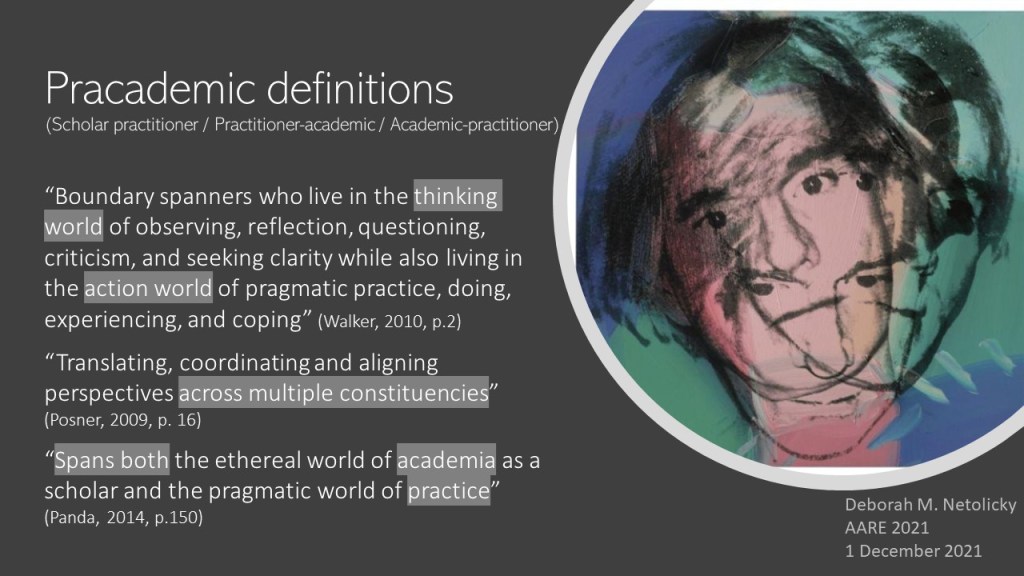
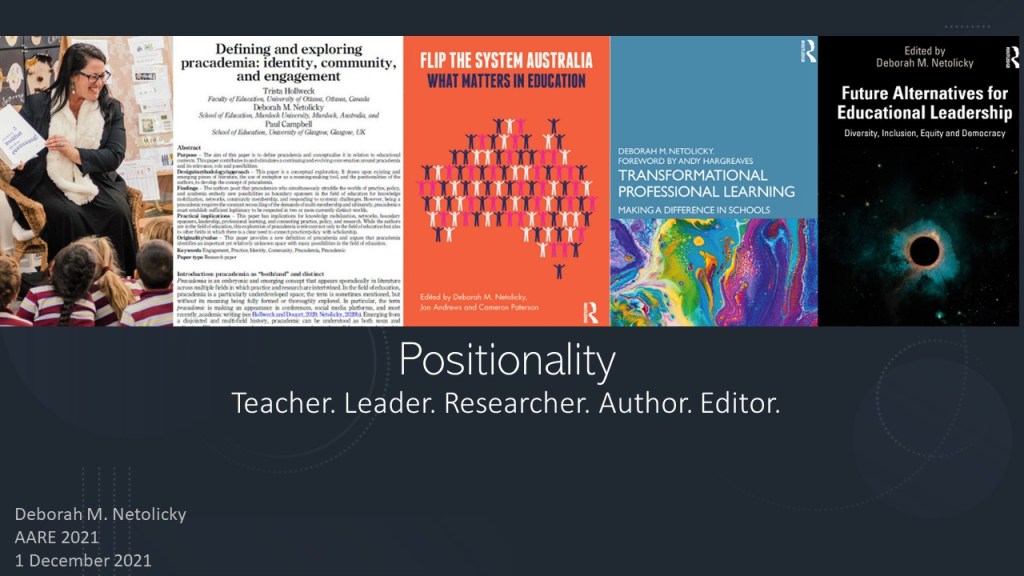
I explored the work I have done with Trista Hollweck and Paul Campbell (Hollweck et al., 2021, as our most thorough example) in defining and exploring the space of pracademia and the notion of an individual as a pracademic. For me, pracademia is about doing good work and about valuable networks and constructive collaboration between educators across and between education spaces.

Virginia described her role as ambiguous, complex and frowned upon, and explained that she was trying the identity of ‘pracademic’ on for size, to see if it fits. This notion of identity work, outsider-ness, and the nature of pracademic community is something I have heard from others who feel that their boundary spanning work is not valued or acknowledged in their professional contexts.

Dorothy challenged us to consider we needed to ‘just get over it’, and—as David Gurr suggested in the chat bar—do good work regardless of in what sphere someone works or what professional label is attached to them.

I asked the question about whether our systems and structures might be reimagined to allow for the valuing of work in multiple spaces.

Virginia and Scott discussed the notion of co-design between those in the academe and those in practice spaces. I mentioned the gap that Trista, Paul and I have noted around the need for policy to be explored more fully in the space of pracademia.

As in the other pracademia-focused conference panels and symposia of which I have been a part, the discussion was rich, energising, and resulted in calls from panellists and the audience for further exploration.

I will leave you with an excerpt from the final paragraph of our paper for the Journal of Professional Capacity and Community Special Issue (‘Pracademia: Exploring the possibilities, power and politics of boundary-spanners straddling the worlds of practice and scholarship’) we co-edited, that is mostly available via EarlyCite:

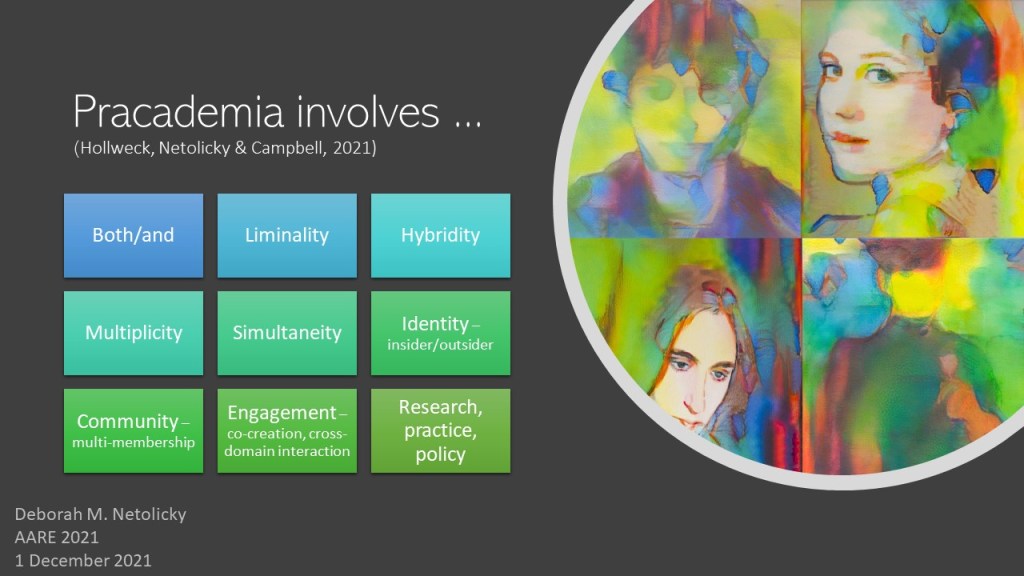
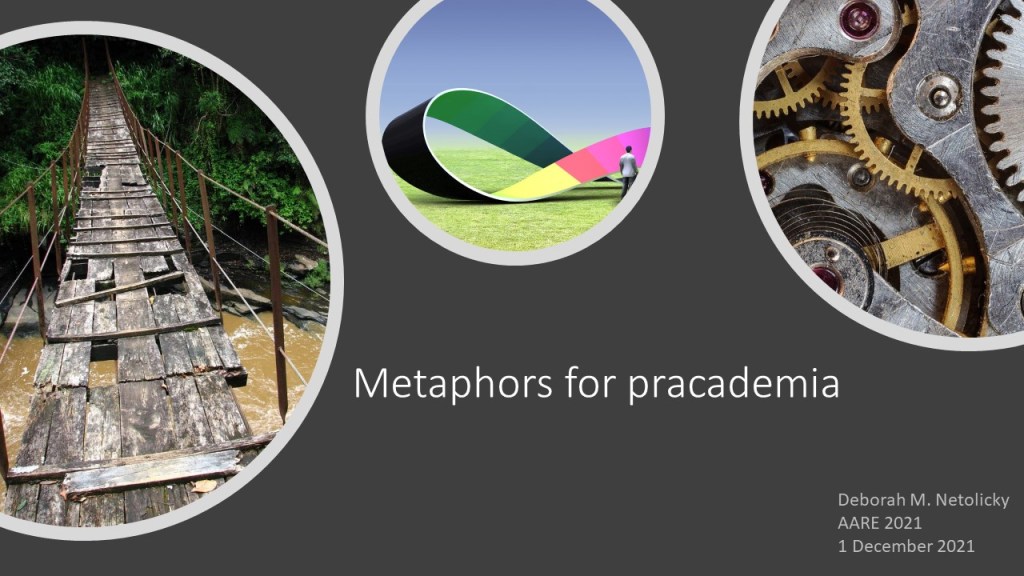
“The pandemic showed the possibilities of what collaboration between and working across multiple spaces in a field can accomplish. The concept of pracademia, and of working as a pracademic across and between spaces, suggests that we may be able to reimagine boundaries, fields, and roles in education and in other fields. For the work of pracademia to be sustainable, the space between practice and academia needs to be valued in terms of legitimacy, credibility, and even paid work. … Embracing the concept of pracademia may go some way to dissolving traditional dualisms of spaces that educators operate within, and increasingly across. It may be part of liquefying boundaries, so that rather than boundary spanning or boundary crossing, educators move back and forth along the Möbius-strip-style  continuum  comprising  the  multiplicities  of  research, practice, and policy. It may be engaging in multiple modes, spaces, and communities that open up learning, knowledge exchange, and mobilization of ideas and practices. It may be structural affordances from schools, universities, and policy bodies such as time, resources, avenues for recognition, and institutional support. For we authors, exploring and embedding ourselves in the identities and communities of pracademia is about making a positive difference in education; advocating for empowerment beyond the often-rigid structures, expectations and silos; and encouraging a valuing of alternate networks, contributions, and influences.” (Hollweck, Netolicky, & Campbell, 2021)

What do activism and power look like?

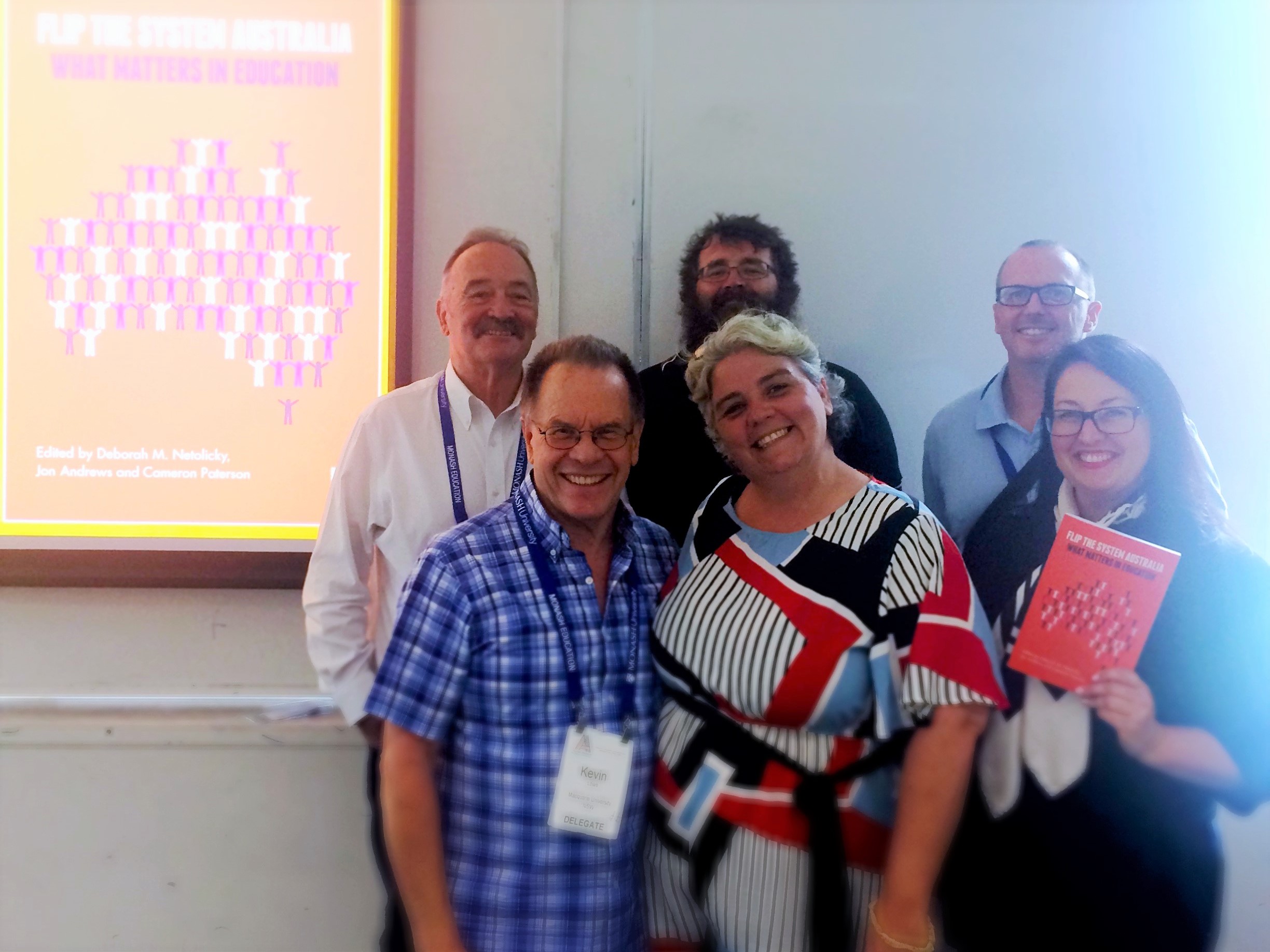
Title slide for our AARE 2018 symposium

I have been thinking about a question from the audience during the AARE symposium I chaired and presented in yesterday. The symposium abstract (below) outlined the notion of flipping the education system as a thread connecting the five papers presented.

The education system, in Australia and around the world, has governments and policymakers at its apex, making decisions disconnected from those at the nadir: teachers and students. Schools in this system are highly bureaucratic institutional settings, and teachers are increasingly undervalued, constrained and de-professionalised. The individuals and groups that wield influence on education policy and practice operate bureaucratically are physically removed from schools. They construct narrow measures of the success of schooling, and these impact on teacher agency. This education policy environment was evident in the recent Gonski 2.0 report with its focus on PISA, NAPLAN, and rhetoric of ‘cruising schools’ failing generations of Australians. A focus on numbers and rankings contribute to the disconnect between bureaucracy and the profession, and to the tension between education’s vision for equity and the realities of competition, marketisation and a culture of performativity.

This symposium shares perspectives around the notion of ‘flipping’ the education system in ways that embrace human aspects of education, wrestle with the criticality of the task of schooling at the margins, and engage with multiple voices in education, especially those often side-lined in education discourse and education policy. This collection of diverse papers together makes a compelling case for change in education policy and practice by tackling: elevating the professional identities and voices of teachers and school leaders; teachers’ perceptions of commercialisation in Australian schools; discourses that silence Indigenous voices in education; authentic engagement between teachers and Indigenous families and communities; and empowering educators to reclaim narratives of schooling.

During the symposium’s question time, an audience member suggested that if we were going to really ‘flip the system’ in education that there would need to be some sort of (Foucauldian) rupture, a traumatic breaking apart of the system in order to rebuild it. He told us that as presenters we were (too) measured and polite in our arguments, something he didn’t see as necessarily able to flip a system. Where was the rupturing, the eruption, the kapow of revolution?

I have wondered before about activism and the forms it takes. Who can be an activist? Is it only those with secure, late-career jobs? Can the early career teacher or researcher really challenge the system in which they work when that can put them at risk of unemployment or further precarity and uncertainty? Does an activist have to look, act and speak a certain way? Can an activist use the apparatuses of power in order to undermine that power, or does she need different tools?

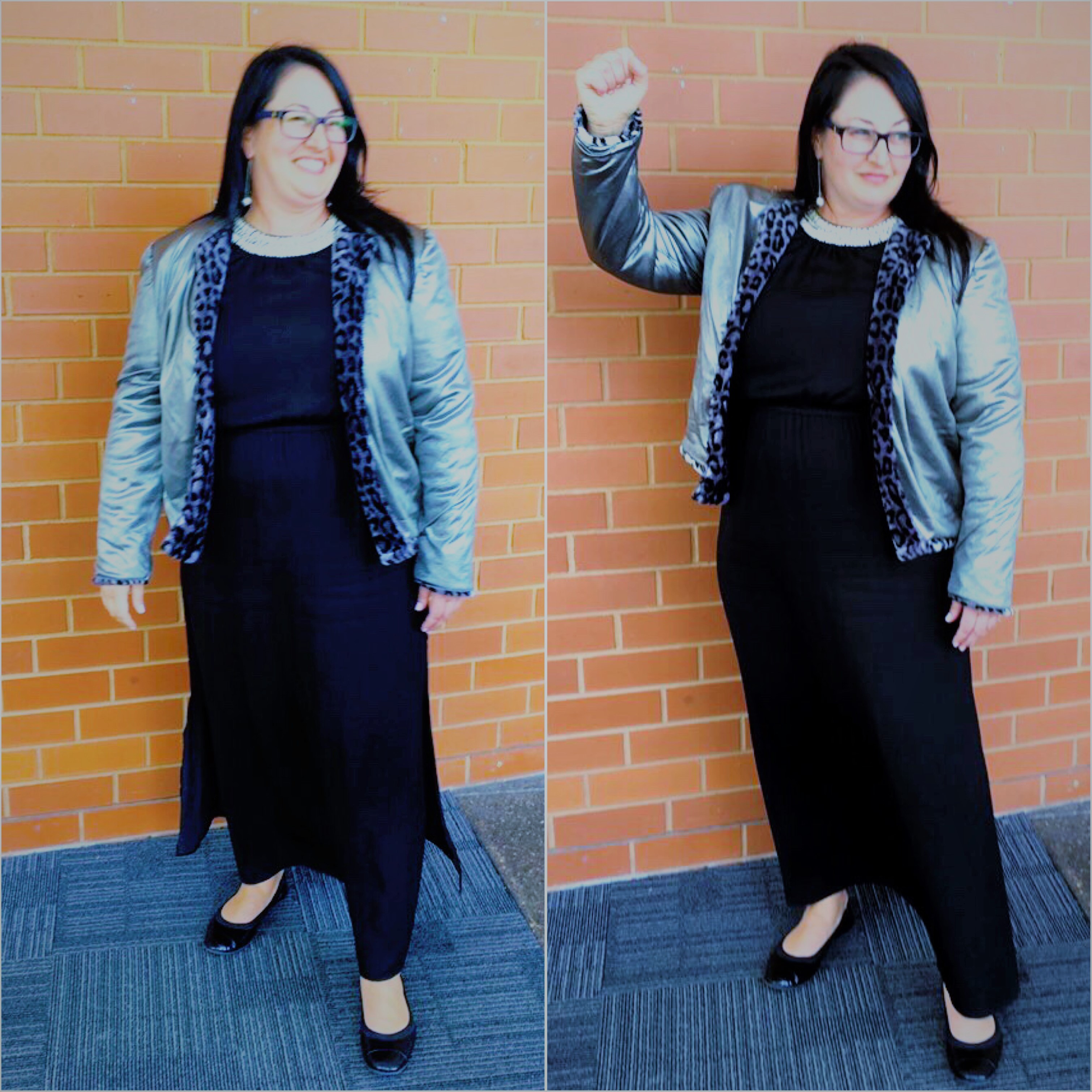
donning the FEAS power dressing blazer

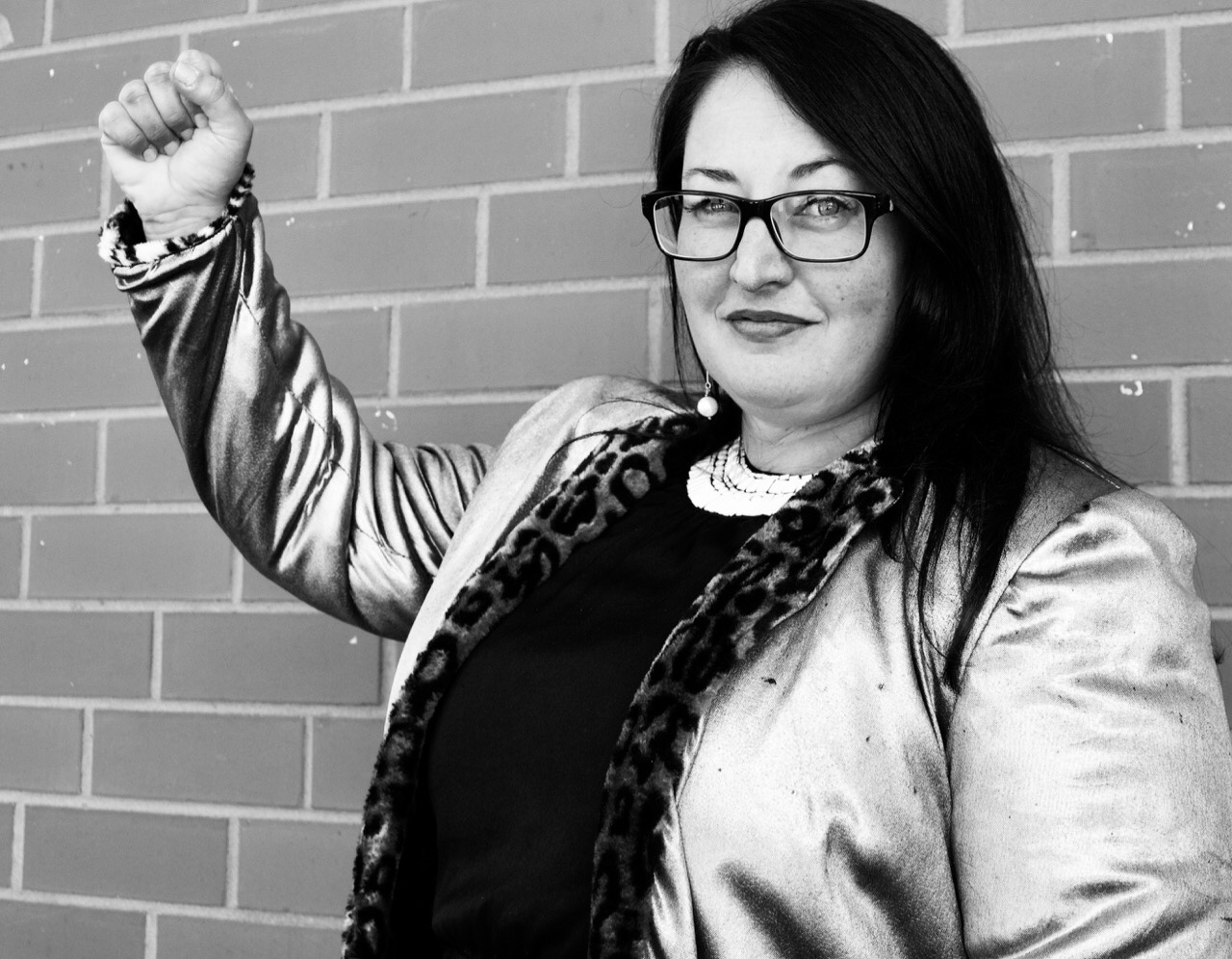
I also wonder what power looks like. This week at the AARE conference, I took part in the Feminist Educators Against Sexism (FEAS) power dressing project, which you can read more about here. Above are two photos a colleague took of me while I was wearing the FEAS symbolic power dressing blazer. In the first, I am laughing as I prepare for the photo, and in the second I am attempting a ‘power pose’. I like the first photo better. I love the symbolism and the gallery of images of the FEAS power dressing project, which show the range of ways women can appear powerful. What I am questioning here is my own discomfort with performing power in a way that might not be authentic. I wish I had worn my favourite red lipstick and laughed at the camera (although I did manage a sardonic raised eyebrow). Power doesn’t have to be a Rosie the Riveter bicep curl or a ferocious snarl. It doesn’t have to be loud, enraged or serious. It can be quiet, comfortable or joyful. Powerful women can and do smile, and enjoy the way they dress and the way they look, as well as their contributions to work and life.

my FEAS power dressing photo (credit: Linda Knight)

In the Flip the (education) System movement—explored in a variety of ways in yesterday’s symposium and in our new book Flip the System Australia: What Matters in Education—we believe that teaching, leading, researching and writing are political acts. In education, we are all activists. But activism does not have to be violent or deafening. Many of the arguments in the book and in yesterday’s symposium are measured and polite, as our audience member pointed out. Our intention is that a greater range of voices be invited to and heard at the decision making tables of bureaucracy and policymaking in education. In order to be invited in, we need to engage with system level decision makers in considered and convincing ways. We can do that with words and research, not just with placards and protests.

Our book chapters provide examples of resistance that is logical and beautifully articulated. In their chapter, Greg Thompson, David Rutkowski and Sam Sellar argue that international large scale assessments like PISA should not be dismissed. They have a place in the education landscape, but that teachers can be part of engaging with them in order to inform education systems. “Who,” the authors ask, “has better vantage point from which to shape the public debate about quality education than the educators who are constantly striving to deliver it in our schools?” (p. 62).

In her chapter, Rebecca Cody invites school leaders to abandon binary thinking that leads to schools embracing either performative accountabilities, or principles of holistic education. She argues that school leaders can and should ride both these ‘wild horses’ simultaneously.

Melitta Hogarth calls for Aboriginal and Torres Strait Islander peoples to “be more vocal and ‘stand on toes’”, to “unite in our concerns for our children’s futures, demanding a position at the table” (p. 113), but acknowledges the difficulties and complexities inherent in such a call.

These chapters reflect the point made by Nicole Mockler and Susan Groundwater-Smith in their new book, Questioning the language of improvement and reform in education: Reclaiming language, in which they suggest that it might not be fruitful to argue against concepts such as quality, standards and improvement, but that we can resist and reclaim the way these are used in education. We can focus on growth, collaboration, and professionalism, for instance, rather than using accountabilities as a stick with which to beat teachers and schools.

So, I have reflected on our audience member’s question about the need for a rupture in the system, in order to flip it, liquefy it, and democratise it. We speakers and writers are hyper aware that we are using the structures and language of the powerful in order to speak into this space. Book chapters written in fairly formal English and referencing academic texts could be seen to perpetuate the very system we are attempting to challenge. But we can work to change the system from the inside out.

Foucault, who was mentioned by our questioner, noted that there are occasional radical ruptures, but that more often there are smaller forces or moments of resistance. Those of us within the system can agitate in ways that are dramatic and fierce, but also be in ways that are eloquent and subtle. Revolution and power can come in the form of micro rebellions and the snowballing of a collective voice that is revolutionary in its strength in numbers, in its logic, and in its unwavering persistence to nudge the system towards positive change.

My AARE 2018 slides

Flip the System Australia AARE 2018 symposium

Flip the System Australia AARE 2018 symposium

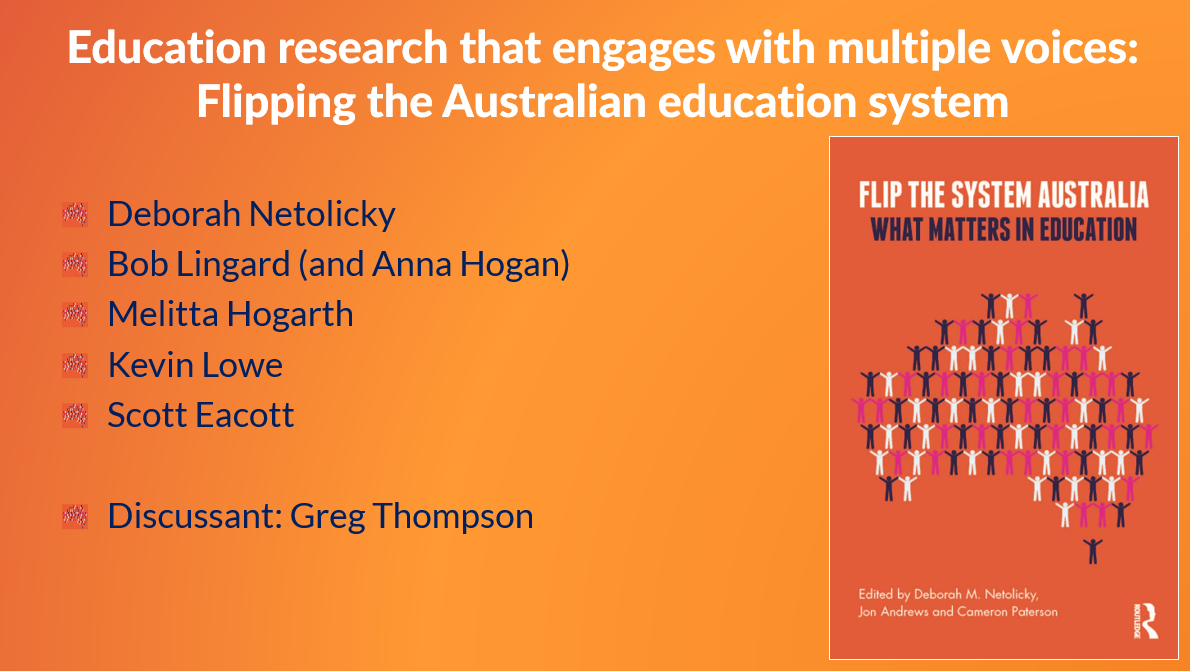
Today I chaired a symposium at the Australian Association for Research in Education (AARE) conference. The symposium was titled ‘Education research that engages with multiple voices: Flipping the Australian education system’. I presented alongside other authors from the just-published book Flip the System Australia: What Matters in Education: Dr Kevin Lowe, Dr Melitta Hogarth, Professor Bob Lingard, Associate Professor Greg Thompson, and Associate Professor Scott Eacott. You can get a sneak peek of our papers, which appear as chapters in the book, on Google Books.

Below I share the title, abstract, and slides from my presentation.

TITLE

Elevating the professional identities and voices of teachers and school leaders in educational research, practice, and policymaking

ABSTRACT

Flipping the system is not as simple as upending the current decision-making tower in education; it is about eking out, listening to, and elevating the voices of those on the ground in our schools.  Often the subjective voices and intricate identities of teachers and school leaders are absent, marginalised, or simplified in educational research, practice, and policymaking.

This paper analyses interview data from an empirical study of one Australian school in order to interrogate the nexus between teacher, school leadership, and school, from the perspective of those working in classrooms and schools.  It was crucial to include in this study those voices often at the nadir of the system: teachers and middle leaders who are frequently overlooked in school reform efforts.

The paper advocates for considering the identities, voices, and professional autonomy of teachers, and also considering the complex, unpredictable work of school leaders as they navigate fluid and multiple identities, and competing pressures.  It argues that the system has the potential to be an inclusive and collaborative crucible in which those working in schools are given platforms to speak, in which teacher and school leader experience and professionalism is trusted.

SLIDES

I used images of the kaleidoscope in my presentation, a metaphor for identity that I’ve explored in a previous blog post. The slides don’t tell the whole story of what I had to say, but they give a sense of it, and some people who attended have requested that I share them.

This slideshow requires JavaScript.


Voice and action on International Women’s Day

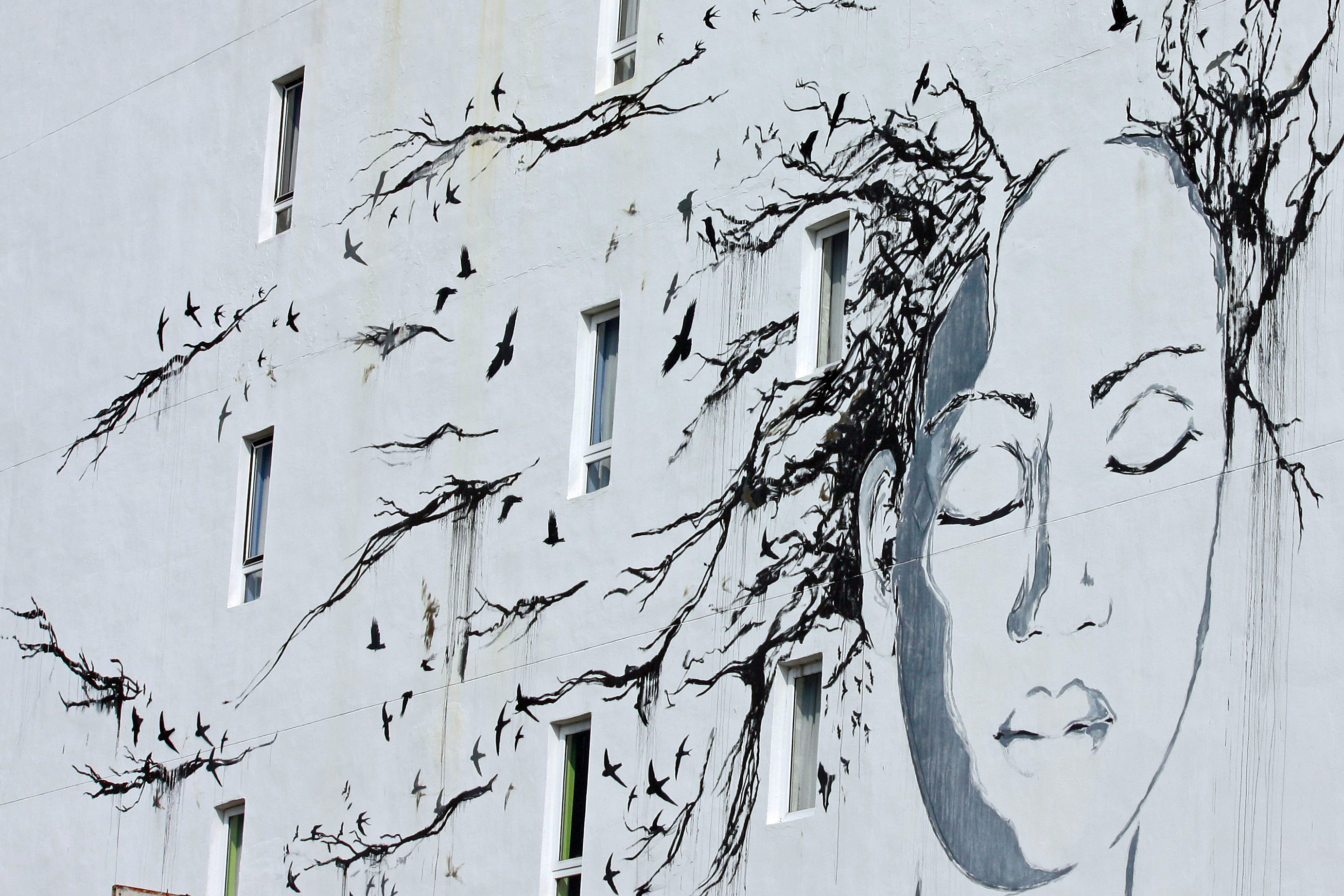
mural in George Town, Penang

Today is International Women’s Day. It is a day that is about raising mindfulness and action around parity, equality and inclusivity. In some ways, the world is changing. In the last week, a man in Belgium has been fined for a sexist comment towards a police officer. In October last year, Jacinda Ardern was appointed as the prime minister of New Zealand at the age of 37, making her the world’s youngest female head of government. Her first day in office, however, she was quizzed about whether she had plans to have children, and has since been the subject of plenty of opinion about her pregnancy, including during a 60 Minutes interview that focused on her pregnancy and her appearance, rather than her politics. Many have noted that male politicians would not be subjected to similar attention.

There remains gender disparity in leadership. Women currently account for 27% of ASX 200 board positions, up from the woeful 8% in 2009. In Australia, only one in four IT graduates and fewer than one in ten engineering graduates are women. In the education sector in Australia there remains a discrepancy between the amount of women in teaching versus the number of those in school leadership. 80% of primary teachers are female but only 57.5% of primary principals are female. 58.4% of secondary teachers are female, yet only 41.7% of secondary principals are female. Australia’s National Excellence in School Leadership Initiative has named 2018 the ‘Year of Women in Leadership’. They argue in their white paper that there are insufficient leadership opportunities for women, inadequate support mechanisms, and a paucity of role models for female teacher and students who aspire to leadership. I have reflected before about masculine models of leadership, in which the (often white) male leader (usually in a suit) is normalised as an image of ‘leader’, and what this tells people who are female, Indigenous, black, brown, or LGBQTI.

In her 2017 book, Women & Power: A Manifesto, Mary Beard writes that “we have no template for what a powerful woman looks like, except that she looks rather like a man.” In advocating for a world in which power can exist in diverse ways, she adds:

“You cannot easily fit women into a structure that is already coded as male; you have to change the structure. That means thinking about power differently. It means decoupling it from public prestige. It means thinking collaboratively, about the power of followers not just of leaders. It means, above all, thinking about power as an attribute or even a verb (‘to power’), not as a possession.”

Social media has been the vehicle for much of the global solidarity and activism surrounding issues of discrimination and inequity, and a way that some use to try and think about power differently. It can be a democratised platform where everyone can speak, regardless of power or position.

There are those who use humour to shine a spotlight on the absurdity of how the world can see women. The spoof Twitter account @manwhohasitall, for example, tweets out advice such as:

“MY DREAM: That one day boys will become anything they want to be – male chairwomen, gentleman drivers, men writers or boys who code”; and

“I am interviewing a famous working dad who manages to juggle 3 kids and work outside the home for a magazine. What should I ask him?”

There are more serious movements on social media, too, such as the #MeToo and #TimesUp hashtags, which build on the work that activist Tarana Burke began as a grassroots movement in 2006 as a way to help young marginalised women feel safe to speak up about sexual assault, in order to support survivors. After Alyssa Milano’s 2017 tweet using the hashtag #MeToo, the hashtag was used more than 12 million times, helping to de-stigmatise speaking up about assault. TIME magazine named its person of 2017 as ‘The Silence Breakers’ of the Me Too movement. Then, early this year, a number of high-profile people from Hollywood founded the #TimesUp movement to build momentum from #MeToo by confronting discrimination, harassment and pay parity across industries. On a recent Q&A ‘MeToo Special’ on the ABC, however, the panel showed no understanding of the history of the MeToo movement, despite being directly asked by an audience member:

“The #MeToo movement was initially created in 2006 by social activist Tarana Burke as a means to promote empowerment for women of colour experiencing sexual harassment. How can we ensure that this campaign is inclusive of all forms of diversity going forward?”

Host Virginia Trioli responded with, “It started, of course, as you say, correctly, Janet, as a very privileged white conversation. But it doesn’t mean that it has to stay that way.” She and the expert panel showed no knowledge that this was originally a grassroots movement in a black community, not a ‘privileged white conversation’. On the one hand, these movements can be seen as powerful attempts to rally the world to address issues of inequity, and bring attention (and hopefully action) to issues of discrimination and inequity. On the other, I wonder what these movements say about power in our world when the words of Tarana Burke, a black woman activist working in her local Alabama neighbourhoods, only become legitimised and amplified when appropriated by those who have power and platform. Pleasingly, there are actions emerging from social campaigns. TimesUp members have set up a legal defense fund to help victims of sexual assault that has raised over $21 million. They are advocating for legislation that penalises companies that tolerate persistent harassment and that discourages the use of nondisclosure agreements to silence victims.

Meanwhile, I have been working on the Australian Flip the System book with my co-Editors Jon Andrews and Cam Paterson, and thinking on inclusivity. The book is an Australian take on the theme explored in Flip the System: Changing Education from the Ground Up (Evers & Kneyber, 2016) and Flip the System UK: A Teachers’ Manifesto (Rycroft-Smith & Dutaut, 2018). Flipping the system is about subverting power hierarchies in the education system, and elevating the voice, agency and influence of those often ignored or marginalised by the system. This involves sharing teacher perspectives and Indigenous perspectives, for instance, alongside the academic voices of scholars. What we have found, however, is that elevating the voices of those at the nadir of the system is full of challenges. Often there are vulnerabilities or ethical tensions that deter individuals and groups from sharing their stories. Like those voices who have brought prominent social campaigns to the fore, it is those who have the most power, stability and security that often feel most free to speak. Those who have the most to lose, or who are in the most precarious circumstances, can be wary about speaking up or speaking out. I wonder about how much career stage and level of influence make a difference to the extent to which it is possible to disrupt the status quo.

Tarana Burke said in an interview with The Guardian that “having privilege isn’t bad, but it’s how you use it, and you have to use it in the service of other people.” Those of us with a privilege and a platform to be heard can ask ourselves: Who gets to speak? What voices are heard and what voices are ignored, drowned out, or silenced? How might we resist power structures, rather than perpetuating them? Are we participating in slacktivism, self-aggrandisement and self-congratulation, or are we taking positive action?

To ‘Press for Progress’ in issues of discrimination, opportunity and diversity, we can be mindful of those things that are normalised in our world in terms of who gets to speak, where power resides, and (when the social media storm melts away) what is actually getting done.

METAMORPHOSIS and emerging from the chrysalis: #oneword2018

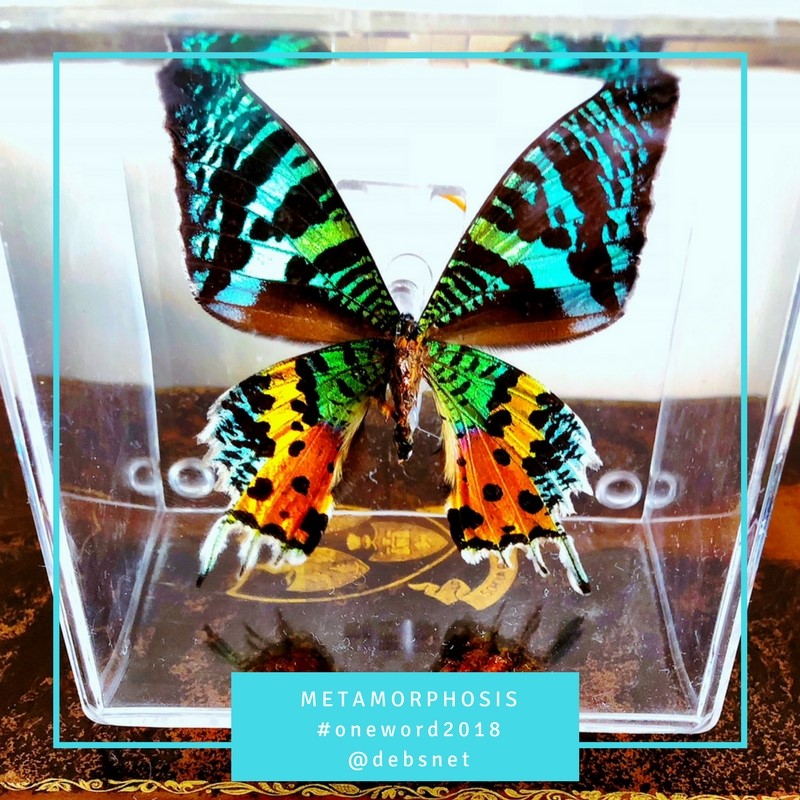
taxidermy butterfly left to me by my scientist grandfather

It’s that time of year when we’re recovering from the holiday season and gearing up, or regenerating, for the new year. It’s a time, often, of reflecting on the year that’s been and planning for the year ahead. For the last few years I have used a ‘oneword’ to clarify my intent for my year. While I sometimes forget the oneword intentionality I have set, especially when life is at its busiest or most pear-shaped, mostly I find that choosing a single word allows me to bring a mindfulness to my year that is based on an essential focus to which it is easy to return across a year.

In 2015 it was CONQUER, as I worked at a ruthless pace to submit my PhD in between parenting my two young children and working 0.8 at my school.

In 2016 it was MOMENTUM, as I tried to capitalise on my PhD through lots of presenting (including at AERA) and writing from my thesis, still in the spaces between life and work.

In 2017 it was NOURISH, as I worked to clarify my work and life by focusing on that which nourished me.

On 2017 …

In 2017 my oneword embodied itself in multiple aspects of my life. As my youngest child entered full-time school, I returned to full-time work that has been nourishing in its focus. That is, I’ve been grateful to spend my time in areas of passion and purpose: teacher professional learning, building a research culture, focusing on staff development, and leading the Library, as well as teaching English.

In 2017 I have said ‘yes’ to projects because they are nourishing experiences for me, or because I have been burning to say something. My formal 2017 publications, for example, have been:

I have also joined the Board at my children’s school, and become a member of Evidence for Learning’s Research Use and Evaluation Committee. These commitments are about contribution, giving back, and making a difference; through them I receive the nourishment that comes from doing something worthwhile.

In 2017 I have spent nourishing time with my family, including a couple of lovely holidays. I have been seeing a new personal trainer whose strength and conditioning sessions have meant that my regular three-day-long headaches seem to have disappeared. Working with him has meant looking after my body, paying more attention to it, and getting stronger.

To 2018 …

2018 is around the corner and I’ve been considering what might be my fundamental intention for a year that already feels like an ending before it has begun. The end of 2018 will mark 10 years since I returned to Australia from the UK. That decade is a time in which I have had my two children, from pregnancy to babies to primary school students. It’s the decade in which I completed my PhD. The end of 2018 will mark a full decade of working at my current school (well and truly my longest ever period of employment). And at the end of next year I will have a zero birthday. The years from 2009-2018 feel like a chrysalis from which I will emerge at the end of next year. (I’m no doubt influenced here by the book I’ve just finished: Stephen and Owen King’s 715-page novel Sleeping Beauties in which women around the world are falling asleep indefinitely and being cocooned in mysterious chrysalides.) This seems a perfect time for looking back and looking forward.

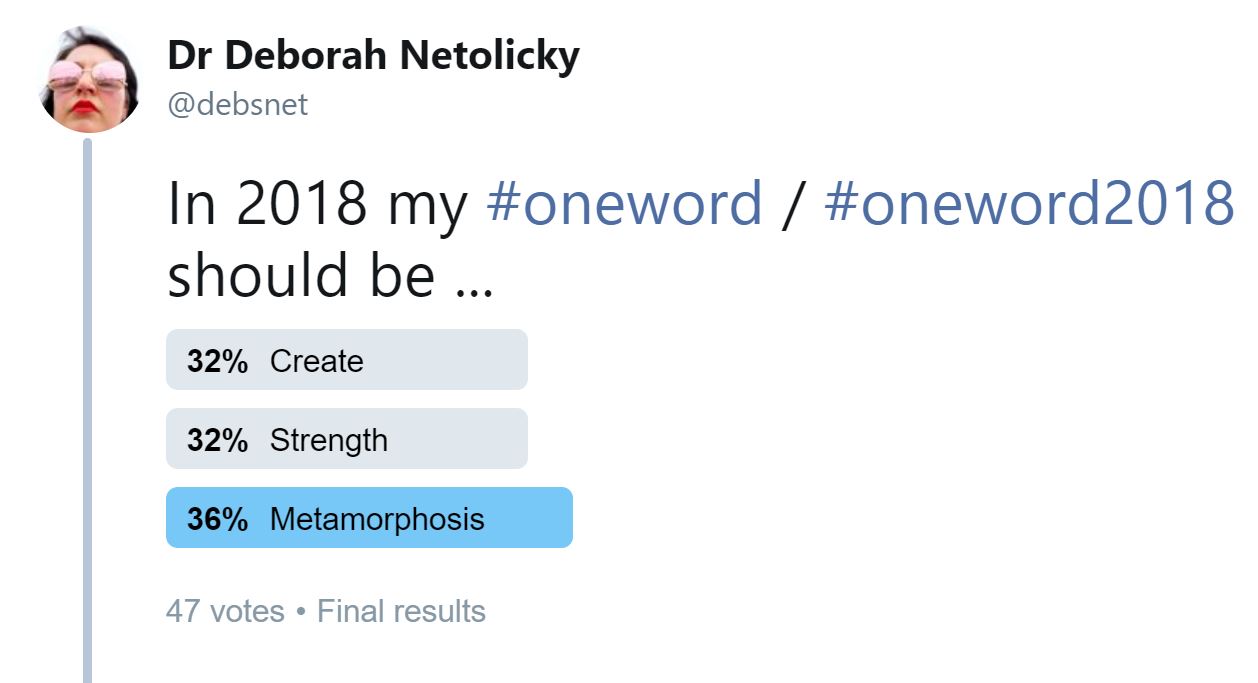
On Twitter it was a close race ….

For 2018 I have considered the word CREATE because I have some projects I’m keen to progress. I have considered STRENGTH because I would benefit from focusing on the strength of my body as well as the strength of my advocacy for others and perhaps for myself. But I am going to tackle a more complex and messy word this year: METAMORPHOSIS.

It’s not that I think 2018 will be filled with transformation. In fact, it’s more likely to be about consolidation and simplification (think Marie Kondo’s KonMari method applied to life, or perhaps Sarah Knight’s life-changing magic of … ahem … figuring out what not to worry about). METAMORPHOSIS isn’t just about change. It isn’t that I think I’ll grow proverbial wings in the space of a year. But it is about development and moving on to another stage. For me that stage is mid-teaching-career, post baby-having, post-PhD stage. It’s time to figure out what ‘mid’ and ‘post’ look like when they are my ‘now’.

METAMORPHOSIS is also about letting go. It is about shedding old skins, old bodies, old habits, old values, old dreams. It is about considering what I want to take into my next decade, and what I’m willing to leave behind. After a few packed but fragmented years, full of simultaneous, competing, overlapping commitments (teaching! school leadership! PhD! academic writing! presenting at conferences! pregnancies! parenting! moving house! all at the same time!), it’s about re-assessing how I am spending my time and considering where it might be that all my endeavour is leading me.

The questions I will ask in 2018 in order to be mindful of METAMORPHOSIS in 2018 are:

  • What might flight, freedom, joy, and purpose look like and feel like for me?
  • How might I imagine the next decade and what might I need to do to get there?
  • What do I want to focus on doing and what can I stop doing, or do less of, in order to fulfil that focus?

What does it mean to be a leader?

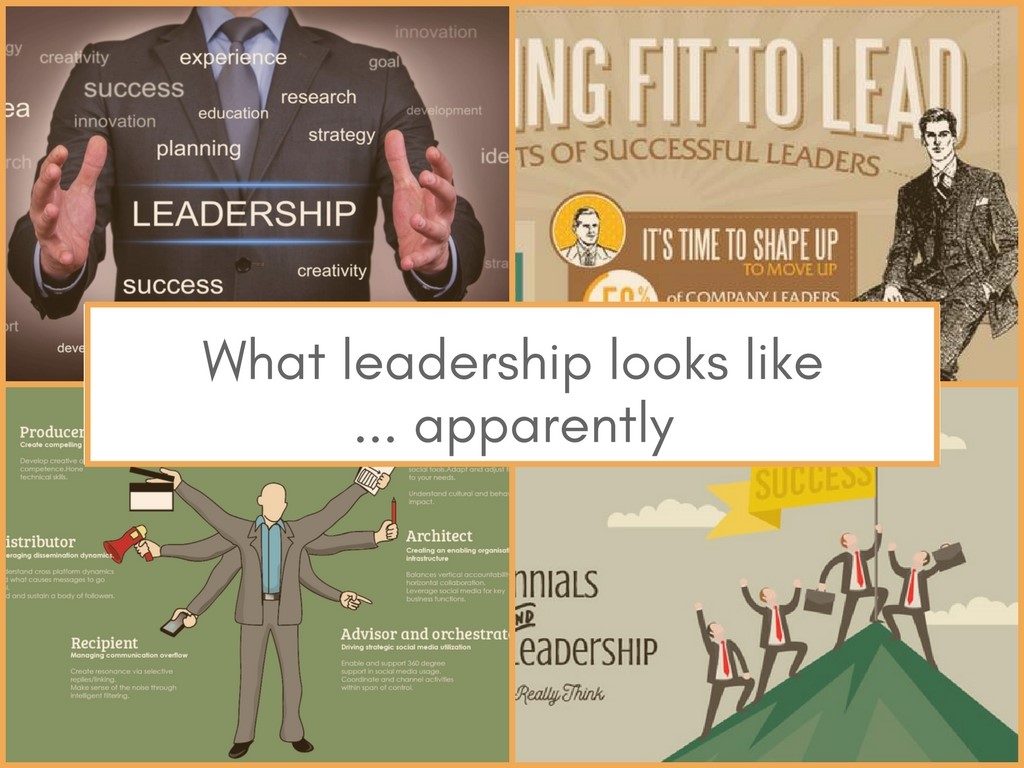
leadership according to the internet

One thing that drives me mad in my social media feeds are the images that accompany articles on leadership. Infographics about leaders often feature male suited figures. An Google image search for ‘leader’ results in swarms of male figures in front of a group or standing atop a mountain. This presents a very limited notion of what a leader is or to what leaders should aspire. The men photographed or illustrated for these images of leadership tend to be white and photogenic, and wearing suits or capes. Leader as man. Leader as hero. Leader as at the apex. Leader as forging ahead.

Some of the academic writing I’ve been doing around leadership, in the form of journal articles and book chapters, has me revisiting my thinking around leadership. I’ve written before about challenging traditional notions of what a leader is and what they do. I wonder how my own approach and journey might play a part in offering alternative narratives of leadership. How does my story allow others to imagine a leader who may not be out in front, or on top, or male, or in a suit, or wearing a cape? How might leaders or aspirant leaders give themselves permission to lead differently, or to aspire to images of leadership that are different: softer, more collaborative, less visible, more joyful?

This isn’t about being a woman or a man, but about everyone being able to access a continuum of ways of being and leading. Or perhaps it isn’t a continuum but a web of possibilities, connected but divergent.

I have always lived the educational cliché – doing my very best, striving for high achievement, immersing myself in lifelong learning. Many of the leaders in my PhD study said the same: not only had they drunk the Kool-Aid of education, but they also felt its essence down to their bones. Leading, teaching, and learning aren’t add-ons or aspirations, but ways of being based on deeply held beliefs.

I have been a school leader since my first principal took a chance on me by promoting me to a Head of Faculty position in my second year of teaching. I was 22 years of age. I was tasked with leading teachers who had been teaching for more years than I had been living. My approach then, similarly to my approach now, was around building trust and relationships as the foundation stones of leadership. As Bryk and Schneider (2002) assert, relational trust is the connective tissue that binds together individuals with the common mission of advancing the education and welfare of students.

Now, my leadership style is based in an understanding of leadership literature, valuing of relationships, belief in the capacities of those I lead, and willingness to listen equally to enthusiastic perspectives and dissenting voices. My PhD and current role mean that I am a practitioner committed to I research-informed and data-rich practice. I also, however, place great value in practitioner experience, the wisdom of professional practice, and the capacity of those with whom I work, to grow, improve, and serve their students and communities.

My approach to school and cultural change is ‘go slow to go fast’. Deliberate, collaborative change coaxes buy-in and ownership from stakeholders. It involves creating a shared need, designing a shared vision, and then energising, mobilising, and building the capacities and motivations of others to propel change. This kind of leadership isn’t about me, but about how to fire holonomy (Costa & Garmston, 2015): the nuanced interactions between ‘me’ and ‘we’, individual and organisation, cog and machine. As Andy Hargreaves and Michael Fullan (2012) point out, the group is more powerful than the individual in school and system change.

The reason that I continue to blog, to edit and contribute to books, to act as a peer reviewer for journal articles, to engage at conferences and online, is because I want to be part of shaping narratives of education and leadership. It is my hope that through sharing my voice I can be part of offering alternatives and providing solutions.

I have had two children along the way, and have navigated my way through the decision-making that comes with finding ways to be a good parent, a good spouse, and to do work that I think makes a difference in the world. As a leader I am mindful of the example I set for others in the decisions I make around work, family, and wellbeing.

As a leader, I don’t aspire to embody the hero, perform the all-knowing problem-fixer, or forge ahead with innovation at a rate of knots. I aim to be my authentic self and work to empower and elevate others in what Andy Hargreaves, Alan Boyle, and Alma Harris (2014) call ‘uplifting leadership’. Sometimes leading means holding the line or being calm in the eye of a storm. It often means giving others what they need based simultaneously on a balcony view of the macro picture, and an intimate understanding of the individual.

References

Bryk, A., & Schneider, B. (2002). Trust in schools: A core resource for improvement. Russell Sage Foundation.

Costa, A. L., & Garmston, R. J. (2015). Cognitive Coaching: Developing self-directed leaders and learners. Hawker Brownlow Education.

Hargreaves, A., Boyle, A., & Harris, A. (2014). Uplifting leadership: How organisations, teams, and communities raise performance. John Wiley & Sons.

Hargreaves, A., & Fullan, M. (2012). Professional capital: Transforming teaching in every school. Teachers College Press.

Metaphors for digital spaces: Considering Westworld

the Westworld landscape (source: scifi.stackexchange.com)

You really do make a terrible human being. And I mean that as a compliment. ~ Maeve, Westworld

The Western genre involves representations of the powerful and the powerless, the heard and the voiceless, the abusers and the abused. In the romanticised landscape of the Western, heroes (usually white and male) overcome the challenges of the frontierland. Historical brutalities are often overlooked in favour of myth and legend; the Wild West is one of imagination rather than reality.

In an open access, peer-reviewed paper published this month, Cyborgs, desiring-machines, bodies without organs, and Westworld: Interrogating academic writing and
scholarly identity, I use the HBO television series Westworld as a lens for exploring academic identity and writing. The Westworld setting is a theme park, called Westworld, a kind of real virtual reality that the very rich can frequent on their vacations, for a hefty fee. The theme park recreates the idealistic American desert frontier, full of sweeping vistas, damsels, brothels, gun-slinging bad guys, and cowboy heroes. It drags the Western genre and setting out of the archives, dusts it off, and breathes new life into it by marrying it with science fiction. Like much speculative fiction, it takes our current world and presses a hypothetiocal fast forward: What if technology evolves to a point where we can bring multi-player computer games to life in theme parks populated with robots that appear and act human?

The Westworld universe is one that brings together the Western genre—its hopes and its atrocities—with technology. The guests to the Westworld park aspire to play a part in this world as hero or villain. (In the show we mainly follow the arc of male guests, so it is their desires we see pursued and borne out.) The hosts of the theme park are cyborgs who follow narrative loops designed to allow guests to act out their darkest fantasies without guilt or consequence.

A recent blog post by Benjamin Doxtdator has me thinking more about the notion of the digital frontier, and about how we envisage ourselves in digital spaces. In his post, Benjamin explored the metaphor of the internet as a frontier-style landscape that can be mastered or explored. He argues that this is an unhelpful and even dangerous metaphor. He proposes the lens of surveillance capitalism as an alternative; here I imagine Foucauldian panopticism, the telescreens of Orwell’s 1984, and the Eyes of Atwood’s The Handmaid’s Tale.

Benjamin’s post got me thinking about what we might glean from considering the Westworld world as a metaphor for digital space, and the human characters as representations of how people and organisations interact with that space. The park’s creators manipulate the landscape and the cyborg characters in order to engage, entertain, and satisfy their guests, while the guests treat the park with egomaniacal entitlement. Some guests pursue exciting story arcs for themselves, while others leave their morals at the door as they live out depraved fantasies of violence and abuse.

The show presents the cyborg characters as more human than the humans, perhaps encouraging us to question our relationship with technology and its dehumanising influence. It also asks us to consider the ways in which we feel free to interact with digital spaces where we feel we can be either free from our non-digital selves, or to enact alternate identities online. Westworld, viewed this way, presents us with a humanity with which we don’t want to associate and provides a warning to its audience about the dangers of interacting unethically and unthinkingly with technologies.

Meanwhile the cyborg characters, with whom we are encouraged to empathise, are awakening and beginning to rise up against those who oppress and violate them. The show lays bare inequities and power imbalances in technological arenas. It presents a critique of the powerful puppet masters and privileged users of tech, questioning what people do with their privilege and with technology when there are no checks and balances. Westworld‘s artificial frontierland encourages us to reconsider what we might do in digital spaces, and to what ends.

In Westworld it is the cyborgs, the underdogs and the underclass, who provide us with potential for resistance and who begin to question their world. We are constantly, however, reminded of the ways in which the cyborgs are created, controlled, and sometimes cast aside by those who run the Westworld world.

At a time when I am working on a framework for digital pedagogy at my school, I am reflecting on the notion of metaphor. I agree with Benjamin Doxtdator that conceptualising technology as a playground is dangerous. How do we want our children and students to see and interact with the world of technology? In a world of big data, cyber attacks, and alternative facts, perhaps it is with a combination of enthusiasm, caution, fear, confidence and criticality.

Stitching the shadows: Writing & social media

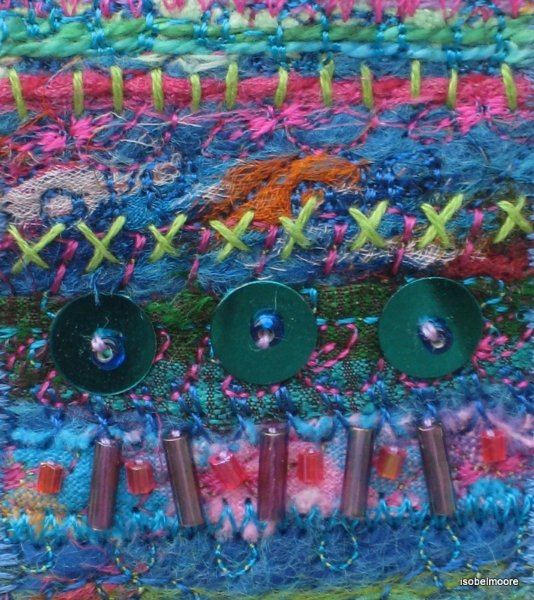
textile detail by Isobel Moore http://www.threadnoodle.co.uk/

textile detail by Isobel Moore http://www.threadnoodle.co.uk/

This blog post is part of a blogversation. It responds to two blogs, both of which came to my attention via my Twitter feed. This one on qualitative research methods by Naomi Barnes, and this one on tracing the social media interchange that followed, by Ian Guest. This is not the first time I have jumped into a blogversation unannounced and univited. The first time was when Helen Kara challenged Naomi Barnes to the #blimage challenge, after I had first challenged Helen to the same. The post I wrote, in response to Helen’s photograph of spider webs in her garden, echoes the themes of this post – the power and messiness of connectivity on social media. Another of Naomi’s posts had me thinking about diffraction.

The great thing about social media is that by engaging we situate ourselves within a public conversation. It’s when people jump in—to ask a question, make a comment, respectfully challenge, add their lived experience, share their perspective—that dialogue is enriched and we influence each other, across time, space and devices.

In Naomi’s recent post she articulates some ways of thinking that are close to my heart and my keyboard: blogging as inquiry and using metaphors as a method of sense-making. As many of you would know, I used Alice’s Adventures in Wonderland as a literary metaphor through which I viewed and re-constructed my PhD data. Metaphors, as any reader of this blog will recognise, are one way that I make sense of the world. Metaphors also emerged from the stories of the participants of my PhD as they worked to make sense of their selves and worlds.

As une édu flâneuse I was taken with Naomi’s notion of the ‘concept flâneur’. The flâneur, or its feminine alternative the flâneuse, is the attentive observer, the attuned wanderer, a scholar of the world and a chameleonic surveyor of the crowd. The ‘concept flâneur’ reminds me of my own use of bricolage in my PhD that I describe here as rethinking well-worn traditions and stitching them back together in new form. But flânerie is about more than stitching together. It is about rapt observation and devoted contemplation, about deep understanding and applying scholarly thinking. The theoretical flâneur is the insider-outsider, at once looking in and immersed within.

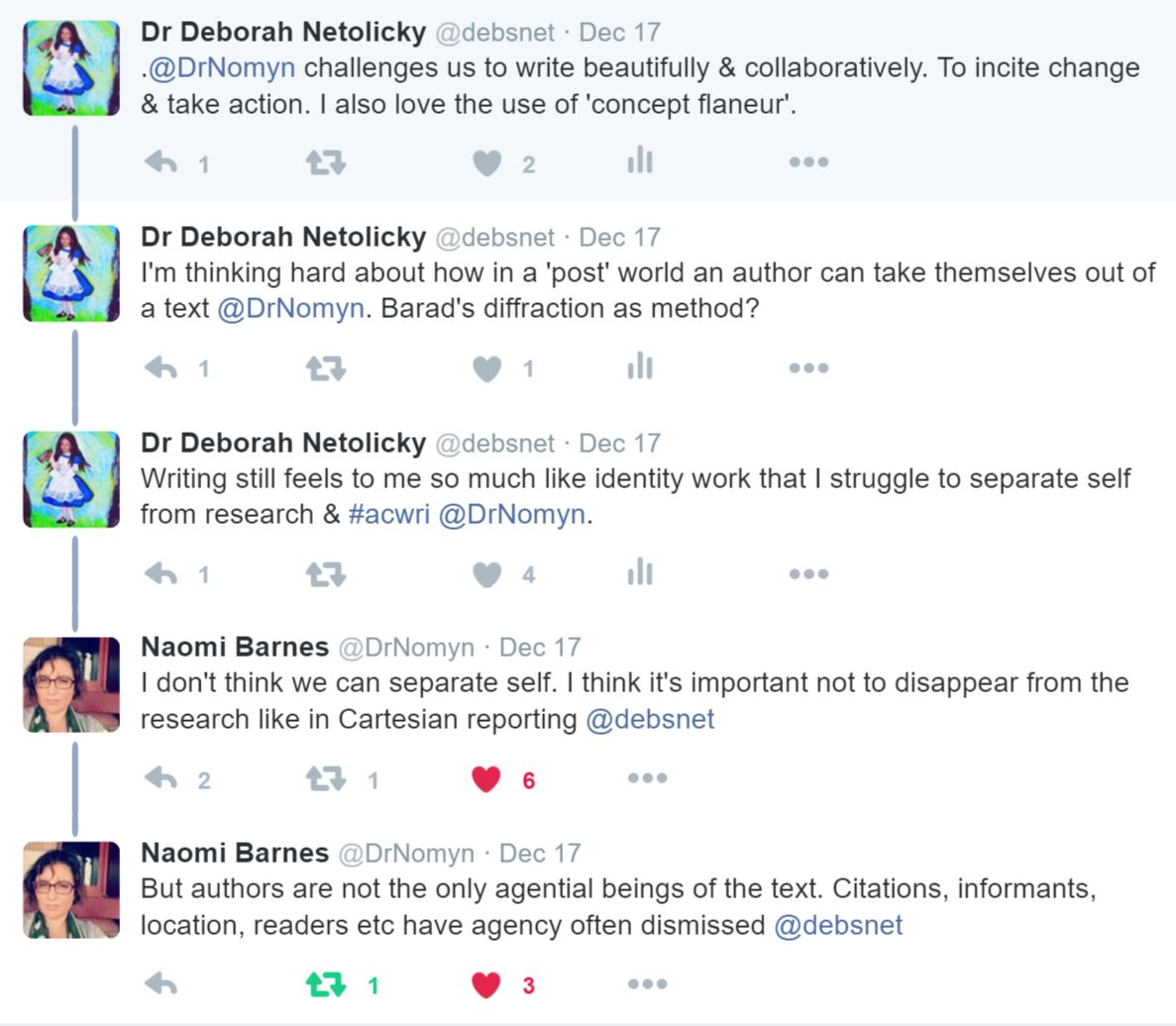
The part of Naomi’s post that challenged me the most was when she stated that qualitative research has stagnated as “the author has become central in the writing. It becomes about writing, rather than the research and the need for change.” It led me to a Twitter exchange in which I explored my own uncertainty around the self in research and the author’s place in writing.

a Twitter exchange resulting from Naomi Barnes' blog post

a Twitter exchange resulting from Naomi Barnes’ blog post

In keeping with Naomi’s metaphor of the sutured-together monster body, I see these kinds of social media interactions as textile. I have written before about textiles as a metaphor for subversion and political activism. We stitch onto shared fabric, adding perspectives, colour, texture, visual elements to a work. Our hands and minds shape the work (our thinking work, our writing work, our collaborative dialogue work), as it shapes us. Needles prick and rub callouses into fingers. We cramp. We struggle with the material. We can be proud of our contribution, working together like a quilting circle on the collaborative work of seeking to understand and to theorise.

Ian, in his post that responds to Naomi’s post, points out the non-linear, messy ways that exchanges happen on Twitter, despite their appearance in the feed as linear threads. I’ve written before about the butterfly effects of Twitter conversations, their serendipitous, surprising and subtly influential moments. Their powerful, unforeseen circumstances.

Ian wonders about the silences and the blurred boundaries between people and thoughts. I agree that it is in the silences, the shadows, the fissures, the dark cracks, of exchanges and of our own thinking, that we are most in a state of becoming and therefore potential change. It’s in the dark and vulnerable spaces that we learn. Blogging can be a bit like this: an exposure, a laying bare, a stripping down.

Ian mentions in his post that he shared a blog post via email despite sitting right next to his colleague; they collaborated via technology despite being in the same room. This reflects the evolving relationship that Naomi and I share. We have begun a co-authorly relationship, via digital tools. Word to word, screen to screen, device to device. When we met in person for the first time recently, we didn’t discuss our writing projects specifically. We saved our writerly collaborations for online spaces: email, Google docs, Twitter. In our fledgling collaboration, for me the digital sphere feels simultaneously a bit sacred and a draft-notebook-type place for working out. We show our workings to each other via our thinking-out-loud digital musings.

The wonderful thing about blogging, tweeting, emailing, writing and reading as inquiry is the acceptance, and even celebration, that it is all unformed. There are moments of awkwardness, uncertainty, openness, weakness, resistance, emotion. It’s all laid bare on screen, and open to tangled-threaded multi-webbed interchanges that have us emerging from the knotted labyrinthine tangles as from a chrysalis, declaring “here I am” so that we can be challenged and changed again.

On the emotional, human dimension of teaching

A world map for World Teachers’ Day (photo by me)

On today, World Teachers’ Day*, I‘m going to reflect on my experience of teachers as a school student. I’ve written about what research indicates about ‘good teaching’, but this post shares my personal story of the teachers I remember, and how they shaped me as a teacher.

Growing up, but especially during high school, I didn’t want to be a teacher. I think partly this was because of my dislike for those in authority who saw their role as to uphold what I saw as petty rules. While on the one hand I was a geek who diligently completed my school work and strove for academic success, I did not want to fit into norms set by others. I skipped some classes. I didn’t see the point in wearing the school uniform, unless it was to shackle me to conformity as part of a homogenous group. One year in high school I called the State Education Department and checked their rules on wearing uniform, and then asked that they contact my school to explain that uniform was not legally enforceable. It turned out that the only enforceable guideline at the time was that students in government schools be neat and tidy in appearance. (Yes, I was that student.)

In Year 8, my English teacher insisted that I rewrite a creative story entitled ‘Stop, thief!’ Although I had worked hard and long to craft the story, she told me that a thief should not be good looking with a “chiseled jaw,” and that I was to rewrite him as ugly with a hooked nose and hunched back if I wanted to pass. This felt to me to be an unjust response, one that not only supported what I considered to be an unrealistic and one-dimensional stereotype, but one which failed to acknowledge my effort and deliberate authorial decisions. I wanted my villain to be good looking!

In Year 10, after approaching a teacher to transfer into his higher Mathematics class, I did not pursue the subject change after he told me he wouldn’t speak to me unless I tucked my shirt in.

These experiences contributed to my view of the identity of ‘teacher’ as authority figure and stickler for petty rules, an identity I had no desire to emulate.

After deciding eventually, and almost accidentally, to pursue teaching as a profession, my “I don’t want to be a teacher” sentiment morphed into “I never want to be a teacher like that but I do want to be this kind of teacher.”  As a teacher I am often an advocator for looser rules (such as encouraging mobile technology in class, rather than banning mobile devices) and am guilty of ignoring those rules which I think are there for control and assertion of authority, rather than for learning and developing students into self-regulating, autonomous, responsible, thinking individuals.

At school I connected with teachers who I thought cared about me and my learning, who gave me some scope to try alternative methods and pathways of learning, and who did unexpected things: the Literature teacher who helped the class read a difficult novel by providing coffee and breakfast while we listened to the audio book; the Mathematics teacher who differentiated to allow her students to feel success; the English teacher who would surprise the class by wearing elements of costume while enacting scenes from texts. 

I try to emulate these things in my own teaching, thinking of little ways to surprise and inspire. I began one lesson while standing on a chair, conducting with a pair of drumsticks I had confiscated. I take students to the river or the high street to write. I surprised a very serious class of International Baccalaureate Diploma students, with whom I had been doing difficult laborious text analysis work, by providing them with textas, pencils, reams of paper, and chocolate biscuits (Arnott’s Tim Tams and Mint Slices for my Australian readers). At the end of all our hard work trying to understand 800-plus page Anna Karenina, they were to spend a couple of hours creating a visual representation of the novel. The result was a thoughtful and inspired creation, a train driven by Tolstoy, in which each carriage visually represented a key moment in the novel, with a lit candle at the front of the train and a burnt-out candle at its end, representing Anna’s journey.

A later experience, as a postgraduate student in a class during my Graduate Diploma of Education, supported and developed these earlier experiences of the emotional dimension of being a student and of the impact of teachers and classrooms on student confidence. There I was, in a class of mature age Graduate Diploma of Education students. I was the youngest, at 20 years old, and the oldest among us was 62. We were asked to share our memories of the best and then the worst teacher we had ever had. What I noticed as my fellow students, themselves almost-teachers, responded to this question, was the emotions they seemed to experience as they recalled their memories of teachers who either inspired and encouraged them, or who made them feel small, exposed, and uncared about. I was reminded of the famous quotation, attributed to a number of people including Carl Buehner and Maya Angelou: “People will forget what you said, people will forget what you did, but people will never forget how you made them feel.”

It occurred to me during that Grad. Dip. Ed. class that the impact of a teacher, and their behaviour, on a student, each student, can be powerful and lifelong. That what for the teacher may be a throwaway line on a bad day, may for the student be a criticism which cuts deep and lasts a lifetime. It reminded me of the vulnerability of students and the turbulence of finding a sense of self throughout childhood and adolescence. This led me to continually reflect upon the effect I am having on students, my building of relationships, and my self-monitoring of things which may be seen by students as hurtful.

So while I often take an intellectual approach to teaching, looking to evidence, research and impacts, I think we also need to remember and recognise the deeply emotional, human experience of being both student and teacher. Happy World Teachers’ Day!

* World Teachers’ Day is held internationally on 5 October, but as this usually falls in the Australian school holidays, Australia celebrates it on the last Friday of October.

Reflecting on my PhD graduation ceremony

my Tudor bonnet and graduation shoes

my Tudor bonnet and graduation shoes

My Tudor bonnet brings all the cred to the yard

At my PhD I worked so hard

Wherever I lay my hat that’s my home

Its soft black velvet quells imposter syndrome

The PhD is seemingly never ending. Its end is emotional. Completion and post-PhDness is identity-bendingly confusing. And in Australia, with no viva or oral defense, there’s no clear end to the PhD. No full stop. Certainly no celebratory exclamation mark. I’ve reflected that my PhD ended with a whimper, not a bang.

So, while I have tended to avoid graduation in the past (only thus far attending my Grad. Dip. Ed. ceremony because my mum was graduating from her PhD that same night), the messiness of post-PhD identity wrangling, combined with an inner desire for a rite of passage or moment of celebration, drew me to attending my PhD graduation ceremony. While I have enjoyed some other milestones – submitting the finished thesis, having thesis amendments signed off, having the published thesis book in my hands, being conferred with the doctorate and getting the doctor title – a university graduation ceremony seemed to offer the acknowledgement and closure I felt I was missing. It was the last PhD milestone. The final carved stone obelisk at the end of one road and the beginning of another.

How I felt attending my graduation ceremony, 5 months after conferment of my degree

how I felt attending my graduation ceremony (5 months after conferment of my degree)

Graduation didn’t disappoint.

It was a great reason to design and purchase some graduation shoes, but also to procure a Tudor bonnet, age-old symbol of the doctorate. With its stiff round brim, silken tassels and floppy (impossibly-soft!) velvet top, this hat is at once unflattering, medievally ridiculous, and a long-standing symbol of scholarship. The red satin facings on the front and sleeves of the academic gown (which is burgundy at my university), and the accompanying Cambridge hood, represent the doctoral degree. Altogether it is quite the ensemble.

It was a lovely ceremony that allowed PhD graduates to feel acknowledged and respected for their achievements. We processed in past the seated audience, leading in the academic faculty procession, and were the first of the night to receive our degrees. Each of us was introduced, with our name and a blurb about our thesis (its title and description), at which point we walked across the stage to be personally congratulated by the Chancellor and to receive our degree. We were then invited up onto the stage to sit behind the Chancellor, professors and other academic faculty, a gesture welcoming doctoral graduates into the community of scholars.

Graduation was a wonderful opportunity to bring together some of the people who had been supportive during the PhD. It was an excuse to share this ritualistic formality with family and friends. As PhD graduates, we and our guests had VIP tickets that allowed us to mix with other PhDs, their families, their supervisors (including mine; I’m her 24th PhD completion), the faculty and distinguished guests, in a private room beforehand. There were more drinks and refreshments following the ceremony.

I can highly recommend attending your PhD graduation. After a journey that is often isolating, long and difficult, without a clear end, the ceremony was special, memorable and about coming together with your favourite people (and an applauding auditorium).

I now feel more able to rock those robes, not just with a saucy dash of red lipstick, but in terms of owning the achievement and assuming-subsuming-becoming the doctoral identity. I’m more ready to continue to move on from the PhD into The Next, The Beyond and The As-Yet-Unimagined-Faraway.

#graduationselfie #rockyourrobes

#graduationselfie #rockyourrobes #lovemybonnet