School leadership and resisting performativity

Performativity is a technology, a culture and a mode of regulation that employs judgements, comparisons and displays as means of incentive, control, attrition and change based on rewards and sanctions (both material and symbolic). The performances (of individual subjects or organisations) serve as measures of productivity or output, or displays of ‘quality’, or ‘moments’ of promotion or inspection. As such they stand for, encapsulate or represent the worth, quality or value of an individual or organisation within a field of judgement. (Ball, 2003, p.216)

We live in an education world that is highly-metricised and focused on hyper-accountability. Students, teachers and school leaders exist in a world in which data and high-stakes testing rule with a policy-clad fist. Countries, schools and students are pitted against each other. The media creates polarising narratives – public vs. private schooling, parents vs. teachers, home vs. school, this country vs. Finland or China. Governments create policies like competitive performance pay for teachers and additional testing.

Sahlberg (2011) frames the Global Education Reform Movement (GERM) as a viral force of accountability, performativity, and commodification. Ball (2003) notes the panopticism of managing schools; all are watched and simultaneously scrambling to be visible in the ‘right’ ways. Zhao (2016) acknowledges the strong desire for measuring students, teachers, and schools, but argues for treating numbers with suspicion and expanding what is measured in education. Biesta (2015) notes that the view of education as encompassing only academic achievement in a small and selective number of domains and subject areas, is a limited one. He warns:

The problem with excellence is that it very quickly leads to a competitive mind-set, where some schools or some education systems are supposed to be more excellent than others. In my view, the duty of education is to ensure that there is good education for everyone everywhere.

This notion of democratisation rather than contestation or commodification is radical in our current edu-climate. Ball identifies institutional self-interest, pragmatics and performative worth as the new ethical systems of education. Heffernan (2016) points out that principals’ behaviour has changed as the focus of schools has shifted towards one led by performative numbers and specific sets of data; principals work to improve data. She cautions against “focusing on improving these specific data sets to the detriment of other, holistic, pursuits in education that are not so easily quantified and measured” (p.389). Keddie et al. (2011) express concern that the narrowing of priorities due to performative schooling cultures has pushed to the margins schools’ focus on social justice and equity. Ball suggests that ‘values schizophrenia’ is experienced by educators whereby they sacrifice their commitment, judgement and authenticity for impression and performance.

Leading in schools is complex at the best and easiest of times. Plenty of scholars have identified the qualities of effective school leaders. One example is Gurr and Day (2014), who in their reflections on 15 stories of successful school principals across 13 countries, identify successful principals as: having high expectations; being both heroic and empowering in their leadership; developing collective, shared vision; taking on the symbolic role of storyteller and sense-maker; embodying integrity, trust, and transparency; being people centred; and balancing instructional and transformational leadership. Navigating these multiple and complex roles is challenging even when everything is going well and there is plenty to celebrate. When things get tough and demanding, leaders are really tested.

In a world that values metrics over stories and test scores over empathy, it takes courage to hold the line on egalitarianism, advocating for individuals with difficult circumstances, or mining richer seams of data than the popular ones of NAPLAN, PISA, TIMSS, tertiary entrance examination scores, and an ever-increasing litany of tests. It can be daring and dangerous to advocate for an education that does more than pander to market perception, external measures and competitive league tables.

Sometimes, leaders have to make difficult but unpopular decisions for the greater good of the organisation, for the many, or for the principles of education. Leaders’ decisions can be objected to by those without the big picture context or an understanding of a situation’s complexities. Leaders can listen to others’ feedback and take it on board in decision-making, and they can be as transparent as possible in their communication. (Academic writing, especially the blind peer review process, has helped to shape my acceptance of and willingness to learn from dissenting voices, brutal criticism and those who disagree with me. I’ve applied this in my school context by finding ways to ask for honest, sometimes anonymous, feedback from others in order to inform my practice and the education reform initiatives in which I have been involved.)

Can we adopt Biesta’s call to pursue ‘good education for everyone everywhere’ while also pursuing excellence? Can leaders of schools help to create counter- or simultaneous narratives to those of high-stakes accountability around narrow foci?  I think leaders can buck against the push for compliance, performance and the enterprise mindset. We can choose resistance to performative pressures, although not without a price.

*           *           *

Post-script: Interested in democratising education? This Re-Imagining Education for Democracy Summit, in Queensland in November, could be a great place for presentation and discussion of ideas. It’s being spearheaded by Stewart Riddle, who wrote this 2014 Conversation piece Education is a public good, not a private commodity.

References

Ball, S. J. (2003). The teacher’s soul and the terrors of performativity. Journal of Education Policy, 18(2), 215-228

Biesta, G. (2015). What is education for? On good education, teacher judgement, and educational professionalism. Eurpoean Journal of Education Research, Development and Policy, 50(1), pp 75-87.

Gurr, D., & Day, C. (2014). Thinking about leading schools. In C. Day & D.Gurr (Eds.), Leading schools successfully: Stories from the field (pp. 194-208). Abingdon, OX: Routledge.

Heffernan, A. (2016). The emperor’s perfect map: Leadership by numbers. Australian Educational Researcher, 43(3), 377-391.

Keddie, A., Mills, M., & Pendergast, D. (2011). Fabricating an identity in neo-liberal times: Performaing schooling as ‘number one’. Oxford Review of Education 37(1), pp. 75-92.

Sahlberg, P. (2011). Finnish lessons. New York, NY. Teachers College.

Zhao, Y.  (2016). Numbers can lie: The meaning and limitations of test scores. In Y. Zhao (Ed.), Counting what counts: Reframing education outcomes (pp. 13-29). Bloomington, IN: Solution Tree.

Workload and anxiety

grass tree panorama

grass tree panorama

I have tonight breezed in the door to home with dirt caked in my nostrils and shoes, smelling of sweat and the Australian bush, utterly dishevelled after five days of Year 9 camp. Going on camp was important; it was an opportunity for me to get to know more closely my pastoral group, the class I’ll be travelling with on their high school journey for the next four years.

The group built cohesion and relationships across the week. Individuals and the team were challenged by everything from expedition hiking, camping, eating and toileting, to abseiling over cliff faces into caves, surfing big Margaret River swell, and completing a high ropes course.

I recognise the significance of the week of camping for my students, while simultaneously trying to quell the rising panic that comes from a week away, ‘out of the office’. Not only was it a lot of work to prepare to be away—planning a week’s worth of lessons and resources, shopping and packing for camp, making sure the things required for our house sale-and-purchase were in order before I left, getting through the Famous Five novel I’ve been reading with my kids—but I’m returning to being (at least) a week behind my work.

Yes, lessons will have been taught while I’ve been away, but the double pile of marking I left behind wasn’t marked by marking fairies while I was away (darn those marking fairies; never there for you when you really need them!). Deadlines remain as they were, despite me being unable to make progress for a week (although I did take a notebook on which to scribble ideas). I feel in debit with my family, like I need to spend extra time with my kids and husband, like I somehow owe ‘extra’ because I left them for five days.

So I am feeling behind in my work and behind at home. I am pulled between the tension of wanting to do the right thing at home by immersing myself in time with my family; to do the right thing by work by catching up on marking, policy-writing and strategic project implementation plans; and to do the right thing by myself by painting my chipped toenails, exercising my aching body and finding time for solitude and seeing friends.

Workload and homeload as a working parent are always a tricky balance that can easily tip on their delicate axes. While I currently feel sucked into a vortex of mild anxiety, I know rationally that I will catch up. Sometime, I will catch up. In the meantime, I’ll breathe, do my best with the time I have available, and remember some of the stunning vistas I enjoyed while on camp in the West Aussie great outdoors.

my home for the week

my home for the week

Redgate Beach

Redgate Beach

abseiling into Brides Cave

abseiling into Brides Cave

Karri forrest

Why selling a house is like finishing a doctorate

Sold! Now what?

Sold! Now what?

This week my husband and I sold our house and bought another one, so it’s been a week filled with terrifying leaps of faith, trembling uncertainty, and dizzying highs that have involved actual whooping and jumping up and down. During this selling-buying-a-home experience, I was viscerally reminded of what it feels like at the end stages of a PhD.

Firstly, no matter how much work you have put in to getting your home ready for sale (or getting your PhD ready for examination), you don’t know how it’s going to go in the marketplace (or examiners’ eyes). There’s nail-biting insecurity that you won’t get the result you want. The waiting is insomnia-inducing. What if there is a low offer or no offer (a major revisions or a revise and resubmit)?

Secondly, there is no clear ending to the process, and no clear-cut moment to celebrate. We put our house on the market in January, like submitting a PhD to examiners, and then we have waited for results to come in. On Sunday night we received an offer, but it didn’t seem time to open the champagne. Nor did it the next night when we accepted that offer. Yes, we had sold our house, but celebrating the possibility of being without a home for our family didn’t seem appropriate. We put an offer on another house, but until it was accepted we didn’t feel we could celebrate. Even then (and we did celebrate) we are still faced with small milestones to complete and dominoes to fall, before we know that both sales are unconditional (finance, inspections, settlement).

Similarly, the end of the PhD seems to go on and on. There’s thesis submission. There’s the waiting game for examiners’ reports. Often, there’re the revisions. There is acceptance of those corrections and conferral of the degree and the title of ‘Doctor’ (which for me, was marked by having just presented at the AERA conference in DC). The printing of the bound PhD thesis that will luxuriate on the library shelf. The rollercoaster of completion emotions. There is graduation. Then there’s the first aeroplane boarding pass with ‘Dr’ on it, and the first post-graduation event when you get to wear the floppy hat and doctoral robes. There’s even the identity tussle as you come to terms with your doctorness, just as I’m sure my husband and I will need to transition from our current home, which we love and in which we have raised two young boys, to a new home which offers up the stage for the next chapter in our story.

It was interesting for me to note the way that an unrelated life event could bring my memories of the tail end of my PhD rushing back so vividly. Perhaps some of life’s most rewarding experiences are those which test our mental toughness, give us sleepless nights, and which don’t have clear cut endings.

The Research Lead Down Under

candle at the Emu Plains Market

candle at the Emu Plains Market

Schools, school leaders and teachers are increasingly expected to be research literate, to be informed by evidence in their decisions and practices, and to be assessed against a range of high-stakes measures. In this kind of education world, schools need to be able to make sense of the measures against which they are being assessed, and have the capacity to generate counter-narratives or alternative data to measure those things that are important for them.

As I’ve alluded to, I have this year begun a new role at my school, which encompasses overseeing professional learning, staff development, innovation and pedagogy. But it also encompasses the kinds of work associated with what UK schools call a ‘Research Lead’: developing the research base and systematic methodologies of the organisation; data generation and analytics; executing evidence-based strategic initiatives; overseeing and developing research and innovation frameworks.

As Hargreaves and Fullan (in Professional Capital, 2012) point out, leading evidence-based school practices and change is a complex process. Having a person dedicated to the curation, generation and communication of research supports everyone from the classroom to the boardroom in making better decisions. A role dedicated to raising the profile and practice of research helps a school to remain agile in response to current educational research; evidence-informed and systematic in its methods; proactive in its processes and communications; and keenly focused on its strategic impacts within the wider context of the global education world.

The Research Lead role has been around in UK schools for a few years, and now there are Research Schools. See, for instance, the Wellington Learning and Research Centre and the Huntington Research School.

As the UK’s College of Teaching noted yesterday, teachers need access to evidence, strategies for understanding it, and opportunities to conduct their own research, not to mention the desire to engage with research in the first place. Access is a real issue, and while there are open access journals, the occasional free paper, and popular dissemination sites like The Conversation and the AARE blog, many teachers do not have the library privileges, money or time to access pay walled journals and expensive books. The Research Lead can be a conduit between research and staff at the school.

The role of Research Lead is explained in this Education Development Trust report, by Tom Bennett. The report positions the Research Lead as gatekeeper, consigliere, devil’s advocate, auditor and project manager. Interestingly, the report notes that schools where Research Leads had made the biggest impact were frequently schools where the role was part of the brief of a senior member of the leadership team. It lists authentic buy-in from senior leadership and a ‘place at the table’ of school life as necessary conditions of the role; the Executive needs to support the role and give it authority, autonomy, time (for the Lead to manage projects and for staff to engage with research) and commitment. The autonomy is partly important for projects and getting work done, but also because the Research Lead might have to sometimes take an unpopular position, or suggest a pause during a time of rapid change; they need to be free to do so.

Elsewhere in the world, the American School of Bombay has a Research and Development Centre. In Australia, examples such as the St Stephens Institute in Perth, the Barker Institute in Sydney, the Crowther Centre at Brighton Grammar School in Melbourne, the Centre for Learning, Research and Innovation at Geelong College, and the Centre for Research, Innovation and Future Development at St Paul’s in Brisbane, show how Australian schools are focusing on centralising and developing research. Just last year, my own role and others local to me were created, incorporating ‘research’ in the title. Some of these roles incorporate learning technologies. Others incorporate student academic achievement and staff learning and development. The research focus is based around the strategic vision and learning principles of each school. In Australia, there is often a focus on generation and innovation (finding out what might work in what context) rather than on prescribing ‘what works’. Teachers are seen by many schools as potential researchers.

So the Research Lead, or equivalent, is advisor, instigator, filter, conduit, provocateur, disseminator, critical questioner, sceptic, creator of partnerships, and builder of a professional culture in which rigorously considering evidence, research literature, and how to measure impacts are an accepted part of the way things are done. The Lead is across and through the organisation, an influence and an advocate for systematic thinking through. As Gary Jones’ blog often explores, evidence-based practice is nuanced and rife with challenges. The Research Lead needs to move beyond lip-service to research and hat-tips to evidence-based practice. They need to be aware of their own preferences, biases, blind spots and deficiencies, as well as the research-and-evidence temperature of the organisation, and how to evaluate and generate evidence and research.

I’m looking forward to shaping the Research Lead part of my own role. As a boundary-spanning PhD-universityadjunct-schoolleader-teacher it is something to which I am deeply committed and about which endlessly fascinated. My nerdery will be put to good use!

The power of clear messaging

Cervantes sign

Cervantes sign

While professional learning is the internal process of knowing, learning and becoming, professional development tends to refer to activities, courses, sessions, talks or conferences that teachers attend, voluntarily or otherwise. While it’s more trendy now to say ‘CPD’ (continuing professional development) than ‘PD’, one-off rather than sustained learning continues to pepper the lives of teachers as they and their schools attempt to improve themselves, keep up to date with the profession and meet legal and professional requirements.

The Australian school year has begun, which means that teachers have been given the opportunity to enjoy or endure staff days. Staff days prior to the commencement of the academic year tend to include time for planning, collaboration and setting up classrooms, as well as guest speakers, seminars or the kind of scattergun PD that hopes to land somewhere in the audience and maybe make a difference.

How do schools make decisions as to what kinds of development, collaboration and individual growth they facilitate for their staff? Especially in light of provocative reports like that from the TNTP (2015), The mirage: Confronting the hard truth about our quest for teacher development, which suggested that we do not yet know what helps teachers to improve the quality of their instruction? The TNTP report (of a two year study into teacher professional learning of over 10,000 teachers and 500 school leaders in three USA public school districts) found that, despite schools and systems investing time and money into professional learning of teachers, no clear patterns emerged to suggest which deliberate efforts improved teacher performance, as measured by teacher evaluation scores (using the education district’s final evaluation score, calculated using the district’s official methodology).

The TNTP report did note one school system whose teachers and students consistently performed better and improved more than the three public school districts. The report states that this better-performing, teacher-developing system had a more disciplined and coherent system for teacher development, a clear vision of success, and a network-wide culture of high expectations and continuous growth. Coherent system. Clear vision. Cohesive culture.

This year, my school decided not to invite a dizzyingly inspirational guest speaker or enlist the services of an external expert to run PD with our staff on those days. Instead our focus was on honouring, respecting and utilising internal expertise, and on communicating clear messaging around the school’s strategic priorities for the year. Valuing tacit knowledge and lived professional experience was important, as the strategic priorities were not new, either for the school or in education. The message, from the school executive and senior leadership team, to teachers, psychologists, education assistants and non-teaching staff, was that there are three key priorities for the year, summarised as three simple words. And that none of these was new, but rather things that teachers and other staff engage in every day, in and out of their classrooms.

What we aimed to do on our staff days was what Hargreaves and Shirley describe in their book The fourth way: The inspirational future for educational change as “explore the nitty gritty challenges of their practice through thoughtful exchanges with colleagues and in relation to relevant research” (2009, p. 93). We provided presentations from internal experts and leaders, including a panel of community members, as well as accessible readings and time for colleagues to collaborate with one another, both in their teams and with others from across the school.

The sense I got from our staff days was that staff were:

  • Relieved at the lack of new initiatives and the deliberate slowness in rolling out current projects; we continue to move forward, but in a measured way.
  • Comfortable with the clarity, simplicity and consistency of the messaging.
  • Grateful to be informed of and included in the strategic direction of the school.
  • Energised by the opportunity to work in a structured way with colleagues, around how the school’s strategic priorities would come alive in their own contexts.

I am often inspired by Ellie Drago-Severson’s work on adult learning, and the notion of the ‘holding environment’ as one of high support and high challenge, where people feel both ‘held’ and encouraged to be their best. Additionally, plenty of literature around school change talks about the need for shared vision, as does the 2016 ACER Professional Learning Community Framework for Australian schools. It is worth considering at length how to share school vision with the community so that it is lived, breathed, understood and propelled by those across the organisation. Everyone from the principal to parents and students have a part to play in knitting a community together around a common purpose. This year, those three words communicated from the executive down are helping to bind our community more closely together with common vision and shared purpose.

Teaching and leading schools in a #posttruth word of #altfacts

General Hux's speech in The Force Awakens (reddit.com)

General Hux’s speech in The Force Awakens (source – reddit.com)

Post-truth: relating to or denoting circumstances in which objective facts are less influential in shaping public opinion than appeals to emotion and personal belief. ~ Oxford Dictionary

To my continued astonishment, we are living in a post-truth world. ‘Post-truth’ was the Oxford Dictionary’s 2016 word of the year. The Trump administration in its first week seemed to impersonate the Star Wars totalitarian First Order when it claimed that it was not lying but providing the public with ‘alternative facts’. Then, gag orders were placed on a number of government agencies, including the Department of Agriculture, the Environmental Protection Agency and the Department of Health and Human Services. (Hurrah for whoever tweeted rebelliously about inauguration crowds and climate change from the National Parks Service ‘Badlands National Park’ account.) 

For a Western government to blatantly deny reality is at once baffling and terrifying. Hello, propaganda. Hello, the invocation of untruths (sorry, ‘alternative facts’) to smother any unfavourable actuality.

We shouldn’t be surprised. The misuse and abuse of language and facts is something that dystopian and speculative fiction has been warning of for decades, and something that history tells us has the ability to tap into the hive mind and rally societies around a common, often chilling, cause or leader. 

In this post I’ll explore the notion of a post-truth world of alternative facts and empty emotive rhetoric, around two arenas in my own life: teaching English and Literature, and my new role at my school, which encompasses in part engagement with research across the school.

First, to teaching in a post-truth world …

With the school year beginning next week, my Year 12 English team are finalising the texts to be taught and studied this Australian academic year. We’ve been tossing up between two contemporary texts about modern issues like gender, sporting culture and bullying, but every day the news and my social media feed give me a nagging feeling, a tugging at my literary shirt sleeve, a whisper to pause, take stock, listen. And dig out a dystopian classic.

Last year we taught the 12s Fahrenheit 451, a text that portrays books as dangerous threats to government control and societal compliance. This year perhaps we should teach Orwell’s 1984. Its Ministry of Truth, that falsifies historical events, and Newspeak, a language that restricts freedom of thought, are more relevant than ever. In fact, Orwell’s novel has this week rocketed to number 1 on the Amazon best sellers list.

A more recent text also comes to mind. Lionel Shriver’s 2016 The Mandibles, set between 2029 and 2047, is an economic dystopia that imagines the USA’s collapse. In her novel, the bungling US government has little respect for its citizens. First world problems like gluten intolerance disappear as violence and poverty rise. It is Mexico that builds an electrified, computerised, constantly-surveyed fence to keep desperate Americans illegals out.

Of course as a teacher of English and Literature I teach versions of reality and multiplicity of perspectives, but that plurality doesn’t stretch to bald-faced lies for the purposes of propaganda, banning scientists from speaking, or removing language like ‘climate change’ from government policy and websites. Language matters. It shapes thought. It wields power. It’s our job as teachers to elevate our students’ capacities to engage critically with their world. To be sceptical consumers of what they see, hear and read, and to be empowered to use language as an agentic tool.

Next, to school leadership in a world of alternative facts …

I am also coming to terms with how schools might respond to this post-truth world. This is especially relevant to me as I have just begun a new role at my school (new to me and new to the school). It is a senior leadership role that encompasses the use of evidence and research to make informed decisions from the classroom to the boardroom, as well to underpin and frame pedagogy, professional learning, performance review processes and capacity building across the organisation.

In this paper published online on 18 January, Brown and Greany (2017, p.1)—thanks to Gary Jones, whose blog is a great resource in this space, for sharing it—write:

Educational evidence rarely translates into simple, linear changes in practice in the ways that what-works advocates might hope. Instead, … evidence must be combined with practitioner expertise to create new knowledge which improves decision making and enriches practice so that, ultimately, children’s learning is enhanced.

This focus on what Brown and Greany call ‘what matters’ as well as ‘what works’ resonates with me. As Jon Andrews (channelling Marilyn Cochran-Smith) reminds us, teaching is unforgivingly complex. If we schools and educators are to really engage with research, then we need to honour our own contexts and value our own wisdom of practice. Teachers and schools can and should engage with research. I’m grateful that my school is able to create a role like mine in order to elevate evidence and research, execute research initiatives, and further embed scientific thinking and data analytics into the fabric of the school a culture. I’m grateful that there are schools around the world bringing evidence, mindfulness and crticiality to their decision making and pedagogy.

In a post-truth world, how do we balance a respect for truth, evidence and reason, with an honouring of plurality, multiplicity and praxis? How might we use literature or research as vehicles for respecting perspectives, while exploring challenges and possibilities?

Stitching the shadows: Writing & social media

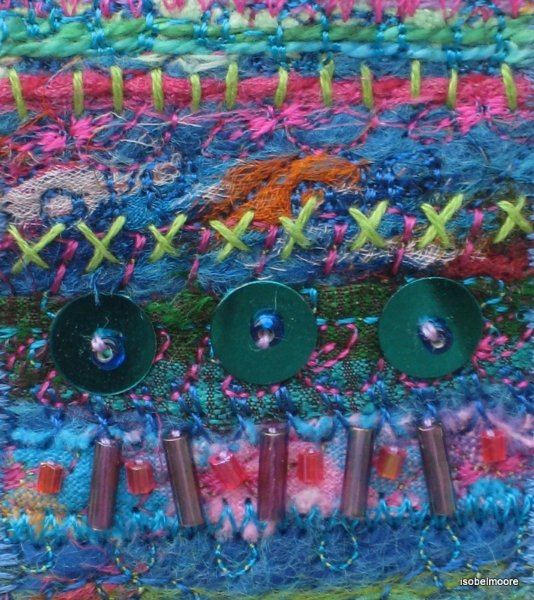
textile detail by Isobel Moore http://www.threadnoodle.co.uk/

textile detail by Isobel Moore http://www.threadnoodle.co.uk/

This blog post is part of a blogversation. It responds to two blogs, both of which came to my attention via my Twitter feed. This one on qualitative research methods by Naomi Barnes, and this one on tracing the social media interchange that followed, by Ian Guest. This is not the first time I have jumped into a blogversation unannounced and univited. The first time was when Helen Kara challenged Naomi Barnes to the #blimage challenge, after I had first challenged Helen to the same. The post I wrote, in response to Helen’s photograph of spider webs in her garden, echoes the themes of this post – the power and messiness of connectivity on social media. Another of Naomi’s posts had me thinking about diffraction.

The great thing about social media is that by engaging we situate ourselves within a public conversation. It’s when people jump in—to ask a question, make a comment, respectfully challenge, add their lived experience, share their perspective—that dialogue is enriched and we influence each other, across time, space and devices.

In Naomi’s recent post she articulates some ways of thinking that are close to my heart and my keyboard: blogging as inquiry and using metaphors as a method of sense-making. As many of you would know, I used Alice’s Adventures in Wonderland as a literary metaphor through which I viewed and re-constructed my PhD data. Metaphors, as any reader of this blog will recognise, are one way that I make sense of the world. Metaphors also emerged from the stories of the participants of my PhD as they worked to make sense of their selves and worlds.

As une édu flâneuse I was taken with Naomi’s notion of the ‘concept flâneur’. The flâneur, or its feminine alternative the flâneuse, is the attentive observer, the attuned wanderer, a scholar of the world and a chameleonic surveyor of the crowd. The ‘concept flâneur’ reminds me of my own use of bricolage in my PhD that I describe here as rethinking well-worn traditions and stitching them back together in new form. But flânerie is about more than stitching together. It is about rapt observation and devoted contemplation, about deep understanding and applying scholarly thinking. The theoretical flâneur is the insider-outsider, at once looking in and immersed within.

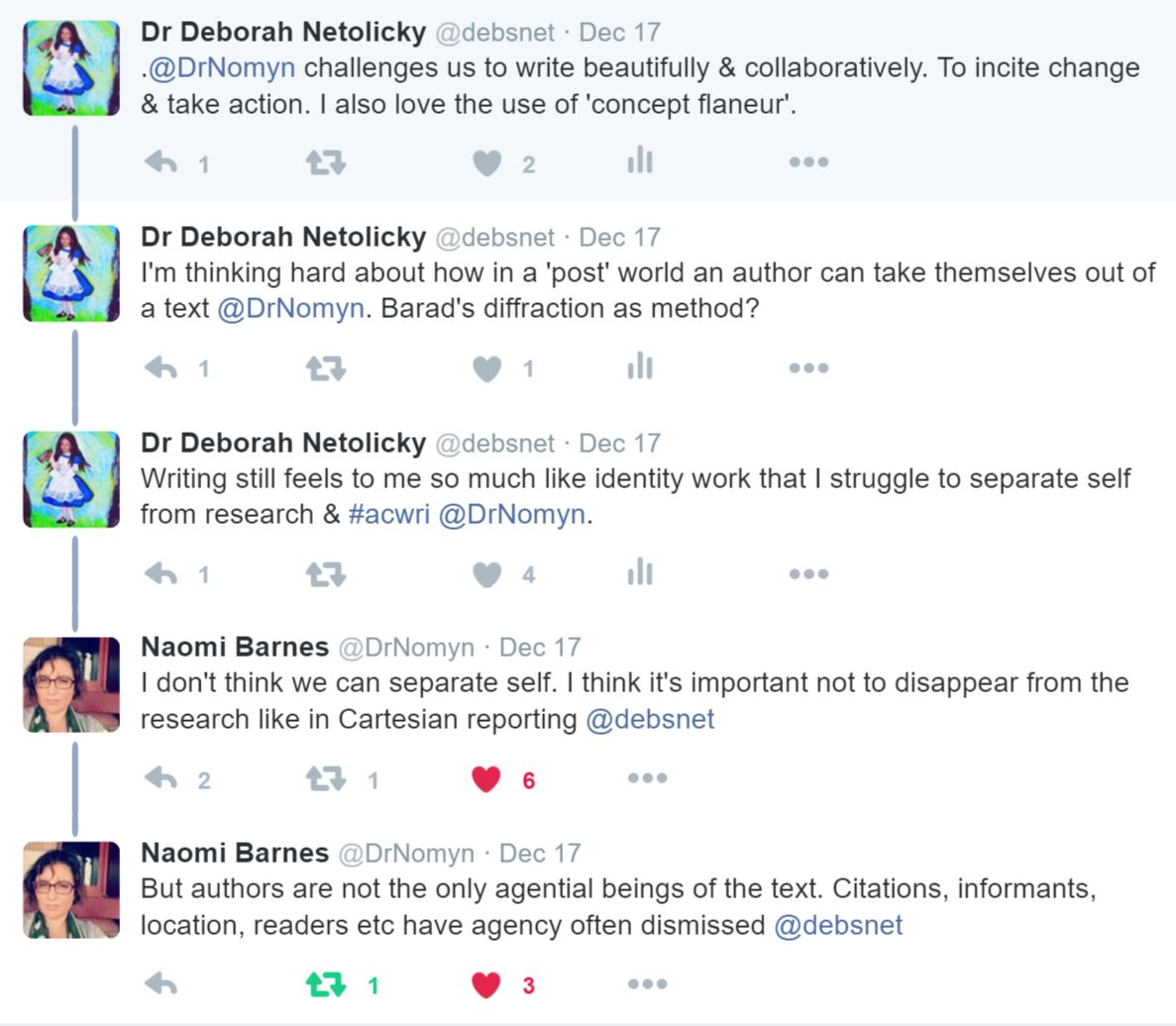
The part of Naomi’s post that challenged me the most was when she stated that qualitative research has stagnated as “the author has become central in the writing. It becomes about writing, rather than the research and the need for change.” It led me to a Twitter exchange in which I explored my own uncertainty around the self in research and the author’s place in writing.

a Twitter exchange resulting from Naomi Barnes' blog post

a Twitter exchange resulting from Naomi Barnes’ blog post

In keeping with Naomi’s metaphor of the sutured-together monster body, I see these kinds of social media interactions as textile. I have written before about textiles as a metaphor for subversion and political activism. We stitch onto shared fabric, adding perspectives, colour, texture, visual elements to a work. Our hands and minds shape the work (our thinking work, our writing work, our collaborative dialogue work), as it shapes us. Needles prick and rub callouses into fingers. We cramp. We struggle with the material. We can be proud of our contribution, working together like a quilting circle on the collaborative work of seeking to understand and to theorise.

Ian, in his post that responds to Naomi’s post, points out the non-linear, messy ways that exchanges happen on Twitter, despite their appearance in the feed as linear threads. I’ve written before about the butterfly effects of Twitter conversations, their serendipitous, surprising and subtly influential moments. Their powerful, unforeseen circumstances.

Ian wonders about the silences and the blurred boundaries between people and thoughts. I agree that it is in the silences, the shadows, the fissures, the dark cracks, of exchanges and of our own thinking, that we are most in a state of becoming and therefore potential change. It’s in the dark and vulnerable spaces that we learn. Blogging can be a bit like this: an exposure, a laying bare, a stripping down.

Ian mentions in his post that he shared a blog post via email despite sitting right next to his colleague; they collaborated via technology despite being in the same room. This reflects the evolving relationship that Naomi and I share. We have begun a co-authorly relationship, via digital tools. Word to word, screen to screen, device to device. When we met in person for the first time recently, we didn’t discuss our writing projects specifically. We saved our writerly collaborations for online spaces: email, Google docs, Twitter. In our fledgling collaboration, for me the digital sphere feels simultaneously a bit sacred and a draft-notebook-type place for working out. We show our workings to each other via our thinking-out-loud digital musings.

The wonderful thing about blogging, tweeting, emailing, writing and reading as inquiry is the acceptance, and even celebration, that it is all unformed. There are moments of awkwardness, uncertainty, openness, weakness, resistance, emotion. It’s all laid bare on screen, and open to tangled-threaded multi-webbed interchanges that have us emerging from the knotted labyrinthine tangles as from a chrysalis, declaring “here I am” so that we can be challenged and changed again.

Arguing on Education Twitter: BINGO

Today I had a draft blog post I was going to finish for publication today, but then I woke up to a tweet in which someone, with whom I’ve had no previous interaction, quoted a tweet of mine (a tweeted summary of an article to which I was sharing the link) and wrote above it the following:

God….. you really do have to laugh. Where do some get their PhDs??? # stupid

I’m still not sure of the reasoning for the tweeter’s ridiculing comment. Were they offended by or did they disagree with the content of the article I shared? It was a long article, at almost 3000 words. With what aspects of the article did they disagree? Did they read the article at all or did they just react to my teaser of its content? While they seemed to question my intelligence—with the #stupid hashtag, the triple question mark next to ‘Where do some people get their PhDs???’, and the suggestion that something about my tweet or my doctorate was laughable—the way in which they engaged with me did little to encourage debate or discussion, or to further either my or their understanding. Perhaps their intention was not to engage in dialogue, communicate their perspective to me, or interrogate my perspective.

This and some of the Twitter discussion that followed, got me thinking about the nature of some debates on edu Twitter, and of the social media tribalism Greg Thompson wrote about on his blog this week.

I’ve written before about the importance of graceful disagreement, such as in this post and in this one. I always learn from listening to the perspectives of those with alternate perspectives and counter arguments. On social media I (mostly) enjoy engaging in debates that help me to understand other viewpoints, see my own perspective from others’ points of view, and on occasion change my mind. If there is one thing my PhD taught me, it’s that there is much I don’t know or deeply understand, and that I have much to learn from others. In my leadership roles I look for ways to get honest feedback from all stakeholders, including and especially those who question, critique and resist. These are important voices to which we should listen.

But perhaps there are those who disagree, criticise or mock without the desire to talk further or understand more.

In anticipation of more enthusiastic debate and derision over the holiday period in the world of education Twitter, I’ve prepared this handy BINGO card for the festive season. It’s an attempt to see the lighter side of what can sometimes get heated as passionate educators fight for ideological corners. I may have thrown ‘Shakespearean insult’ in there as the odd ‘thine face is not worth sunburning’ or ‘thou cream faced loon’ might add interest to some debates.

You’re welcome.

My Edu Twitter BINGO: Watch your feed for these beauties

My Edu Twitter BINGO: Watch your feed for these beauties

Post script (11th December): I have begun to realise that there are aspects of EduTwitter arguing that I left off this BINGO card, like ‘false dichotomy, ‘Twitter poll’, ‘hyperbole’ and ‘subtweeting about someone’s lack of understanding or expertise’. I’d also like to clarify that my intention is not to judge any of these moves. They are used by people with a variety of profiles who argue on multiple sides of various debates. I think many of these moves transgress the debates themselves and reflect more of what brings education tweeters together, rather than what separates us. It’s also my attempt to reclaim my own experiences and to inject some fun into what can get intense or even nasty. I’ve especially enjoyed a few of the Shakespearean insults that have been thrown around since my post. Shakespeare really knew how to write a scathing and masterful take-down (although many of these would be classified as ad hominen or hyperbole in the context of Twitter debate).

I also love that someone made a GIF with my BINGO card.

Use at your leisure.

Use at your leisure.

ECR reflections on #AARE2016

welcome drinks at the Melbourne Cricket Ground

welcome drinks at the Melbourne Cricket Ground

As a neophyte researcher less than five years post doctoral completion, I get to claim the label of ‘early career researcher’ or ‘ECR’. I’ve just this week returned from the Australian Association for Research in Education (AARE) national conference, which provides excellent opportunities for an Australian early career researcher in the field of education: presenting, attending, connecting and thinking.

………………………………………..

Presenting

I was a last minute delegate at AARE this year, so didn’t present myself, but presenting last year was a highlight. ECRs can present alone (but papers are usually grouped with other thematically-like papers), with other ECRs, or with more experienced academics and professors. These presentations are important in helping to refine ideas and develop thinking, of both audience and presenter. While there are some ineffective discussants and unhelpful non-questions from audience members, discussion time after a presentation can be a great opportunity for the presenter to clarify and extend their thinking, thanks to questions, comments and provocations from the audience.

Presenting is also important for refining the precision and effectiveness of your science communication. How have you titled your presentation? How have you designed your slides? How have you distilled the essence of your paper down to a 20 minute presentation? The decision making required in order to present helps to refine ideas, clarify theory and fine-tune language.

Attending

The sessions at AARE are arranged around a number of Special Interest Groups including: Aboriginal and Torres Strait Islander Research; Arts Education and Practice; Assessment and Measurement; Educational Leadership; Gender, Sexualities and Cultural Studies; a number of school-subject specific SIGs; Politics and Policy; various theories and philosophies; Professional and Higher Education; Social Justice; methodologies; and Teacher Education and Research Innovation.

This year I was able to spread my time between sessions relevant to my own research and practice, and those that interested me outside of my normal bubble, such as a session on the intersections and interactions between academia and the media, and a particularly indulgent session on theory and writing, which buoyed and provoked me. That theory session, while not seeming directly relevant to much of my work and research, will influence my writing and the ways I consider research and practice.

One thing that struck me this year was what I learned as an ECR watching more experienced academics. Some of the sessions I attended involved very experienced academics presenting as-yet-unformed ideas. They were sharing and modelling the ways in which they explore a theorist they are reading for the first time, or work through a newborn idea. The vulnerability of these academics–willing not to present the workings-out of their practice and not just the result of layered years of thinking–was a great example to ECRs of embracing what we don’t know. Not only do we evolve as researchers over time, but we can embrace knowing what we don’t know and celebrate working through discomfort to interrogate those gaps.

Connecting

As I attended AARE last year in Fremantle, and I also presented at the AERA (the American Educational Research Association) conference this year, I began to see patterns of those who attend these conferences and those who are active in the research community and in particular SIGs. As I am active on Twitter, there were many additional familiar faces in the room. That’s one thing I love about Twitter – that it allows me to walk into a room in which I’ve barely met anyone, yet feel like I know a number of people.

The AARE conference is a great opportunity to connect with academics across a wide range of Australian and international universities, who approach education research in a variety of ways, through multiple different lenses. Many experienced or well-known academics are very open to meeting ECRs, and most are incredibly generous with their time and their advice. And the great thing about kicking on to dinner with a bunch of researchers is that it’s a wonderful opportunity to go full-nerd and explore all kinds of real and theoretical possibilities in a conversational environment. A Melbourne cocktail or two only adds to the conversation. I can see the potential for many a collaboration or co-authorship to be sparked at an AARE conference.

Additionally, editors from academic publishing firms like Routledge and Sage are at the conference venue, so it is a great opportunity to discuss your book idea.

Thinking

A conference like AARE provides a wonderful opportunity to break from the daily routine and think. While the program is busy, it allows delegates to listen to, cogitate on and talk about those arenas of research and education in which they wish to immerse themselves. The time and space for this kind of immersion and thinking is an excellent opportunity in itself.

………………………………………..

Having been conferred my PhD earlier this year, I am an ECR, but I am also a teacher and school leader. I’m a boundary spanner, a ‘pracademic’, traversing and often transgressing the boundaries between practice and theory, doing and research. The AARE conference allows me to indulge intellectually in the education sphere, and to engage in current thinking in educational research.

I live and breathe teaching and leading for most of the year, but here for a few days I get to engage with multiple lenses for considering and improving that work. What does current educational research have to say about areas of practice? How might I—as teachers, school leader and researcher—positively influence my own contexts, as well as broader narratives of education?

AARE provides the time, space and stimulation to help me do this. No doubt I’ll be back for the next round: Canberra 2017.

Cartoons to communicate science? #scicomm

With the knowledge of science we can solve resource limitations, cure diseases, and make society work happily–but only if people can figure out what in the world scientists are talking about and why they should care. ~ Randy Olson, Don’t be such a scientist

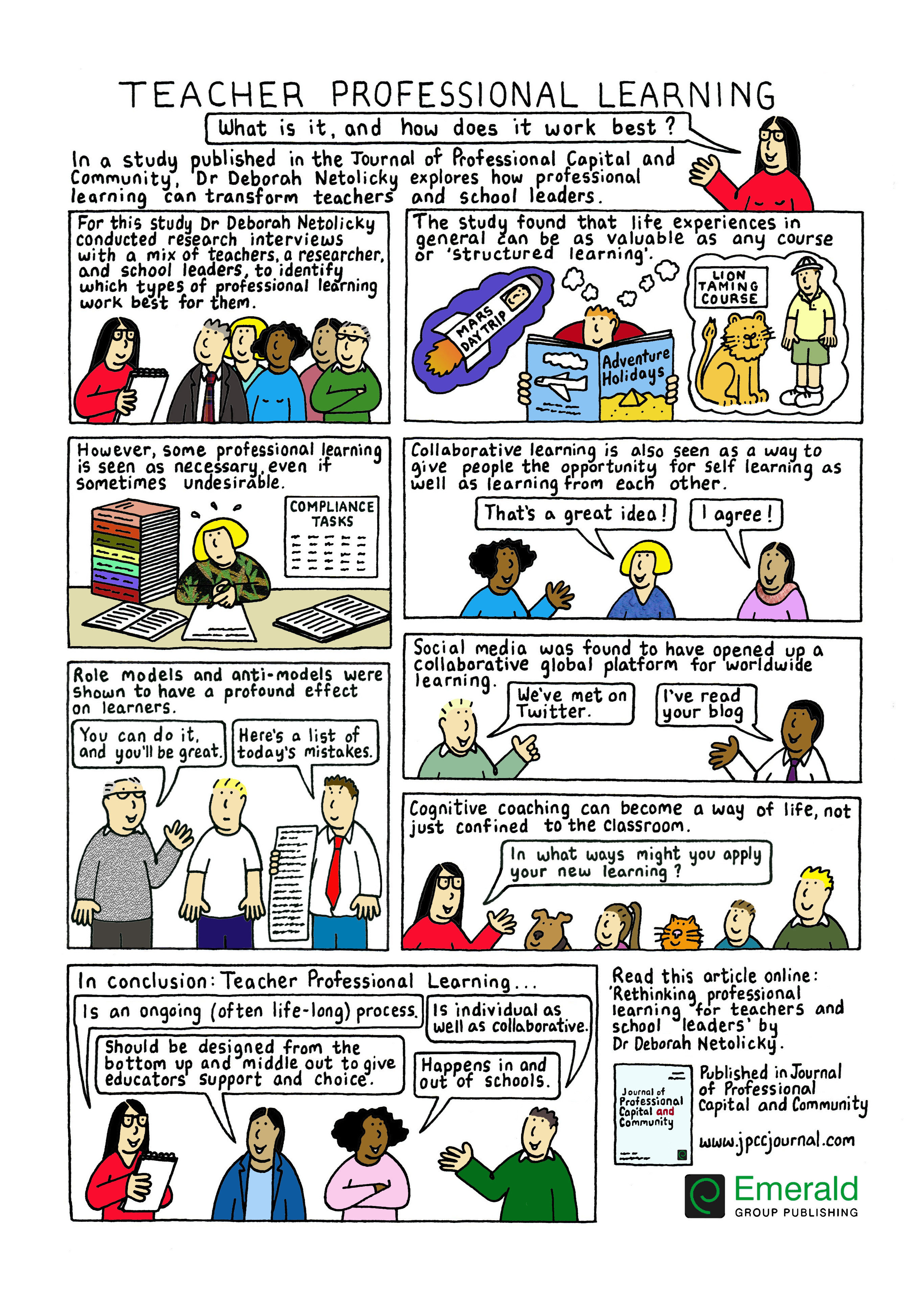
In 2015 the Oxford Dictionary word of the year was the ‘face with tears of joy’ emoji. This year I have seen PhD researchers communicate their theses via emoji on Twitter. Today Emerald Publishing and the Journal of Professional Capital and Community released the following cartoon abstract of my peer-reviewed paper ‘Rethinking professional learning for teachers and school leaders’. The paper itself, which has so far been downloaded over 4000 times, is open access, and I have also blogged about it.

What do you think of the notion of a cartoon or graphical abstract of a research paper? Is this a way forward for science communication? Can we use visual language to make research more accessible and more widely read? Could you or would you be open to designing a cartoon strip or graphic-novel-style summary of your research?

designed by Emerald and posted here on JPCC website: http://jpccjournal.com/teacher.htm

designed by Emerald and posted on the JPCC website